
Social comparison is one of the most ordinary things the human mind does, and one of the most clinically consequential. When a client says “everyone else seems to have it figured out,” “I’ll never be as good as her,” or “at least I’m not as bad off as him,” they are reporting the raw output of a comparison process that Leon Festinger formalized in 1954. LLM This article situates that process for practicing therapists: what the construct is, where it came from, how to use it at the level of formulation and intervention, and where to be honest about its limits.
Type & Discipline
Social comparison theory is a construct and theoretical framework within sociology and social psychology, not a treatment modality. LLM It originated in Leon Festinger’s 1954 paper “A Theory of Social Comparison Processes,” published in Human Relations. 1 At its core is a simple postulate: people have a drive to evaluate their opinions and abilities, and they prefer to do so against objective, non-social standards when those exist; in the absence of objective standards, they evaluate themselves by comparison with other people. 1 Because it is a construct rather than a therapy, it enters clinical practice as an explanatory lens — a way to understand the mechanism behind self-esteem fluctuation, body-image distress, envy, and perfectionism — rather than as a manualized protocol. LLM
Creators & Lineage
Leon Festinger is the originating figure, and the 1954 Human Relations paper is the primary source. 1 Festinger is better known to many clinicians for cognitive dissonance theory, and social comparison theory shares his characteristic style: a small set of formal hypotheses with derived corollaries. LLM The theory sits within a family of mid-twentieth-century social-psychological ideas about how people locate themselves relative to others, conceptually adjacent to relative deprivation, reference group theory, and later social identity theory. LLM
The theory did not stay where Festinger left it. A pivotal extension came from Thomas Ashby Wills, who in 1981 articulated downward comparison — comparing oneself to those who are worse off — as a mechanism that can elevate mood and subjective well-being, especially under threat. 7 Joanne Wood (1989) later distinguished self-evaluation (seeking accurate information by comparing with similar others) from self-enhancement (selectively comparing to feel better). 7 Jerry Suls and colleagues elaborated proxy, triadic, and attributional models of how people choose comparison targets, and Abraham Tesser’s self-evaluation maintenance model examined when a close other’s success threatens versus flatters the self. 7 For clinical purposes, the useful through-line is that comparison is not a single act but a family of strategically deployed moves with predictable affective consequences. LLM
Core Principles
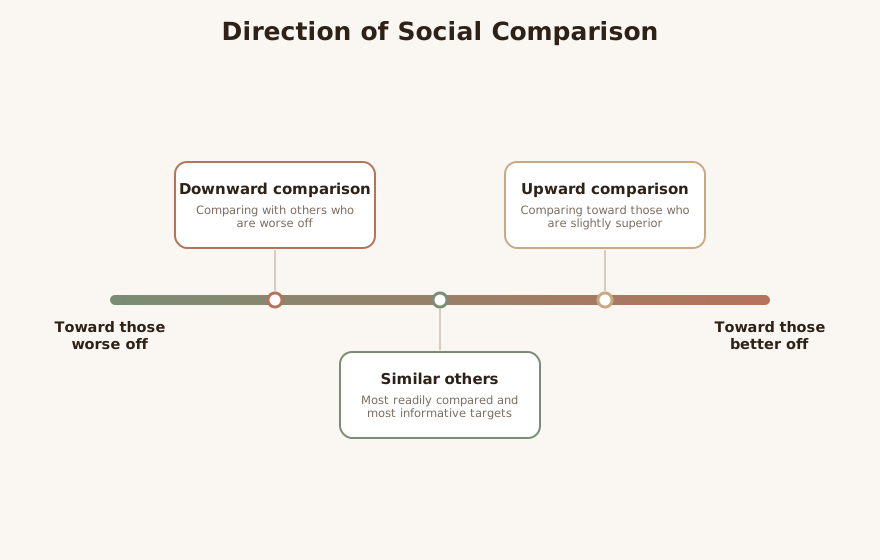
Festinger built the theory from nine hypotheses with associated derivations. 1 The first and most foundational: there exists a drive in the human organism to evaluate one’s opinions and abilities. 1 The second: to the extent objective, non-social means are unavailable, people evaluate their opinions and abilities by comparison with the opinions and abilities of others. 1 The third introduces the similarity principle — the tendency to compare oneself with a specific other person decreases as the difference between that person’s opinion or ability and one’s own increases. 1 In plain terms, we compare ourselves most readily to people who are roughly like us, and similar targets yield the most informative, and often most distressing, comparisons. 4
A crucial asymmetry follows. Festinger proposed a unidirectional drive upward for abilities that is largely absent for opinions — people want to do better and better, so ability comparisons tend to pull attention toward those who are slightly superior. 1 He also noted that non-social restraints (real-world limits on how much one can improve a skill) constrain ability change, whereas opinions can shift more freely. 1 Other hypotheses describe pressures toward uniformity within groups, the tendency to cease comparison with — and even derogate — those who are too divergent, and stronger pressures to change among those nearest the group’s modal position. 1
From these postulates the working clinical vocabulary emerges. Upward comparison means evaluating oneself against someone better off on a relevant dimension; downward comparison means evaluating against someone worse off. 5 Each can cut two ways. Upward comparison can inspire (an assimilation or “inspiration” effect, when the superior outcome seems attainable) or it can demoralize and breed envy (a contrast effect, when the gap seems fixed or unfair). 5 Downward comparison typically lifts self-esteem through relief, but it can also provoke anxiety by foreshadowing what one might become. 5 The clinically actionable insight is that distress is driven less by comparison itself — which is automatic — than by its direction, the perceived attainability of the gap, and whether the person assimilates toward or contrasts away from the target. LLM
Interventions & Techniques
Because social comparison theory is a construct rather than a therapy, it is operationalized through whichever evidence-based modality the clinician already uses. LLM In cognitive-behavioral work, comparison-driven automatic thoughts (“she’s thinner, so I’ve failed”) become explicit targets for cognitive restructuring, with attention to the similarity principle (Is this an apt comparison target?) and the attainability appraisal (Is this gap fixed or movable?). LLM Behavioral experiments and stimulus-control strategies are natural fits: reducing exposure to high-frequency upward-comparison environments — curated social media feeds, for instance — and observing the effect on mood. 7
A second technique is comparison-direction awareness: helping clients notice, in real time, whether they are comparing upward or downward, and toward what end. LLM Acceptance- and mindfulness-based approaches can decouple the automatic comparison from the secondary appraisal, so the comparison is observed rather than fused with self-worth. LLM Values clarification reframes self-evaluation away from social yardsticks toward objective, personally meaningful standards — an intervention that maps directly onto Festinger’s claim that objective standards, when available, displace social ones. 1 Finally, psychoeducation itself is an intervention here: naming the process normalizes it and reduces the shame of “I shouldn’t compare myself,” which is often a meta-distress layered on top of the comparison. LLM
LLM-generated illustrative example (not a guideline): A graduate student presents with depressed mood that spikes after scrolling LinkedIn. In session, she and her clinician trace the pattern to dense upward comparison against same-cohort peers (high similarity, perceived-fixed gap), then design a stimulus-control experiment and a restructuring script that substitutes an objective progress metric for the social yardstick. LLM
Evidence Base
Maturity here is best described as established as a foundational theory but mixed in applied clinical translation. LLM The 1954 framework is one of the most cited and durable theories in social psychology, with a large encyclopedic and textbook footprint, and its basic premises have been repeatedly extended rather than overturned. 3 Applied research links body-related social comparison to disordered eating — adolescents with eating disorders engage in substantially more body-related comparison than peers without such conditions — and connects upward appearance comparison, particularly against unrealistic media standards, to body dissatisfaction. 4 Work on illness adjustment shows patients with serious illness often make spontaneous downward comparisons that support optimism. 7
The honest caveats matter. Much of the applied literature is correlational and cross-sectional, so causal claims (comparison → pathology) should be made cautiously. LLM Comparison direction does not map cleanly onto outcome: upward comparison can help or harm depending on appraisal, and downward comparison can soothe or threaten, which limits simple prescriptions like “stop comparing up.” 5 Social comparison is a transdiagnostic mechanism, not a standalone treatment with its own randomized-trial base; the evidence for interventions rests on the host modality (e.g., cognitive-behavioral therapy), not on the construct itself. LLM Clinicians should present it to clients as a robust descriptive framework, not as a proven causal switch. LLM
Populations & Indications
The construct is broadly applicable but especially salient in contexts saturated with visible, similar comparison targets. LLM Adolescents and teens are developmentally primed for peer and media comparison around appearance and status. 4 College and university students face dense cohort comparison on achievement. 4 High-achieving professionals, elite and competitive athletes, and performing artists operate in fields with explicit rankings and constant near-peer benchmarking, which intensifies upward ability comparison. LLM Women have been described in the appearance literature as disproportionately engaging in upward appearance comparison against idealized media standards. 7 The perinatal population — surrounded by social images of effortless parenthood — is another setting where comparison can amplify mood and anxiety symptoms. LLM
Problems-for-Work
Social comparison maps onto a wide band of presenting problems. LLM For low self-esteem and contingent or unstable self-worth, the formulation is that self-evaluation has been outsourced to shifting social yardsticks; work targets the dependence on comparison rather than the content of any single comparison. LLM For body image dissatisfaction, body dysmorphic disorder, and anorexia nervosa, upward appearance comparison against media and peer standards is a documented driver, making comparison-exposure reduction and restructuring central. 4 For perfectionism, maladaptive perfectionism, and fear of failure, the unidirectional drive upward — wanting to do ever better — can become a treadmill, and the clinical move is to surface attainability appraisals and reintroduce objective standards. 1
For imposter syndrome and chronic self-doubt at work, clients typically run dense upward ability comparisons while discounting downward and objective evidence; naming the selective comparison is often clarifying. LLM For major depressive disorder, the cognitive triad is frequently fed by habitual upward comparison and the failure of the usual self-protective downward comparisons. 7 For social anxiety disorder and fear of negative evaluation, the person continuously compares their internal anxiety to others’ apparent ease — an apples-to-oranges comparison worth making explicit. LLM For envy and social comparison distress, the construct names the experience directly: envy is the affective signature of a contrast-effect upward comparison against a similar, valued target. 5
Contraindications, Cautions & Cultural Humility
There are no contraindications to using the construct as a formulation lens, but there are real cautions in how it is delivered. LLM Telling a client to simply “stop comparing yourself” is rarely helpful and can add shame, since the drive is, by Festinger’s account, intrinsic. 1 Pushing downward comparison as a mood-repair tactic is risky: it can foster contempt for others, depend on others’ misfortune, and provoke anxiety about one’s own decline, so it should not be handed out as a coping skill without nuance. 5 With eating-disorder and body-dysmorphic presentations, comparison work must be embedded in specialty-appropriate care, not used as a substitute for it. LLM
Cultural humility is essential because what counts as a relevant comparison target, an acceptable standard, and even a legitimate domain of self-evaluation is culturally shaped. LLM In more collectivist or interdependent contexts, comparison may be oriented toward group fit and harmony rather than individual ranking, and the reference groups that matter may differ from the clinician’s assumptions. LLM Socioeconomic and structural realities also mean some “comparisons” reflect genuine material inequity, not cognitive distortion — relative deprivation, not faulty thinking — and should be validated as such rather than restructured away. LLM
Treatment-Plan Suggestions & SMART Objectives
| Goal | SMART objective (example) | Mechanism |
|---|---|---|
| Reduce comparison-driven mood crashes | Client will log comparison episodes and their direction daily for 2 weeks, identifying at least 3 high-cost patterns by session 4 | Self-monitoring makes the automatic comparison process explicit and observable 5 |
| Decrease upward appearance comparison | Client will reduce curated-feed exposure to ≤15 min/day for 3 weeks and rate body satisfaction pre/post | Stimulus control limits exposure to idealized upward-comparison targets 7 |
| Loosen self-worth from social yardsticks | Client will identify 2 objective, values-based standards of progress and apply them weekly over 4 weeks | Reinstates non-social evaluation, which Festinger holds displaces social comparison 1 |
| Restructure contrast-effect appraisals | Client will reframe ≥5 “fixed-gap” upward comparisons toward attainability appraisals across 4 sessions | Shifts contrast (envy/demoralization) toward assimilation (inspiration) 5 |
| Reduce shame about comparing | Client will articulate the normality of comparison in their own words by session 3 | Psychoeducation removes the meta-distress layered on the comparison 1 |
| Target imposter-type self-doubt | Client will record one objective competence datum daily for 2 weeks to counter selective upward comparison | Broadens the comparison field beyond cherry-picked superior peers LLM |
| Build mindful decoupling | Client will practice a brief “notice-and-name” comparison exercise 5x/week for 3 weeks | Decouples the comparison from fused self-evaluation LLM |
Common Misconceptions
A first misconception is that social comparison is inherently pathological and the goal is to eliminate it. LLM Festinger frames comparison as a normal, drive-based evaluation process; the clinical target is maladaptive patterns and appraisals, not comparison as such. 1 A second is that upward comparison is always harmful and downward always helpful — both are double-edged, with upward able to inspire and downward able to threaten. 5 A third is that the theory was a finished 1954 product; in fact downward comparison, self-enhancement versus self-evaluation, and target-selection models were substantial later additions. 7 A fourth, common in pop psychology, is that social media “invented” comparison; social media intensifies and accelerates an old process by supplying dense, similar, idealized targets, but the mechanism predates it. 7
Training & Certification
There is no certification in social comparison theory, and none is needed, because it is a foundational construct rather than a proprietary method. LLM Clinicians typically encounter it in undergraduate and graduate social psychology coursework and in encyclopedic references. 3 Competence comes from fluency in the host modality — for most clinicians, cognitive-behavioral, acceptance-based, or interpersonal frameworks — into which the construct is integrated, plus familiarity with the primary 1954 source and its major extensions. LLM
Key Terms
Drive to self-evaluate — the basic human motivation to assess one’s opinions and abilities. 1 Objective (non-social) standard — a real-world yardstick that, when available, is preferred over social comparison. 1 Similarity principle — comparison is strongest with similar others and weakens as differences grow. 1 Upward comparison — evaluating against someone better off on a dimension. 5 Downward comparison — evaluating against someone worse off, often to protect self-esteem. 7 Assimilation vs. contrast — whether a comparison pulls self-appraisal toward the target (inspiration) or away from it (envy/demoralization). 5 Self-evaluation vs. self-enhancement — comparing to gain accurate information versus comparing to feel better. 7 Unidirectional drive upward — the asymmetric push to improve abilities, weaker for opinions. 1
Resources & Further Reading
▶ Watch — a video introduction to this concept:
- Festinger, L. (1954). A Theory of Social Comparison Processes. Human Relations (full text PDF)
- Social Comparison Theory — Springer Nature, Encyclopedia of Personality and Individual Differences
- Social Comparison Theory — EBSCO Research Starters (Psychology)
- Social Comparison Theory: Upward vs Downward Explained — PsychologyNotesHQ
- Social comparison theory — Wikipedia
Reflective / Supervision Questions
- When this client compares, what are they trying to evaluate — an opinion, an ability, their worth — and is an objective standard available that social comparison has displaced? LLM
- Am I noticing the direction of comparison in session, and am I tracking whether the client assimilates toward or contrasts away from the target? LLM
- Where am I tempted to offer downward comparison as quick relief, and what are the costs of doing so for this person? LLM
- How do this client’s reference groups, culture, and material circumstances shape what counts as a “fair” comparison — and where am I mislabeling genuine relative deprivation as distortion? LLM
- What is my own comparison process doing in the room — toward this client, toward colleagues — and how might it color the formulation? LLM