
Attachment to God extends Bowlby and Ainsworth’s attachment framework into the psychology of religion, treating a believer’s perceived relationship with God as a functional attachment bond 1. For clinicians who work with religious clients, it offers a structured, non-pathologizing way to formulate how faith regulates affect, organizes meaning, and either buffers or amplifies distress LLM. This article summarizes the theory, its measurement, the honest limits of its evidence, and how to use it as a formulation lens inside recognized billable modalities LLM.
Type & Discipline
Attachment to God is a mid-range theory within the psychology of religion, not a standalone treatment model 6. It sits at the intersection of attachment theory and the empirical study of religious cognition and experience, and it is most often operationalized through psychometric measurement of how individuals relate to God 4. Within clinical practice it functions as a formulation framework rather than a branded therapy, informing assessment and case conceptualization that are then delivered through established modalities LLM. Its disciplinary home is academic psychology of religion, with applied uptake in spiritually integrated and pastoral counseling settings LLM.
Creators & Lineage
The application of attachment theory to religion was pioneered principally by Lee Kirkpatrick, whose evolutionary account framed God as a candidate attachment figure and articulated the field’s two central pathways 1. Pehr Granqvist advanced and consolidated this program, integrating normative and individual-difference perspectives and tempering early claims with more rigorous evidence 2. The measurement lineage was advanced by Richard Beck and Angie McDonald, who in 2004 published the Attachment to God Inventory and tested working-model correspondence across multiple samples 4. The intellectual roots run through Bowlby and Ainsworth’s attachment theory, the broader psychology of religion, object relations theory, and contemporary spiritually integrated psychotherapy 6.
Core Principles
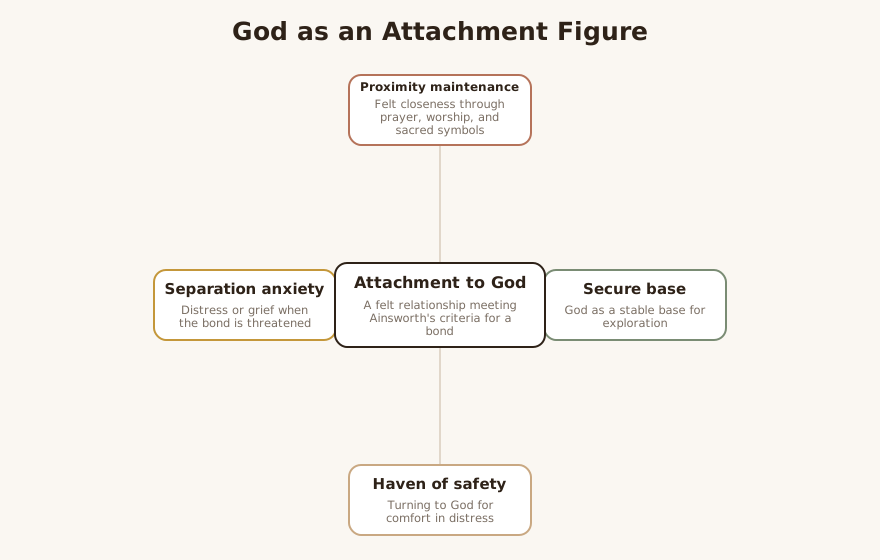
The foundational claim is that the perceived relationship with God meets Ainsworth’s criteria for an attachment bond: proximity maintenance, use of the figure as a secure base for exploration, the figure as a haven of safety in distress, and separation anxiety or grief when the bond is threatened 4. Believers maintain felt proximity through prayer, worship, and sacred symbols, and God’s perceived omnipresence and omnipotence make God, in principle, an unusually stable secure base 6.
Two competing developmental pathways organize the literature. The correspondence hypothesis predicts that internal working models formed with early caregivers carry forward, so securely attached people tend to experience God as warm and available, anxiously attached people develop emotionally intense and clingy relationships with God, and avoidantly attached people perceive God as distant or inaccessible 6. The compensation hypothesis predicts the opposite for some individuals: those with insecure or inadequate caregiving may turn to God as a substitute or surrogate attachment figure to regulate distress 6. Empirical support for correspondence is stronger though modest, while compensation effects are inconsistent and tend to appear under specific conditions such as acute stress rather than as a stable trait 2.
Interventions & Techniques
Attachment to God does not prescribe a fixed protocol; it supplies a lens that sharpens assessment and shapes intervention inside other models LLM. Assessment typically begins with mapping the client’s working model of God along two dimensions, anxiety and avoidance, often using a validated inventory or clinical interview adapted from it 4. From there, the clinician can explore how the client uses God as a safe haven during distress and as a secure base for exploration, and where that function breaks down LLM.
Common techniques drawn from spiritually integrated practice include exploring God images and the affect attached to them, examining prayer as an attachment behavior (proximity-seeking) and its emotional aftermath, and gently testing whether feared abandonment by God reflects a generalized working model rather than the client’s lived experience LLM. Therapists can also track ruptures and repairs in the felt relationship with God much as they would in human attachment work, supporting the client toward what the tradition would call earned security LLM.
LLM-generated illustrative example (not a guideline): A client high in anxious attachment to God reports compulsively praying for reassurance and feeling devastated when prayers go “unanswered,” reading silence as proof of being unlovable. The therapist names this as a proximity-seeking pattern under threat and links it to a broader working model that others’ care is conditional and uncertain, then uses standard cognitive and emotion-focused techniques to test that belief. LLM
Evidence Base
The maturity of this body of work is established at the descriptive and correlational level, and it is important to state precisely what that does and does not cover LLM. The construct is well operationalized: the Attachment to God Inventory shows good factor structure, internal consistency, and construct validity across two college and one community sample, supporting a two-dimensional structure of Avoidance of Intimacy and Anxiety about Abandonment 4. Cross-sectional associations with mental health are robust and directionally consistent; in a nationwide sample of 1,041 Presbyterians, secure attachment to God was inversely associated with psychological distress while anxious attachment to God was positively associated with distress 3. That same study found attachment patterns more predictive of distress than God imagery once both were modeled together 3.
The longitudinal and stress-related literature, including work examining attachment to God alongside stressful life events and change over time, extends the picture but remains observational rather than experimental 5. Correspondence between working models of romantic partners and of God has been supported, though only weakly 4. Crucially, the theory’s evidentiary maturity concerns the construct and its correlates, not treatment efficacy: interventions derived from an attachment-to-God framework have not been validated in controlled trials, and any clinical use rests on extrapolation from general spiritually integrated and attachment-informed practice LLM. Findings on compensation specifically remain mixed and sometimes contradictory 6.
Populations & Indications
The framework is most directly applicable to religious adults and members of faith communities for whom God is a personal, relational figure 4. It is especially useful with spiritually struggling individuals, where distress is bound up with the felt relationship to the divine 6. Older adults and grieving individuals are well-served populations, given that bereavement activates attachment systems and that the felt presence of God is often recruited as a haven of safety during loss LLM. Clergy and religious professionals are a distinctive population in whom attachment-to-God dynamics intersect with vocation, performance, and identity, and who may present with both spiritual and occupational strain LLM.
Problems-for-Work
The lens applies to a range of presenting problems where faith is clinically salient LLM. For spiritual distress and religious struggle, mapping the anxiety and avoidance dimensions clarifies whether the client fears abandonment by God or has withdrawn from intimacy with God 4. For grief and loss, the clinician can frame the felt loss of God’s presence as a disruption of a safe haven and support reconnection or meaning reconstruction LLM. For depression and loneliness, secure attachment to God may be protective while anxious attachment may compound distress, consistent with the directional associations observed empirically 3.
LLM-generated illustrative example (not a guideline): A recently widowed client says she “can’t feel God anymore” and feels abandoned at her most vulnerable. The therapist formulates this as a safe-haven rupture during attachment-system activation, validates the felt absence without arbitrating its theology, and integrates grief work with gentle exploration of how proximity to God was previously maintained. LLM
For existential anxiety and meaning-or-purpose problems, the secure-base function of God supports exploration and tolerance of uncertainty 6. For clients whose insecure attachment is generalized, the relationship with God can serve as both a mirror of and a leverage point for the underlying working model LLM.
Contraindications, Cautions & Cultural Humility
The single most important scope limitation is built into the theory: the attachment model presumes a personal, relational, and broadly (mono)theistic conception of God, and its developers explicitly noted that it is unclear how the model describes the divine in traditions where the deity is not thought of as personal 4. The framework therefore does not map cleanly onto non-theistic, polytheistic, or impersonal-transcendence traditions, and applying it there risks distortion LLM. Clinicians should not impose an attachment narrative on a client whose tradition frames the divine differently LLM.
Religious struggle is not in itself pathology, and a client’s anxious or avoidant relationship with God may be a meaningful, even adaptive, response to genuine adversity rather than a disorder to be corrected LLM. The therapist’s task is to follow the client’s own theology and not to adjudicate religious truth, repair “weak faith,” or evangelize toward a particular God image LLM. Because compensation effects are inconsistent, clinicians should resist the assumption that insecurely attached clients are necessarily more religious or that turning to God is a deficit 6. Caution is also warranted with clients whose religious environment is itself a source of harm, where attachment-to-God language could be co-opted to rationalize abuse LLM.
Treatment-Plan Suggestions & SMART Objectives
| Goal | SMART objective (example) | Mechanism |
|---|---|---|
| Reduce anxious attachment to God | Over 8 weeks, client will identify 3 specific fear-of-abandonment beliefs about God and reframe each, lowering self-rated spiritual anxiety by 2 points on a 0-10 scale | Targets the Anxiety-about-Abandonment dimension via cognitive restructuring 4 |
| Restore safe-haven function during distress | Within 6 sessions, client will practice and log a proximity-seeking or grounding routine during 4 distress episodes, reporting use in session | Re-establishes God-as-haven coping during attachment-system activation 6 |
| Address avoidant disengagement from faith | Over 10 weeks, client will name 2 emotions previously avoided in relation to God and tolerate them in session without withdrawal | Targets the Avoidance-of-Intimacy dimension through emotion-focused exposure 4 |
| Process grief as safe-haven rupture | By session 8, client will articulate the meaning of God’s felt absence and identify 2 sustaining sources of comfort | Reframes bereavement-related spiritual distress within attachment terms LLM |
| Reduce depressive symptoms via secure-base support | Over 12 weeks, client will reduce PHQ-9 score by 30%, integrating valued spiritual activity twice weekly | Leverages protective association of secure attachment to God with lower distress 3 |
| Strengthen meaning and exploration | Within 8 sessions, client will set and pursue 1 values-based goal previously avoided due to existential anxiety | Uses the secure-base function to support exploratory behavior 6 |
| Build self-worth not contingent on God’s approval | Over 10 weeks, client will distinguish unconditional from performance-based images of God in 3 logged situations | Decouples self-esteem from anxious working models of God 4 |
Common Misconceptions
A frequent error is treating attachment to God as a validated treatment; it is a well-supported construct with robust correlates but no controlled trials of derived interventions LLM. A second is assuming the compensation pathway is the rule — that distressed or insecure people reliably turn to God — when the evidence for compensation is mixed and condition-dependent 6. A third is conflating God image with attachment style; the Presbyterian data show that once attachment patterns are modeled, God imagery adds little independent prediction of distress 3. A fourth is assuming the framework generalizes to all spiritualities, when its developers restricted their claims to traditions with a personal deity 4. Finally, some assume an anxious or avoidant attachment to God is inherently pathological, rather than a meaningful relational pattern that may warrant respect as much as intervention LLM.
Training & Certification
There is no certification in “attachment to God” as such, and no credentialing body governs it as a discrete therapy LLM. Competence is built by combining graduate training in attachment theory with supervised practice in spiritually integrated psychotherapy and the psychology of religion 6. Clinicians can deepen understanding through Kirkpatrick’s foundational text and Granqvist’s syntheses, and can adopt the Attachment to God Inventory as a structured assessment aid with appropriate attention to its psychometric scope 14. Practical application is best developed under supervision from clinicians experienced in both attachment-informed and faith-sensitive care LLM.
Key Terms
- Attachment bond: A relationship meeting Ainsworth’s criteria — proximity maintenance, secure base, safe haven, and separation distress 4.
- Secure base: The function of an attachment figure that supports confident exploration of the world 6.
- Safe haven: The function of an attachment figure as refuge and source of comfort under threat 6.
- Correspondence hypothesis: The prediction that working models of early caregivers carry forward into the relationship with God 6.
- Compensation hypothesis: The prediction that some insecurely attached people recruit God as a substitute attachment figure 6.
- Anxiety about Abandonment: One AGI dimension capturing fear of being abandoned or insufficiently loved by God 4.
- Avoidance of Intimacy: The second AGI dimension capturing discomfort with closeness and dependence on God 4.
- Working model: The internalized template of relationships that shapes expectations of availability and responsiveness 6.
Resources & Further Reading
▶ Watch — a video introduction to this concept:
- Kirkpatrick, L. A. (2005). Attachment, Evolution, and the Psychology of Religion — Guilford Press 1
- Granqvist, P. — Attachment theory and religion (Current Opinion in Psychology) 2
- Attachment to God, Images of God, and Psychological Distress in Presbyterians (PMC3545685) 3
- Beck, R., & McDonald, A. (2004). The Attachment to God Inventory: Tests of Working Model Correspondence 4
- Attachment to God, Stressful Life Events, and Changes — Baylor ISR 5
- Attachment theory and psychology of religion — Wikipedia 6
Reflective / Supervision Questions
- When a client describes their relationship with God, can I locate it along the anxiety and avoidance dimensions without imposing my own theology? LLM
- Am I treating attachment to God as a formulation lens, or am I overclaiming it as an evidence-based treatment? LLM
- How do I distinguish a religious struggle that is adaptive and meaningful from one that is clinically impairing? LLM
- Does this client’s tradition actually frame the divine as a personal, relational figure, or am I applying a framework that does not fit? LLM
- Whose secure base am I serving — the client’s, the institution’s, or my own assumptions about healthy faith? LLM
- In what billable modality am I delivering this work, and is my documentation grounded in that modality’s recognized techniques? LLM
1: Kirkpatrick, L. A. (2005). Attachment, Evolution, and the Psychology of Religion. New York: Guilford Press. 2: Granqvist, P. Attachment theory and religion. Current Opinion in Psychology. 3: Bradshaw, M., Ellison, C. G., & Marcum, J. P. (2010). Attachment to God, Images of God, and Psychological Distress in a Nationwide Sample of Presbyterians. International Journal for the Psychology of Religion (PMC3545685). 4: Beck, R., & McDonald, A. (2004). Attachment to God: The Attachment to God Inventory, Tests of Working Model Correspondence, and an Exploration of Faith Group Differences. Journal of Psychology and Theology, 32(2), 92-103. 5: Ellison, C. G., Bradshaw, M., et al. Attachment to God, Stressful Life Events, and Changes in Psychological Distress. Baylor Institute for Studies of Religion. 6: Attachment theory and psychology of religion. Wikipedia.