
Type & Discipline
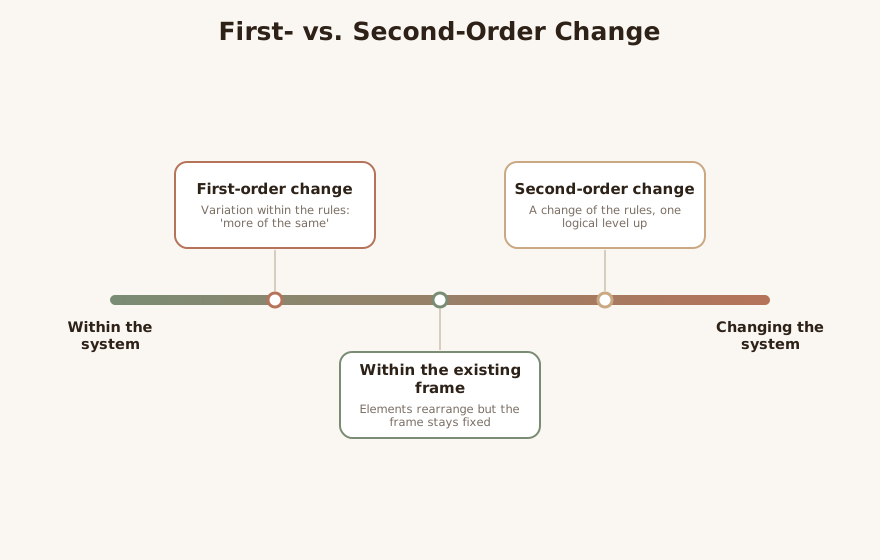
First- versus second-order change is a theory — more precisely, a conceptual distinction about how change itself occurs within systems — rather than a treatment package or a set of techniques 1. Its disciplinary roots are unusual for a clinical idea: the authors of Change drew the distinction from two mathematical sources, the theory of groups and the theory of logical types, and applied them by analogy to human problems 1. The unit of analysis is not the individual psyche but a system — a couple, a family, a team, or a single person’s repeating pattern of behavior — and the question is whether a given change happens within that system’s rules or whether it changes the rules themselves 4. First-order change is variation among the system’s internal states while the system, its premises, and its rules stay intact; second-order change is a shift of the system to a different state of organization, a change of the very frame within which first-order changes were being attempted 1. For practicing clinicians, the most useful framing is that this is a diagnostic lens on stuckness: it tells you why a client doing more and more of a sensible-seeming thing is getting nowhere, and what category of move would actually break the impasse LLM.
Creators & Lineage
The distinction was articulated by Paul Watzlawick, John Weakland, and Richard Fisch in their 1974 book Change: Principles of Problem Formation and Problem Resolution, the foundational text of the Mental Research Institute’s Brief Therapy Center in Palo Alto 1. The three authors were central figures of the Palo Alto group, whose work grew out of Gregory Bateson’s research on communication and the broader cybernetics movement, which reframed human difficulties as features of feedback systems rather than intrapsychic states 5. The intellectual borrowing is explicit and deliberate: the authors took group theory and Bertrand Russell’s theory of logical types — abstract mathematics — and used them as a rigorous scaffold for thinking about the difference between change that leaves a system’s structure intact and change that transforms it 1. The idea is therefore native to the Mental Research Institute brief-therapy tradition and is tightly bound to its companion concepts — the problem-maintaining “attempted solution,” reframing, and paradox 4. Its lineage runs forward into strategic family therapy and into Solution-Focused Brief Therapy, both of which inherited the premise that small, well-aimed shifts at the level of the system’s rules can resolve problems that resisted endless effort within those rules 5. The book has remained in print and continues to be read, reviewed, and taught decades after publication, a marker of how durable the distinction has proven 5.
Core Principles
The defining claim is that there are two logically distinct types of change, and that confusing them is a primary source of clinical and human stuckness 1. First-order change occurs within a given frame of reference; the system’s elements rearrange, but the rules governing them — and the frame itself — do not 1. The authors illustrate this with the example of a person caught in a nightmare: within the dream they can run, hide, fight, or jump, but no amount of such activity ends the nightmare, because all of it is within-dream (first-order) behavior 1. Only waking up — stepping entirely out of the dream’s frame — ends it, and waking is categorically not one of the things possible inside the dream; it is second-order change, a change of the state of the whole system 1. Second-order change is thus always a “change of the change”: it operates one logical level up, on the rules rather than within them, and from inside the old frame it characteristically looks impossible, paradoxical, or like a non sequitur 1. A second, equally canonical illustration is the nine-dot problem, which cannot be solved as long as one assumes the lines must stay inside the implicit square formed by the dots; the solution requires extending lines beyond that self-imposed boundary, that is, changing the assumed frame rather than working harder within it 1. The same logic exposes the be-spontaneous paradox: telling someone (or oneself) to “be spontaneous,” “relax,” “get an erection,” or “want to sleep” is a first-order demand that guarantees failure, because the demanded state can only arise outside the frame of deliberate effort 1. The practical upshot is that most everyday problem-solving is first-order, that it works fine for ordinary difficulties, and that it becomes pathogenic precisely when a problem actually requires a second-order solution but the system keeps applying “more of the same” 4.
Interventions & Techniques
Because this is a theory rather than a protocol, its “interventions” are the brief-therapy moves that operationalize a second-order shift 4. The most important of these is reframing — changing the conceptual or emotional frame in which a situation is experienced so that its meaning, and therefore the range of possible responses, changes, even though the concrete facts stay the same 1. Reframing is the prototypical second-order operation: it does not argue the client out of the facts but relocates them in a different class, so that what was “a hostile partner who won’t talk” might be reframed as “a partner protecting the relationship from a fight he fears he’d lose,” opening responses the old frame foreclosed 1. A second family of moves targets the attempted solution: the therapist identifies what the client and others keep doing to solve the problem and then interrupts it, often by prescribing a 180-degree reversal, on the principle that the maintaining “solution” is itself first-order “more of the same” 4. Symptom prescription and other paradoxical directives dissolve the be-spontaneous trap by asking the client to deliberately produce the symptom, which changes the frame from “I must stop this” to “I am choosing this,” a second-order relocation of the behavior 1. Go-slow and restraint-from-change messages counter the client’s first-order push to fix things faster, since urgency is frequently part of the maintaining loop 4. Across all of these, the technical aim is constant: stop optimizing within the box and instead change the box LLM.
LLM-generated illustrative example (not a guideline): A client with insomnia has spent months perfecting sleep hygiene — earlier bedtimes, no screens, breathing drills, hours of lying still “trying” to sleep — and is more exhausted than ever. The clinician recognizes that every strategy is first-order: more and better effort within the frame of trying to sleep, which is itself a be-spontaneous demand. A second-order reframe instructs the client to get out of bed and stay pleasantly awake when sleep won’t come, abandoning the goal of forcing sleep. Removing the effortful frame, rather than refining the effort, is what allows sleep to return LLM.
Evidence Base
Honesty about maturity is essential here, and it cuts in a particular direction because this is a theory, not a treatment 1. The distinction is established in the strongest sense available to a conceptual contribution: it is foundational, enormously influential, durable across decades, and woven into family-systems, strategic, and brief-therapy thinking 5. But “established” here means established as a conceptual framework with deep face validity and broad clinical adoption — not as an intervention with its own bank of randomized controlled trials 1. The construct was developed through logical analysis, analogy to mathematics, and accumulated clinical observation at the Brief Therapy Center, not through outcome trials of “second-order change” as a discrete manipulable variable 1. Its empirical standing is therefore largely inherited: it lives inside the evidence base of the models that carry it — the Mental Research Institute brief-therapy tradition, strategic family therapy, and most robustly Solution-Focused Brief Therapy, which has accumulated a substantially larger outcome literature 5. Clinicians should present the distinction to clients and colleagues as a respected, generative, and well-developed way of understanding change, while being candid that the phrase “second-order change” does not by itself denote a trial-validated technique LLM. Where outcome accountability is required, the construct is best used as a case-conceptualization heuristic alongside an evidence-based modality and measurement-based care, rather than as a stand-alone justification for any single move LLM.
Populations & Indications
The distinction is population-agnostic in principle, because any system with rules can be analyzed for whether its change is first- or second-order 4. In practice it is most immediately useful with couples and families, where the rules of interaction are visible and where “more of the same” loops are easy to identify 5. It applies equally to individuals stuck in repetitive problem-solving, since one person can describe and alter the frame governing their own behavior even when no one else is in the room 4. It scales upward to organizations and teams, whose policies and procedures are literally system rules that can be optimized first-order or transformed second-order 4. It is especially indicated for treatment-resistant clients and for people caught in chronic crisis cycles, where the very persistence of the problem despite effortful, reasonable solutions is the signal that a frame-level change is needed 1. The clearest indication is the clinical pattern of a sincere, intelligent client or family who has been working hard on a problem and getting more of it — the diagnostic fingerprint of a first-order solution applied where a second-order one is required LLM.
Problems-for-Work
In this framework, the problem-for-work is defined less by symptom content than by the level at which change is needed 1. Chronic and recurring problems sustained by “more of the same” solutions are the signature target: the clinician maps what keeps being done and asks whether the persistence is despite those efforts or because of them 4. Treatment resistance and therapeutic impasse are reframed as a sign that prior interventions — possibly including the therapist’s own — were first-order, so the work becomes finding the frame that has gone unexamined 1. Relationship conflict often reveals a be-spontaneous demand (“prove you love me,” “just be honest”) that no within-frame effort can satisfy, calling for a reframe of the demand itself 1. Symptom maintenance — anxiety worsened by vigilant self-monitoring, conflict worsened by relentless attempts to “resolve” it — is approached by interrupting the effortful frame rather than intensifying it 1. Rigid problem-solving patterns and stuck life patterns are treated as nine-dot problems, where the client is invited to question an assumed boundary they did not know they had drawn 1. Crisis cycles and failed prior treatments are read as evidence that the system has been escalating first-order solutions, and the work is to step out of that escalation entirely 4.
Contraindications, Cautions & Cultural Humility
The framework offers no diagnostic contraindication list, but several cautions are important LLM. First, the distinction is a lens, not a license: labeling a client’s hard-won coping as “merely first-order” can be dismissive and alliance-damaging, and not every problem needs or benefits from a frame-level upheaval — many difficulties are resolved perfectly well by competent first-order effort 4. Second, the techniques that produce second-order change — paradoxical directives, symptom prescription, restraint-from-change messages — demand particular care; delivered without a solid alliance, a clear rationale fitted to the client, and genuine respect, they can feel manipulative, and they are inappropriate where the behavior in question carries real danger 1. Third, in acute risk, active psychosis, or severe untreated illness, stabilization and a comprehensive safety-oriented frame take priority over clever frame-shifts LLM. Cultural humility is built into the concept itself: a “frame” is largely cultural, and what one community experiences as a problem requiring transformation, another experiences as a value to be preserved 4. A reframe that ignores a client’s cultural, religious, or family frame will simply be rejected, so the clinician must treat the client’s worldview as the very material being worked with, never as an error to be corrected LLM. Honest, transparent collaboration protects informed consent even when indirect methods are used LLM.
Treatment-Plan Suggestions & SMART Objectives
| Goal | SMART objective (example) | Mechanism |
|---|---|---|
| Identify the maintaining first-order solution | By session 2, client will name the specific, repeated effort being used to solve the problem and rate, 0–10, how well it has worked | Surfaces the “more of the same” loop so a frame-level change can be considered |
| Replace within-frame effort with a frame shift | Within 4 sessions, client will articulate at least one alternative meaning (reframe) for the situation and act differently on it once | Reframing enables responses the old frame foreclosed |
| Interrupt a be-spontaneous demand | Over 2 weeks, the partner will substitute one acknowledgment of difficulty for each demand for reassurance on 3 of 5 flashpoints | Removes the first-order demand that guarantees the desired state cannot occur |
| Dissolve an effort-maintained symptom | Within 2 weeks, client will, 5 of 7 occasions, abandon “trying” to produce the wanted state and follow a prescribed restraint plan | Exits the effortful frame sustaining the symptom |
| Break a chronic crisis-escalation cycle | Over 3 weeks, the family will reduce one habitual escalating response (e.g., emergency check-ins) by half, tracked on a simple log | Withdraws the first-order escalation that fuels the crisis cycle |
| Test a questioned frame assumption | By session 3, client will name one rule they had treated as fixed and run one small behavioral experiment outside it | Reveals a self-imposed boundary (the nine-dot trap) as optional |
| Consolidate and prevent first-order relapse | In the final 2 sessions, client will rehearse a plan for a future flare that does not revert to the old “more of the same” solution | Guards against drift back into within-frame problem-solving |
Common Misconceptions
A frequent error is to read the two types as a hierarchy of value, with first-order change “bad” and second-order change “good”; in fact first-order change is the appropriate and sufficient response to most ordinary difficulties, and only becomes problematic when a frame-level change is what the situation actually requires 4. Another is to equate “second-order change” with “big, dramatic, or radical change”; the distinction is about logical level, not magnitude — a tiny reframe can be second-order, and an enormous amount of effort can be entirely first-order 1. Clinicians sometimes assume the idea is anti-effort or anti-perseverance, when its real claim is narrower: persistence within the wrong frame is what fails, not persistence as such 1. The concept is also wrongly treated as a piece of vague systems jargon; it is in fact grounded in specific mathematics — group theory and the theory of logical types — and yields concrete, testable clinical moves 1. Finally, some treat the distinction as identical to the whole of brief therapy, when it is one foundational principle within a larger interactional model 5.
Training & Certification
There is no certification in “second-order change”; it is a theoretical concept practiced by qualified clinicians within their existing scope, typically as part of training in systemic, strategic, and brief therapies LLM. The primary-source curriculum is the founders’ own text, Change: Principles of Problem Formation and Problem Resolution, which remains the definitive statement of the distinction and its mathematical underpinnings 1. Clinicians generally encounter the idea through family-therapy and brief-therapy coursework, supplemented by the descendant literatures of strategic family therapy and Solution-Focused Brief Therapy, and by supervised practice in the interactional method 5. Accessible secondary explanations — including educational overviews and book reviews — can help orient newcomers before they engage the primary text 4. Practitioners should pursue this conceptual training while operating within the competencies and credentials required by their own license and jurisdiction LLM.
Key Terms
- First-order change — change occurring within a system whose rules and frame remain invariant; variation among internal states, or “more of the same” 1.
- Second-order change — change of the system’s rules or frame itself; a “change of the change” that operates one logical level up and often appears paradoxical from inside the old frame 1.
- Frame / frame of reference — the set of premises and rules within which a situation is experienced and within which first-order solutions are attempted 1.
- Group theory (as applied) — the mathematical source for the idea of a system whose members can change while the system stays the same, the formal model of first-order change 1.
- Theory of logical types (as applied) — the mathematical source for the idea that a class cannot be a member of itself, grounding the meta-level jump of second-order change 1.
- Be-spontaneous paradox — the trap created by demanding, of oneself or another, a state that can only arise spontaneously, so that first-order effort guarantees failure 1.
- Nine-dot problem — the classic illustration that some problems are unsolvable until the solver abandons a self-imposed boundary, that is, changes the assumed frame 1.
- Reframing — relocating the facts of a situation in a different conceptual or emotional class so that new responses become possible; the prototypical second-order move 1.
- Attempted solution — the repeated, well-intentioned effort to fix a problem that, being first-order, maintains it 4.
Resources & Further Reading
▶ Watch — a video introduction to this concept:
- Change: Principles of Problem Formation and Problem Resolution (Watzlawick, Weakland & Fisch, 1974) — Internet Archive
- Change: Principles of Problem Formation and Problem Resolution — Google Books
- Change: Principles of Problem Formation and Problem Resolution — full text PDF (sietmanagement.fr)
- First and second order change — The Open University
- Book review — Change: Principles of Problem Formation and Problem Resolution (Niki Payne)
Reflective / Supervision Questions
- For this case, what is the frame within which the client and I have been working — and have I ever actually examined it LLM?
- Is the client’s persistence in the problem happening despite their solutions or because of them, and what does that tell me about which order of change is needed LLM?
- Where am I, as the therapist, at risk of prescribing “more of the same” — more insight, more skills practice, more reassurance — when a frame shift is what’s required LLM?
- Is there a be-spontaneous demand hidden in the presenting complaint, in which effort itself is keeping the wanted state out of reach LLM?
- What unexamined boundary is this client treating as fixed, and what would a small experiment outside it look like LLM?
- If I am considering a paradoxical or restraint-based intervention, is the alliance strong enough, the rationale clear enough, the behavior safe enough, and the client’s cultural frame respected LLM?
- Am I representing this idea honestly — as a respected, foundational conceptual lens rather than a trial-validated technique — to clients and colleagues LLM?