
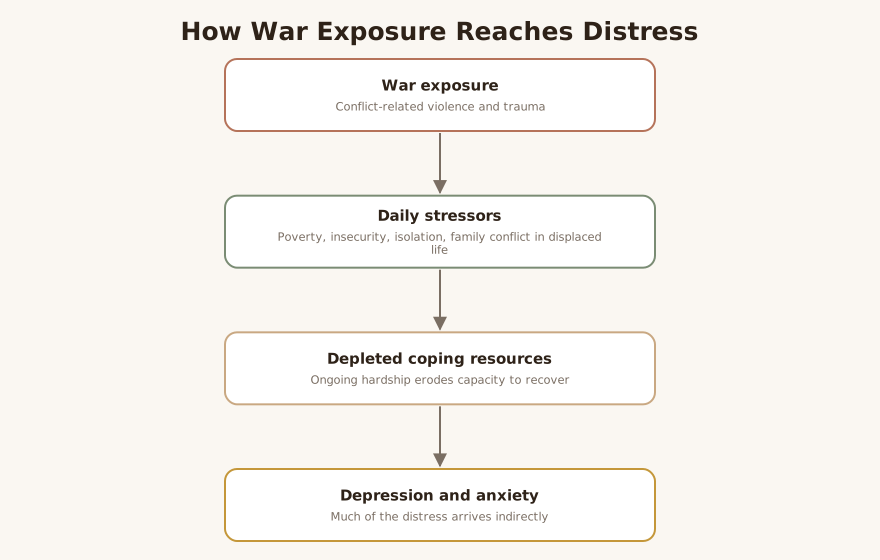
The Daily Stressors Model is the claim that much of the distress seen in refugees and conflict-affected people is driven not directly by what happened during the war, but by what is happening to them now — the poverty, insecurity, isolation, and family strain of displaced life 1. Kenneth Miller and Andrew Rasmussen argued that these ongoing “daily stressors” statistically mediate a large part of the relationship between war exposure and mental health, which reframes the clinical task: trauma-focused therapy alone will not reach a client whose depression is being fed each day by hunger, an uncertain asylum claim, or a marriage strained by displacement 12. For the practicing therapist working with refugees, asylum seekers, or other displaced clients, the model is worth understanding because it changes both how you formulate a case and what you decide is actually treatable in the room LLM.
Type & Discipline
The Daily Stressors Model is a framework — an explanatory and ecological model of distress — rather than a discrete psychotherapy 1LLM. Its disciplinary home is refugee and conflict-affected mental health, within the broader field of humanitarian and global mental health, and its unit of analysis is the relationship between a person’s social environment and their psychological functioning rather than a single therapeutic technique 23. Miller and Rasmussen developed it as a bridge between two camps that had largely talked past each other: a trauma-focused tradition centered on war exposure and PTSD, and a psychosocial tradition centered on the ongoing conditions of displaced life 1.
Because it is a framework rather than a modality, the model is defined by an empirical argument and not by a set of procedures LLM. In its fuller form it is often described as an ecological model of refugee distress, locating mental health within nested levels of influence — individual, family, community, and societal — rather than reducing it to a single pathogen and a single outcome 23. What makes it coherent is a recurring, replicable finding: across conflict-affected populations, post-migration and displacement-related stressors account for a substantial share of variance in distress, often more than war exposure itself 2.
Creators & Lineage
The model is associated above all with Kenneth E. Miller and Andrew Rasmussen, whose 2010 paper in Social Science & Medicine set out to bridge “the divide between trauma-focused and psychosocial frameworks” in conflict and post-conflict settings 1. Miller’s prior work on ecologically grounded mental health interventions with displaced communities laid the groundwork, and the daily stressors argument grew out of fieldwork observing that what most burdened refugees was frequently their present circumstances, not only their wartime past 13. The two authors went on to articulate the broader ecological model of refugee distress that extends the original insight across multiple levels of social organization 2.
The intellectual lineage runs through community and ecological psychology — the tradition that situates distress in person-environment fit rather than in the individual alone — and connects to the public-mental-health and psychosocial movements in humanitarian work that emphasize social determinants over a narrow disorder focus 3LLM. The model is best read as a corrective within that lineage: a deliberate counterweight to a refugee mental health literature that, in the authors’ view, had become “predominantly trauma-focused” and had under-attended to the chronic stressors of displaced life 13. Its claims have since been tested and extended by other researchers, including network-analytic work with displaced young people that examines how stressors and symptoms hang together 4.
Core Principles
The first principle is that daily stressors mediate much of the war-to-distress relationship 1. Miller and Rasmussen’s central proposition is that war exposure exerts a large part of its effect on mental health indirectly, by generating or worsening the ongoing stressors of displaced life, so that those stressors statistically account for a substantial share of depression and anxiety 12. In the ecological formulation, “post-migration stressors partially mediate the impact of war trauma on psychological wellbeing,” depleting the coping resources a person needs to recover 2.
The second principle is a broad definition of daily stressors as ongoing, often mundane hardships — both conflict-related and not — rather than discrete traumatic events 13. These include poverty and unemployment, insecurity and uncertain legal status, social isolation and marginalization, perceived discrimination and stigma, changes in family roles, and increased family or marital violence 23. The model stresses that “conflict-related violence often takes place against a pre-existing background of chronic stressors,” so displacement frequently stacks new hardships onto old ones 3.
The third principle is specificity of distress to its source: depression arising from unemployment or isolation is a different clinical object from grief over an unresolved loss or intrusive memories of violence, and the model insists these be distinguished because they call for fundamentally different responses 2LLM. The fourth principle is ecological, multi-level causation — distress is produced across individual, family, community, and societal levels, which is why the model resists reducing refugee mental health to “a single pathogen” linked to “a single mental health outcome” 23.
Interventions & Techniques
The model’s “interventions” are not a new therapy but a reorganization of the clinical and programmatic response so that it matches where the distress is actually coming from 2LLM. Its first implication is a multi-service approach: individual or group therapy combined with case management aimed at helping clients “address the social and material conditions of their daily lives,” because reducing the stressor often does more for mood than processing the trauma would 2. For the individual clinician this means that linking a client to housing, legal aid, food assistance, or employment support is not adjunctive to the treatment — within this model it can be the treatment 2LLM.
The second implication is matching the intervention to the source of distress 2. The model asks the clinician to formulate carefully — is this depression being driven by present, modifiable stressors, or by unresolved war-related grief and trauma? — and to direct trauma-focused therapy toward those whose distress is genuinely trauma-rooted, while directing psychosocial and practical support toward those whose suffering is being sustained by current conditions 24. Network-analytic findings reinforce this: in displaced young people, daily stressors connected strongly to depression and anxiety but much less to avoidance, intrusion, and hyperarousal, suggesting that “refugees may suffer from mental health symptoms even when they fail to reach the ‘trauma threshold’” 4.
The third implication reaches beyond the clinic into structural and promotive work: projects that foster livelihoods, change policies to permit refugee employment, and reduce family violence can improve mental health “collaterally,” without being formally psychotherapeutic 2. Promotive interventions that strengthen “self-esteem, agency and a sense of hope,” together with intersectoral coordination across health, legal, and social sectors, are part of the model’s logic even though no single clinician delivers them all 3.
LLM-generated illustrative example (not a guideline): A clinician sees a recently resettled asylum seeker presenting with low mood, poor sleep, and hopelessness. Rather than moving straight to trauma processing, the clinician maps her stressors: she is awaiting an asylum decision, cannot legally work, is isolated from her language community, and is sending money she does not have to relatives abroad. The clinician treats the case on two tracks — connecting her to legal advocacy, a community group, and benefits support to lower the daily-stressor load, while monitoring for genuinely trauma-rooted symptoms that would warrant trauma-focused work later. As the practical pressures ease, her mood lifts well before any trauma processing begins LLM.
Evidence Base
The maturity of the model is best described as established: its core mediation claim has been replicated across multiple conflict-affected and displaced populations, and it now anchors much of how the field thinks about refugee distress 12. The repeated finding is striking — across studies, “post-migration stressors have accounted for greater variance in levels of depression and anxiety than war-related experiences,” which is the empirical backbone of the whole framework 2. This is a claim about variance explained, derived from mediation and regression analyses across diverse samples, not a single flagship trial 12LLM.
The 2023 network analysis of unaccompanied young refugees illustrates both the support and the nuance 4. Studying 392 unaccompanied young refugees (mean age about 16, predominantly male) recruited across Libya, Greece, Italy, and Belgium, the authors found that daily stressors were strongly connected to depression and anxiety but correlated far less with the avoidance, intrusion, and hyperarousal subscales of a trauma measure, while stressful life events were “much less connected to anxiety and depression symptoms” 4. The authors describe their results as “consistent with this critique and the ecological model of refugee distress,” and note that depression emerged as a central node in the symptom-stressor network 4.
Honesty about scope matters. The strongest evidence concerns depression and anxiety, for which daily stressors are most clearly implicated; the model does not claim that war trauma is unimportant, only that its effect is substantially mediated by present conditions and that PTSD-type symptoms behave differently from mood symptoms 14. Much of the underlying evidence is cross-sectional and correlational, the populations and stressor measures vary across studies, and the broader intervention-evaluation literature remains “skewed towards interventions focused on particular disorders,” so the model’s psychosocial implications are better established as theory than as a deep trial base 3LLM.
Populations & Indications
The model was developed for, and is most directly indicated in, work with refugees, asylum seekers, and internally displaced people affected by armed conflict — the more than sixty million forcibly displaced people worldwide whose lives unfold amid ongoing stressors, the majority of them in low- and middle-income countries 3. It applies across the displacement trajectory, encompassing “pre-migration war exposure, perilous experiences of flight and current post-migration stressors,” and is therefore relevant both in humanitarian settings near the conflict and in resettlement countries 2.
Within these populations the model has particular salience for displaced young people, including unaccompanied minors, for whom uncertainty about the future, separation from family, boredom, and discrimination are documented drivers of depression and anxiety 4. It is indicated wherever a clinician suspects that a client’s distress is being sustained by present hardship — precarious legal status, poverty, isolation, family conflict — rather than, or in addition to, past trauma 24. It is equally indicated as a formulation discipline for any clinician at risk of attributing all of a refugee client’s suffering to wartime events and missing the modifiable stressors in front of them 1LLM.
Problems-for-Work
The model reframes which problems are most tractable by directing clinical attention to the ongoing stressors that often carry the heaviest causal weight 1LLM.
- Depression sustained by displacement-related hardship is the flagship problem-for-work: when low mood is being fed by unemployment, poverty, or isolation, the model points toward easing those conditions as a primary route to symptom relief 24.
- Anxiety tied to insecurity and uncertain status — for example the chronic dread of an unresolved asylum claim — is a core target, addressed by coupling clinical support with practical and legal advocacy 24.
- Social isolation and marginalization are themselves problems-for-work, since reconnecting a client to a language community or peer group can lift mood independently of any trauma processing 34.
- Family and marital conflict intensified by displacement, including increased family violence and shifting family roles, is named explicitly in the model as a stressor worth targeting directly 23.
- Trauma-rooted symptoms (intrusion, avoidance, hyperarousal) remain a distinct problem-for-work, but the model helps the clinician distinguish these from stressor-driven mood symptoms so that trauma-focused therapy is offered to those who actually need it 24.
LLM-generated illustrative example (not a guideline): A therapist working in a resettlement clinic notices that several clients referred for “PTSD” are not endorsing many re-experiencing symptoms but are overwhelmed by housing instability and discrimination at work. Reformulating through the daily stressors lens, the clinic adds a case-management arm and partners with a legal-aid organization. Over the following months, symptom scales improve for the clients whose distress was stressor-driven, while the smaller group with genuine trauma symptoms is routed to focused trauma treatment LLM.
Contraindications, Cautions & Cultural Humility
The principal caution is one of balance, not harm: the model corrects an over-emphasis on trauma, but it must not be flipped into a blanket dismissal of trauma-focused care 1LLM. War exposure still matters, and a subset of clients carry genuinely trauma-rooted symptoms that will not resolve by improving living conditions alone; the model’s own logic — match the intervention to the source — requires that these clients receive appropriate trauma-focused treatment rather than only psychosocial support 24. Using “it’s just daily stressors” to withhold indicated trauma care would misread the framework LLM.
A second caution is that addressing daily stressors can exceed the clinician’s reach. Many of the most potent stressors — legal status, the right to work, poverty — are structural and not resolvable within a therapy hour, which is why the model calls for intersectoral coordination and case management rather than placing the whole burden on individual psychotherapy 23. Acknowledging this honestly with clients, rather than implying that talking will fix material hardship, is part of using the model responsibly LLM.
On cultural humility, the model is itself a humility move: it insists that distress be understood within a person’s actual social and material context rather than imposed through a single diagnostic template 23. That same spirit demands attention to whether symptom measures and “trauma thresholds” are valid across cultures, since clients may suffer real impairment while falling below thresholds calibrated elsewhere 4. The clinician’s task is to listen for which stressors a particular client and community find most burdensome, not to assume a universal ranking 3LLM.
Treatment-Plan Suggestions & SMART Objectives
| Goal | SMART objective (example) | Mechanism |
|---|---|---|
| Reduce displacement-related daily-stressor load | Within 8 weeks, client will be connected to at least two concrete supports (e.g., legal aid and food/housing assistance) addressing top-rated stressors | Easing material/social stressors reduces the conditions mediating distress 2 |
| Distinguish stressor-driven from trauma-driven distress | By session 3, clinician and client will complete a shared formulation separating present-stressor symptoms from trauma-rooted symptoms | Matching intervention to source of distress 24 |
| Lower depression sustained by hardship | Over 12 weeks, client’s depression rating will decrease by a clinically meaningful margin as stressors are addressed and tracked | Daily stressors connect strongly to depression and anxiety 4 |
| Address social isolation | Within 6 weeks, client will attend a community, peer, or language-group connection at least twice monthly | Reducing isolation/marginalization improves mood collaterally 23 |
| Reduce family/marital conflict tied to displacement | Over the episode, client will engage in support targeting family-role strain or family conflict where present | Family violence and role change are named daily stressors 23 |
| Provide trauma-focused care to those who need it | For clients above the trauma threshold, a course of evidence-based trauma-focused therapy will be initiated within 4 weeks of formulation | Trauma-focused therapy directed to genuinely trauma-rooted distress 24 |
| Strengthen agency and hope | Over 12 weeks, client will identify and act on at least one valued goal restoring a sense of agency | Promotive work on self-esteem, agency, and hope 3 |
| Coordinate care across sectors | Throughout the episode, the plan will be coordinated with at least one non-clinical sector (legal, housing, employment) serving the client | Intersectoral, multi-service response to multi-level causation 23 |
Common Misconceptions
The most common misconception is that the model denies that war trauma matters. It does not; it argues that war exposure’s effect on mental health is largely mediated by ongoing stressors, while still recognizing trauma as real and as warranting focused treatment for those whose symptoms are trauma-rooted 12. A second misconception is that it is a new therapy; it is an ecological framework for formulating distress and organizing care, not a manualized treatment 2LLM. A third is that “daily stressors” means minor everyday hassles; in this model they are often severe, chronic conditions — poverty, insecurity, isolation, violence — that powerfully shape mental health 23. A fourth is that the model implies therapists should just do social work; it calls for a multi-service approach in which clinical and psychosocial supports are matched to the source of distress, not a replacement of one by the other 24. A fifth is that the evidence is thin; the core mediation finding has been replicated across populations, even as the psychosocial intervention-evaluation literature remains less developed than the disorder-focused one 23.
Training & Certification
There is no license or certification in the Daily Stressors Model; it is a conceptual framework that clinicians and programs adopt to shape formulation and service design rather than a credentialed modality 1LLM. Competence in it is built primarily by reading the foundational and ecological papers and by working within multidisciplinary refugee-serving teams where case management, legal advocacy, and clinical care are coordinated 23. The practical skill it asks of clinicians is disciplined ecological formulation — the habit of mapping a client’s current stressors and distinguishing stressor-driven from trauma-driven symptoms — which is learned through supervised practice with displaced populations 24.
Because the model’s implications are inherently intersectoral, training in it overlaps with broader humanitarian and global mental health frameworks that emphasize social determinants, stepped and matched care, and coordination across health, legal, and social services 3LLM. Clinicians strengthen their use of it by partnering with the legal, housing, and community organizations that can actually move the structural stressors the model identifies 23.
Key Terms
- Daily stressors: ongoing, often chronic hardships of displaced life — poverty, insecurity, isolation, discrimination, family conflict — distinct from discrete traumatic events, that drive a substantial share of distress 13.
- War exposure: direct experience of conflict-related violence and its events, traditionally treated as the primary cause of refugee distress but, in this model, largely mediated by daily stressors 12.
- Mediation: the statistical relationship in which war exposure affects mental health partly through the daily stressors it generates or worsens, rather than only directly 12.
- Ecological model of refugee distress: the broader formulation locating mental health within nested individual, family, community, and societal levels rather than in war exposure alone 23.
- Post-migration stressors: stressors arising after flight and resettlement — legal uncertainty, unemployment, marginalization — repeatedly found to explain large variance in depression and anxiety 2.
- Trauma-focused vs. psychosocial divide: the two traditions the model sought to bridge — one centered on war trauma and PTSD, the other on the social conditions of displaced life 1.
- Multi-service approach: combining clinical therapy with case management and structural support so that intervention matches the source of distress 2.
- Trauma threshold: the symptom level at which trauma-related disorder is identified; the network finding that clients suffer below it underscores that not all distress is trauma-driven 4.
Resources & Further Reading
▶ Watch — a video introduction to this concept:
- Miller & Rasmussen (2010), War exposure, daily stressors, and mental health in conflict and post-conflict settings — Semantic Scholar
- The mental health of civilians displaced by armed conflict: an ecological model of refugee distress — Epidemiology and Psychiatric Sciences (Cambridge)
- An ecological model for refugee mental health: implications for research — PMC
- Daily stressors, stressful life events, and mental health in refugees: a network analysis — Frontiers in Psychology (2023)
Reflective / Supervision Questions
- For a refugee client in front of me, have I actually mapped the present daily stressors, or have I defaulted to attributing the distress to wartime events? 1
- When I formulate, can I distinguish symptoms that are being driven by current hardship from those that are genuinely trauma-rooted, and am I matching my interventions accordingly? 24
- What can I realistically influence — and what is structural and beyond the therapy hour — and am I being honest with the client about that boundary? 23
- Am I withholding indicated trauma-focused care from anyone because I have over-applied the “it’s just daily stressors” frame? 2
- Which stressors does this client and community find most burdensome, and have I asked rather than assumed a universal ranking? 3
- Are the symptom measures and trauma thresholds I rely on valid for this client’s culture, given that real distress can sit below them? 4