
Type & Discipline
Therapeutic documents and letters are a written technique within narrative therapy, a collaborative and non-pathologizing approach situated in the family therapy tradition 4. They are not a freestanding modality but a set of practices that extend the narrative therapy conversation onto paper, where it can be re-read, kept, and circulated 4. The practice is informed by theoretical traditions distinct from those of mainstream counseling psychology, psychiatry, and social work — namely post-structuralism and anti-individualism 4. Within this frame, identity is treated as fluid, contextual, and multi-storied rather than fixed and located inside the individual, and the written document is one means of making an alternative, preferred story durable 4.
The text analogy is central: narrative therapy treats lives as texts that can be read and re-read, so writing fits naturally as an extension of the work 4. Stories take on added meaning and permanence when they are written down, which is the core rationale for putting therapeutic conversation into letter form 4.
Creators & Lineage
Narrative therapy was developed by Michael White (an Australian) and David Epston (a New Zealander), who together authored the foundational text that introduced therapeutic letters, certificates, and documents as instruments of healing 3. White and Epston’s 1990 work, Narrative Means to Therapeutic Ends, is the origin point for the systematic use of written documents in this tradition 13. David Epston in particular has been instrumental in the practice of narrative letter writing and is credited with articulating why the written word matters in therapy 4.
Epston framed the rationale memorably, writing that conversation is by its nature ephemeral — a client may leave a powerful session and find that, a few blocks away, the exact words that struck home are already hard to recall, whereas the words in a letter endure through time and space, bearing witness to the work of therapy 4. The contemporary elaboration of letter-writing categories drawn on throughout this article comes from Anja Bjoroy, Stephen Madigan, and David Nylund, who catalogued and illustrated the major types of narrative letters in current use 4. The broader lineage connects to social constructionism, family therapy, and the wider family of narrative practices maintained by training centers such as the Dulwich Centre 3.
Core Principles
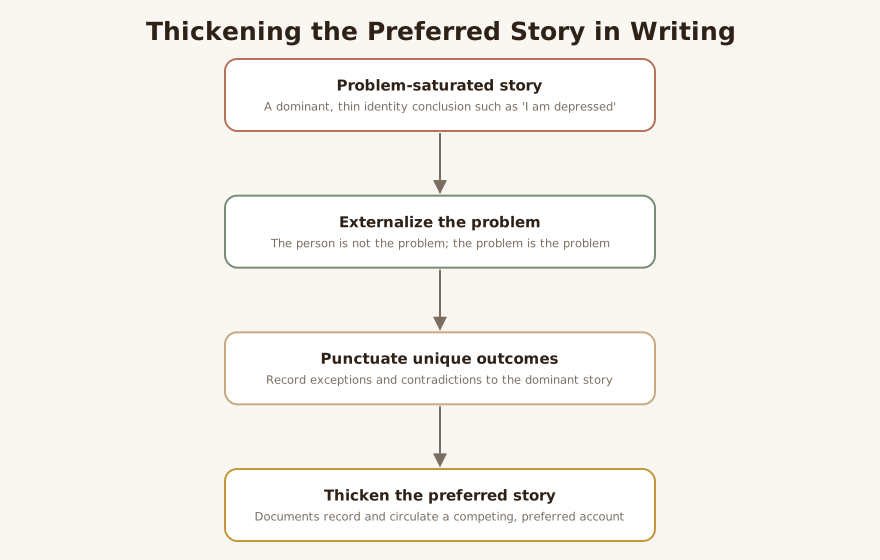
The practice rests on the narrative premise that people make meaning of their lives through stories, and that the stories someone lives by actively shape lived experience rather than merely mirroring it 4. By the time a person reaches therapy, they have often developed a dominant, problem-saturated story that recruits them into a “thin” identity conclusion — for example, concluding that “I am depressed” is a fixed, biologically innate fact about who they are 4. Therapeutic documents are designed to counter that thinness by recording and thickening a competing, preferred account 4.
A foundational move is externalizing the problem, captured in the narrative motto that the person is not the problem; the problem is the problem 4. Letters reinforce this linguistic separation, using reflexive verbs and evaluative questions — for example asking whether a client has been “more in charge of” their anger rather than it being in charge of them, instead of flatly stating “you have been controlling your anger” 4. Letters also punctuate unique outcomes — exceptions and contradictions to the dominant problem story — and treat them as entry points into alternative storylines 4. Above all, the document positions the client as the final editor of their own story and as a witness to their own forgotten abilities and values 4.
Interventions & Techniques
The most commonly used document is the summary or “letters as narrative” type, which records and reflects the session back to the client 4. Such letters serve several explicit purposes: to confirm the therapist heard the client’s story accurately, to let the client take up emerging counter-stories without waiting for the next session, to document and retell the preferred story, to extend the conversation between meetings, and to strengthen the therapeutic relationship 4. Practical guidance for these letters includes an introductory paragraph reconnecting to the prior session, verbatim client quotes, statements describing the relative influence of the problem, questions rather than assertions about under-explored areas, and the use of humour and puns 4.
Other catalogued forms each do specific work 4:
- Letters of prediction write a future narrative encompassing the client’s hopes, so that conviction in the new story helps the forecast come true 4. One example was sealed and given to a twelve-year-old with instructions not to open it until Christmas, predicting his move toward responsibility and away from conflict with his mother 4.
- Letters of invitation reach out, with the attending member’s consent, to a family member who is absent but whose presence would help 4.
- Brief letters simply signal that the therapist is still thinking about the conversation, and can help an isolated client feel valued and less alone 4.
- Counter-referral letters send the new narrative back to the referring worker, teacher, or probation officer, spreading the preferred story beyond the therapy dyad 4.
- Therapeutic letter-writing campaigns recruit a “community of concern” to write competing, preferred stories of a person whom institutions had labeled chronic, re-membering them back into systems of love and support 4.
- Counter-documents are awards, diplomas, or certificates marking the completion of a goal — for instance a “Reputation Re-worker Certificate” recognizing a twelve-year-old’s shift from a “bully” reputation toward being “kind” and “accountable” 4.
For couples, the authors also write directly to the relationship itself, beginning a letter “Dear X and Y’s relationship,” and may invite each partner to write back from the relationship’s point of view, countering individualizing cultural ideas about couplehood 4.
Evidence Base
The honest position is that this is an established, widely taught narrative practice with limited empirical support 4. The chapter that most fully catalogues the technique states plainly that, at present, there is not much evidence for the effectiveness of therapeutic letters in narrative therapy 4. What exists is informal clinical research rather than controlled trials 4.
Epston and White asked clients two questions: how many sessions a received letter was worth, and what percentage of positive outcomes the client attributed to the letters 4. The average client rated a letter as worth the equivalent of about 4.5 sessions, and attributed somewhere between 40% and 90% of therapy’s positive outcome to the letters 4. A small replication at a large California medical facility by Nylund and Thomas found an average rated worth of 3.2 face-to-face interviews (range 2.5–10) and 52.8% of positive outcome attributed to the letters alone 4. These figures are client-rated worth and satisfaction, not efficacy data from a controlled design, and should be presented to colleagues and clients as such 4LLM. The authors’ inference is that the time investment in writing seems worth the effort, but the empirical foundation for that claim remains thin 4LLM.
Populations & Indications
The practice has been applied across a wide age range, with documented letter-writing campaigns designed for people as young as six and as old as seventy-six 4. Source examples span children with night fears, adolescents in conflict with parents, adults with anxiety and depression, and couples in conflict 4. Letters are also explicitly indicated for isolated or demoralized clients, where simply receiving mail can restore a sense of being valued and connected 4. The campaign variant was developed specifically for people in desperate, life-threatening circumstances — those given long psychiatric admissions and labeled chronic, including people contending with anorexia, despair, and suicidality 4.
In practice, the technique is well suited to clients carrying a problem-saturated identity around depression, anxiety, low self-esteem, trauma, grief, or relationship conflict, because the document gives the emerging counter-story a tangible, re-readable form 4LLM. It also fits family and systemic work, where a letter can carry the preferred story to members who were not in the room 4.
Problems-for-Work
- Problem-saturated identity / demoralization. A summary letter that quotes the client’s own words back and names unique outcomes externalizes the problem and gives the thin, deficit story a durable rival 4.
- Anxiety. The sample letter to “Kyle” recounts how Anxiety and its “allies” recruited him into a negative story, then highlights moments — a teacher who believed in him, the bravery of meeting his partner — when Anxiety “took a back seat,” using questions to thicken that account 4.
- Childhood fears. The playful letter to an eight-year-old co-authored “Rules of Fear” with the family and built a shared, lighthearted plan for finding bravery, making the work memorable and collaborative 4.
- Parent–adolescent conflict. A letter of prediction to a twelve-year-old forecast less bickering and more responsibility, inviting him to step into a preferred future self 4.
- Grief and loss. Narrative documents pair naturally with “saying hullo again” responses to loss, recording a continued, preferred relationship to what was lost rather than its erasure 3.
- Relationship conflict. Letters written directly to the couple’s relationship, and reply-letters written from the relationship’s point of view, counter individualizing stories and surface renewed hopes for the partnership 4.
LLM-generated illustrative example (not a guideline): After a session in which a client described herself as “just a depressed person,” a clinician might send a brief letter quoting her own remark that she had “still managed to walk the dog every morning, even on the worst days,” and ask: when Depression tells you nothing is moving, what does the morning walk know that Depression doesn’t? LLM
Contraindications, Cautions & Cultural Humility
Narrative therapy holds that lives and problems do not exist in a vacuum but are shaped by powerful discursive contexts — class, race, gender, sexual orientation, and ability — so a culturally humble letter attends to those contexts rather than locating the problem inside the individual 4. The post-structural, anti-individualist stance is itself a guard against pathologizing language, and the document should reflect that stance in its wording 4.
Beyond what the sources address, several practical cautions apply LLM. Letters presuppose literacy and a shared written language; for clients who do not read fluently, or who read in a different language, a written document can exclude rather than include, and an oral or co-read alternative may be needed LLM. A written record is also permanent and discoverable, which raises a genuine safety concern with the couples and relationship-conflict population: a letter that recounts a problem story, or that names a partner’s behavior, could be found by an abusive partner and used against the client LLM. With trauma survivors, documenting a problem story without robust double-story development risks re-inscribing the very narrative the work aims to loosen, so a trauma narrative should be put on paper only alongside the preferred, competing account 5LLM. Clinicians should also obtain explicit consent before sending letters to third parties such as absent family members or referral sources, as the sources note for invitation and counter-referral letters 4.
Treatment-Plan Suggestions & SMART Objectives
| Goal | SMART objective (example) | Mechanism |
|---|---|---|
| Externalize a problem-saturated identity | Within 4 sessions, client will receive and respond to one summary letter that names the problem in externalized language, identifying at least two unique outcomes | Externalizing the problem; positioning client as editor of their story 4 |
| Thicken a preferred story | Over 6 weeks, client will co-author and keep two letters quoting their own words and at least three exceptions to the problem story | Documenting and “thickening” the preferred, multi-storied account 4 |
| Reduce the felt power of anxiety | Within 8 sessions, client will use a summary letter’s evaluative questions to identify three moments when they were “in charge of” anxiety rather than it of them | Grammar of agency; reflexive verbs re-author relationship to the problem 4 |
| Re-member supportive relationships | Within 5 sessions, client will participate in one letter-writing campaign soliciting two letters from a chosen community of concern | Re-membering; circulating competing, preferred stories of identity 4 |
| Mark and consolidate change | By session 10, client will receive a counter-document (certificate) naming a completed therapeutic goal in their own preferred terms | Visual, durable record of a unique outcome and new reputation 4 |
| Reduce parent–adolescent conflict | Within 6 weeks, family will engage one letter of prediction describing a preferred future with reduced conflict, reviewed together at next session | Future-oriented narrative invites the forecast to come true 4 |
| Decrease isolation / demoralization | Over 4 weeks, isolated client will receive two brief letters signaling the therapist’s ongoing reflection between sessions | Connection and continuity; client feels valued and less alone 4 |
| Re-author a couple’s shared story | Within 5 sessions, each partner will write one reply-letter from the standpoint of “the relationship” describing renewed hopes | Relational (non-individualizing) re-storying of the partnership 4 |
Common Misconceptions
A frequent misconception is that the letter is the therapist’s interpretation or homework assignment imposed on the client; in narrative practice the document positions the client as the final editor of their own story, not the recipient of expert pronouncements 4. Another is that more evidence backs the practice than actually does — the session-equivalence figures are sometimes cited as if they were efficacy outcomes, when they are informal client ratings of worth and the literature itself concedes limited evidence 4LLM. A third is that letters are merely tidy case summaries; the narrative letter is built to expose contradictions in the dominant problem story and elaborate competing perspectives, which is a different task from neutral record-keeping 4. Finally, some assume letter writing is a quick add-on, but practitioners describe it as time-intensive, requiring sustained reflection and multiple drafts, and acknowledge it cannot follow every session 45.
Training & Certification
There is no licensure or certificate specific to writing therapeutic documents; competence is developed within broader narrative therapy training and supervision 4LLM. Foundational learning begins with White and Epston’s original text and the worked letter examples it contains 14. Established narrative training organizations, including the Dulwich Centre, offer courses and resources in narrative approaches within which document practice is taught 3. The catalogued letter categories and accompanying example letters in the Bjoroy, Madigan, and Nylund chapter provide a practical template set for clinicians building the skill 4. Because letters require careful reflection and revision rather than a fixed formula, supervised practice with feedback on actual drafts is the most direct route to competence 5LLM.
Key Terms
- Therapeutic document / letter — a written artifact that records and circulates the client’s emerging preferred story outside the session 4.
- Externalizing the problem — linguistically separating the person from a deficit identity, captured as “the person is not the problem, the problem is the problem” 4.
- Problem-saturated story — a dominant, “thin” account that recruits a person into a negative, fixed identity conclusion 4.
- Unique outcome — a contradiction or exception to the problem story that serves as an entry point into an alternative narrative 4.
- Preferred story / counter-story — the alternative, richly described account highlighting skills, values, and competencies, which letters aim to thicken 4.
- Re-membering / community of concern — recruiting loving others to author competing stories and reconnect the person to supportive membership 4.
- Letter of prediction — a future-oriented document whose conviction in the new story is intended to help the forecast come true 4.
- Counter-document — an award, diploma, or certificate marking a therapeutic accomplishment 4.
Resources & Further Reading
▶ Watch — a video introduction to this concept:
- White, M., & Epston, D. (1990). Narrative Means to Therapeutic Ends — W. W. Norton
- David Epston — Letter-writing (Re-authoring Teaching)
- About Narrative Approaches — The Dulwich Centre
- Bjoroy, A., Madigan, S., & Nylund, D. — The Practice of Therapeutic Letter Writing in Narrative Therapy (PDF)
- Narrative Practices: Therapeutic Letters — Tiffany Sostar
Reflective / Supervision Questions
- When you draft a letter, whose words predominate — the client’s verbatim quotes, or your own clinical summary — and what does the balance say about who is positioned as editor of the story? 4LLM
- How would you describe the evidence base for therapeutic letters to a client or a skeptical colleague without overstating the informal session-equivalence data? 4LLM
- For a given client, does the dominant story you would commit to paper carry a re-traumatization or safety risk, and is the preferred counter-story developed richly enough to balance it? 5LLM
- Does this client read fluently in the language you would write in, and if not, what oral or co-read alternative preserves the same collaborative spirit? LLM
- Before sending any document to a third party — an absent family member, a referral source — have you secured explicit consent and considered who else might read it? 4LLM
- What discursive contexts (class, race, gender, sexual orientation, ability) shape this person’s problem story, and does your letter’s language honor those contexts rather than locating the problem inside the individual? 4