
Type & Discipline
Theraplay is a structured, therapist-led, dyadic play therapy positioned within clinical child psychology and the broader field of play therapy 5. Unlike non-directive child-centered play therapy, in which the child leads and play is used to externalize internal thoughts and feelings, Theraplay sessions are highly structured by the therapist and deliberately recruit a parent or caregiver into the work, so that the relationship itself becomes the agent of change 2. It is relationship-focused, interactive, physical, and playful, and it concentrates on present-moment “here-and-now” interactions rather than on the child’s narrative of past or present experience 2. The core therapeutic move is to recreate the kinds of attuned, face-to-face exchanges characteristic of early healthy parent-infant relationships, regardless of the presenting problem that brought the dyad to treatment 2.
Creators & Lineage
Theraplay was developed by clinical psychologist Ann Jernberg in the late 1960s and was subsequently expanded and codified by Phyllis Booth, whose name appears alongside Jernberg’s on the field’s standard manual 52. The Theraplay Institute, established around 1970, remains the certifying and disseminating body for the model worldwide 2. Theoretically, the approach is rooted in attachment theory, drawing directly on Bowlby’s concept of the internal working model: children who experience pleasurable, attentive caregiving build a positive internal model of self, others, and world, while children deprived of those interactions are hypothesized to be more vulnerable to behavior problems and relational difficulties 2. The model also reflects object relations thinking about the formative power of the earliest relationship, and it sits in the same family as filial therapy and other play-based approaches that mobilize the caregiver as a healing presence 62. Theraplay further integrates a regulation lens, treating the early attachment relationship as the original site of dyadic affect regulation and the scaffold for a child’s later self-regulation 2.
Core Principles
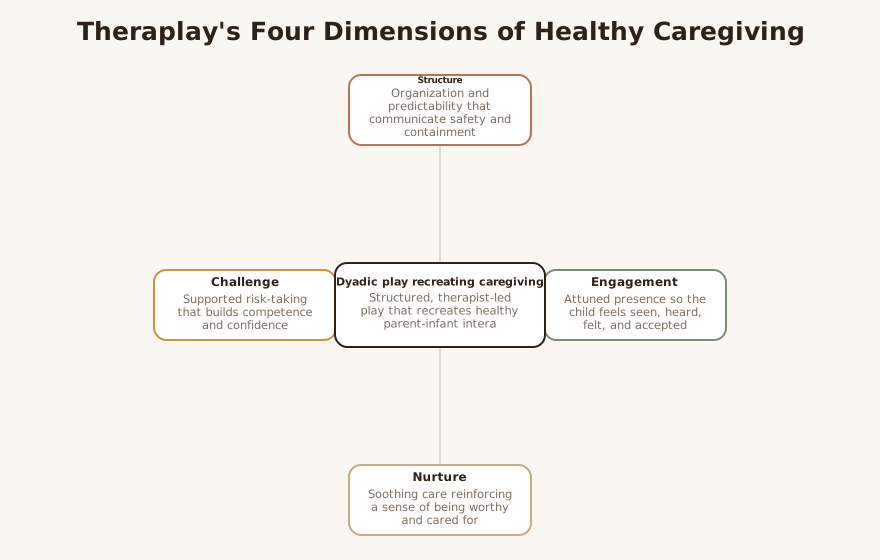
The model rests on four dimensions that, in combination, are held to characterize healthy caregiving and to drive change. Structure is the adult’s provision of organization and predictability, which communicates safety and helps a dysregulated or anxious child feel contained 14. Engagement is sustained, attuned presence – eye contact, facial expression, vocal tone, shared delight – through which the child experiences being seen, heard, felt, and accepted 14. Nurture is soothing, calming care that helps the child feel good physically and emotionally and reinforces a sense of being worthy and cared for, often echoing the gentle physical care of early childhood 14. Challenge supports the child in mastering developmentally appropriate skills, building competence and confidence through manageable, supported risk-taking 14.
A second principle is the deliberate transfer of regulation: the therapist first co-regulates and models attuned interaction, then coaches the caregiver to take over that role, so the dyad can carry the new pattern into daily life 2. The work is explicitly designed to repair or strengthen the child’s internal working model by furnishing repeated, positive, responsive interactions 2.
Interventions & Techniques
Theraplay is delivered through structured games that operationalize the four dimensions, sequenced into a predictable session arc 2. Sessions typically open with a check-in or greeting game that signals the adults are glad to reconnect, move into a body of dimension-based activities, and close with a transition that marks the shared time and returns the child to everyday life 2. Activities are simple, low-cost, and relational rather than toy-mediated: examples include lotion or powder games and feeding a snack (nurture), balloon tennis, cotton-ball blow, or pillow-push games (challenge and engagement), and hand-clapping or turn-taking games that require the adult to set the pace (structure) 25. Therapists intentionally combine up-regulating and down-regulating games to widen the child’s window of arousal and to give the caregiver repeated practice as a co-regulator 2.
Assessment commonly begins with the Marschak Interaction Method (MIM), a structured observation of caregiver-child interaction tasks; rated versions such as the MIM Rating System have been used in research to track change across the four dimensions 2. Clinically, the MIM identifies relational strengths to amplify and gaps to target, informing the selection of activities for that specific dyad 2.
LLM-generated illustrative example (not a guideline): With a 6-year-old adopted at age 3 who stiffens at physical closeness, a therapist might begin with high-structure, low-touch engagement games (mirroring movements across the room), then titrate toward brief nurture activities such as applying lotion to a “hurt” the child points out, coaching the adoptive parent to follow the child’s pace and narrate care aloud LLM.
Evidence Base
Honesty about maturity requires separating two distinct claims. As a practice, Theraplay is well established: a roughly five-decade history, a published manual, a certifying institute, and broad international dissemination across services and populations 23. As an empirical evidence base, however, the rigorous research supporting effectiveness is thin. A 2021 PRISMA-registered systematic review searching four databases identified only six eligible peer-reviewed articles (seven studies) using Theraplay as a standalone treatment for children aged 12 and under, and the authors concluded that the small, heterogeneous, and methodologically mixed literature did not permit firm conclusions about effectiveness or mechanisms of change 2.
Within those few studies the signals were promising but uneven. A case series reported declines in externalizing, internalizing, and total problems on the CBCL with large effect sizes 2. Two randomized controlled trials from Hong Kong showed benefit – one for internalizing problems (d = 1.19) and one for social functioning in children with intellectual disabilities – though both RCTs had unclear randomization and allocation procedures 2. A controlled longitudinal study and a multicenter study of children with a dual diagnosis of language disorder and clinical shyness/social anxiety found meaningful improvements in shyness, social withdrawal, cooperation, and expressive and receptive language, with gains maintained at two-year follow-up 2. A study of children with autism spectrum disorder found improvements in the child’s positivity, eye contact, and acceptance of guidance, maintained at three-month follow-up 2.
Crucially, results were not uniformly positive: a study of looked-after children with social and emotional difficulties found no significant change on the SDQ, and – notably – it was the only included study that reported no affiliation with the Theraplay Institute 2. The review flagged pervasive problems: clinical heterogeneity in setting, dose (4 to 66 sessions), and key adult; frequent reliance on caregiver self-report; unreported funding; and only one study that actually measured change across the four core dimensions 2. The reasonable clinical read is that Theraplay is a credible, theoretically coherent, widely practiced modality whose efficacy is promising for several presentations but not yet rigorously established 2.
Populations & Indications
Theraplay was designed primarily for children aged 12 and under, with adaptations described for adolescents and adults presenting comparable relational difficulties 5. It is used across countries and settings for a wide range of presentations: attachment difficulties (including fostered and adopted children), trauma and regulation problems, developmental disorders such as autism, and the broad span of internalizing and externalizing concerns 2. The relevant dyads include parent-child and caregiver-infant pairs, with the caregiver participating actively rather than observing 45. Because the model targets the relationship rather than a discrete symptom, it is often selected when the formulation centers on a disrupted or thin caregiver-child connection – for example in adoption, foster care, or families recovering from early adversity 56.
Problems-for-Work
The reviewed evidence and the model’s rationale together suggest the most defensible problems-for-work. For internalizing difficulties (anxiety, withdrawal, social isolation), Theraplay’s engagement and nurture dimensions aim to lower threat and increase felt safety, and internalizing problems showed some of the strongest empirical signals 2. For externalizing and oppositional behavior, structure and predictable adult leadership are intended to contain dysregulation, with case-series support for reduced externalizing scores 2. For developmental trauma and attachment difficulties, the model’s explicit goal is to rebuild the internal working model through corrective relational experience 2.
LLM-generated illustrative example (not a guideline): A foster carer reports a 5-year-old who escalates at transitions; the therapist targets behavioral dysregulation by building a tightly structured session ritual the carer leads, pairing each transition with a predictable nurture game, so the child’s body learns that the adult reliably organizes and soothes the moment LLM.
For social skills deficits and ASD-related relational difficulties, challenge and engagement games scaffold reciprocity; trials showed gains in social communication and in eye contact and acceptance of guidance 2. For parent-child relational problems, the model directly coaches the caregiver into attuned, responsive interaction 2. Clinicians should note the explicit negative signal for social-emotional difficulties in looked-after children, where no significant change was found 2.
Contraindications, Cautions & Cultural Humility
No provided source enumerates formal contraindications, so the following reflects clinical reasoning that practitioners should weigh case by case LLM. The nurture dimension’s physical closeness and touch – a defining feature of the model – can be activating or frankly retraumatizing for children with histories of physical or sexual abuse, and must be introduced with explicit consent, careful attunement, and titration, never as a fixed protocol LLM. The therapist-led, directive structure that helps some dysregulated children can feel intrusive or controlling to others, particularly older children or those for whom autonomy and choice are central to felt safety LLM. The model’s framing around idealized “healthy parent-infant interaction,” and its assumptions about eye contact, touch, and play, are culturally situated; norms for physical affection, gaze, and adult-child hierarchy vary across families and cultures, and clinicians should adapt rather than impose LLM. The reviewed evidence also offers a source-backed caution: Theraplay did not produce significant change for looked-after children with social and emotional difficulties, so it should not be assumed effective for every relational presentation 2. Given the limited evidence base overall, clinicians should set expectations honestly with families and monitor outcomes 2.
Treatment-Plan Suggestions & SMART Objectives
| Goal | SMART objective (example) | Mechanism |
|---|---|---|
| Increase felt safety in sessions | Within 4 sessions, child tolerates a therapist- and caregiver-led opening ritual without escalation in 3 of 4 consecutive sessions 2 | Structure: predictability communicates safety 1 |
| Strengthen caregiver attunement | Over 8 weeks, caregiver initiates attuned engagement (eye contact, matched affect) in at least 5 activities per session, by therapist tally 2 | Engagement: shared positive interaction 1 |
| Build tolerance for nurture/closeness | Within 6 sessions, child accepts one consented nurture activity (e.g., lotion to a “hurt”) in 3 of 4 sessions 2 | Nurture: soothing care builds worth and safety 1 |
| Improve emotion regulation | Over 10 sessions, child returns to baseline arousal within 2 minutes after an up-regulating game in 4 of 5 sessions 2 | Up/down-regulating games widen arousal window 2 |
| Increase social reciprocity | Within 8 weeks, child sustains turn-taking in a challenge game for 5 exchanges, observed in session 2 | Challenge + engagement scaffold reciprocity 4 |
| Transfer co-regulation to caregiver | By session 12, caregiver independently leads 50% of dimension activities while maintaining attunement 2 | Therapist-to-caregiver transfer of regulation 2 |
| Reduce internalizing symptoms | Over 12 weeks, caregiver-reported CBCL internalizing score decreases by a clinically meaningful margin 2 | Corrective relational experience 2 |
Common Misconceptions
A frequent misconception is that Theraplay is simply unstructured “playing with” the child; in fact the therapist tightly structures every session and selects activities to target specific dimensions 2. Another is that it is interchangeable with child-centered or non-directive play therapy – it is not, because Theraplay is directive, dyadic, and relationship-mediated rather than child-led and symbolic 2. A third is that “evidence-based,” as it appears in promotional materials, means the efficacy question is settled; the strongest available review concludes the opposite, that the rigorous evidence base is small and firm conclusions cannot yet be drawn 2. Finally, some assume the caregiver is a passive observer; the caregiver’s active participation and eventual assumption of the co-regulating role are central to the model 52.
Training & Certification
Theraplay training is offered through the Theraplay Institute and is open to a range of professionals who work directly with children and families, including psychologists, social workers, teachers, speech-language pathologists, occupational and physical therapists, and other mental health professionals 1. The standard reference text for the model is the third edition of the manual by Booth and Jernberg, which sets out the theory, the four dimensions, assessment via the MIM, and session structure 3. The systematic review noted that studies varied in whether therapists were documented as Theraplay-trained, underscoring the importance of formal training and fidelity for both practice and research 2.
Key Terms
Dyadic therapy – treatment that works with the caregiver-child pair together rather than the child alone, using the relationship as the mechanism of change 2. Internal working model – Bowlby’s construct for a child’s internalized expectations of self, caregivers, and world, which Theraplay aims to revise toward security 2. The four dimensions – Structure, Engagement, Nurture, and Challenge, the organizing qualities of healthy caregiving that the model recreates 1. Co-regulation – the process by which an attuned adult helps regulate a child’s arousal and affect, scaffolding later self-regulation 2. Marschak Interaction Method (MIM) – a structured observational assessment of caregiver-child interaction used to plan treatment and, in rated form, to measure change 2.
Resources & Further Reading
▶ Watch — a video introduction to this concept:
- Core Concepts – The Theraplay Institute 1
- Money, Wilde & Dawson (2021): The effectiveness of Theraplay for children under 12 – a systematic review 2
- Booth & Jernberg, Theraplay, 3rd Edition (Wiley) 3
- Understanding the 4 Dimensions of Theraplay (Compass) 4
- What is Theraplay and Why is it Helpful? (Carepatron) 5
- What is Theraplay? (Play Strong Institute) 6
Reflective / Supervision Questions
- How would you decide whether a particular dyad’s formulation truly centers on the caregiver-child relationship, versus a child-level concern better served by another modality LLM?
- Given the model’s reliance on physical nurture, how will you assess a trauma history and obtain meaningful, ongoing consent for touch before introducing nurture activities LLM?
- How do your own cultural assumptions about eye contact, affection, and adult-child hierarchy shape which activities you choose, and how will you adapt for families whose norms differ LLM?
- Knowing the evidence base is promising but limited, how will you set honest expectations with families and define measurable markers to decide whether the work is helping 2?
- When you transfer the co-regulating role to a caregiver, how will you judge that the caregiver is ready, and what will you do if they are not LLM?