
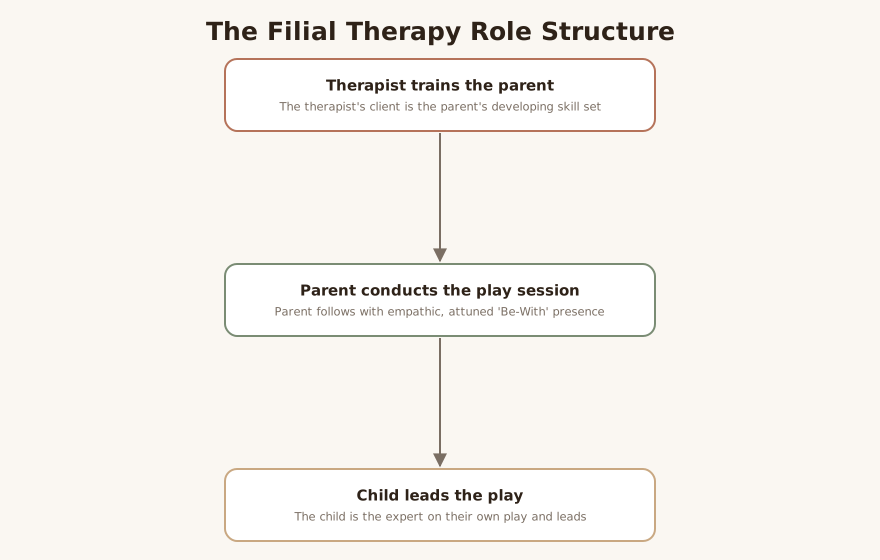
Filial therapy is a parent-mediated approach in which the therapist does not work directly with the child as the primary change agent but instead trains, coaches, and supervises the parent to conduct child-centered play sessions with their own child LLM. Child-Parent Relationship Therapy (CPRT) is its best-known, manualized form: a structured 10-session program built directly on this filial premise 3. For clinicians who already practice play therapy or parent training, filial therapy sits at a useful intersection — it borrows the relational stance of child-centered play therapy but distributes the therapeutic relationship to the people the child goes home with LLM.
Type & Discipline
Filial therapy is a modality within play therapy, and more specifically within the child-centered, parent-mediated branch of that field LLM. It is relationship-enhancement work: the explicit aim is to strengthen the parent-child relationship rather than to remediate a symptom in isolation 5. CPRT operationalizes filial therapy as a 10-week program delivered to small groups of parents, combining didactic instruction with supervised practice of play-session skills 3. Because the parent becomes the agent of change in place of a play therapist, the model is often described as a hybrid of psychotherapy and structured parent training, grounded in child-centered and person-centered theory and consistent with child development and attachment principles 5.
Creators & Lineage
Filial therapy was developed by Bernard Guerney Jr. and Louise Guerney in the 1960s 7. Bernard Guerney’s foundational paper, “Filial Therapy: Description and Rationale,” was published in the Journal of Consulting Psychology in 1964 1. A central motivation was practical scarcity: the Guerneys recognized that too few clinicians were trained to work directly with children, and that parents — already present in the child’s daily life — could be taught to deliver the therapeutic ingredients themselves 7. In the original Guerney model, parents trained for an average of about 12 months while conducting weekly play sessions, with the clinician observing and supervising 7. Louise Guerney is regarded as a leader in the field of child-centered play therapy, and the approach is widely understood as an outgrowth of that tradition 72.
The lineage is therefore multilayered LLM. From child-centered play therapy and its parent discipline, person-centered therapy, filial therapy inherits the core conditions — empathy, acceptance, genuineness — and the conviction that the child possesses an inner drive toward growth when met with the right relational climate 5. From attachment theory it draws the goal of building security, trust, and closeness within the dyad 5. And like parent management training, it teaches parents specific, rehearsable skills and uses structured home practice — though its mechanism is relational warmth rather than contingency management LLM. Garry Landreth and Sue Bratton later condensed the Guerney approach into the time-limited CPRT protocol, making filial therapy far more transportable to typical clinical and community settings 5.
Core Principles
The first principle is role reversal: the parent, not the therapist, conducts the therapeutic play session, and the therapist’s client is effectively the parent’s developing skill set LLM. During each weekly 30-minute “special playtime,” the child leads and the parent follows — observing with keen interest, refraining from questions, suggestions, teaching, or praise, and joining the play only when invited 6. The CPRT protocol frames this vividly: for 30 minutes the parent is “dumb” and does not have the answers, because the child is the expert on their own play 6.
Second is empathic attunement, operationalized through what CPRT calls the “Be-With” attitudes — the parent’s presence and responses should convey “I am here — I hear you — I understand — I care — I delight in you” 6. The parent’s central task is to see and experience the play through the child’s eyes 6.
Third, understanding must be communicated, primarily through reflective responding: verbally describing what the child is doing, reflecting what the child says, and most importantly reflecting the feelings the child expresses through play 6.
Fourth, a small number of therapeutic limits are held firmly and stated so as to give the child responsibility for their own behavior, fostering self-control 6. In CPRT the limits are deliberately few — time, not breaking toys or damaging the play area, and not physically hurting self or parent 6. A defining cultural rule of the model is that special playtime is never used as a reward or consequence, regardless of the child’s behavior that day 6.
Interventions & Techniques
The concrete machinery of CPRT is the weekly special playtime conducted at home with a standardized kit of carefully selected toys 6. The kit is organized into categories — real-life/nurturing toys (baby doll, bottle, doctor kit, doll family, toy phones), acting-out/aggressive toys (bop bag, dart gun, rubber knife, toy soldiers), and creative/emotional-expression materials (Play-Doh, crayons, paper, scissors) — chosen so the child can express a full range of experience symbolically 6. Toys need not be new or expensive 6.
Within sessions, parents are taught a discrete sequence of skills LLM. They learn to “set the stage” by preparing the play area and minimizing interruptions, to give full attention (“toes follow nose”), to allow the child to name and define the toys to protect make-believe, to reflect content and feeling, to set limits only when needed but consistently, and to give 5-minute and 1-minute advance notices before ending 6. Across the four broad skill domains, parents learn to respond empathically to feelings, to build the child’s self-esteem, to help the child develop self-control and self-responsibility, and to set therapeutic limits 6.
The training-and-supervision layer is what makes this therapy rather than advice LLM. CPRT delivers skill instruction in the first sessions and shifts to refinement and generalization later, with parents video-recording their weekly home play sessions and bringing them for review and feedback from the therapist and the parent group 3. The small-group format (typically 5-8 parents) supplies modeling, normalization, and peer support alongside the didactic content 3.
LLM-generated illustrative example (not a guideline): During a supervised review, a father watches his recording and notices he asked, “Why did you crash the truck?” The therapist helps him convert the question into a reflection — “You wanted that truck to crash hard” — and the group practices similar reflections, illustrating how filial supervision targets the parent’s response rather than the child’s symptom LLM.
Evidence Base
Filial therapy is best described as an established, mature modality: more than five decades of study, a manualized protocol, and broad clinical use, rather than a model still proving it works at all 2. A 50-year research review reported large within-field effects — an average effect size of about d = 1.15 across studies that focused specifically on training parents, with CPRT-methodology studies showing an even larger effect (about d = 1.30) 2. The same body of work found that play therapy with full parental involvement (filial therapy) yielded greater effects than partial or no parental involvement 2.
These figures should be read with appropriate caution LLM. They come largely from within-field meta-analysis by researchers invested in the model, so independent clearinghouse appraisals offer a useful corrective LLM. The California Evidence-Based Clearinghouse for Child Welfare assigns CPRT a scientific rating of 3 — which on the CEBC’s 1-to-5 scale (where 1 is the strongest) corresponds to “Promising Research Evidence” — across attachment interventions, disruptive-behavior treatment, and parent-training programs 3. CPRT’s program record there lists roughly 10 peer-reviewed studies, predominantly randomized controlled trials 3. The federal Title IV-E Prevention Services Clearinghouse likewise rates CPRT “Promising,” having identified 32 studies, deemed 18 eligible, and found favorable effects on child behavioral-emotional functioning and on parental well-being, parenting practices, and family functioning 4. The honest summary, then, is convergence: large effects within the field, “Promising” (not yet “Well-Supported”) from two independent reviewers LLM.
Populations & Indications
CPRT is designed for parents of young children, with target ages commonly given as 2-10 (CEBC specifies 3-8; the federal clearinghouse uses 2-10) 34. It is indicated for children experiencing behavioral, emotional, social, or attachment disorders, and the model has been studied across a notably diverse range of families — single parents, incarcerated fathers, immigrant families, adoptive families, and survivors of abuse 3. This breadth makes it a reasonable consideration for foster and adoptive families and other caregiver-child dyads where relationship repair is a goal LLM.
Because the parent is the change agent, indications hinge as much on the caregiver as on the child LLM. Good candidates are parents who can attend a multi-week group, tolerate watching their own recordings, and adopt a following, non-directive stance for 30 minutes a week LLM. The model fits especially well when the presenting problem is relational — when symptoms are entangled with the parent-child interaction rather than driven by an acute, dyad-external cause LLM.
Problems-for-Work
- Oppositional and conduct problems. CPRT is rated for disruptive-behavior treatment, and parents commonly report reductions in child behavior problems 3. In practice, the limit-setting skill gives parents a calm, consistent way to hold boundaries that often generalizes beyond playtime LLM.
- Attachment difficulties. The model is explicitly an attachment intervention aimed at building security, trust, and closeness in the dyad 35. It is frequently used when foster or adoptive placements need relationship-building before behavioral gains are realistic LLM.
- Parent-child relational problem. This is arguably the home indication: the overall aim is to strengthen the relationship through warmer interactions and increased familial affection and trust 5.
- Childhood anxiety, separation anxiety, and adjustment difficulties. The accepting, child-led playtime gives anxious or recently-stressed children a predictable space to express and master feelings, with the parent reflecting rather than reassuring or fixing 6.
- Emotional dysregulation and trauma exposure. Studies include abuse survivors, and the reflective stance plus a kit that allows aggressive and nurturing expression gives dysregulated or trauma-exposed children a symbolic outlet 36.
- Parenting stress. Reduced parental stress and improved parent well-being are among the most consistently reported outcomes 34.
Contraindications, Cautions & Cultural Humility
The provided clearinghouse records do not list formal contraindications 3. Clinically, several cautions follow from the model’s design LLM. Filial therapy assumes a caregiver who is safe, available, and able to learn a non-directive stance; where there is active maltreatment, unmanaged caregiver psychopathology or substance use, or a child whose acute risk requires direct clinical contact, parent-mediated work may be premature or inappropriate without other treatment in place LLM. The required 30-minute weekly home session and group attendance also impose real demands of time and consistency that some families cannot meet 3. The model’s hard rule — never use special playtime as a reward or punishment — can run against a parent’s existing discipline philosophy and may need direct discussion rather than assumption 6.
On cultural humility: although CPRT has been studied with immigrant, single-parent, and incarcerated-parent families 3, the non-directive, child-led, “follow the child” stance reflects particular cultural assumptions about parenting and authority that are not universal LLM. Clinicians should frame the playtime as a bounded 30-minute practice rather than a wholesale prescription for how to parent, and invite families to make sense of it within their own values LLM.
Treatment-Plan Suggestions & SMART Objectives
| Goal | SMART objective (example) | Mechanism |
|---|---|---|
| Strengthen the parent-child relationship | Parent completes a 30-minute child-led special playtime weekly for 8 of 10 program weeks | Relationship enhancement via consistent, attuned dyadic contact 5 |
| Increase parental empathy/attunement | Parent delivers >=3 feeling-reflections per recorded session by week 6, per supervision review | “Be-With” attitudes and reflective responding 6 |
| Reduce child disruptive behavior | Caregiver-reported behavior-problem score decreases by program end | Self-control fostered through child-led play and responsibility-giving limits 3 |
| Improve consistent limit-setting | Parent applies the CPRT limit sequence to >=1 limit per session without losing the playtime structure | Few, firm limits stated to give the child responsibility 6 |
| Reduce parenting stress | Parent self-reports lower parenting-stress rating by week 10 | Group support, skill mastery, and improved interactions 34 |
| Build child self-esteem/regulation | Parent uses esteem-building/encouraging responses (vs. praise) in recorded sessions by week 7 | Acceptance and self-responsibility-supporting responses 6 |
| Support attachment security | Dyad sustains weekly playtime and parent reports increased felt closeness over the program | Predictable, accepting relational climate 5 |
Common Misconceptions
A frequent misreading is that filial therapy is “just teaching parents to play with their kids” LLM. In fact the playtime is highly structured, non-directive, governed by specific skills and a firm rule set, and never used as a reward or consequence — it is therapeutic technique, not casual play 6. A second misconception is that the therapist offloads the case onto the parent; instead the therapist’s work intensifies into training and weekly video-supervision of the parent’s emerging skill 3. Third, clinicians sometimes assume the goal is symptom reduction in the child, when the model’s stated aim is relationship enhancement, with behavioral change following from a stronger, more accepting dyad 5. Finally, the large within-field effect sizes are sometimes cited as if filial therapy were the unambiguously best play therapy; the more defensible reading pairs those effects with the “Promising” independent ratings 234.
Training & Certification
CPRT is a manualized, 10-session protocol with published therapist and parent materials, and fidelity rests on following that structure: weekly 2-hour group sessions, didactic skill instruction front-loaded then refined, and parents’ video-recorded home play sessions reviewed in supervision 35. The treatment manual and model text by Landreth and Bratton provide the session-by-session objectives, skills, and supervision format, including transcripts of actual sessions 5. Beyond the manual, clinicians typically pursue filial/CPRT training and play-therapy credentialing through recognized play-therapy professional bodies and the model’s developers; specific certification pathways and providers should be verified directly rather than assumed LLM. Because the original Guerney model involved extended (roughly year-long) training of parents, clinicians should be clear about which model they are delivering — the time-limited CPRT protocol or a longer filial format 7.
Key Terms
- Filial therapy — parent-mediated play therapy in which the therapist trains and supervises parents to conduct therapeutic play sessions with their own children 7.
- CPRT — Child-Parent Relationship Therapy, the manualized 10-session filial therapy model 3.
- Special playtime — the structured, child-led 30-minute weekly play session that is the core intervention 6.
- “Be-With” attitudes — the parent’s intended message: “I am here — I hear you — I understand — I care — I delight in you” 6.
- Reflective responding — verbally describing and reflecting the child’s play, words, and especially feelings 6.
- Therapeutic limits — the few firm limits stated to give the child responsibility and foster self-control 6.
Resources & Further Reading
▶ Watch — a video introduction to this concept:
- Guerney, B., Jr. (1964). Filial therapy: Description and rationale (PubMed)
- Cornett, N., & Bratton, S. C. (2015). A golden intervention: 50 years of research on filial therapy
- Landreth & Bratton — Child-Parent Relationship Therapy (CPRT): An Evidence-Based 10-Session Filial Therapy Model (Routledge)
- Child-Parent Relationship Therapy — California Evidence-Based Clearinghouse for Child Welfare (CEBC)
- Child-Parent Relationship Therapy — Title IV-E Prevention Services Clearinghouse (HHS/ACF)
- Excerpts from CPRT Ages 3-10, Therapist Protocol (Association for Play Therapy, PDF)
- Bernard and Louise Guerney: Who they are and their contribution (GoodTherapy)
Reflective / Supervision Questions
- When this child’s parent is the change agent, where do I locate my own therapeutic responsibility — and how do I supervise without taking the case back? LLM
- Is the caregiver safe, available, and able to adopt a following, non-directive stance? If not, what needs to be in place before filial work is appropriate? LLM
- How do the model’s assumptions about parenting, authority, and play fit this family’s culture and values, and how will I invite them to make it their own? LLM
- Am I representing the evidence honestly — naming both the large within-field effects and the “Promising” independent ratings — when I recommend this to a family or team? LLM
- What in the parent’s own history surfaces when they watch their recordings, and how do I hold that in supervision? LLM