
Type & Discipline
Adlerian Play Therapy (AdPT) is a directive-integrative play therapy modality situated within the broader discipline of play therapy 2. Its theoretical home is Alfred Adler’s Individual Psychology (Adlerian), which AdPT translates into developmentally appropriate work with children through the medium of play 2. As a clinical method, it sits between the nondirective end of the play-therapy spectrum (child-centered play therapy) and explicitly structured approaches, drawing on both relational attunement and therapist-guided activity LLM. The intervention is manualized around a defined four-phase sequence, which distinguishes it from open-ended relationship play therapy and makes it possible to study and replicate 2. In contemporary practice it is most often delivered as an individual modality with children, frequently augmented by parent and teacher consultation consistent with Adler’s emphasis on the child’s social field LLM.
Creators & Lineage
AdPT was developed by Terry Kottman, who synthesized Adlerian theory with the play-therapy tradition and articulated the model in her foundational text Partners in Play: An Adlerian Approach to Play Therapy 3. The lineage runs directly from Alfred Adler’s Individual Psychology (Adlerian), which frames behavior as goal-directed, socially embedded, and organized around a person’s “lifestyle” — their characteristic pattern of beliefs about self, others, and the world 2. Kottman’s contribution was to operationalize these constructs for children who communicate through play rather than verbal insight, and to structure the work into discrete, teachable phases 3. The model has been carried forward and tested empirically by collaborators including Kristin Meany-Walen and Sue Bratton, whose controlled research forms much of the modality’s evidence base 1. AdPT shares ancestry and clinical sensibility with child-centered play therapy and filial therapy, and Kottman has continued to teach and elaborate the approach through training and professional dialogue 6.
Core Principles
At the heart of AdPT is the Adlerian premise that all behavior is purposive and that children, like adults, strive toward belonging and significance LLM. When a child cannot find belonging through useful means, they pursue it through mistaken goals — patterns the clinician learns to recognize and reframe LLM. AdPT organizes assessment around the child’s lifestyle: the early-formed convictions that drive how the child interprets situations and chooses responses 2. A central aim is to identify the child’s mistaken beliefs and help the child move toward more accurate, self-enhancing convictions and choices 2.
The approach is fundamentally encouraging rather than corrective. Adlerian clinicians distinguish encouragement (which builds the child’s sense of capability and contribution) from praise (which ties worth to performance), and they work to help children recognize personal assets 2 LLM. Many Adlerian play therapists frame the child’s underlying needs through the “Crucial Cs” — connection, capability, courage, and counting (mattering) — and through the four goals of misbehavior (attention, power, revenge, and assumed inadequacy) LLM. The therapeutic relationship is explicitly egalitarian: the therapist is a partner, not an authority dispensing fixes, which is reflected in the model’s first phase 2.
Interventions & Techniques
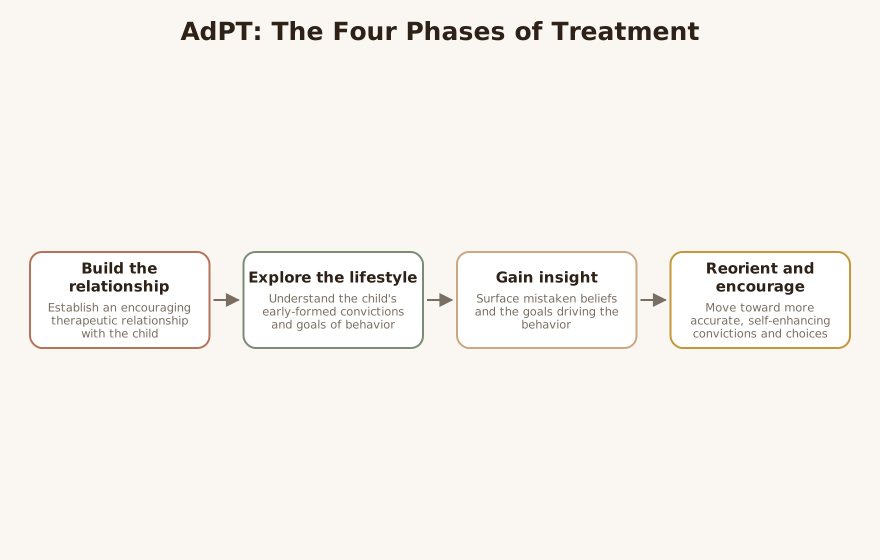
AdPT proceeds through four phases, each with characteristic tasks and techniques 2.
Phase I — Building an egalitarian relationship. The therapist establishes trust and partnership using reflective skills and metacommunication, returning responsibility to the child and tracking play themes 2. This typically spans the early sessions 2.
Phase II — Exploring the child’s lifestyle. The clinician assesses the child’s functioning through observation, play, questioning, art, storytelling, and sand tray work, building a picture of the child’s convictions and goals 2. Information from parents and teachers about the child’s social field complements direct observation LLM.
Phase III — Gaining insight. Using therapeutic metaphors, art, and bibliotherapy, the therapist helps the child develop awareness of their own behavioral patterns and the goals those patterns serve 2. With children, “insight” is often nonverbal and metaphorical rather than declarative LLM.
Phase IV — Reorientation and re-education. The therapist teaches new skills and strategies and supports the child in making more constructive, self-enhancing choices 2. Practice, encouragement, and generalization to home and school are emphasized here LLM.
Common techniques across phases include tracking and reflecting feelings, metacommunication about play, mutual storytelling, art directives, and sand tray, all selected to match the phase and the child’s developmental level 2.
Evidence Base
The honest summary: AdPT is an established, manualized modality with a promising but still-emerging controlled-trial base LLM. The California Evidence-Based Clearinghouse for Child Welfare assigns AdPT a scientific rating of 3 on a 1-5 scale (“Promising Research Evidence”) with a Medium child-welfare system relevance level 2. That rating reflects supportive controlled research that has not yet reached the volume or independent replication required for the highest evidence tiers LLM.
The flagship trial is a randomized controlled study of 58 elementary students with disruptive classroom behavior; using teachers and raters blinded to group assignment, children receiving AdPT showed statistically significant reductions in behavior problems with moderate-to-large treatment effects, alongside reduced teacher-reported stress in the teacher-child relationship 1. The dissertation work behind this line of research used a comparable randomized design (58 kindergarten-through-third-grade students, 16 twice-weekly 30-minute sessions, an active reading-mentoring control) and reported moderate-to-large effects across measures, with 72% of AdPT participants moving from clinical or borderline to more normative functioning 5.
The principal limitation is concentration: much of the strongest evidence comes from a single research group (Meany-Walen, Bratton, and Kottman), so independent replication remains thin LLM. A 2026 systematic review by independent authors examined cognitive-behavioral and Adlerian play therapies for children aged 3-12 across studies published 2003-2023, concluding that these play therapies effectively address externalizing and internalizing behavior problems and can support cognitive functions, though effects on executive function and memory varied 4. That review’s inclusion of a risk-of-bias appraisal lends credibility while underscoring that the field is still maturing 4.
Populations & Indications
AdPT is designed for young and school-age children. CEBC specifies a target range of roughly ages 3-10, while the broader literature reviewed in 2026 extends consideration to children aged 3-12 2 4. Indicated presentations include disruptive behaviors, aggression, anxiety, depression, trauma symptoms, and co-occurring internalizing and externalizing problems that impede healthy development 2. Because the model situates the child within a social field, families with young children are natural collaborators, and parent and teacher consultation is commonly integrated 2 LLM. The empirical work has been conducted in school settings with behaviorally referred children, supporting its use in school-based and community mental health contexts 1 5. The studied samples have been ethnically diverse, including substantial Latino, European American, and African American representation, which modestly supports applicability across these groups 5.
Problems-for-Work
LLM-generated illustrative example (not a guideline): A first-grader sent repeatedly to the principal for defiance is conceptualized in AdPT as pursuing the mistaken goal of power; the therapist uses Phase II play observation and teacher input to confirm the pattern, then shifts in Phase IV toward giving the child legitimate avenues for capability and choice rather than escalating control battles LLM.
AdPT is well-matched to disruptive behavior disorders and oppositional defiant disorder, where the strongest controlled outcomes exist 1 5. It is also applied to anxiety in children, low self-esteem and discouragement, adjustment difficulties, social skills deficits, and behavioral and emotional regulation problems, consistent with CEBC’s described target population of internalizing and externalizing concerns 2. The Adlerian lens reframes “discouragement” as a clinical target in its own right: a discouraged child who has stopped striving usefully is understood through assumed inadequacy, and the encouragement process directly addresses it LLM.
LLM-generated illustrative example (not a guideline): A withdrawn third-grader who says “I’m just dumb” is conceptualized as discouraged and operating from assumed inadequacy; the clinician uses Phase III bibliotherapy and metaphor to externalize the belief, then Phase IV experiences of mastery and encouragement to rebuild a sense of capability LLM.
Contraindications, Cautions & Cultural Humility
AdPT has no formally established absolute contraindications in the provided evidence, but several cautions follow from clinical reasoning LLM. Acute safety concerns — active abuse, severe untreated trauma activation, or crisis-level dysregulation — generally require stabilization and safety planning before insight-oriented play work; AdPT is not a substitute for trauma-specific or crisis intervention when those are indicated LLM. For children with significant cognitive or developmental differences, metaphor- and insight-oriented phases may need substantial adaptation or may be a poor fit LLM.
Cultural humility is essential because the Adlerian constructs of “belonging,” “significance,” and acceptable striving are culturally shaped; what one family reads as healthy assertiveness another reads as disrespect LLM. The model’s strong reliance on parent and teacher collaboration also assumes a degree of caregiver availability and school partnership that not all families have LLM. Encouragingly, the controlled research was conducted with ethnically diverse, predominantly Latino and Black samples, which supports — but does not by itself guarantee — cross-cultural applicability; clinicians should still calibrate goals and language to the family’s values 5 LLM.
Treatment-Plan Suggestions & SMART Objectives
| Goal | SMART objective (example) | Mechanism |
|---|---|---|
| Reduce disruptive classroom behavior | Within 16 twice-weekly sessions, decrease teacher-rated disruptive incidents by 50% from baseline | Reorientation away from mistaken goals toward useful belonging 1 2 |
| Improve emotion regulation | Over 12 weeks, child demonstrates 2 self-soothing strategies in session without prompting in 3 consecutive sessions | Phase IV skill teaching and rehearsal 2 |
| Increase sense of capability (reduce discouragement) | Within 8 weeks, child initiates 1 mastery-oriented play task per session in 4 of 5 sessions | Encouragement process building “capability” 2 LLM |
| Strengthen the teacher-child relationship | By session 16, teacher-reported relationship stress decreases by one clinical band | Improved child behavior and reframed teacher response 1 |
| Build social skills | Over 10 sessions, child enacts cooperative turn-taking in role-play in 3 of 4 trials | Insight (Phase III) plus rehearsal (Phase IV) 2 |
| Reduce child anxiety symptoms | Within 12 weeks, caregiver-reported anxiety frequency drops by 40% from baseline | Metaphor/bibliotherapy processing and reorientation 2 LLM |
| Increase prosocial belonging behaviors | By week 8, child seeks help or connection appropriately at least 2x/week per caregiver log | Addressing mistaken goal of attention with useful alternatives LLM |
Common Misconceptions
A frequent misconception is that play therapy is unstructured “just playing”; AdPT is in fact organized around a defined four-phase protocol with distinct assessment and reorientation tasks 2. A second is that it is purely nondirective like child-centered play therapy — AdPT is integrative and includes directive techniques, particularly in the insight and reorientation phases 2 LLM. A third is that the evidence is robust and settled; in reality the controlled base is promising but modest and concentrated, warranting honest framing with families and supervisees 4 LLM. Finally, some assume Adlerian work means dispensing praise and advice — but the model deliberately distinguishes encouragement from praise and positions the therapist as an egalitarian partner rather than an expert correcting the child 2 LLM.
Training & Certification
The foundational training resource is Kottman’s Partners in Play, which lays out the theory, phases, and techniques in detail 3. CEBC identifies a designated training contact for the program, indicating that structured training is available through the model’s developers and successors 2. Practitioner-facing dialogue with Terry Kottman is also accessible through professional media that walk clinicians through the approach 6. Beyond AdPT-specific study, clinicians typically pursue play-therapy credentialing and supervised play-therapy experience through their professional bodies; AdPT competency is generally built on that base LLM. No single mandatory certification is specified in the provided sources, so clinicians should treat published manualized training plus supervised practice as the practical pathway LLM.
Key Terms
- Lifestyle — the child’s characteristic, early-formed pattern of convictions about self, others, and the world that organizes behavior 2.
- Mistaken beliefs / mistaken goals — inaccurate convictions and the unhelpful behavioral goals they drive, which AdPT aims to surface and revise 2 LLM.
- Encouragement (vs. praise) — building a child’s intrinsic sense of capability and contribution rather than tying worth to performance 2 LLM.
- Crucial Cs — connection, capability, courage, and counting (mattering): a framework for the child’s core needs LLM.
- Four goals of misbehavior — attention, power, revenge, and assumed inadequacy, used to interpret disruptive behavior LLM.
- Egalitarian relationship — the partnership stance of Phase I, with the therapist as collaborator rather than authority 2.
- Reorientation — the Phase IV process of teaching and practicing new, self-enhancing skills and choices 2.
Resources & Further Reading
▶ Watch — a video introduction to this concept:
- Effects of Adlerian Play Therapy on Reducing Students’ Disruptive Behaviors — Meany-Walen, Bratton & Kottman (2014), Journal of Counseling & Development
- Adlerian Play Therapy — California Evidence-Based Clearinghouse for Child Welfare (CEBC)
- Partners in Play: An Adlerian Approach to Play Therapy — Terry Kottman (foundational text)
- The Effectiveness of CBT and Adlerian Play Therapies in Children Aged 3-12: A Systematic Literature Review (SAGE, 2026)
- Adlerian Play Therapy: Effectiveness on Disruptive Behaviors of Early Elementary-Aged Children — Meany-Walen (UNT dissertation)
- Exploring Adlerian Play Therapy with Terry Kottman — Lessons from the Playroom (podcast/video)
Reflective / Supervision Questions
- When a child in my care acts out, can I name the likely mistaken goal (attention, power, revenge, assumed inadequacy) before I respond, and does my response feed or interrupt it? LLM
- Where do I default to praise rather than encouragement, and how might that be reinforcing performance-based worth in my young clients? LLM
- How honestly am I representing AdPT’s evidence base — promising but modest and concentrated — to families and supervisees? 4 LLM
- Am I genuinely operating from an egalitarian partnership in Phase I, or slipping into the expert-fixer role? 2 LLM
- How am I checking that Adlerian constructs of belonging and significance fit this particular family’s cultural values rather than my own? LLM
- When the family lacks caregiver or school availability, how do I adapt a model that leans heavily on the child’s social field? LLM