
Type & Discipline
Scarcity and the bandwidth tax is a psychological construct drawn from behavioral economics and cognitive science rather than a treatment modality in its own right 1. It describes what happens to attention and mental capacity when a person has less of something than they feel they need — whether that something is money, time, or social connection 5. The central claim is mechanistic and falsifiable: scarcity does not merely make life harder, it changes how the mind allocates its limited processing resources 1. For clinicians, the value of the construct is explanatory. It offers a non-pathologizing account of behavior that can otherwise look like poor motivation, impulsivity, or treatment non-adherence LLM.
The construct sits at the intersection of decision research, attention research, and the psychology of stress, and it is most useful when imported into an existing therapeutic frame rather than used as a standalone intervention LLM.
Creators & Lineage
The construct was developed by economist Sendhil Mullainathan and psychologist Eldar Shafir, with cognitive scientist Anuj Shah as a key collaborator on the foundational experimental work 1. The 2012 Science paper by Shah, Mullainathan, and Shafir, “Some Consequences of Having Too Little,” established the core experimental case, and the 2013 trade book Scarcity: Why Having Too Little Means So Much by Mullainathan and Shafir brought the framework to a general and clinical audience 12. Collaborator Jiaying Zhao contributed to the influential field and laboratory studies that followed 3.
Its intellectual lineage runs through behavioral economics (the study of how real decisions deviate from rational-actor models), cognitive load theory (the idea that working memory is a finite resource), stress-and-coping theory, and self-regulation models that treat self-control as a depletable capacity LLM. Scarcity research can be read as an attempt to unify these threads under a single organizing variable — the subjective experience of “not enough” — and to show that this variable predictably loads the mind 5.
Core Principles
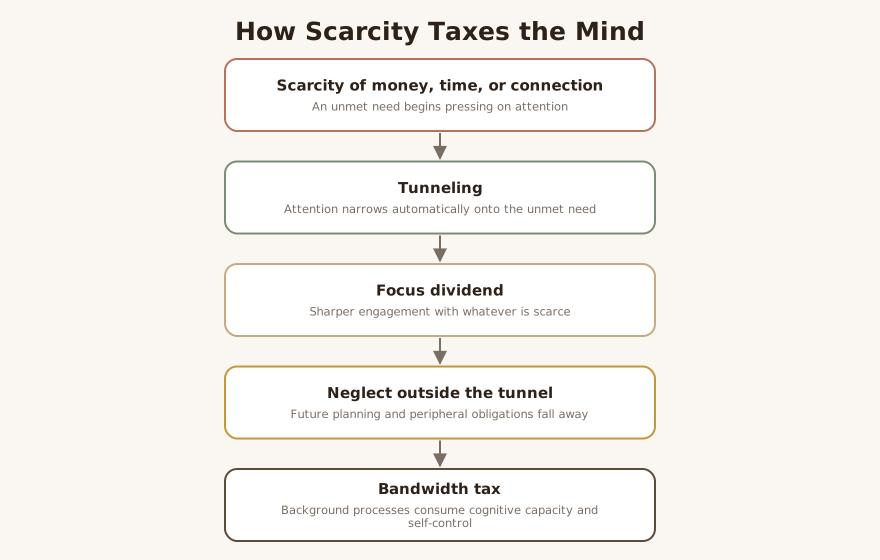
The first principle is tunneling. Scarcity captures attention automatically and focuses it on the unmet need, narrowing the field of view much as a tunnel narrows what a driver can see 1. This narrowing produces a genuine benefit the authors call the focus dividend: pressing deadlines and tight budgets can sharpen engagement with the thing that is scarce 3. The same mechanism, however, pushes everything outside the tunnel — future planning, peripheral obligations, long-term goals — into neglect 1.
The second principle is the bandwidth tax. The authors use a computer analogy: when many programs run in the background, the processor slows for every task 5. Scarcity occupies cognitive “background processes” with the unmet need, leaving less capacity for whatever the person is actually trying to do 5. This tax is not metaphorical hand-waving; it shows up on standard measures of fluid intelligence and cognitive control 3.
The third principle is that scarcity is contextual, not characterological. The same person performs differently depending on whether scarcity is currently pressing on them, which reframes the deficits as “a contextual outcome, more open to remedies” than a fixed trait 5. The fourth principle is slack — the buffer of unused resource that the resource-rich enjoy and the resource-poor lack, which is what allows small shocks to cascade into crises for those already stretched thin 2.
Interventions & Techniques
Because scarcity is a construct rather than a protocol, “techniques” here means design principles a clinician can apply within whatever modality they already practice LLM. The first is to reduce the bandwidth load directly: simplify between-session tasks, shorten and clarify paperwork, send reminders, and remove steps from any process the client must complete, on the logic that scarcity-burdened attention has little to spare 3. The second is to build slack deliberately into a client’s plan — protected time, a small financial or emotional buffer, a margin that absorbs shocks before they become emergencies 2.
A third technique is timing interventions to the scarcity cycle. Field evidence that the same individuals show large cognitive differences depending on their current resource state implies that demanding cognitive work may land better during periods of relative abundance 3. A fourth is externalizing the tunnel: helping clients see, on paper, the long-term obligations that tunneling pushes out of view, so that neglected priorities are reintroduced into the field of attention rather than left to be ambushed later 1.
LLM-generated illustrative example (not a guideline): A clinician working with a client who repeatedly misses appointments during the last week of each month — when money runs out — might, instead of framing this as ambivalence, schedule that client earlier in the month and pre-pay attention to the predictable end-of-month tunnel. LLM
Evidence Base
The evidence base is best described as emerging, and clinicians should hold it with appropriate caution LLM. The foundational finding is striking: in laboratory studies, prompting lower-income participants to contemplate a demanding financial scenario measurably reduced their performance on tests of fluid intelligence and cognitive control, while higher-income participants were unaffected by the same prompt 3. The authors estimated the effect as comparable to losing roughly 13–14 IQ points, an impairment they describe as larger than the cognitive cost of a night’s lost sleep 5. Field work added external validity: Indian sugarcane farmers tested before harvest, when money was tight, scored meaningfully lower than the same farmers tested after harvest, when they were relatively flush, with education and other factors controlled 3.
The same-person, before-and-after design is the strongest feature of the evidence, because it isolates the effect of the resource state from stable individual differences 3. However, honesty about maturity requires noting the replication picture. In a published self-replication exercise, the authors were unable to reproduce the first experiment from the 2012 paper, even as they retested the broader set of findings with larger samples 6. This is exactly the kind of mixed result that should temper confident causal claims about effect magnitude 6. The construct’s core logic remains well-motivated and clinically useful, but specific effect sizes — especially the headline IQ-point figure — should be cited as suggestive rather than settled LLM.
Populations & Indications
The construct is most directly relevant to people living in poverty and to financially stressed adults, the populations in which it was first demonstrated 3. It extends naturally to people experiencing food insecurity, where the scarce resource is calories and basic provision, and to time-pressured caregivers, where the scarce resource is hours 1. Scarcity of social connection — loneliness and isolation — is treated in the framework as another form of scarcity capable of capturing attention and taxing bandwidth, making socially isolated individuals a relevant population 5.
More broadly, anyone under chronic stress, where some valued resource is persistently insufficient, may show the tunneling-and-tax pattern 5. In clinical terms, the construct is indicated less as a diagnosis than as a lens for understanding why executive function, planning, and follow-through falter in clients whose life circumstances are squeezing them, and for choosing interventions that work with, rather than against, a depleted attentional system LLM.
Problems-for-Work
Scarcity maps onto several recognizable clinical problems-for-work. Impaired executive function and cognitive overload are the most direct: tunneling and the bandwidth tax describe precisely the breakdown in planning, working memory, and self-monitoring that clients report when overwhelmed 15. Attentional narrowing is the mechanism itself and can be named as a problem when a client’s focus on an immediate threat crowds out everything else 1.
Financial stress and decision-making difficulties are core targets, since the framework predicts that scarcity drives the very short-horizon choices — over-borrowing, neglecting maintenance — that deepen the trap 12. Poor self-control fits the self-regulation lineage: when bandwidth is taxed, the capacity to inhibit impulses thins 5. Chronic stress, anxiety, and burnout describe the affective and exhaustion correlates of living persistently inside a tunnel 5.
LLM-generated illustrative example (not a guideline): A client in burnout who cannot follow through on a self-care plan might be understood not as resistant but as bandwidth-taxed; the work shifts toward subtracting demands so that some processing capacity is freed before new behaviors are asked of them. LLM
Contraindications, Cautions & Cultural Humility
The construct carries real risks if misapplied. The most important is avoiding a deficit narrative: although the research documents reduced cognitive performance under scarcity, the explicit point is that this is contextual and remediable, not evidence of inherent inferiority 5. Clinicians must take care not to convert a framework intended to de-stigmatize poverty into a tool that pathologizes poor clients LLM. The finding that scarcity is a state, not a trait, should be foregrounded with clients, not buried 5.
A second caution is not weaponizing it as individual responsibility. The original work points toward structural and design remedies — simpler systems, more slack, better-timed support — as much as personal ones, and a clinician who reframes systemic deprivation as a personal bandwidth problem inverts the message 2. Cultural humility requires recognizing that what counts as scarcity, what resources are valued, and what slack is available are all shaped by community, structural inequity, and lived context that the clinician may not share LLM. Finally, the evidence is emerging and partly contested, so the construct should be offered as an organizing lens, not as established neuroscience certain to apply to any given client 6.
Treatment-Plan Suggestions & SMART Objectives
| Goal | SMART objective (example) | Mechanism |
|---|---|---|
| Reduce bandwidth load from logistics | Within 4 weeks, client will consolidate recurring obligations into one weekly planning page, reviewed each session | Externalizes the tunnel; frees working memory 5 |
| Build financial slack | Within 8 weeks, client will establish a small automatic buffer (e.g., a set-aside) and report its status biweekly | Creates slack that absorbs shocks before crisis 2 |
| Reduce end-of-resource crises | Over 6 weeks, client will identify the two predictable monthly pinch points and pre-plan one coping step for each | Counters neglect-of-future driven by tunneling 1 |
| Improve appointment follow-through | Within 30 days, sessions and tasks will be scheduled during the client’s lower-scarcity window, with adherence tracked | Times demands to the scarcity cycle 3 |
| Decrease attentional narrowing | Weekly, client will complete a brief “outside the tunnel” review naming one neglected long-term priority | Reintroduces peripheral goals to attention 1 |
| Lower chronic stress load | Over 8 weeks, client will subtract two low-value demands and report perceived bandwidth on a 0–10 scale | Reduces background cognitive load 5 |
| Strengthen self-control supports | Within 4 weeks, client will pre-commit one high-temptation decision via an environmental change rather than willpower | Compensates for taxed self-regulation 5 |
Common Misconceptions
A frequent misconception is that scarcity research says poor people are less intelligent LLM. The actual claim is the opposite: the same person performs worse while under scarcity and recovers when the pressure lifts, which locates the deficit in the situation, not the individual 5. A second misconception is that tunneling is purely harmful; in fact the focus dividend means scarcity can improve performance on the scarce dimension, which is part of why the trap is seductive 3.
A third is that scarcity is only about money — the framework deliberately spans time, food, and social connection, defining scarcity as the subjective experience of having less than one feels one needs 5. A fourth is treating the headline numbers, such as the 13–14 IQ-point estimate, as firmly established; the partial failure of the authors’ own self-replication should keep clinicians from overstating effect magnitudes 6. A fifth is mistaking the construct for a therapy modality; it is an explanatory lens to be embedded in established treatment, not a protocol with its own sessions LLM.
Training & Certification
There is no certification, credential, or formal training pathway for scarcity and the bandwidth tax, because it is a research construct rather than a clinical modality LLM. The primary route to competence is reading the source literature: the 2012 Science paper for the experimental case and the 2013 book for the fuller framework and its policy implications 12. Accessible secondary summaries from the American Psychological Association and from Harvard’s quantitative social science institute orient clinicians to the cognitive findings without requiring a background in economics 34.
Because no governing body credentials its use, the clinician’s responsibility is to apply the construct within a modality they are already trained and licensed to deliver, and to stay current with the evolving and partly contested evidence rather than treating the framework as fixed 6.
Key Terms
Scarcity — the subjective experience of having less of a resource than one feels one needs, whether money, time, or connection 5. Tunneling — the automatic narrowing of attention onto the scarce resource, at the cost of attending to anything outside the “tunnel” 1. Focus dividend — the genuine performance benefit that comes from scarcity’s intense focus on the pressing need 3. Bandwidth tax — the reduction in available cognitive capacity (working memory, fluid intelligence, self-control) caused by scarcity occupying mental background processes 5. Slack — the buffer of unused resource that lets the resource-rich absorb shocks and that the resource-poor lack 2. Scarcity trap — the self-perpetuating cycle in which scarcity drives short-horizon decisions that deepen the scarcity 2.
Resources & Further Reading
▶ Watch — a video introduction to this concept:
- Shah, Mullainathan & Shafir (2012), “Some Consequences of Having Too Little,” Science
- Mullainathan & Shafir, Scarcity: Why Having Too Little Means So Much (2013)
- The psychology of scarcity — APA, Monitor on Psychology (2014)
- Mullainathan and Shafir Explore the Cognitive Effects of Scarcity — Harvard IQSS
- Scarcity excerpt: “Why Having Too Little Means So Much” — Behavioral Scientist
- An exercise in self-replication: Replicating Shah, Mullainathan, and Shafir (2012)
Reflective / Supervision Questions
- When a client misses appointments or fails to complete between-session tasks, how often do I attribute this to motivation or ambivalence when bandwidth scarcity might be the better explanation? LLM
- Am I designing my own paperwork, reminders, and between-session demands in a way that adds to, or subtracts from, a client’s cognitive load? LLM
- How do I talk about a client’s apparent lapses in self-control — in language that locates the difficulty in their context, or in their character? 5
- Where in this client’s month, year, or life cycle does scarcity press hardest, and am I timing my most demanding interventions accordingly? 3
- Given that the construct’s evidence is emerging and partly contested, how am I holding it — as a useful lens or as established fact — and does my language with clients and supervisees reflect that humility? 6
- For clients facing structural deprivation, am I working to build slack and reduce load, or inadvertently reframing systemic problems as personal failings? 2