
Type & Discipline
Clinical Pastoral Education (CPE) is a structured, experiential, supervised training framework rather than a discrete psychotherapy or clinical intervention 6. It sits within the discipline of pastoral education and chaplaincy, and its purpose is the professional formation of spiritual caregivers who work at the bedside 1. CPE is defined as experience-based theological education that promotes the integration of personal history, faith tradition, and the behavioral sciences in the practice of spiritual care 6. For practicing therapists, the most useful framing is that CPE is the standard pipeline that produces the chaplains you collaborate with, and a coherent model of reflective, relationship-centered caregiving whose stance overlaps substantially with person-centered psychotherapy LLM.
It belongs to a family of supervised experiential ministry training, distinguished by its insistence that learning happens through direct patient contact that is then dissected in supervision rather than through classroom instruction alone 1. The framework is delivered in “units,” each combining clinical practice with structured group reflection under a certified educator 1. Because CPE is an educational and formational process, the language of “treatment” maps onto it only by analogy, and that distinction matters when therapists borrow its tools LLM.
Creators & Lineage
The clinical pastoral movement emerged in the early twentieth century from the convergence of medicine, psychiatry, and ministry 4. In 1925 the physician Richard Cabot published an article proposing that every candidate for ministry receive clinical training for pastoral work analogous to the clinical training given to medical students 6. The Reverend Anton Boisen then pioneered supervised clinical placements for theology students in mental hospitals during the late 1920s and 1930s, work that grew into the Council for Clinical Training and ultimately the Association for Clinical Pastoral Education (ACPE) 6. Boisen is widely regarded as the founding figure of the field 5.
The early leaders of the movement, named together as Anton Boisen, Elwood Worcester, Helen Flanders Dunbar, and Richard Cabot, were unusually gifted figures whose lives and work intersected in the opening decades of the twentieth century 4. Their enduring contribution lies both in the people they inspired and in the professional organizations and academic programs that grew from their pioneering work 4. Understanding the movement requires placing it within the broader American religious, psychiatric, and cultural ferment of the period, when a genuine dialogue between religion and psychiatry first became possible 4.
Boisen’s own psychiatric hospitalizations shaped his conviction that the suffering person could be read directly, an emphasis that gave the field its signature metaphor of the “living human document” 5. The lineage therapists will recognize runs from this pastoral-care and chaplaincy root through person-centered (Rogerian) counseling, into contemporary spiritually integrated psychotherapy, and alongside the broader tradition of experiential supervision and reflective practice LLM.
Core Principles
The organizing principle of CPE is the “living human document”: the patient, and the caregiver’s own inner life, are texts to be read and understood rather than problems to be solved 5. Boisen advanced the idea that theological and human insight should be drawn from the direct study of living persons in distress rather than from books alone 5. This reorientation toward the person in front of you, attended to closely and without premature interpretation, is the conceptual bridge between CPE and humanistic psychotherapy LLM.
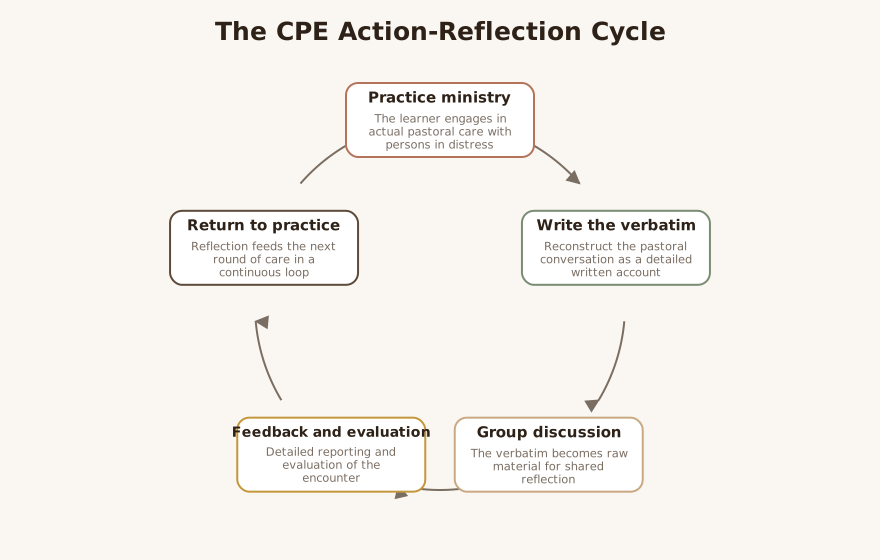
The second core principle is action-reflection learning 6. Students engage in the actual practice of ministry to persons, then submit that practice to detailed reporting and evaluation, so that experience and reflection feed one another in a continuous loop 1. Concretely, learners present their encounters as “verbatims,” reconstructed accounts of pastoral conversations, which become the raw material for group discussion and feedback 1. This action-reflection cycle is also documented in the broader literature as the defining educational mode of CPE 6.
A third principle is the integration of three domains: personal history, faith tradition, and the behavioral sciences 6. CPE explicitly asks trainees to examine how their own biography shapes their caregiving, connecting theological and behavioral-science perspectives to lived practice 1. Through this process students are expected to develop new self-awareness alongside skills in interpersonal and interprofessional relationships 1. The use of self as the primary instrument of care, refined through reflective scrutiny, is the principle therapists will find most immediately portable LLM.
Interventions & Techniques
CPE is not built around discrete clinical techniques in the way a manualized therapy is, but it does train recognizable skills LLM. Chief among them is the verbatim: a written reconstruction of a care encounter, presented to the peer group and educator for discussion and feedback 1. The verbatim functions as a self-supervision and case-formulation tool, surfacing what the caregiver felt, avoided, or imposed during the conversation LLM.
Trainees also learn skills in attentive engagement: listening and attending to patients more effectively and interpreting both verbal and nonverbal communication 3. The daily structure typically interleaves clinical seminars, didactic sessions, peer group meetings, and opportunities for worship 1. Within the group, peer feedback is facilitated by the educator, who challenges trainees to grow while holding supportive parameters around the process 1.
LLM-generated illustrative example (not a guideline): A chaplain intern sits with a dying patient who says, “God is punishing me.” In the verbatim, the intern records that they immediately reassured the patient that God does not punish, then notices in group that the reassurance shut the conversation down. The educator helps them see they were managing their own discomfort. The reworked stance is to stay with the patient’s image and ask, “What does it feel like to carry that?” LLM.
For therapists, the transferable techniques are the verbatim-as-self-supervision habit, disciplined non-anxious presence, and the practice of attending to spiritual and existential material as legitimate clinical content rather than steering away from it LLM.
Evidence Base
CPE’s evidence base is best described as institutionally established rather than empirically validated as a clinical treatment, and being honest about this distinction matters for a clinical audience LLM. CPE is “established” in the sense that it is the primary, accredited training method for hospital, hospice, and spiritual care chaplains across the United States, Canada, Australia, and New Zealand, with decades of continuous practice behind it 6. ACPE accredits more than 300 CPE programs across hospitals, prisons, churches, and seminaries, functioning as the field’s principal quality-assurance mechanism 2.
What “established” does not mean is that the spiritual care produced by CPE has a deep randomized-controlled-trial outcome literature comparable to first-line psychotherapies LLM. The accreditation framework attests to educational quality, consistency, and accountability among programs, not to measured patient outcomes 2. Therapists should therefore treat CPE as a mature, credentialed formation pathway whose face validity and professional standing are high, while recognizing that the empirical efficacy literature for the chaplaincy care it yields is comparatively thin LLM. Conflating “this is an established, accredited training” with “this is an evidence-based treatment” is the error to avoid LLM.
Populations & Indications
CPE trains a defined population of learners: theological students and ministers of all faiths, including pastors, priests, rabbis, imams, and others, typically with at least a year of theological education though requirements vary by center 1. Increasingly the programs also serve clergy seeking skill enhancement, first responders, nurses, social workers, physicians, and hospital volunteers, essentially anyone providing emotional and spiritual support to patients 3.
The patient populations these trainees serve, and the populations relevant to a therapist drawing on CPE principles, include hospital and hospice patients, those facing serious illness or end of life, bereaved families, and healthcare staff carrying the cumulative weight of their work 1. CPE placements occur in health-care institutions, hospitals, geriatric centers, hospices, parishes, mental health facilities, and correctional institutions 1. For the therapist, the indication is not “refer for CPE” but rather “this is the population and the kind of distress where the CPE stance, attending to meaning, faith, and finitude, is clinically apt,” especially with patients in spiritual or existential distress LLM.
Problems-for-Work
The problems that CPE-informed care addresses are largely existential and meaning-related, and they map onto problems therapists treat under supportive and spiritually integrated approaches LLM. Spiritual and existential distress is the central one: patients confronting illness, mortality, or loss often present questions of meaning that standard symptom-focused work can sidestep LLM. Grief and bereavement, and coping with serious illness and dying, are core areas where the CPE habit of staying present without rushing to fix is directly useful 1.
Demoralization and loss of meaning, and religious and spiritual struggles, are problems where the “living human document” stance, reading the person’s own framework rather than imposing one, prevents the common error of premature reassurance 5. Moral injury and caregiver burnout, particularly among the healthcare staff CPE also serves, are increasingly recognized as targets for reflective, meaning-oriented support 1. Crisis and acute distress round out the list, given the bedside and emergency settings in which CPE is practiced 1.
LLM-generated illustrative example (not a guideline): A therapist sees a hospice nurse with insomnia and irritability after a string of patient deaths. Rather than treating this purely as a sleep or mood problem, the clinician names the possible moral injury and meaning erosion, and uses a CPE-style reflective inquiry into specific deaths that “stuck,” opening grief that the nurse had been carrying without language LLM.
Contraindications, Cautions & Cultural Humility
The first caution is categorical: CPE is a training framework, not a psychotherapy, and a therapist should never present “doing CPE work” as a treatment or imply it carries the evidence weight of an established therapy LLM. CPE itself has no clinical contraindications in the pharmacologic sense, but its principles can be misapplied; spiritual exploration is contraindicated as a focus when a patient is acutely unsafe, floridly psychotic, or when meaning-talk would defer needed symptom stabilization LLM.
Cultural and religious humility is intrinsic to CPE’s design, which is explicitly interfaith and serves ministers and patients of all traditions 1. The “living human document” principle is itself a humility stance: it requires reading the patient’s own faith framework rather than importing the caregiver’s 5. Therapists must hold their own beliefs in check, avoid proselytizing or pathologizing religion, and recognize that secular, atheist, and non-Western spiritual frameworks all warrant the same attentive reading LLM. The action-reflection method’s insistence on examining how the caregiver’s biography shapes the encounter is precisely the mechanism that guards against imposing one’s worldview 1.
Treatment-Plan Suggestions & SMART Objectives
The following objectives translate CPE principles into patient-facing goals delivered within standard psychotherapy; they are illustrative, not prescriptive LLM.
| Goal | SMART objective (example) | Mechanism |
|---|---|---|
| Reduce existential distress | Patient will identify and verbalize one source of meaning sustaining them through illness in 3 of 4 sessions over 6 weeks | “Living human document”: reading and validating the patient’s own meaning framework 5 |
| Process grief | Patient will narrate the story of the loss in session and report a 2-point drop on a subjective grief-intensity scale within 8 weeks | Reflective presence and non-anxious staying-with, modeled on CPE bedside practice 1 |
| Address religious/spiritual struggle | Patient will articulate the specific spiritual conflict (e.g., anger at God) without therapist reassurance in 2 consecutive sessions | Action-reflection inquiry that stays with the patient’s image rather than resolving it 6 |
| Mitigate moral injury (healthcare worker) | Patient will name one ethically distressing event and reframe their role in it during a structured debrief within 4 sessions | Verbatim-style reconstruction surfacing avoided affect and self-judgment 1 |
| Counter demoralization | Patient will set one value-aligned, achievable weekly action and complete it 3 of 4 weeks | Integration of personal history and meaning into concrete behavior 6 |
| Strengthen end-of-life coping | Patient will complete a values-and-legacy conversation and report reduced fear on a 0-10 scale within 6 weeks | Attentive engagement with finitude as legitimate clinical content 3 |
| Reduce caregiver burnout | Patient will establish one reflective practice (journaling/verbatim) and use it weekly for 6 weeks | Self-as-instrument reflection adapted from CPE supervision 1 |
Common Misconceptions
A frequent misconception is that CPE is a form of counseling or psychotherapy that chaplains practice; it is in fact an educational and formational program, and the spiritual care it trains is its product, not the program itself 6. A related error is assuming CPE is religious instruction; the model is experiential and reflective, integrating behavioral sciences and direct patient contact rather than transmitting doctrine 1.
Another misconception is that CPE is for ordained clergy only; programs increasingly admit nurses, social workers, physicians, first responders, and volunteers who provide emotional and spiritual support 3. Some assume CPE is faith-specific or even narrowly Christian, when it is explicitly interfaith and serves caregivers and patients across all traditions 1. Finally, clinicians sometimes assume an accredited training equals an evidence-based treatment; accreditation speaks to educational quality and consistency, not to measured clinical outcomes 2.
Training & Certification
CPE is delivered in units, each comprising roughly 400 total hours, with a minimum of about 250 hours of supervised clinical work and a minimum of about 100 hours of theoretical education, blending group work, individual conversation, and direct patient contact 6. Units typically run 10 to 12 weeks, with some centers offering year-long programs of three to four consecutive units; the provider standard is an equivalent balance of ministry and education hours 1. Each unit is supervised by an ACPE Certified Educator who guides learning and facilitates peer feedback 1.
Accreditation is the field’s quality-assurance backbone: ACPE describes it as a voluntary activity in which programs agree on standards of educational quality and hold themselves accountable, and it accredits over 300 programs across diverse settings 2. CPE is the primary training pathway toward professional chaplaincy and is generally required for board certification as a chaplain 6. The accreditation landscape has shifted recently, with ACPE withdrawing from U.S. Department of Education recognition in 2024 and other bodies such as Clinical Pastoral Education International gaining accreditation through separate commissions 6. For therapists, the practical takeaway is that the chaplains you co-treat with have completed structured, supervised, accredited training of this kind LLM.
Key Terms
Living human document — Boisen’s foundational metaphor that the suffering person, and the caregiver’s own inner life, should be studied and read directly as the primary source of theological and human insight 5.
Action-reflection — the defining educational mode of CPE, in which direct ministry practice is followed by detailed reporting and evaluation, so experience and reflection continuously inform each other 6.
Verbatim — a written reconstruction of a care encounter (a Pastoral Care Report), presented to peers and the educator for discussion and feedback 1.
Unit of CPE — the basic building block of training, roughly 400 hours combining supervised clinical work and theoretical education 6.
ACPE Certified Educator — the credentialed supervisor who oversees a CPE program, guides learning, and facilitates peer feedback 1.
Accreditation — a voluntary quality-assurance process in which programs agree on shared standards of educational quality and hold themselves accountable 2.
Resources & Further Reading
▶ Watch — a video introduction to this concept:
- CPE Students – ACPE: The Standard for Spiritual Care and Education
- CPE Program Accreditation – ACPE
- Clinical Pastoral Education (CPE) – Spiritual Care Association
- Present at the creation: the clinical pastoral movement and the origins of the dialogue between religion and psychiatry – PubMed
- The Biography of Anton Theophilus Boisen – ACPE History (PDF)
- Clinical pastoral education – Wikipedia
Reflective / Supervision Questions
- When a patient raises spiritual or existential material, do I attend to it as legitimate clinical content, or do I steer back to symptoms because the territory is uncomfortable? LLM
- Whose meaning framework am I reading in the room, the patient’s “living human document,” or my own assumptions about faith and mortality? LLM
- Could a verbatim-style reconstruction of a difficult session surface affect I avoided or reassurance I offered to soothe myself rather than the patient? LLM
- Am I clear in my documentation and framing that I am applying CPE-derived principles within billable psychotherapy, not delivering CPE as a treatment? LLM
- How does my own biography, faith or its absence, and history of loss shape how I sit with dying, grief, and religious struggle? LLM
- When I collaborate with a chaplain, do I understand the supervised, accredited formation behind their role, and where our scopes are complementary rather than redundant? LLM