
Type & Discipline
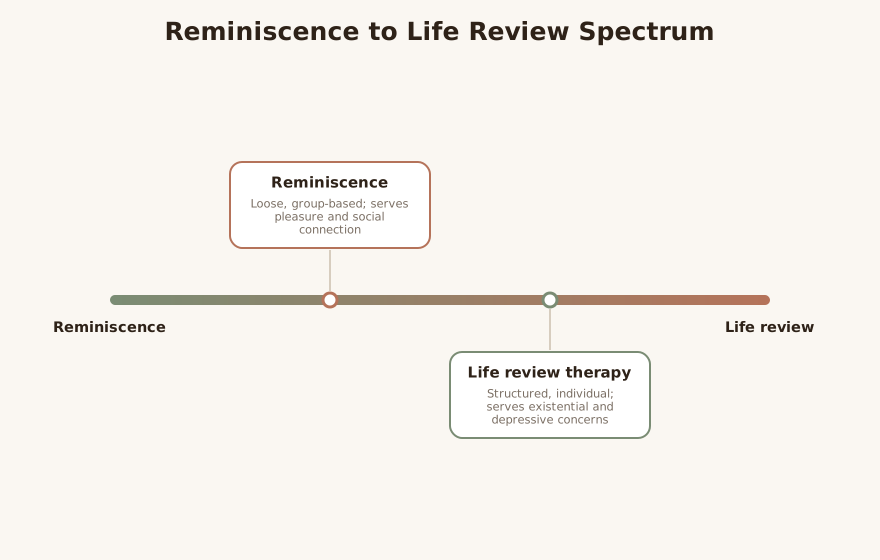
Life review and reminiscence therapy is a family of structured, recall-based interventions rooted in geriatric psychology and the broader tradition of narrative and life-span counseling LLM. The shared mechanism is the deliberate retrieval and re-evaluation of autobiographical memory, used not as nostalgic diversion but as therapeutic work toward integration, meaning, and emotional resolution 5. Clinically, the term spans a spectrum rather than a single protocol LLM.
At one end sits reminiscence therapy (RT), which is typically informal, group-oriented, and focused on pleasure, social connection, and mood elevation through the sharing of past experiences 6. At the other end sits life review therapy (LRT), a more structured and often individual approach that aims to integrate positive and negative life events into a coherent, meaningful whole, especially when a person faces serious illness or the end of life 5. The two are best understood as related interventions on a continuum of structure and existential depth rather than as wholly separate therapies LLM.
Creators & Lineage
The modern clinical use of reminiscence is usually traced to psychiatrist Robert Butler, who in 1963 reframed the older adult’s tendency to look back as a normal, universal mental process rather than a sign of cognitive decline or self-absorption 6. Butler’s reconceptualization legitimized the “life review” as a developmentally adaptive task, opening the door to deliberate therapeutic use 6.
This work built directly on Erik Erikson’s psychosocial theory, which frames later life as a final stage organized around the tension between ego integrity (a sense of acceptance, coherence, and wholeness about the life one has lived) and despair (regret, bitterness, and a feeling that time has run out) 6. Life review is, in effect, a structured method for helping a person tilt toward integrity LLM. The lineage also intersects with narrative therapy, which treats identity as a story open to re-authoring, and with meaning-centered and dignity-oriented approaches used in palliative care LLM.
Core Principles
Several principles distinguish this work from ordinary conversation about the past LLM:
- Memory as raw material for integration. The goal is not simply to recall events but to weave positive and negative experiences into a coherent narrative that the person can accept as their own 5.
- Developmental framing. Looking back is treated as a normal and adaptive task of later life, not pathology 6.
- Movement from despair toward integrity. The work explicitly targets regret, unresolved conflict, and demoralization, aiming to help the person arrive at a sense of meaning and acceptance 6.
- Function matters more than content. What the person does with a memory—savoring, problem-solving, meaning-making, transmitting wisdom—is more clinically relevant than the memory itself 6.
- Structure tracks intensity. Pleasure and social connection can be served by loose, group-based reminiscence; existential and depressive concerns generally call for more structured, individual life review 5.
Interventions & Techniques
Reminiscence is typically delivered through sensory and biographical prompts that cue autobiographical recall 5. Commonly used tools include memory boxes containing photographs, keepsakes, and meaningful objects; photographs used to elicit personal narratives; music and dance to trigger emotionally rich recall; familiar trade or hobby tools to reconnect a person to a prior occupational identity; and structured questioning that guides the person across life stages 5.
Life review therapy adds deliberate chronological structure, often walking through childhood, adolescence, work and family life, and later years, and then working to integrate the difficult chapters alongside the cherished ones into a meaningful whole 5. The framework also distinguishes among functions or types of reminiscence: simple reminiscence (pleasure-focused), instrumental (drawing on past coping to build present resilience and problem-solving), integrative (finding meaning in difficulty and reconciling regret), and transmissive (passing wisdom across generations) 6. Integrative reminiscence maps most closely onto the depression- and despair-focused work, whereas simple reminiscence supports mood and social connection LLM.
LLM-generated illustrative example (not a guideline): A clinician working with a 78-year-old widower who describes his life as “wasted” might shift from simple recollection to integrative reminiscence—asking how he got through his wife’s long illness, what he drew on, and what that says about him—so that a chapter he frames as failure can be re-read as endurance LLM.
Sessions in the evidence base commonly run roughly 30 to 120 minutes, are delivered weekly, and cluster around six to eight sessions, though some protocols extend longer 2.
Evidence Base
The maturity of this field is best described as established but methodologically heterogeneous LLM. Multiple systematic reviews and meta-analyses support efficacy, but they consistently flag high heterogeneity, small samples, and uneven study quality 32.
For late-life depression, an updated meta-analysis of life review therapy and reminiscence supports a meaningful antidepressant effect, with structured life review therapy generally outperforming simple reminiscence on depressive outcomes 1. A systematic review of 10 RCTs (527 adults aged 50+) found a significant reduction in depression (mean difference −3.75; 95% CI −4.67 to −2.83) and an improvement in life satisfaction (mean difference 7.55) 3. In that review, group reminiscence was effective for mild and moderate depression while individual reminiscence reached significance only for mild depression, and effects tended to decrease over time 3. A meta-analysis restricted to older adults without obvious cognitive impairment reported a medium-to-large effect on depression (SMD −0.61; 95% CI −0.94 to −0.28) across 12 studies and a small-to-medium effect on life satisfaction (SMD 0.40) 4.
For quality of life and life satisfaction, a meta-analysis of 32 studies (2,353 participants) found large pooled effects on both quality of life (SMD 1.07) and life satisfaction (SMD 1.12) 2. Secondary benefits reported across reviews include reduced loneliness, improved self-esteem, and lower anxiety 46.
The honest caveats are substantial LLM. Reviews report high statistical heterogeneity (often I² ≥ 50%), few large trials, frequent failure to report allocation concealment or blinding, lack of standardized protocols, short follow-up with effects that may fade, and detectable publication bias for some outcomes 324. Findings on optimal format also conflict: some reviews favor individual sessions for quality of life, others favor group formats for life satisfaction, which should temper any strong claim about the “best” delivery mode 24.
Populations & Indications
The interventions are used most with older adults, including those in long-term care and nursing homes, community settings, and day programs 52. They are applied with people living with dementia, where reminiscence shows promise particularly in mild-to-moderate impairment 62. They are widely used in palliative and hospice care and with terminally ill patients, where life review supports end-of-life adjustment and meaning 56. Other described populations include cancer patients, older veterans (including those with post-traumatic stress), and grieving or bereaved individuals, for whom life review can help address unresolved grief 56.
Problems-for-Work
This modality is most apt where the clinical picture involves looking backward—at a life, at losses, at regrets—and where coherence and meaning are at stake LLM.
- Depression in older adults. The most evidence-supported target, with structured life review especially indicated for moderate presentations 13.
- Despair vs. ego integrity. Directly targets the Eriksonian crisis of later life, helping convert regret and bitterness toward acceptance 6.
- Unresolved grief and bereavement. Life review can help integrate the loss into an ongoing life story 5.
- Regret and demoralization. Integrative reminiscence reframes “failed” chapters as endurance, coping, or meaning 6.
- Adjustment to aging and existential distress. Useful when illness or decline threatens a person’s sense of who they are 5.
- Low self-esteem and anxiety. Reported secondary improvements support adjunctive use 46.
LLM-generated illustrative example (not a guideline): For a hospice patient voicing existential distress—“none of it mattered”—a clinician might use chronological life review to surface the people she mentored and raised, helping her locate a transmissive thread of meaning rather than disputing the despair directly LLM.
Contraindications, Cautions & Cultural Humility
The reviewed sources do not specify formal contraindications, which itself warrants caution: absence of documented harms is not evidence of safety 6LLM. Reviewing a life inevitably surfaces painful material, so several clinical cautions apply LLM. Recall of trauma, abuse, or profound loss can destabilize, and in clients with PTSD histories, unstructured prompting may retraumatize rather than integrate; structured, contained pacing and a clear plan for affect regulation are prudent LLM. In advanced dementia, structured life review that demands coherent narration may exceed cognitive capacity, so simpler, sensory, pleasure-oriented reminiscence is generally the better fit 6LLM. A genuine risk also exists that life review consolidates despair rather than integrity if the clinician only elicits memories without actively supporting meaning-making LLM.
Culturally, what counts as a “good life,” what is appropriate to disclose, and how generations transmit wisdom vary widely; the evidence base itself draws heavily on a small number of countries and skews female, limiting generalizability 32. Clinicians should hold the integrity narrative loosely and let the client define meaning on their own terms LLM.
Treatment-Plan Suggestions & SMART Objectives
| Goal | SMART objective (example) | Mechanism |
|---|---|---|
| Reduce depressive symptoms | Client completes 6–8 weekly structured life review sessions and reduces GDS score by a clinically meaningful margin within 8 weeks | Integrative reminiscence and narrative coherence linked to reduced late-life depression 13 |
| Improve life satisfaction | Client identifies and reframes 3 previously “regretted” life chapters over 8 sessions, with a measurable rise on a life-satisfaction scale | Integration of positive and negative events into a meaningful whole 25 |
| Resolve regret / move toward integrity | Client articulates one coherent meaning statement about a difficult life period by session 6 | Eriksonian shift from despair toward ego integrity 6 |
| Address unresolved grief | Client narrates the relationship and loss across 4 sessions and reports reduced grief-related distress | Narrative integration of the loss into ongoing identity 5 |
| Reduce loneliness / build connection | Client attends 8 weekly group reminiscence sessions and reports increased perceived social connection | Social sharing and group reminiscence reduce loneliness 46 |
| Support end-of-life meaning | Palliative client produces a legacy artifact (recorded story or memory book) within 4 sessions | Transmissive reminiscence and dignity-oriented meaning-making 56 |
| Improve self-esteem | Client lists 5 instances of past competence/coping and rates self-worth higher by session 6 | Instrumental reminiscence recruits past coping into present self-view 6 |
Common Misconceptions
- “It is just nostalgic chatting.” Therapeutic life review is goal-directed integration work, distinct from casual reminiscing; the function the memory serves is the point 6LLM.
- “Reminiscence and life review therapy are the same thing.” They sit on a continuum: reminiscence leans social and pleasure-focused, life review leans structured and integrative 5.
- “More sessions are always better.” Some evidence suggests benefit clusters around six to eight sessions, with diminishing returns beyond that for certain outcomes 2.
- “It only suits people with dementia.” The strongest depression evidence is in older adults without obvious cognitive impairment 4.
- “The evidence is definitive.” It is established but heterogeneous, with quality limitations and fading long-term effects 32.
Training & Certification
There is no single universally required credential to practice reminiscence or life review; the reviewed literature notes that delivery has ranged from professional psychologists to nurses, with only a minority of studies using psychologists 3. This variability is double-edged: it makes the approach accessible across disciplines, but standardized, manualized protocols improve replicability and outcomes 3LLM. Clinicians are best served by working within their existing psychotherapy licensure and competencies, using structured protocols, and seeking supervision when working with trauma, complicated grief, dementia, or end-of-life populations LLM.
Key Terms
- Reminiscence therapy (RT): Informal, often group-based recall focused on pleasure, mood, and social connection 6.
- Life review therapy (LRT): Structured, often individual integration of positive and negative life events into a coherent whole 5.
- Ego integrity vs. despair: Erikson’s final psychosocial stage; the target tension of life review 6.
- Integrative reminiscence: Finding meaning in difficulty and reconciling regret 6.
- Instrumental reminiscence: Recruiting past coping to build present resilience 6.
- Transmissive reminiscence: Sharing wisdom and legacy across generations 6.
Resources & Further Reading
▶ Watch — a video introduction to this concept:
- Looking back on life: An updated meta-analysis of life review therapy and reminiscence on late-life depression
- Effectiveness on Quality of Life and Life Satisfaction: A Systematic Review and Meta-Analysis of Life Review and Reminiscence Therapy
- The Effectiveness of Reminiscence Therapy on Alleviating Depressive Symptoms in Older Adults: A Systematic Review
- Effects of reminiscence therapy on psychological outcome among older adults without obvious cognitive impairment
- Reminiscence Therapy vs. Life Review Therapy: A Quick Guide (PositivePsychology.com)
- Benefits of Reminiscence and Life Review Therapy for Older Adults (Psychology Town)
Reflective / Supervision Questions
- Am I doing integration work, or am I letting the session become unstructured reminiscing without a meaning target? LLM
- Where on the reminiscence–life review continuum does this client belong, and is my structure matched to their cognitive capacity and distress level? LLM
- When painful material surfaces, do I have a plan to contain affect and prevent the session from consolidating despair? LLM
- Whose definition of a “good life” am I implicitly imposing, and how am I letting the client define meaning on their own terms? LLM
- Given the heterogeneous evidence, how am I measuring whether this is actually helping this client rather than assuming benefit? LLM