
Type & Discipline
The Kestenberg Movement Profile (KMP) is a structured observational assessment system rather than a freestanding treatment, and it belongs primarily to the field of dance/movement therapy 7. Dance/movement therapy (DMT) is defined by the American Dance Therapy Association as the psychotherapeutic use of movement to support emotional, cognitive, physical, and social integration 5. Within DMT, the KMP functions as the field’s most elaborated developmental movement-analysis instrument, taught at the graduate level to clinicians who use it for assessment across the lifespan 7. It is both a descriptive instrument, intended to notate movement with minimal cultural bias, and an interpretive tool that links movement patterns to psychological meaning 7. Because it is an assessment framework, the KMP is most accurately understood as something that informs treatment planning and tracks change, not as a billable modality in its own right LLM. Clinicians from psychology, occupational therapy, and early-childhood disciplines also draw on KMP observation skills, but its formal home and credentialing pathway sit within DMT LLM.
Creators & Lineage
The KMP was developed by the psychoanalyst Dr. Judith Kestenberg and her colleagues, building directly on the movement-analysis tradition founded by Rudolf Laban 7. Kestenberg’s clinical roots in psychoanalytic developmental theory shaped the profile’s central ambition: to read observable movement as evidence of drive development, affect, defense, ego and superego functioning, object relations, and areas of intrapsychic conflict or harmony 4. The contemporary canonical text, The Meaning of Movement, is authored by Janet Kestenberg Amighi, Susan Loman, and K. Mark Sossin, who carried the system forward into embodied developmental, clinical, and cultural applications 1. The KMP’s lineage therefore braids together three strands: Laban Movement Analysis as the notational backbone, psychoanalytic and object-relations developmental theory as the interpretive frame, and dance/movement therapy as the clinical discipline of practice 1. This dual inheritance — empirical movement observation married to psychodynamic interpretation — explains both the system’s richness and the evidentiary tensions discussed below LLM. Wikipedia notes that the KMP categorizes itself within the broader Laban movement-analysis family while extending it substantially into the developmental and relational domains 7.
Core Principles
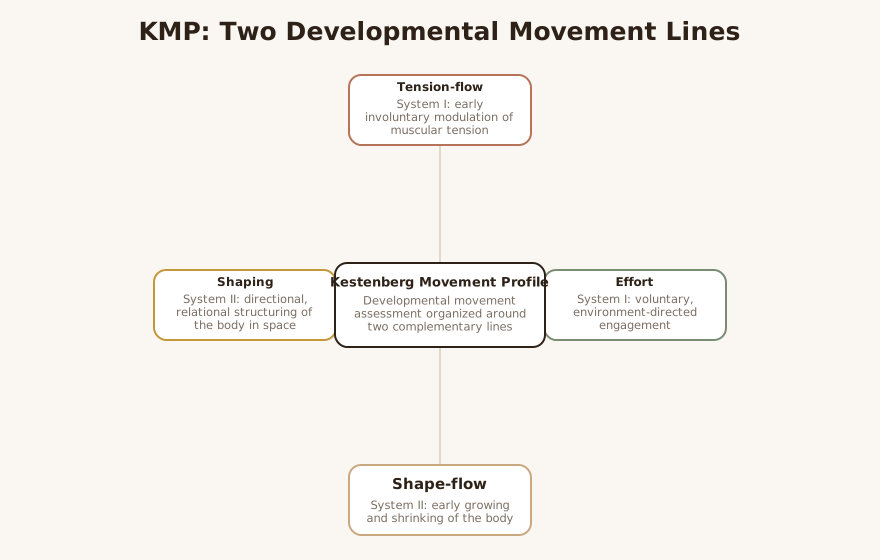
The KMP is organized around two complementary developmental lines, conventionally labeled System I and System II 7. System I concerns the tension-flow / effort line of development, describing the dynamics of movement — how a person modulates muscular tension and engages with the environment through qualities of effort 7. System II concerns the shape-flow / shaping line, describing relational development and the spatial structuring of the body in relation to itself and others 7. A guiding principle is that early, involuntary tension-flow patterns mature into more voluntary, environment-directed effort qualities, and that early shape-flow (breathing, growing and shrinking of the body) matures into directional and shaping relationships with space and people 1. The profile assumes that movement development unfolds in phases and that each phase has characteristic, age-appropriate patterns 4. Crucially, the KMP frames deviation diagnostically only in a developmental sense: it can indicate delayed, missed, distorted, or prematurely induced developmental milestones by revealing scanty or overabundant amounts of phase-appropriate movement 4. The system also rests on the idea that movement qualities carry semantic meaning — that rhythm, shape, and effort can be read as expressions of affect and relational stance 3. This semantic claim, that observable movement maps onto inner states, is the interpretive engine of the whole profile 3.
Interventions & Techniques
Strictly speaking, the KMP yields an assessment, and the “intervention” is what the clinician does with the resulting profile LLM. The core technique is systematic, often frame-by-frame observation of movement, which is notated and aggregated into frequency diagrams representing the relative prevalence of each movement-quality category 7. Wikipedia describes a structure built around multiple frequency diagrams — on the order of several dozen movement-quality categories spread across the two systems — that together produce a movement “portrait” of the individual 7. From this portrait, the clinician identifies developmental strengths, latent potentials, and patterns suggesting delay or conflict 4. The official KMP resources describe categories such as pre-efforts and directions among the movement qualities that are charted 4. In treatment, the profile guides attunement: a dance/movement therapist may mirror or gently contrast a client’s tension-flow rhythms to build relational safety, then introduce movement experiences that scaffold under-developed qualities LLM. With caregiver-infant dyads, the KMP can be used to map mismatches in flow and shaping between parent and child and to coach more synchronous, regulating interaction LLM.
LLM-generated illustrative example (not a guideline): A therapist observes that a 4-year-old with marked self-regulation difficulties shows abundant abrupt, high-intensity tension-flow with little of the smooth, gradual flow associated with soothing. The therapist uses rhythmic, gradual movement games — slow stretching, rocking — to introduce the missing quality, then coaches the parent to match the child’s tempo before gently downshifting it together LLM.
These techniques are delivered inside a recognized psychotherapeutic relationship; the KMP supplies the lens, not the treatment frame itself LLM.
Evidence Base
The KMP’s maturity is best described as an established framework with limited efficacy evidence LLM. It is established in the sense that it is widely taught, has a canonical text and an organizing professional structure, and has been applied across more than half a century of clinical and observational work 1. However, its psychometric foundation is more modest than its clinical reputation LLM. The frequently cited study by Koch, Cruz, and Goodill examined the performance of novice raters and found that achieving acceptable inter-rater reliability on the KMP is demanding and contingent on substantial, specialized training 2. That finding is double-edged: it confirms the system is teachable to standardized criteria, but it also signals that reliability is fragile in untrained hands and that the instrument is not a quick, plug-and-play measure 2. Beyond reliability studies, controlled efficacy data — randomized trials showing that KMP-informed treatment improves clinical outcomes — are sparse LLM. Some research has applied the KMP to study psychological phenomena in adults, including effects on attitudes and affect, supporting its descriptive utility, but this is observational rather than outcome-confirming work 7. The honest summary for clinicians is that the KMP is a respected, theory-rich descriptive and interpretive tool whose interpretive leaps outpace the current empirical validation of those interpretations 3.
Populations & Indications
The KMP is explicitly lifespan-oriented and has been applied from the prenatal and infant period through adulthood 7. Its most distinctive contributions are in early development: infants and young children, where preverbal movement is the primary communicative channel, and caregiver-infant dyads, where the profile can map relational attunement and mismatch 7. It is used with children and adolescents to characterize developmental trajectory and emotional expression, and with adults in dance/movement therapy for self-expression, affect regulation, and exploration of relational patterns 1. People with developmental disabilities are a recognized population, given the KMP’s capacity to describe movement organization without requiring verbal report 1. Because the profile reads developmental level through movement rather than language, it is particularly indicated where verbal assessment is limited — very young children, nonverbal or minimally verbal individuals, and clients for whom embodied experience is more accessible than narrative LLM.
Problems-for-Work
The KMP is applied to a range of clinical concerns, with the strongest conceptual fit in developmental and relational domains 1. Attachment disturbances and parent-child relational problems are natural targets, because the shape-flow / shaping system directly describes how a body opens toward or withdraws from others 7. For autism spectrum disorder and developmental delays, the profile offers a non-verbal map of developmental level and sensory-motor organization that can complement standardized developmental testing LLM. Emotion-regulation and sensory-processing difficulties show up legibly in the tension-flow line, where over- or under-modulated muscular tension can be charted and worked with 4. For trauma and anxiety, KMP-informed work attends to how defensive or constricted movement patterns express dysregulation, and uses movement to expand the client’s available repertoire LLM. Difficulties with self-expression are addressed by identifying which movement qualities are absent or inhibited and scaffolding their emergence 1.
LLM-generated illustrative example (not a guideline): With an anxious adolescent whose movement shows pervasive bound (high-tension) flow and minimal free flow, the therapist names this pattern, validates its protective function, and gradually introduces structured improvisation that invites brief, contained moments of free flow, tracking the client’s tolerance LLM.
Contraindications, Cautions & Cultural Humility
The KMP carries no acute physical contraindications, but it carries significant interpretive cautions LLM. The most important is that it is a developmental and clinical lens, not a stand-alone diagnostic instrument; movement patterns should never be used to assign a psychiatric diagnosis on their own 7. The system’s psychoanalytic scaffolding — its roots in drive and developmental-phase theory — reflects a particular theoretical tradition, and clinicians should hold its interpretations as hypotheses rather than facts 4. Cultural humility is essential: although the KMP aspires to describe movement with minimal cultural bias at the notation level, the meaning assigned to movement is culturally situated, and what reads as “scanty” or “overabundant” can reflect cultural movement norms rather than pathology 7. A clinician must guard against pathologizing culturally normative movement styles, neurodivergent movement, or disability-related movement organization LLM. The reliability research is itself a caution: because trustworthy KMP coding requires extensive specialized training, interpretations made by undertrained observers should be treated with skepticism 2. Used well, the KMP is a way of seeing; used carelessly, it can launder theoretical assumptions as objective findings LLM.
Treatment-Plan Suggestions & SMART Objectives
| Goal | SMART objective (example) | Mechanism |
|---|---|---|
| Improve dyadic attunement | Within 10 sessions, caregiver will match the infant’s movement tempo in at least 3 of 5 observed play sequences | Shape-flow synchrony in the caregiver-infant dyad 7 |
| Expand affect-regulation repertoire | Over 8 weeks, client will demonstrate the use of gradual (smooth) tension-flow in 2 self-soothing movement sequences per session | Maturation along the tension-flow line toward modulated flow 1 |
| Increase tolerance for free flow | Within 12 sessions, anxious client will sustain 30 seconds of free-flow movement without withdrawal in 3 consecutive sessions | Gradual exposure expanding the constricted tension-flow repertoire LLM |
| Support developmental sequencing | Over a semester, child will display age-appropriate shaping (reaching/directing toward objects) in 4 of 5 structured activities | Scaffolding of phase-appropriate shaping patterns 4 |
| Strengthen non-verbal self-expression | Within 10 sessions, adolescent will initiate 2 novel movement qualities during improvisation per session | Enlarging the available effort/shape repertoire 1 |
| Build relational openness | Over 8 weeks, client will demonstrate open shape-flow (growing toward another) in 3 partnered movement tasks | Shaping development supporting object relations 7 |
| Track developmental progress | Re-profile the client at intake, mid-treatment, and discharge, documenting shifts across both KMP systems | Repeated descriptive assessment of developmental movement patterns 4 |
Common Misconceptions
A first misconception is that the KMP is a validated diagnostic test; it is a developmental descriptive-interpretive framework, and its interpretations are hypotheses, not diagnoses 7. A second is that anyone with movement-observation interest can produce reliable KMP profiles — the reliability research shows that defensible coding requires substantial specialized training 2. A third is that the KMP is simply Laban Movement Analysis renamed; in fact it extends Laban into developmental, psychoanalytic, and relational territory that Laban’s system does not address 7. A fourth is that “more movement variety equals healthier” — the profile reads health developmentally, where both scanty and overabundant amounts of a pattern can signal concern 4. Finally, some assume strong efficacy evidence underlies the system; the descriptive base is far better developed than the outcome base LLM.
Training & Certification
Competent KMP use is gated by training, consistent with the finding that reliability depends on it 2. The official KMP organization maintains a certification pathway, training videos and courses, a registry of certified KMP analysts, and an affiliated Center for Parents & Children 4. Becoming a certified KMP analyst is a structured process distinct from general clinical licensure, reflecting the technical demands of accurate coding 4. Most practitioners encounter the KMP within dance/movement therapy training, and the credentialing of DMT clinicians is overseen by the American Dance Therapy Association, which recognizes the entry-level R-DMT and the advanced BC-DMT designations 5. Clinicians outside DMT who wish to use the KMP responsibly should pursue formal KMP instruction rather than relying on textbook study alone, given how easily untrained coding drifts LLM. Introductory orientation to the system is also available through accessible overview material for those exploring whether to invest in full training 6.
Key Terms
- Tension-flow: the fluctuation of muscle tension (free vs. bound flow), the earliest, most involuntary dynamic layer mapped by System I 7.
- Effort: the more mature, environment-directed qualities (e.g., handling space, weight, time) into which tension-flow develops 7.
- Shape-flow: the growing and shrinking of the body in relation to itself, the foundational layer of System II 7.
- Shaping: the directional structuring of the body in space and toward others, the mature relational development described by System II 7.
- Pre-efforts and directions: intermediate movement qualities charted within the profile’s categories 4.
- Frequency diagrams: the charted summaries of how often each movement-quality category appears, forming the profile 7.
- Phase-appropriate movement: movement patterns expected at a given developmental phase, against which scanty or overabundant amounts are read 4.
Resources & Further Reading
▶ Watch — a video introduction to this concept:
- The Meaning of Movement: Embodied Developmental, Clinical, and Cultural Perspectives of the Kestenberg Movement Profile (Kestenberg Amighi, Loman & Sossin)
- Koch, Cruz & Goodill (2001), The Kestenberg Movement Profile: Performance of Novice Raters, American Journal of Dance Therapy
- Movement analysis in dance therapy: Semantics of movement qualities, rhythm and shape according to Laban and Kestenberg
- Kestenberg Movement Profile — Official Resources & Theory
- American Dance Therapy Association (ADTA)
- Kestenberg Movement Profile (KMP) Introduction (video)
- Kestenberg Movement Profile — Wikipedia
Reflective / Supervision Questions
- When I read a client’s movement, how do I distinguish description from interpretation, and am I holding my interpretations as hypotheses? LLM
- Have I had enough KMP-specific training to code reliably, or am I overreaching beyond my competence? 2
- Could the patterns I am labeling “deviant” reflect cultural, neurodivergent, or disability-related movement norms rather than pathology? 7
- How am I integrating KMP findings into a billable psychotherapeutic frame rather than treating the profile as the treatment itself? LLM
- Where the evidence base is thin, how do I stay transparent with clients and supervisors about the interpretive nature of this work? 3
- In dyadic work, am I attending to my own movement and countertransference, not only the client’s profile? LLM