
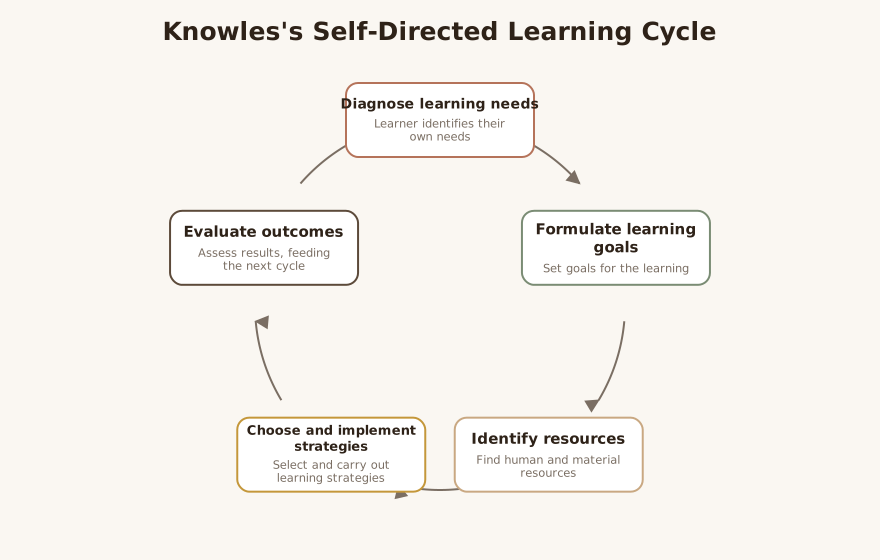
Self-directed learning (SDL) is one of the most durable ideas in adult education, and it maps onto clinical work more directly than almost any other learning framework, because so much of therapy is, structurally, an adult learning to do something differently. LLM Every time a client diagnoses what they want to change, sets a goal, picks a coping strategy, tries it, and judges whether it worked, they are running the self-directed learning cycle — usually without anyone naming it. LLM This article distills SDL for practicing therapists: what Knowles actually claimed, what the evidence supports, and how to use it as a facilitation stance inside recognized treatment without overselling it as a therapy in its own right. LLM
Type & Discipline
Self-directed learning is a framework — a description of a process plus a prescriptive stance for the educator — that originates in adult education rather than clinical psychology. 2 It is most often defined in process terms: a sequence in which the learner takes initiative in diagnosing needs, setting goals, finding resources, choosing strategies, and evaluating results, with or without the help of others. 2 It belongs to the broader family of adult learning theory and sits as the operational core of andragogy, Knowles’s wider set of assumptions about how adults learn. 5
A definitional distinction matters for clinicians. SDL is described two ways in the literature — as a process (a method of organizing instruction and learning) and as a personal attribute or goal (the disposition and capacity to direct one’s own learning). LLM For therapeutic purposes it is most useful to hold both: the process gives you a structure to run with a client, and the attribute view reminds you that building a client’s capacity to self-direct can itself be an outcome of treatment. LLM It is best treated as a facilitation framework — a way to design and deliver collaborative work — rather than as a falsifiable psychological theory or a discrete intervention protocol. LLM
Creators & Lineage
The framework is most closely associated with Malcolm Shepherd Knowles (1913–1997), the central figure in twentieth-century American adult education, who gave SDL its canonical definition in his 1975 guide Self-Directed Learning. 2 Knowles defined it as a process in which “individuals take the initiative, with or without the help of others, in diagnosing their learning needs, formulating learning goals, identifying human and material resources for learning, choosing and implementing appropriate learning strategies, and evaluating learning outcomes.” 2 That sentence is the spine of everything that follows. LLM
The intellectual lineage runs alongside the broader adult-learning tradition. Allen Tough, a Canadian adult educator, is widely credited as a foundational empirical investigator of how adults plan and conduct their own “learning projects” outside formal instruction, and his work is part of the research base that made self-direction a serious object of study rather than a slogan. LLM Knowles synthesized this orientation with his humanistic commitments, drawing on the client-centered tradition of Carl Rogers, whose emphasis on learner autonomy and self-actualization is visible throughout SDL. 2 The framework is the direct operational engine of andragogy and sits as a sibling to self-regulated learning in educational psychology, which formalizes many of the same self-monitoring and self-evaluation processes. 5
Knowles paired the SDL process with a practical device: the learning contract, a negotiated written agreement in which the learner specifies objectives, resources, strategies, evidence of accomplishment, and a timeline. 2 This blend of humanistic autonomy with behaviorally specific contracts is characteristic of his thinking and is, not coincidentally, where SDL most resembles the goal-setting and homework structures already familiar to clinicians. 2
Core Principles
At its heart SDL is the five-step process Knowles systematized. 2 First, the learner diagnoses their own learning needs; second, they formulate learning goals; third, they identify human and material resources; fourth, they choose and implement strategies; and fifth, they evaluate the outcomes. 2 The decisive feature is who owns these steps: in SDL the learner holds initiative across the cycle, and the educator’s role shifts from authority and content-deliverer to facilitator, resource, and co-designer. 2
Knowles offered concrete rationales for emphasizing self-direction. 2 He argued that proactive learners who take initiative tend to retain and use what they learn better than passive recipients; that self-direction aligns with normal psychological maturation toward autonomy; and that adults are increasingly required to take initiative in their own learning rather than wait to be taught. 2 These map cleanly onto clinical aspirations: durability of change, respect for the client’s autonomy, and the goal of a client who can eventually self-correct without the therapist. LLM
A second principle, drawn from the wider adult-learning literature, is relevance and immediacy. 6 Adults are oriented toward learning that solves a present, real problem and want to understand why something is worth their effort before investing in it. 6 In an SDL frame this means the learner’s own stated problem, not an externally imposed curriculum, sets the agenda — a stance with obvious therapeutic resonance. LLM
Interventions & Techniques
SDL translates into a facilitation posture and a set of moves rather than a fixed protocol. LLM The foundational techniques are: collaborative needs assessment, in which clinician and client jointly diagnose what needs to change; learner-set, written goals rather than clinician-imposed ones; deliberate identification of resources the client can draw on; client selection among strategy options; and explicit, shared evaluation of whether the approach worked. 2 The clinician supplies structure, options, and feedback while protecting the client’s ownership of the choices. 2
The learning contract is the most directly portable tool. 2 A client-authored agreement that names the target, the strategy, what counts as evidence of progress, and a review date functions much like a between-session homework plan, but with authorship deliberately handed to the client to recruit autonomy and commitment. 2 Practical adult-learning guidance also applies: explain relevance up front, favor task-focused practice over passive information delivery, treat mistakes as supported self-discovery, and offer flexible, self-paced pathways rather than a single prescribed route. 5
LLM-generated illustrative example (not a guideline): A client with avoidance around job applications resists the therapist’s suggested exposure ladder. The clinician switches to an SDL stance: “What would you need to figure out to make this less awful, and how would you want to test it?” The client diagnoses that uncertainty about rejection is the sticking point, sets a goal of submitting two applications, chooses to draft them with a friend as a resource, and agrees to rate distress afterward — a self-authored plan they are far likelier to enact than a prescribed one. LLM
Evidence Base
Honesty about maturity is essential. SDL is an established framework — foundational, durable, and near-universally cited in adult education — but its evidence base is largely educational rather than clinical, and its status as a rigorous theory is contested. 1 There are no randomized trials showing that “self-directed learning” as such reduces psychiatric symptoms, because it is a learning framework, not a treatment, and has not been studied as one. LLM
Where outcomes have been measured, they come from education. A 2025 systematic review and meta-analysis of self-directed versus traditional didactic learning in undergraduate medical education included 19 studies (2,098 students) in the review and 14 studies (1,792 students) in the meta-analysis, and found self-directed learning superior overall, with an overall mean difference in exam scores of 2.399 (95% CI 0.121–4.678, p < 0.001). 4 Of the 14 pooled studies, 11 favored self-directed learning and only 3 favored didactic teaching. 4 The crucial caveat is heterogeneity: I² was 98.56%, meaning the studies varied enormously in method and result, and the authors flagged small samples, several pilot studies, and possible publication bias. 4 The honest reading is “promising and directionally positive in education, but the effect is unstable across contexts,” not “definitively superior.” LLM
A separate meta-analytic literature on self-directed learning, academic achievement, and motivation likewise reports a positive association between self-direction and both achievement and motivation in educational samples, consistent with the medical-education finding. 3 Overall, SDL is a well-supported design and facilitation heuristic with face validity, broad uptake, and supportive education research, not an intervention with a clinical-trial evidence base. 1 The strongest theoretical critique, from Stephen Brookfield, is that genuine self-direction requires both real learner control over decisions and access to a full range of resources — conditions he called as much political as pedagogical — which is a direct caution against assuming a client can simply “self-direct” without means. 2
Populations & Indications
SDL applies to any motivated adult learner, and several clinical populations map onto it well. 2 It fits adults in psychotherapy who value autonomy and chafe at directive instruction, where a collaborative, learner-led stance reduces resistance. LLM It suits clients in skills-based treatment, where the SDL cycle structures how a coping or regulation skill is selected, practiced, and evaluated. 5 It is well-matched to college students and other learners already operating in self-directed contexts, and to people in vocational rehabilitation, where self-authored goals and resource-finding are central to the work. LLM It is most apt with highly motivated or insight-oriented clients who have the activation to take initiative. LLM
With adolescents, SDL can be powerful for building autonomy but typically needs more scaffolding and clearer external structure, since the capacity for fully self-directed planning is still developing. LLM Across populations, the framework is indication-neutral with respect to diagnosis: it shapes how learning and change are organized, not which condition is treated. LLM
Problems-for-Work
SDL is a useful lens for several recurring clinical targets. LLM
- Low motivation and disengagement from treatment. Handing the client authorship of goals and strategies recruits intrinsic motivation, since adults engage more with learning they have helped design. 6
- Treatment nonadherence. Reframing homework as the client’s own self-authored experiment — ideally as a learning contract — rather than the therapist’s assignment tends to improve follow-through. 2
- Low self-efficacy. Running the full cycle and reaching the evaluation step lets the client see concrete evidence of their own competence, building mastery. 2
- Goal-setting difficulties and poor problem-solving. The five-step structure is itself a teachable problem-solving scaffold the client can internalize and reuse. 2
- Procrastination and avoidance. Learner-chosen, immediately relevant, problem-centered tasks lower the activation barrier compared with abstract or imposed assignments. 6
LLM-generated illustrative example (not a guideline): A client who repeatedly “forgets” their thought records is not lazy — the records were the therapist’s idea. Using an SDL stance, the clinician asks the client to design their own self-monitoring method. The client chooses a voice-memo log on their commute, sets a target of three per week, and agrees to review them together. Adherence improves because the client owns the design. LLM
Contraindications, Cautions & Cultural Humility
SDL has no “contraindications” in the pharmacologic sense, but it has real limits. LLM Its assumption of autonomous initiative may not hold for clients who are acutely unwell, in crisis, severely depressed, cognitively impaired, or so demoralized that “you decide how to fix this” lands as abandonment rather than empowerment. LLM In those states a more directive, scaffolded approach is appropriate, with self-direction introduced gradually as capacity returns. LLM
Brookfield’s critique is the central caution: real self-direction depends on access to resources and genuine control, conditions that are partly political, not purely psychological. 2 Clinically this translates to health equity — a client cannot “self-direct” their recovery without time, access to care, and support, and treating self-direction as a pure act of will can quietly blame people for structural barriers. LLM Cultural humility matters too, because the framework grew out of a Western, individualistic educational tradition that prizes personal autonomy. LLM Clients from collectivist or more hierarchical cultural contexts may legitimately prefer expert guidance, family involvement, or relational decision-making, and imposing a “you should drive this yourself” stance can feel alienating rather than respectful. LLM The clinical move is to check whether an autonomy-forward stance fits this person’s values and current capacity, and to titrate scaffolding accordingly rather than applying SDL mechanically. LLM
Treatment-Plan Suggestions & SMART Objectives
The five-step cycle and the learning-contract format make SDL a practical engine for collaborative, measurable objectives inside a broader treatment plan. LLM The examples below are illustrative templates to adapt, not prescriptions. LLM
| Goal | SMART objective (example) | Mechanism |
|---|---|---|
| Increase engagement in treatment | Client will co-author one written goal in their own words by session 2 and review it at each subsequent session | Learner-set goals recruit ownership and intrinsic motivation 6 |
| Improve homework adherence | Client will design and complete one self-chosen between-session experiment weekly for 4 weeks, recorded on a learning contract | Self-authored tasks improve follow-through 2 |
| Build self-efficacy | Client will run the full diagnose–goal–strategy–evaluate cycle on one target and rate their confidence before and after over 6 weeks | Completing and evaluating the cycle produces visible mastery evidence 2 |
| Strengthen problem-solving skills | Client will independently apply the five-step process to a new real-life problem and report the outcome by session 8 | Internalizing the process scaffold generalizes the skill 2 |
| Reduce procrastination/avoidance | Client will select one immediately relevant, self-paced task per week and log completion for 4 weeks | Relevant, learner-chosen tasks lower the activation barrier 6 |
| Improve goal-setting | Client will convert one vague aim into a written objective with named evidence of progress and a review date by session 3 | Learning-contract structure operationalizes goals 2 |
| Increase autonomous self-monitoring | Client will design their own self-monitoring method and use it 3 times weekly for 4 weeks | Learner-designed methods sustain self-direction 2 |
Common Misconceptions
A frequent error is reading “self-directed” as “unsupported” or “do it alone.” LLM Knowles’s own definition explicitly says “with or without the help of others,” and the facilitator role is active throughout — providing structure, options, resources, and feedback. 2 A second misconception is that SDL is a proven therapy; it is an established and influential learning framework whose effectiveness evidence comes mainly from education, not from clinical outcome trials. 1 A third is treating self-direction as a fixed trait a client either has or lacks, when it is better understood as a capacity that can be scaffolded and built over time, and one that fluctuates with the client’s current state. LLM Finally, clinicians sometimes assume that “letting the client decide” means stepping back entirely; in practice the skill is structuring the client’s choices so the autonomy is real but not overwhelming. 2
Training & Certification
There is no certifying body or credential for self-directed learning; it is a body of knowledge and a facilitation stance, not a licensed practice. LLM Competence is acquired through the source literature — most directly Knowles’s Self-Directed Learning (1975) and the andragogy texts that house it — and through applied practice in designing learner-led, contract-based work. 2 For clinicians, the practical path is to integrate the SDL stance into the collaborative goal-setting, psychoeducation, and homework structures you already use within an established therapy, and to study allied frameworks such as motivational interviewing and self-regulated learning that formalize overlapping skills. 5
Key Terms
- Self-directed learning — a process in which the learner takes initiative, with or without help, to diagnose needs, set goals, identify resources, choose strategies, and evaluate outcomes. 2
- Facilitator — the educator’s role in SDL: a resource, structurer, and co-designer rather than an authority delivering content. 2
- Learning contract — a negotiated written agreement specifying objectives, resources, strategies, evidence of accomplishment, and a timeline. 2
- Andragogy — Knowles’s broader framework of assumptions about adult learning, of which SDL is the operational core. 5
- Process vs. attribute — the distinction between SDL as a method of organizing learning and SDL as a personal capacity or disposition to self-direct. LLM
- Learning project — a sustained, self-planned effort to learn something, central to the early empirical study of how adults learn on their own. LLM
Resources & Further Reading
▶ Watch — a video introduction to this concept:
- Self-Directed Learning: A Core Concept in Adult Education (Loeng, 2020) 1
- Malcolm Knowles, informal adult education, self-direction and andragogy (infed.org) 2
- Self-Directed Learning, Academic Achievement and Motivation: A Meta-Analytical Study (ResearchGate) 3
- Self-directed vs traditional didactic learning in undergraduate medical education: systematic review and meta-analysis (PMC) 4
- The Adult Learning Theory — Andragogy — of Malcolm Knowles (eLearning Industry) 5
- Andragogy Theory — Malcolm Knowles (EducationalTechnology.net) 6
Reflective / Supervision Questions
- Where in my work am I handing clients pre-made plans when I could help them author their own, and what stops me? LLM
- Am I treating self-direction as a fixed client trait, or am I adjusting scaffolding to the client’s current acuity, capacity, culture, and resources? LLM
- When a client “doesn’t do the homework,” am I asking whether the homework was ever really theirs? LLM
- For which clients does an autonomy-forward stance risk landing as abandonment rather than empowerment, and how would I notice? LLM
- Am I attending to Brookfield’s point — whether this client actually has the resources and control that genuine self-direction requires? 2
- Am I overclaiming an evidence base, presenting a learning framework as if it were a proven therapy in its own right? 1