
Type & Discipline
The Interpersonal Theory of Suicide (often abbreviated IPTS) is an explanatory theory, not a treatment modality. 1 It sits within social and clinical psychology and belongs to a family of models concerned with belonging, connection, and the pathways to suicidal behavior. 1 Its purpose is to answer two distinct questions that earlier frameworks often blurred together: why a person comes to want to die, and why a much smaller subset of those people becomes capable of acting on that desire. 1 Because it is a theory rather than a protocol, clinicians do not “deliver” the Interpersonal Theory of Suicide to a client; they use it as a risk-formulation lens that organizes assessment and informs intervention drawn from established treatments. LLM The framework is deliberately specific and falsifiable, which is part of why it has generated a large empirical literature and an equally vigorous critique. 5
Creators & Lineage
The theory was developed by the clinical psychologist Thomas Joiner, who introduced it in his 2005 book Why People Die by Suicide. 2 Joiner’s account drew on his own clinical and personal experience of suicide loss, as well as on a wide reading of the suicidology literature, and it sought to unify scattered risk factors under a small number of necessary and jointly sufficient conditions. 2 The theory was then formalized and operationalized in a frequently cited 2010 Psychological Review paper by Kimberly Van Orden, Tracy Witte, Kelly Cukrowicz, Scott Braithwaite, Edward Selby, and Joiner, which laid out the constructs, their hypothesized interactions, and the measurable predictions that have anchored subsequent research. 1
The model has clear intellectual ancestors. LLM Its emphasis on belonging echoes Émile Durkheim’s sociological observation that social integration protects against suicide, while its attention to the burden one believes oneself to be on others extends ideas about self-perception and social worth. 6 The construct of acquired capability builds on the recognition that the human body and mind are powerfully self-protective, so that overcoming the instinct for self-preservation requires a learned tolerance for pain and a reduced fear of death. 1 In this sense the theory bridges social psychology, learning theory, and clinical suicidology. LLM
Core Principles
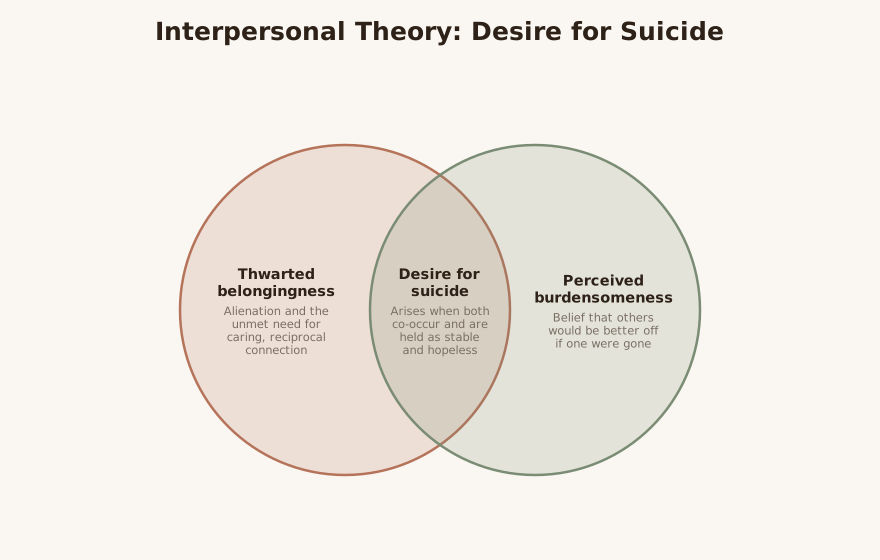
The theory rests on three core constructs. 1 Thwarted belongingness is the experience of being alienated from others and lacking reciprocal, caring connection — the unmet need to belong, captured in feelings of loneliness and the absence of supportive relationships. 1 Perceived burdensomeness is the belief that one’s existence is a liability to others, that loved ones or society would be better off if one were gone, often accompanied by self-hatred. 1 Critically, this is a perception, frequently distorted, not an objective fact. 1
The first central hypothesis is that the desire for suicide arises when thwarted belongingness and perceived burdensomeness are both present at the same time, and when the person additionally feels hopeless that these states will ever change. 1 Either condition alone may produce passive ideation, but the theory predicts that the combination of the two, held as stable and hopeless, generates active suicidal desire. 1
The second central hypothesis concerns lethality. 1 Suicidal desire, however intense, does not by itself produce serious attempts; people enact lethal self-harm only when they have also developed the acquired capability for suicide, comprising a heightened tolerance for physical pain and a lowered fear of death. 1 This capability is theorized to develop through repeated exposure to painful and provocative experiences — prior self-injury, trauma, violence, certain occupations, or other habituating events — that erode the body’s and mind’s natural resistance to self-destruction. 1 In short, the theory holds that the desire for suicide and the capability for suicide are separate, and that the deadliest risk exists at their intersection. 2
Interventions & Techniques
Because this is a theory and not a therapy, its clinical value lies in how it structures assessment and targets intervention. LLM In assessment, the model directs the clinician to evaluate each construct distinctly: the strength and stability of belonging, the presence and intensity of burdensomeness beliefs, the degree of hopelessness about both, and the markers of acquired capability such as prior attempts, self-injury, and exposure to pain and violence. 1 Separating desire from capability in formulation is the theory’s signature contribution to risk assessment, because two clients with equal ideation can carry very different near-term danger depending on capability. LLM
For intervention, the theory points toward modifying the two desire constructs, which are understood as more psychologically malleable than capability. 1 Work on thwarted belongingness aims to restore reciprocal, caring connection — strengthening existing relationships, reducing isolation, and rebuilding a sense of mattering to others. 4 Work on perceived burdensomeness targets the distorted belief itself, using cognitive approaches to test and revise the conviction that others would be better off without the client. 4 Because the theory does not prescribe its own techniques, these aims are typically pursued within established suicide-focused treatments such as brief cognitive behavioral therapy for suicide prevention and dialectical behavior therapy, and through means-safety counseling that targets capability by reducing access to lethal methods. LLM
LLM-generated illustrative example (not a guideline): A clinician working with an isolated older client who repeatedly says “my kids would be relieved if I were gone” might treat that statement as a perceived-burdensomeness belief to be examined collaboratively, while separately scheduling a weekly contact with a grandchild to address thwarted belonging — and, if a firearm is in the home, address means safety directly rather than assuming low capability. LLM
Evidence Base
The evidence base is best described as established but partially contested. 5 The theory has been tested across many countries, samples, and methods, and a 2017 systematic review and meta-analysis synthesizing roughly a decade of cross-national research found broad support for several of its key predictions. 3 In that meta-analysis, the main effects of the constructs were generally significant in the predicted directions: perceived burdensomeness and thwarted belongingness related to suicidal ideation, and the acquired-capability construct related to attempt history, supporting the distinction between desire and capability. 3
Honesty requires noting where support thins. 3 The most demanding part of the model is its interactive hypotheses — that belongingness and burdensomeness multiply rather than merely add, and that capability moderates the move from desire to attempt — and these interaction effects have been less consistently supported than the simpler main effects. 3 The meta-analysis found that the predicted two- and three-way interactions, while sometimes significant, tended to be small and were not reliably replicated, which tempers confidence in the theory’s most distinctive claims. 3
A pointed critique has also been raised. 5 In a 2019 Death Studies article provocatively titled “The emperor’s new clothes?”, Hjelmeland and Knizek argued that the theory’s empirical foundation is weaker than its popularity implies, that key studies often fail to test the full interactive model as specified, and that the constructs are sometimes measured and interpreted loosely. 5 They cautioned against treating the framework as settled fact and called for more rigorous and critical examination. 5 Clinicians should therefore use the theory as a well-supported heuristic for organizing risk — not as a validated predictive algorithm, since no current model reliably predicts who will die by suicide. LLM
Populations & Indications
The theory has been applied across a wide range of populations, which is part of its appeal as a general framework. 3 It has been studied in community and clinical adults, older adults, adolescents and young adults, military personnel and veterans, and medically ill or chronic-pain populations, among others. 3 Older adults are a frequently discussed group because both burdensomeness beliefs and social disconnection are common in late life, and the model gives clinicians language for those experiences. 6 Military and veteran populations are also salient, since occupational exposure to pain, injury, and the threat of death is theorized to elevate acquired capability. 1
Clinically, the theory is indicated less by a diagnosis than by the presence of suicide-relevant phenomena: active or passive suicidal ideation, social isolation and loneliness, expressed beliefs of being a burden, hopelessness, and any history of self-injury, prior attempts, or trauma that may bear on capability. 1 It is most useful at the point of risk formulation, where it helps the clinician translate a tangle of risk factors into a coherent, intervention-relevant picture. LLM
Problems-for-Work
The theory is applied alongside treatment for the suicide-related problems it helps explain, rather than as a stand-alone cure. LLM Relevant problems-for-work include suicidal ideation, suicide attempts, a passive death wish, social isolation and loneliness, perceived burdensomeness, hopelessness, depression, demoralization, nonsuicidal self-injury, and grief or bereavement that has eroded a sense of connection. 1
For a client with perceived burdensomeness, the clinician treats the “they’d be better off without me” belief as a cognitive target to be examined and revised, while watching for the self-hatred that often accompanies it. 1 For a client whose central problem is social isolation and loneliness, intervention focuses on restoring reciprocal, caring connection and a felt sense of mattering, directly addressing thwarted belonging. 4 For a client with nonsuicidal self-injury or a history of attempts, the formulation flags elevated acquired capability, prompting heightened attention to means safety and lethality even when stated ideation is modest. 1
Contraindications, Cautions & Cultural Humility
The first caution is conceptual: the theory is an explanatory model, not a risk-prediction instrument, and using it to reassure oneself that a client is “low capability, therefore safe” would be a dangerous misuse. LLM Suicidal desire warrants a full clinical response regardless of estimated capability, and capability can rise quickly. 1 A second caution is that perceived burdensomeness is, by definition, a perception — clinicians must hold it as a belief to be understood and tested, never as a validation of the client’s worthlessness. 1
Because the theory’s interactive claims are not robustly replicated and have been seriously critiqued, it should be held with intellectual humility rather than treated as proven mechanism. 5 Cultural humility is equally important. LLM The meanings of belonging and of being a burden are deeply shaped by culture; in many collectivist or interdependent contexts, the sense of obligation to family and the fear of burdening others may carry meanings the original, largely Western-derived constructs capture only partially. LLM Definitions of acceptable death, help-seeking norms, and the very expression of distress also vary across communities, so clinicians should interpret each construct through the client’s cultural and relational world rather than importing a fixed template. LLM Finally, the model is one lens among several, and it does not replace comprehensive, collaborative suicide risk assessment and safety planning. LLM
Treatment-Plan Suggestions & SMART Objectives
| Goal | SMART objective (example) | Mechanism |
|---|---|---|
| Reduce thwarted belongingness | Within 6 weeks, client will initiate 2 reciprocal social contacts per week and log them | Restoring reciprocal, caring connection and a sense of mattering |
| Revise perceived-burdensomeness beliefs | Within 8 sessions, client will generate and rate evidence against “others would be better off without me” on at least 3 occasions | Cognitive examination of distorted burdensomeness beliefs |
| Reduce hopelessness about change | Over 8 weeks, client will identify 1 concrete change in connection or burden beliefs each session | Building evidence that the painful states are not permanent |
| Increase means safety (target capability) | Within 2 sessions, client and clinician will complete a means-safety plan, including securing or removing lethal methods | Reducing access to lethal means despite acquired capability |
| Strengthen reasons for living | Within 4 sessions, client will articulate and record at least 3 personally meaningful reasons for living | Counterbalancing suicidal desire with valued connections and roles |
| Build a usable safety plan | Within 2 sessions, client will complete a written safety plan with warning signs, coping steps, and contacts | Structured crisis response that interrupts the desire-to-action pathway |
| Increase reciprocal mattering | Over 6 weeks, client will take on 1 small role that benefits another person | Directly countering burdensomeness through contribution |
| Monitor suicidal ideation and capability markers | Each session, client will complete a brief ideation check and review any new exposure to pain or self-injury | Ongoing separation of desire from capability in risk formulation |
Common Misconceptions
A first misconception is that thwarted belongingness or perceived burdensomeness alone explains suicide; the theory holds that active desire arises from their co-occurrence together with hopelessness, and that desire alone does not produce lethal behavior. 1 A second is that “perceived burdensomeness” describes a real burden — it is an often-distorted self-perception, and treating it as accurate would be a clinical error. 1 A third is that acquired capability is fixed or rare; it is theorized to be learned and to accumulate through exposure to pain and provocation, so it can increase over time. 1
A fourth misconception is that the theory predicts who will die by suicide. 3 Even where the constructs are supported, the interactive predictions are modest and inconsistently replicated, and no model offers reliable individual prediction. 3 A fifth is that the framework is empirically settled; serious critics have argued its foundation is overstated and under-tested as specified. 5 Finally, some treat the theory as a therapy in itself, when it is an explanatory model whose aims are pursued within established suicide-focused treatments. LLM
Training & Certification
There is no licensure or certification in the Interpersonal Theory of Suicide, because it is a theory rather than a regulated modality. LLM Clinicians typically encounter it within graduate training in suicidology and within continuing education on suicide risk assessment and prevention. LLM The foundational primary sources are Joiner’s 2005 book Why People Die by Suicide and the 2010 Psychological Review paper by Van Orden and colleagues, which together provide the conceptual model and its operational definitions. 2 The 2017 meta-analysis is the key reference for understanding what the evidence does and does not support. 3 Accessible expert overviews, such as the Psychwire resource, can orient practitioners quickly, and engaging with published critiques is part of using the theory responsibly. 4 In practice, clinicians integrate the framework into existing competencies in suicide assessment, safety planning, and evidence-based treatment rather than pursuing a separate credential. LLM
Key Terms
Thwarted belongingness: the painful experience of being alienated from others and lacking reciprocal, caring connection — the unmet need to belong. 1
Perceived burdensomeness: the often-distorted belief that one’s existence is a liability and that others would be better off without one, frequently accompanied by self-hatred. 1
Suicidal desire: the wish to die, theorized to arise when thwarted belongingness and perceived burdensomeness co-occur with hopelessness that they will change. 1
Acquired capability for suicide: an elevated tolerance for physical pain and a reduced fear of death, theorized to develop through repeated exposure to painful and provocative experiences. 1
Painful and provocative events: experiences such as prior self-injury, trauma, violence, or injury that habituate a person to pain and fear and thereby raise acquired capability. 1
Lethal (versus nonlethal) suicidal behavior: the theory’s distinction that serious attempts require capability in addition to desire, so desire alone tends toward ideation rather than action. 2
Resources & Further Reading
▶ Watch — a video introduction to this concept:
- The Interpersonal Theory of Suicide (Van Orden, Witte, Cukrowicz, Braithwaite, Selby & Joiner, 2010, Psychological Review)
- Why People Die by Suicide (Thomas Joiner, Harvard University Press, 2005)
- The interpersonal theory of suicide: a systematic review and meta-analysis of a decade of cross-national research (2017)
- The Interpersonal Theory of Suicide (Psychwire, free expert resource)
- The emperor’s new clothes? A critical look at the interpersonal theory of suicide (Hjelmeland & Knizek, 2019)
- Interpersonal theory of suicide (Wikipedia)
Reflective / Supervision Questions
- When I formulate suicide risk, am I genuinely separating a client’s desire to die from their capability to act, or am I collapsing the two and missing one of them? LLM
- How do I respond to a client’s burdensomeness beliefs in a way that takes the pain seriously without confirming the distortion? LLM
- Where am I tempted to use this theory as a prediction tool, and how do I keep it as a heuristic that still demands full clinical response to any suicidal desire? LLM
- How might the constructs of belonging and burden carry different meanings in my client’s cultural and family context than in the model’s original framing? LLM
- Am I attending to means safety and capability markers even when a client’s stated ideation seems mild, given that capability can rise over time? LLM
- How do I hold the model’s contested interactive claims honestly with supervisees, so they neither over-trust nor dismiss a useful framework? LLM