
Type & Discipline
Brief Cognitive Behavioral Therapy for Suicide Prevention is a structured, time-limited, manualized psychotherapy within the cognitive-behavioral family, situated in clinical psychology and suicidology 4. Its defining feature is that suicidality itself — the suicidal mode, the crisis, the attempt — is treated as the primary target rather than as a downstream symptom of depression or another disorder 4. This reframes a familiar clinical assumption: a patient can become suicidal in the context of many diagnoses, so the protocol works directly on the cognitive, emotional, and behavioral machinery that drives a suicidal crisis LLM. It is typically delivered in roughly 12 sessions across distinct phases, and is designed to be portable across settings, including emergency, outpatient, and telehealth delivery 4. The model belongs to the broader category of suicide-specific care, alongside cognitive therapy for suicide prevention and collaborative crisis-management approaches LLM.
Creators & Lineage
The protocol was developed primarily by M. David Rudd and Craig J. Bryan, building on the cognitive theory of suicide pioneered by Aaron T. Beck 5. Beck proposed the “suicide mode” in 1996 to describe the synchronized activation of multiple personality systems that culminates in suicidal behavior 5. A closely related and partly overlapping lineage is the cognitive therapy for suicide prevention tested by Gregory K. Brown, Amy Wenzel, and Beck, which demonstrated that a brief, suicide-focused cognitive intervention could reduce reattempts in civilian patients 2. Rudd and Bryan extended this work into a tightly specified brief protocol and tested it rigorously in military populations 1. The theoretical spine of the model is fluid vulnerability theory, which holds that suicide risk fluctuates as the suicide mode is activated and deactivated over time, rather than remaining static 5. The clinical reference text is Bryan and Rudd’s Brief Cognitive-Behavioral Therapy for Suicide Prevention 4.
Core Principles
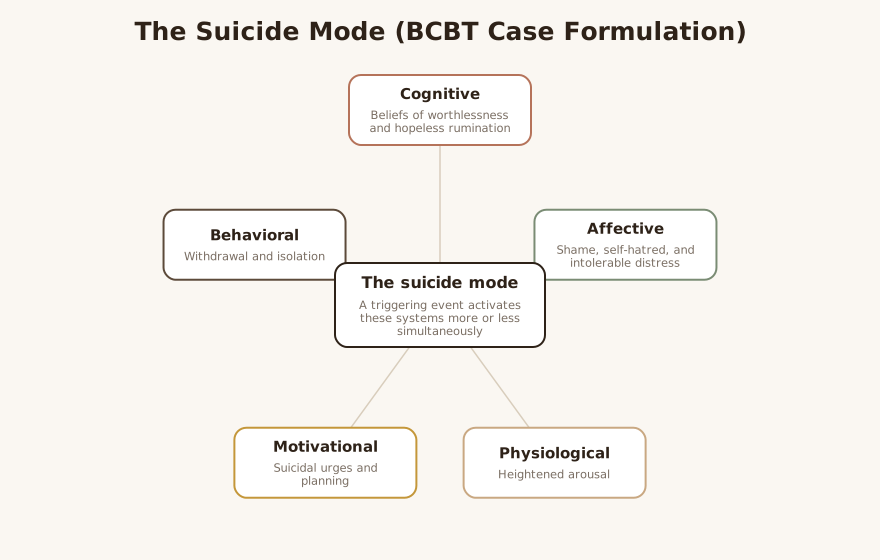
The first principle is that suicidality is the target. The clinician does not wait to treat depression and hope suicidality resolves; the suicidal mode is addressed directly 4. The second is the suicide mode itself as the organizing case formulation: a triggering event activates cognitive (beliefs of worthlessness, hopeless rumination), affective (shame, self-hatred, intolerable distress), physiological (arousal), motivational (urges and planning), and behavioral (withdrawal, isolation) systems more or less simultaneously 5. Treatment aims to “de-activate the suicide mode” by teaching the patient to recognize warning signs and intervene across these systems 5. The third principle is fluid vulnerability: risk is dynamic, so the work builds skills the patient can deploy when the mode reactivates, rather than treating a single crisis as the end of risk 5. A fourth principle is collaboration and transparency — crisis tools are constructed jointly with the patient and written in their own words 6. A fifth, practical principle is brevity and skill-building over insight: the protocol front-loads crisis management and emotion-regulation skills early so that protection is in place before deeper cognitive work LLM.
Interventions & Techniques
The signature early intervention is the Crisis Response Plan, typically handwritten on an index card and developed collaboratively, containing self-management/distraction strategies, reasons for living, social supports, and professional crisis contacts 6. The plan is built around the patient’s personal warning signs so it can be deployed at the earliest detectable point of an emerging crisis 6. A narrative assessment opens treatment: the clinician elicits a detailed, chronological account of the most recent suicidal episode to map the patient’s specific suicide mode 4. Subsequent skills typically include emotion-regulation and distress-tolerance techniques, means restriction counseling, behavioral activation, and cognitive restructuring of the hopelessness and unbearability beliefs that fuel the mode 4. A characteristic later-phase technique is the relapse-prevention task, a guided imagery exercise in which the patient mentally rehearses the prior crisis and then rehearses applying the new skills, used to consolidate learning before treatment ends 4. Throughout, the patient maintains a hope kit or equivalent personalized reminder of reasons for living LLM.
LLM-generated illustrative example (not a guideline): A clinician and a recently discharged patient build a Crisis Response Plan on an index card. Under warning signs the patient writes “I start replaying the argument and stop answering texts”; under self-management, “cold water on my face, walk the dog”; under reasons for living, “my sister, finishing my degree”; under professional support, the clinic line and 988. The card lives in the patient’s wallet and is reviewed each session. LLM
Evidence Base
The evidence base is established for the specific outcome the model was built to change: subsequent suicide attempts LLM. In a randomized controlled trial of active-duty soldiers with recent suicidal ideation or an attempt, the brief protocol roughly halved-to-more than halved the rate of subsequent attempts relative to treatment as usual over a two-year follow-up 1. In a separate randomized trial in civilian adults seen after a suicide attempt, the related cognitive therapy for suicide prevention produced approximately a 50% reduction in reattempts compared with usual care 2. The Crisis Response Plan, a core component, has independent support: in Bryan’s work, active-duty soldiers who received a CRP were 76% less likely to attempt suicide over six months than those receiving standard care, with roughly seven patients needed to treat to prevent one attempt, plus lower hospitalization and improved optimism 6. Delivery via telehealth has been tested in a randomized trial, extending the protocol beyond in-person settings 3. Two honest caveats: the most robust effects are on reattempt rates, not necessarily on the severity of suicidal ideation, and much of the strongest evidence comes from military samples, so generalization and long-term replication across diverse civilian populations remain active questions LLM.
Populations & Indications
The protocol is indicated for individuals at elevated near-term risk of suicidal behavior, particularly those with a recent suicide attempt or current active suicidal ideation 1. The most extensively studied population is active-duty military personnel 1. Civilian adults presenting after a suicide attempt are a second well-supported group 2. The model is also applied with veterans and in emergency or crisis-presentation contexts, where its brevity and front-loaded crisis tools are an advantage LLM. Telehealth delivery extends access to patients who cannot reliably attend in person 3. Because the formulation centers on the suicidal episode rather than a diagnosis, it can be used transdiagnostically across patients who become suicidal in the context of mood, trauma, substance, or personality presentations LLM.
Problems-for-Work
The central problem-for-work is a recent suicide attempt, where the protocol’s narrative reconstruction of the attempt and relapse-prevention rehearsal directly reduce reattempt risk 1. A second is active suicidal ideation, addressed by building and rehearsing the Crisis Response Plan and by restructuring the hopelessness beliefs that drive it 6. A third is acute suicidal crisis, where the patient is taught to detect personal warning signs early and deploy self-management strategies before the suicide mode fully activates 5. A fourth is hopelessness, targeted through cognitive restructuring and reasons-for-living work 2. A fifth is inadequate crisis-coping and emotion-regulation skills, met with distress-tolerance and self-management training so the patient has concrete tools when distress spikes 4.
LLM-generated illustrative example (not a guideline): For a patient whose problem-for-work is active suicidal ideation, sessions focus on rehearsing the Crisis Response Plan aloud until use is near-automatic, then on testing the belief “this will never get better” against the patient’s own history of distress that passed. LLM
Contraindications, Cautions & Cultural Humility
The protocol is a brief, structured intervention and is not a substitute for hospitalization or higher levels of care when imminent risk demands it; clinical judgment about acute safety always precedes protocol fidelity LLM. Means restriction counseling and the Crisis Response Plan are adjuncts to, not replacements for, appropriate emergency response when a patient cannot maintain safety LLM. The model explicitly rejects the no-suicide or “contract for safety” approach in favor of a collaboratively built Crisis Response Plan, and clinicians should not substitute a coercive contract for the collaborative plan 6. Because most efficacy data derive from military samples, clinicians applying the protocol to civilian, adolescent, or culturally distinct populations should hold its generalizability with appropriate humility and monitor outcomes LLM. Reasons for living, warning signs, and acceptable coping strategies are deeply shaped by culture, family, faith, and identity, so the plan must be written in the patient’s own language and values rather than imposed from a template 6. Clinicians should attend to how stigma, gender norms, and help-seeking expectations — pronounced in some military and cultural contexts — affect disclosure and engagement LLM.
Treatment-Plan Suggestions & SMART Objectives
| Goal | SMART objective (example) | Mechanism |
|---|---|---|
| Establish an immediately usable crisis tool | Client will co-create a written Crisis Response Plan on an index card by end of session 1 and carry it daily, reviewed each session for 4 weeks | Pre-rehearsed warning-sign-triggered coping that deactivates the suicide mode early 6 |
| Reduce reattempt risk after an attempt | Client will complete a detailed narrative account of the most recent suicidal episode within the first 2 sessions to map their suicide mode | Individualized case formulation enabling targeted skills 4 |
| Build distress tolerance | Client will identify and practice 3 self-management strategies and report using at least 1 during a distress spike, within 4 weeks | Self-regulation skills interrupt escalation 6 |
| Reduce access to lethal means | Client and clinician will complete means-restriction counseling and implement at least one concrete restriction step within 1 week | Lowered means availability during high-risk windows 4 |
| Reduce hopelessness | Client will generate and review a personalized reasons-for-living list and rate hopelessness weekly, targeting measurable decline over 8 weeks | Cognitive restructuring of unbearability/hopelessness beliefs 2 |
| Consolidate skills before termination | Client will complete a relapse-prevention imagery task rehearsing skill use during a simulated crisis prior to the final phase | Overlearned, retrievable coping under arousal 4 |
| Sustain gains after a recent attempt | Client will demonstrate independent use of the Crisis Response Plan in 2 successive sessions before discharge | Durable self-management reducing reattempt risk 1 |
Common Misconceptions
A first misconception is that the protocol is “just CBT for depression delivered quickly”; it is suicide-focused, with suicidality as the explicit target rather than an expected byproduct of treating an underlying disorder 4. A second is that the Crisis Response Plan is a no-suicide contract; the two are explicitly distinguished, with the collaboratively built plan favored over a contract for safety 6. A third is that brevity means superficiality; the brief course is tightly sequenced to install crisis protection first and consolidate it through rehearsal, not to skim 4. A fourth is that demonstrated efficacy means the intervention lowers suicidal ideation as much as it lowers attempts; the clearest, most replicated effect is on reattempt rates LLM. A fifth is that the evidence is exclusively military; a civilian post-attempt trial and a telehealth trial broaden the base, though military samples remain the most studied 2 3.
Training & Certification
Clinicians typically train through the published treatment manual by Bryan and Rudd, supplemented by workshops and consultation 4. There is no single universally mandated certifying body referenced in the provided sources; competent delivery is grounded in the manual plus supervised practice LLM. Foundational cognitive-behavioral therapy competence and specific training in suicide-specific assessment and crisis management are prerequisites for safe delivery LLM. Familiarity with the suicide mode formulation and fluid vulnerability theory supports fidelity to the model’s case conceptualization 5. Organizations such as the Military Suicide Research Consortium have disseminated component tools like the Crisis Response Plan and associated common data elements that support standardized implementation and measurement 6.
Key Terms
Suicide mode — Beck’s construct describing the synchronized activation of cognitive, affective, physiological, motivational, and behavioral systems that produces suicidal behavior 5. Fluid vulnerability theory — the framework holding that suicide risk fluctuates as the suicide mode activates and deactivates over time 5. Crisis Response Plan (CRP) — a collaboratively built, patient-worded index card listing warning signs, self-management strategies, reasons for living, social supports, and professional contacts 6. Narrative assessment — the detailed reconstruction of the most recent suicidal episode used to formulate the individual’s suicide mode 4. Relapse-prevention task — a guided imagery rehearsal of a past crisis and the new coping skills, used to consolidate learning before termination 4. Means restriction — reducing access to lethal methods during high-risk periods 4.
Resources & Further Reading
▶ Watch — a video introduction to this concept:
- Rudd, Bryan, et al. (2015) — Brief CBT effects on post-treatment suicide attempts in a military sample, RCT with 2-year follow-up (Am J Psychiatry)
- Brown, Wenzel, Beck, et al. (2005) — Cognitive Therapy for the Prevention of Suicide Attempts, RCT (JAMA)
- Telehealth Brief Cognitive Behavioral Therapy for Suicide Prevention: A Randomized Clinical Trial (PMC11558477)
- Bryan & Rudd — Brief Cognitive-Behavioral Therapy for Suicide Prevention (Guilford/Routledge)
- Beck Institute — An Introduction to the Suicide Mode
- Military Suicide Research Consortium — Crisis Response Plan (CRP)
Reflective / Supervision Questions
- How well can I articulate this patient’s specific suicide mode — the triggering event and the cognitive, affective, physiological, motivational, and behavioral systems it activates? 5
- Am I treating suicidality as the target of this episode of care, or am I implicitly waiting for the depression to lift and expecting suicidality to follow? 4
- Is the Crisis Response Plan written in the patient’s own words and warning signs, or have I imported a generic template? 6
- Have I distinguished, in my own framing and documentation, between a collaborative Crisis Response Plan and a coercive no-suicide contract? 6
- Given that the strongest evidence is on reattempt rates and largely from military samples, what am I assuming when I apply this model to a different population, and how am I monitoring whether it is working? LLM
- When risk is acute, am I clear about the threshold at which protocol fidelity yields to a higher level of care? LLM