
Type & Discipline
Intentional Peer Support (IPS) is a relational framework for peer support, not a manualized psychotherapy and not a clinician-delivered treatment 1. It sits within the mental health recovery movement and the broader tradition of peer support and mutual aid, where the helping relationship is built between two people who share lived experience of mental health challenges rather than between an expert and a patient 4. Maine’s Office of Behavioral Health characterizes IPS as “a relationship focused, problem solving, and strengths based, trauma-informed approach,” which usefully signals that it draws on, but is distinct from, trauma-informed care and strengths-based practice 6.
For practicing therapists, the most accurate way to locate IPS is as a framework that peer specialists are trained in and that clinicians increasingly work alongside, rather than something a licensed therapist would bill or deliver as a standalone modality LLM. Understanding it matters because peer specialists trained in IPS may be members of a client’s care team, on crisis warmlines, in emergency departments, or on assertive community treatment (ACT) teams, and their stance can differ meaningfully from a clinician’s 6.
Creators & Lineage
IPS was developed by Shery Mead, and the framework is grounded in her 2005 book Intentional Peer Support: An Alternative Approach 12. Mead’s own trajectory is part of the lineage: she has described moving from a period as what she called a “chronic mental patient” to becoming a mental health advocate, and credits a clinician who asked her whether she would be a chronic patient or a social worker with helping her recognize she had agency 3. That biographical pivot — from a life “defined” by services to one she could author — is encoded in the framework’s emphasis on agency and possibility 3.
Philosophically, IPS is rooted in social constructionism and describes itself as “a system for relational co-development,” in which meaning emerges through vulnerable, trusting connection rather than through expert-driven assessment and intervention 3. Its lineage therefore braids together the mental health recovery model, peer support and mutual aid, trauma-informed care, and person-centered ideas about the primacy of the relationship 63. The book itself is a curriculum more than a treatise — roughly 135 pages organized around the framework’s tasks and principles, with appendices on warmlines, peer-run respite, and navigating the mental health system 2.
Core Principles
IPS rests on three foundational shifts, usually described as movements from one stance to another 1:
- From helping to learning. Rather than positioning one person as helper and the other as helped, both contribute expertise and the work becomes mutual meaning-making 3. The aim is not to fix a problem but to co-construct new understanding 3.
- From the individual to the relationship. Attention shifts away from one person’s symptoms or deficits toward what is happening between the two people, and toward “negotiating meaning” together 3.
- From fear to hope (and possibility). IPS asks people to tolerate uncertainty rather than control it, so that “new possibilities” can emerge 3.
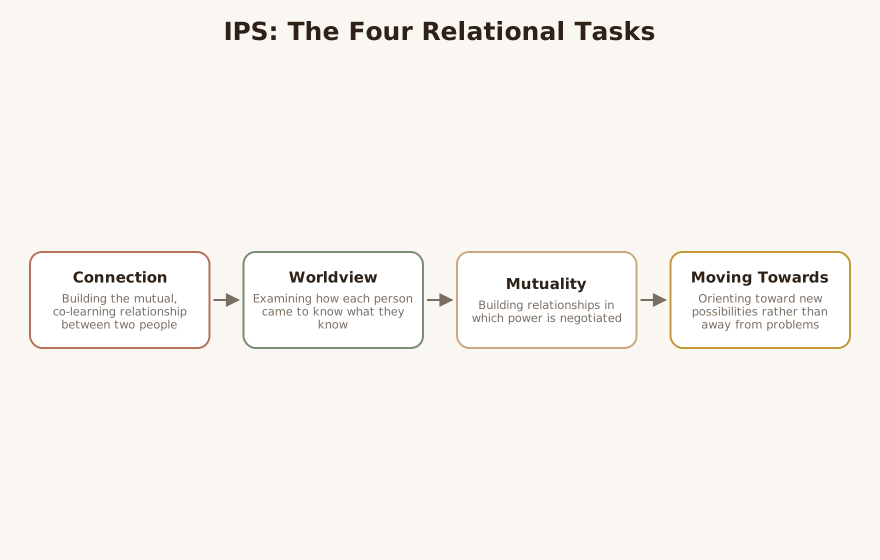
These principles are operationalized through four tasks: Connection, Worldview, Mutuality, and Moving Towards 1. Worldview names the practice of examining how each person “came to know what they know” — surfacing the assumptions and history that shape how a situation is read 1. Mutuality is the deliberate effort to build “relationships in which power is negotiated, co-learning is possible,” rather than relationships organized around one person’s authority 1. Moving Towards reframes the energy of the relationship toward what a person wants and is moving toward, rather than away from what is wrong 1. Shared responsibility runs through all of this: IPS teaches “working towards shared responsibility” instead of unilateral problem-solving, including shared responsibility for the relationship and for safety 1.
Interventions & Techniques
Because IPS is relational rather than protocolized, its “techniques” are practices of conversation and stance rather than discrete clinical maneuvers LLM. The Core Training curriculum names skill areas including creating learning environments, first contact, examining bias and privilege, attention to language, “listening differently,” navigating challenging situations, conversations about self-injury and suicide, and working within systems 6.
Several practices distinguish IPS in conversation LLM:
- Worldview exploration. Instead of moving quickly to advice, the peer asks how each person came to understand a situation the way they do, treating both worldviews as legitimate and open to revision 1.
- Listening differently. Listening is oriented toward connection and co-reflection rather than toward gathering data for assessment 62.
- Co-reflection. Both people reflect on the relationship itself and on what is being built between them, a practice the book explicitly addresses 2.
- Moving-toward conversations. The peer keeps the dialogue pointed at what the person wants to move toward, rather than cataloguing deficits 1.
- Negotiating safety as shared responsibility. Conversations about self-injury and suicide are approached as shared, mutual responsibility rather than as unilateral risk management 16.
LLM-generated illustrative example (not a guideline): A peer specialist meets someone who says, “I’ll never be able to work again.” An IPS-informed response avoids both reassurance (“of course you will”) and assessment (“how long have you felt this way”). Instead the peer might explore worldview — “Where did you learn that about yourself?” — and then move toward — “When you imagine a day that felt okay, what’s in it?” The conversation builds a shared picture of what the person is moving toward, with both people contributing. LLM
Evidence Base
Honesty about maturity matters here. Peer support as a broad practice is well established: Mental Health America describes it as “an evidence-based practice for individuals with mental health conditions or challenges,” supported by quantitative and qualitative research, and reports outcomes including reduced re-hospitalization and inpatient days, increased outpatient service use, lower overall mental health costs, improved quality of life, and greater engagement and satisfaction with services 5. SAMHSA likewise positions peer support workers as a recognized component of recovery support, with defined core competencies for the role 4.
However, the strength of that evidence base does not transfer wholesale to IPS specifically LLM. The MHA summary presents benefits of peer support generally and does not isolate IPS as a distinct intervention, and it does not foreground the methodological limitations of the underlying studies 5. Peer support trials are heterogeneous in how “peer support” is defined and delivered, which complicates attributing outcomes to any one model LLM. The most defensible clinical statement is therefore: peer support is an established, evidence-supported recovery practice, and IPS is one of its most widely adopted and well-articulated training frameworks, but rigorous IPS-specific effectiveness data are thinner than the general peer-support literature 51.
Populations & Indications
IPS was developed by and for people with lived experience of mental illness, and lived experience is a structural requirement of the work, not an optional feature 64. Indicated populations include people in psychiatric recovery, people living with serious mental illness, trauma survivors, people with substance use disorders, and people using crisis support services 65. Maine specifically trains IPS specialists who work on a state warmline, in emergency departments, in behavioral health homes, in state psychiatric hospitals, in peer centers, and on ACT teams — a good map of where the framework is deployed 6.
IPS is particularly suited to the experiences of social isolation, disempowerment and loss of agency, hopelessness, and stigma, because its core mechanism is restoring mutuality and authorship to a relationship 31. MHA notes that peer support has been studied across diverse populations including youth and college students, LGBTQ+ individuals communities, BIPOC communities, rural populations, and older adults with serious mental illness, indicating broad applicability 5.
Problems-for-Work
- Social isolation. The Connection task and the focus on building a relationship of mutuality directly target isolation by creating a relationship where the person is a contributor, not a recipient 1.
- Disempowerment / loss of agency. Negotiated power and shared responsibility return decision-making to the person, echoing Mead’s own recognition that she “had agency” 13.
- Hopelessness. The fear-to-hope principle and Moving Towards keep conversations oriented to possibility and what the person wants 13.
- Trauma-related distress. As a trauma-informed approach, IPS attends to safety, choice, and the relationship rather than re-enacting expert-over-patient dynamics 6.
- Stigma. Mutuality and shared lived experience normalize distress and counter the patient identity that stigma reinforces 3.
- Crisis support needs. IPS specifically trains conversations about self-injury and suicide as shared responsibility, which is why it anchors warmlines and crisis settings 16.
LLM-generated illustrative example (not a guideline): A client repeatedly says she is “just a bipolar person.” A peer working from IPS might gently surface that worldview — how she came to define herself that way and who benefits from that definition — and invite a moving-toward reframe around the roles she still wants to occupy (mother, gardener, friend), loosening the grip of the diagnostic identity. LLM
Contraindications, Cautions & Cultural Humility
IPS is not a substitute for clinical assessment, medication management, or evidence-based psychotherapy, and it is not designed to be one LLM. A central caution comes from Mead herself: peer roles are easily “subsumed by traditional ways,” with peer workers ending up doing medication checks and progress notes and thereby reproducing the very hierarchies IPS tries to dissolve 3. Clinicians and systems integrating IPS should guard against co-opting peers into quasi-clinical roles that erase mutuality 3.
Mutuality and shared responsibility require care in high-acuity or imminent-risk situations; IPS frames safety as shared, but legal and clinical duties around imminent suicide risk remain the clinician’s responsibility, and these conversations should be coordinated, not abdicated LLM. The framework’s training explicitly addresses bias, privilege, and language, which signals that cultural humility is built in rather than added on 6. Because power is meant to be negotiated rather than assumed, practitioners must attend to how race, culture, and social position shape both worldview and the relationship itself 61.
Treatment-Plan Suggestions & SMART Objectives
| Goal | SMART objective (example) | Mechanism |
|---|---|---|
| Reduce social isolation | Within 8 weeks, the client will sustain one mutual peer relationship with at least weekly contact, reported in session | Connection + Mutuality build reciprocal, non-hierarchical relationship 1 |
| Restore sense of agency | Over 6 weeks, the client will identify and act on 2 self-chosen goals not set by providers | Negotiated power and shared responsibility return authorship to the client 13 |
| Increase hope/future orientation | Within 4 weeks, the client will name 3 specific things they are “moving toward” and review weekly | Fear-to-hope principle and Moving Towards task 1 |
| Reduce reliance on patient identity | Over 8 weeks, the client will articulate 2 non-diagnostic self-descriptions in their own words | Worldview exploration loosens internalized stigma 13 |
| Improve safety planning collaboratively | Within 3 sessions, the client will co-author a shared-responsibility plan for distress, naming who they will contact | Conversations about self-injury framed as shared responsibility 16 |
| Increase service engagement | Over 12 weeks, the client will attend ≥80% of chosen supports (peer or clinical) | Peer support increases engagement and outpatient use 5 |
| Strengthen relational skills | Within 6 weeks, the client will practice and report on 2 co-reflection conversations | Co-reflection and “listening differently” 26 |
Common Misconceptions
- “IPS is a type of therapy.” It is a relational framework for peer support delivered by people with lived experience, not a clinician-delivered psychotherapy 14.
- “Peer support is just befriending.” IPS is a structured framework with defined tasks, principles, and a 40-hour core curriculum; “support” here is intentional and skilled, hence the name 1.
- “The peer’s job is to help the client.” IPS deliberately shifts from helping to learning — the relationship is mutual and co-developmental, not one-directional 31.
- “Lived experience is a nice-to-have.” It is foundational; IPS training requires it 6.
- “Peer support is unproven.” Peer support broadly is an evidence-based recovery practice, though IPS-specific trial data are more limited 51.
Training & Certification
The cornerstone credential is the IPS Core Training, a 40-hour foundational program offered either as five days in person or ten days virtually, built directly on Mead’s book and taught in a highly interactive, practice-based format 1. States adapt this into certification pathways: Maine runs an eight-day Certified Intentional Peer Support Specialist Training Program covering creating learning environments, first contact, bias and privilege, language, listening differently, challenging situations, conversations about self-injury and suicide, and working in the system, with a shorter three-hour “Peer Support 101” as both an introduction and a prerequisite 6. Participation requires lived experience with mental health challenges 6. More broadly, SAMHSA articulates core competencies for peer workers that any certification builds upon 4. Therapists themselves are typically not the trainees; understanding the framework, however, helps clinicians collaborate well with IPS-trained peers LLM.
Key Terms
- Mutuality — relationships in which power is negotiated and co-learning is possible, rather than organized around one person’s authority 1.
- Worldview — examining how each person “came to know what they know,” surfacing assumptions that shape how a situation is read 1.
- Moving Towards — keeping the relationship’s energy oriented toward what a person wants, rather than away from problems 1.
- Shared responsibility — working toward joint ownership of the relationship and of safety, instead of unilateral problem-solving 1.
- Connection — the first task: building a genuine, trusting relationship 1.
- Relational co-development — the social-constructionist idea that meaning is created together in relationship 3.
- Lived experience — direct personal experience of mental health challenges, the structural basis of the peer role 64.
Resources & Further Reading
▶ Watch — a video introduction to this concept:
- Core Training — Intentional Peer Support (official organization)
- Intentional Peer Support: An Alternative Approach — Shery Mead (Google Books)
- Shery Mead on Intentional Peer Support — Psychology Today
- Peer Support Workers for Those in Recovery — SAMHSA
- Peer Support: Research and Reports — Mental Health America
- Intentional Peer Support — Maine DHHS Office of Behavioral Health
Reflective / Supervision Questions
- Where in my own practice do I default to “helping” when a more mutual, co-learning stance might serve the client better? LLM
- When I collaborate with a peer specialist, do I inadvertently pull them into clinical tasks that erode the mutuality IPS depends on? 3
- How do I hold the tension between IPS’s “shared responsibility” for safety and my legal and clinical duties around imminent risk? 1
- Whose worldview tends to dominate in my sessions — and how would I know? 1
- For a given client, what are they moving toward, in their own words, and how often do I orient our work to that rather than to symptoms? 1
- How do my own assumptions about bias, privilege, and power show up in the therapeutic relationship? 6