
The diathesis-stress model is one of the most widely taught and clinically useful frameworks in psychopathology, and most therapists already think in its terms whether or not they name it. This article reviews its lineage, its core logic, how it translates into intervention, and—honestly—where its empirical footing is strong and where it is softer than its ubiquity suggests.
Type & Discipline
The diathesis-stress model is an etiological framework within clinical psychology and psychopathology that explains how and why mental disorders develop 1. It is more accurately described as an organizing theory or heuristic than as a single, narrowly testable hypothesis LLM. The model proposes that disorder arises from the interaction of two broad classes of factors: a diathesis, meaning a predisposition or vulnerability to a disorder, and stress, meaning environmental or life-event triggers that tax the person’s coping capacity 1. Across the literature it is also referred to as the vulnerability-stress model, and it underlies many disorder-specific models rather than competing with them 2. Because it is transdiagnostic, it functions less as a treatment manual and more as a way of thinking about onset, course, and recurrence LLM.
Creators & Lineage
The conceptual roots of the term “diathesis” reach back to nineteenth-century medicine, where it described a constitutional predisposition to disease 2. Its modern psychological form is most associated with Paul Meehl, who in the 1960s applied diathesis-stress reasoning to schizophrenia, proposing an inherited neural vulnerability he termed “schizotaxia” that, under environmental learning and stress, could develop into “schizotypy” and, in some individuals, frank schizophrenia 2. Joseph Zubin and Bonnie Spring formalized the vulnerability-stress framing for schizophrenia in their influential 1977 work, shifting attention from the disorder as a fixed entity toward an enduring vulnerability that episodically expresses under stress 2. From these origins the model generalized well beyond psychosis to depression, anxiety disorders, bipolar disorder, and substance use disorders 3. Its descendants and relatives include the biopsychosocial model, gene-environment interaction research, and the differential susceptibility hypothesis 2.
Core Principles
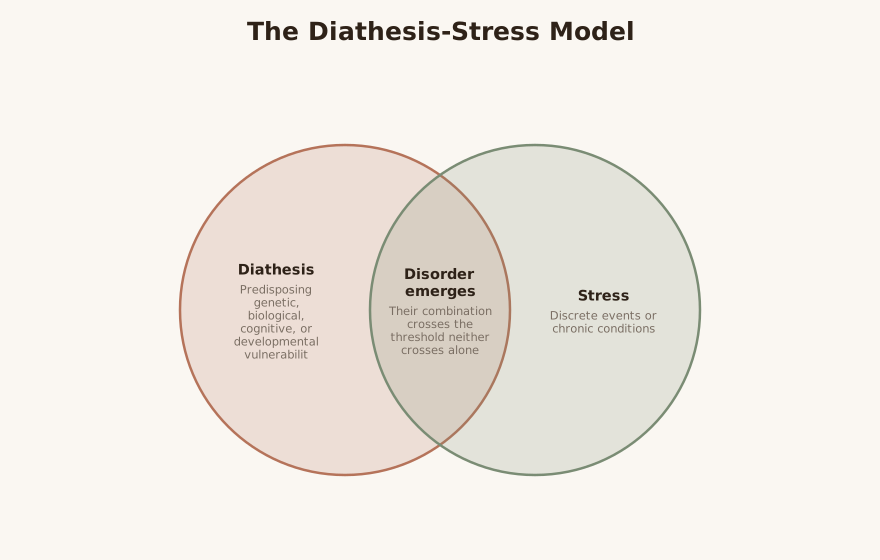
The central claim is interactional: neither vulnerability alone nor stress alone is typically sufficient to produce disorder, but their combination can be 1. A diathesis may be genetic, biological, psychological, cognitive, or developmental—for example, a family history of mood disorder, temperamental traits, maladaptive schemas, or early adverse experiences that sensitize later responding 3. Stress encompasses both discrete events, such as bereavement or divorce, and chronic conditions, such as poverty or ongoing illness 2. A widely used teaching image is the “cup” or threshold analogy: each person holds a cup whose pre-filled level reflects their vulnerability, so that individuals with greater diathesis need far less additional stress to overflow into disorder 3. Critically, the model is not purely additive in every formulation; vulnerability often determines sensitivity to stress, such that highly vulnerable people react to stressors that would leave a low-vulnerability person unaffected 4. The framework is explicitly probabilistic rather than deterministic, describing risk and likelihood rather than certainty 5.
Protective factors are an essential and sometimes neglected half of the model LLM. Resources such as supportive relationships, secure attachment, self-esteem, and effective coping can buffer the impact of stressors and raise the effective threshold at which disorder emerges 3. This buffering logic is what makes the model genuinely clinical rather than merely descriptive: vulnerability is fixed or slow-changing, but stress exposure and protective resources are both modifiable LLM.
Interventions & Techniques
The diathesis-stress model is a formulation framework, not a treatment package, so its “interventions” are really the implications it carries for whatever evidence-based modality a clinician is already using LLM. First, it directs assessment toward a careful inventory of both vulnerabilities and current and historical stressors, including family psychiatric history, temperament, early adversity, and present life load 4. Second, because diatheses are largely not directly modifiable, intervention concentrates on the two malleable levers: reducing or better managing stress exposure, and strengthening protective and coping resources 3. Practically, this maps onto stress-reduction and problem-solving work, skills training for emotion regulation and distress tolerance, cognitive restructuring of stress-amplifying appraisals, and deliberate cultivation of social support and self-efficacy LLM. Third, the model grounds psychoeducation: explaining to clients that they carry a vulnerability that is activated, not caused outright, by stress can reframe self-blame and motivate stress management 5. In relapse-oriented care for recurrent conditions such as depression or psychosis, the framework supports early-warning-sign monitoring and threshold-protective routines around sleep, substances, and life stress LLM.
LLM-generated illustrative example (not a guideline): A clinician working with a client who has a first-degree relative with bipolar disorder uses the model to frame sleep, stimulant use, and unstructured high-stress periods as threshold-lowering factors, and collaboratively builds a routine that protects sleep and pre-plans support during predictable stressors LLM.
Evidence Base
Honesty about maturity matters here. As a broad organizing framework, the diathesis-stress model is firmly established and has structured psychopathology research and teaching for over half a century 2. It enjoys strong face validity, is consistent with the observation that not everyone exposed to the same stressor develops disorder, and underpins well-supported disorder-specific models, particularly in schizophrenia and depression 3. That said, “established” describes the framework’s dominance and utility more than the confirmation of any single mechanism LLM. The model is broad enough that it can be difficult to falsify, and critics note that it risks becoming an after-the-fact explanation for almost any outcome LLM. At the molecular level, early enthusiasm for specific gene-by-environment findings—most famously the serotonin-transporter (5-HTTLPR) by life-stress interaction in depression—was tempered by notable replication failures and meta-analytic disputes, a cautionary tale about over-reading specific G×E claims LLM. The framework also evolved in response to its own limits: the differential susceptibility hypothesis reframes some “vulnerabilities” as plasticity factors that confer worse outcomes in bad environments but better outcomes in good ones, complicating the original risk-only reading 2. The fair summary is a durable, clinically indispensable heuristic whose general shape is well supported even where specific causal pathways remain contested LLM.
Populations & Indications
Because it is transdiagnostic, the model is relevant across most clinical populations, but it is especially useful where vulnerability and stress visibly interact LLM. It is well suited to clients with a family history of mood, psychotic, or substance use disorders, where genetic or familial diathesis is salient 3. It is valuable with trauma-exposed clients, where early adversity functions as a sensitizing developmental diathesis for later stress reactivity 2. It fits adolescents and emerging adults at the onset of first episodes, a developmental window in which many disorders first cross threshold 5. It supports relapse-prevention work in recurrent depression and psychosis, where the goal is to keep cumulative load below the threshold LLM. It also helps frame high-stress occupational populations, where otherwise sub-threshold vulnerabilities may be pushed into expression by sustained demand LLM.
Problems-for-Work
The model translates naturally into concrete problems-for-work LLM. Stress reactivity and dysregulation can be addressed by helping a client see how their particular vulnerability amplifies ordinary stressors and then building regulation skills to lower that amplification 4. Relapse and recurrence become workable when client and clinician monitor cumulative load and protect threshold-raising routines LLM. Internalized self-blame—the painful “what’s wrong with me that this happened”—can be reframed through psychoeducation that locates the cause in an interaction rather than a personal defect 5. Hopelessness rooted in familial or genetic fatalism can be countered by emphasizing that the modifiable levers are stress and protection, not destiny LLM. Difficulty identifying and modifying stressors is a direct target of the assessment inventory the model prescribes 4. Underdeveloped protective factors become an explicit treatment focus, since strengthening support, coping, and self-efficacy raises the effective threshold 3.
LLM-generated illustrative example (not a guideline): A client with recurrent depression and a perfectionistic cognitive style maps, with the clinician, how high-stakes work deadlines reliably precede low episodes; together they treat the perfectionistic appraisals as a vulnerability and the deadline crunches as predictable stressors, intervening on both LLM.
Contraindications, Cautions & Cultural Humility
The model carries no contraindications as such, since it is a way of thinking rather than a procedure, but it can be misapplied LLM. The most common error is sliding from “predisposition” into biological or genetic determinism, which can deepen hopelessness rather than relieve it; clinicians should foreground modifiability 5. A second caution is that the framework can pathologize normal responses to genuinely toxic environments, locating the “problem” inside the person when the stressor itself is the appropriate target of change LLM. Cultural humility is essential: what counts as a stressor, what supports buffer it, and how distress is expressed are all culturally shaped, and structural stressors such as racism, poverty, and discrimination are themselves powerful, ongoing diathesis-activating loads that should not be reframed as individual vulnerability LLM. Used well, the model’s attention to protective factors and resilience invites a strengths-based, context-aware stance rather than a deficit one 3.
Treatment-Plan Suggestions & SMART Objectives
| Goal | SMART objective (example) | Mechanism |
|---|---|---|
| Build a shared etiological formulation | Within 3 sessions, client will name two personal vulnerabilities and two current stressors with the clinician | Externalizes cause as interaction, reducing self-blame |
| Reduce modifiable stress load | Over 6 weeks, client will identify and reduce or restructure one chronic stressor, rated weekly | Lowers cumulative input toward threshold |
| Strengthen protective factors | Within 8 weeks, client will add two buffering resources (e.g., one support contact, one coping routine) | Raises the effective threshold for onset |
| Improve stress appraisal | In 5 sessions, client will use cognitive restructuring on stress-amplifying thoughts in 3 logged situations | Reduces vulnerability-driven reactivity |
| Establish relapse early-warning plan | Within 4 sessions, client will list 3 personal early-warning signs and a 3-step response | Detects threshold approach before full episode |
| Protect threshold-raising routines | Daily for 30 days, client will track sleep and substance use against a target | Stabilizes physiological buffers against stress |
| Reduce fatalistic hopelessness | Within 6 sessions, client will articulate two modifiable levers in their own words, self-rated for belief | Shifts locus from destiny to agency |
Common Misconceptions
A frequent misconception is that a diathesis guarantees the disorder; in fact the model is explicitly probabilistic, and many vulnerable individuals never cross threshold 5. Another is that “diathesis” means “genetic”—it can be genetic, but it also includes cognitive, developmental, and acquired psychological vulnerabilities 3. A third is that stress alone causes disorder; the model’s whole point is that identical stressors produce divergent outcomes depending on vulnerability and protection 1. Some assume the relationship is simply additive, when in many formulations vulnerability multiplies sensitivity to stress rather than just summing with it 4. Finally, clinicians sometimes forget the protective half of the model and treat it as a pure risk framework, missing its most actionable, strengths-based implications LLM.
Training & Certification
There is no certification in the diathesis-stress model, and none is needed: it is foundational content in undergraduate and graduate psychopathology curricula rather than a credentialed modality 5. Clinicians absorb it through abnormal psychology coursework, where it is a standard explanatory framework, and through the disorder-specific models built on it 2. Competent application instead rests on general clinical training in assessment, case formulation, and an evidence-based treatment modality into which the framework can be embedded LLM. Freely available academic overviews and tutorials, including the introductory video and explainer resources listed below, are sufficient for grounding in the concept 6.
Key Terms
Diathesis — a predisposition or vulnerability to a disorder, which may be genetic, biological, psychological, cognitive, or developmental 1. Stress — environmental or life-event demands, acute or chronic, that tax coping and can trigger disorder onset 2. Threshold — the point at which combined vulnerability and stress exceed the person’s capacity and disorder becomes likely, often taught via the “cup” analogy 3. Protective factors — resources such as support, attachment, and coping that buffer stress and raise the effective threshold 3. Schizotaxia / schizotypy — Meehl’s terms for an inherited neural vulnerability and its partial behavioral expression on the path toward schizophrenia 2. Differential susceptibility — an evolution of the model in which some “vulnerability” factors are better understood as plasticity, yielding worse outcomes in adverse and better outcomes in supportive environments 2.
Resources & Further Reading
▶ Watch — a video introduction to this concept:
- Diathesis-Stress Model in Psychology — Simply Psychology
- Diathesis-stress model — Wikipedia
- Diathesis-Stress Model — ScienceDirect Topics overview
- Diathesis-stress model — EBSCO Research Starters
- The Diathesis-Stress Model — Psych Exam Review
- The Diathesis Stress Model (Intro Psych Tutorial #225) — YouTube
Reflective / Supervision Questions
- For a current client, can you articulate the specific diathesis and the specific stressors, and which of the two is actually modifiable in treatment? LLM
- Where might you be over-attributing distress to internal vulnerability when a toxic or structural stressor is the more appropriate target of change? LLM
- Have you mapped the client’s protective factors as carefully as their risks, and are you building any of them as an explicit goal? LLM
- How do you present this framework to clients in a way that reduces self-blame without sliding into genetic fatalism? LLM
- For clients from cultural contexts different from your own, are you defining stressors, supports, and thresholds through their frame rather than yours? LLM