
Type & Discipline
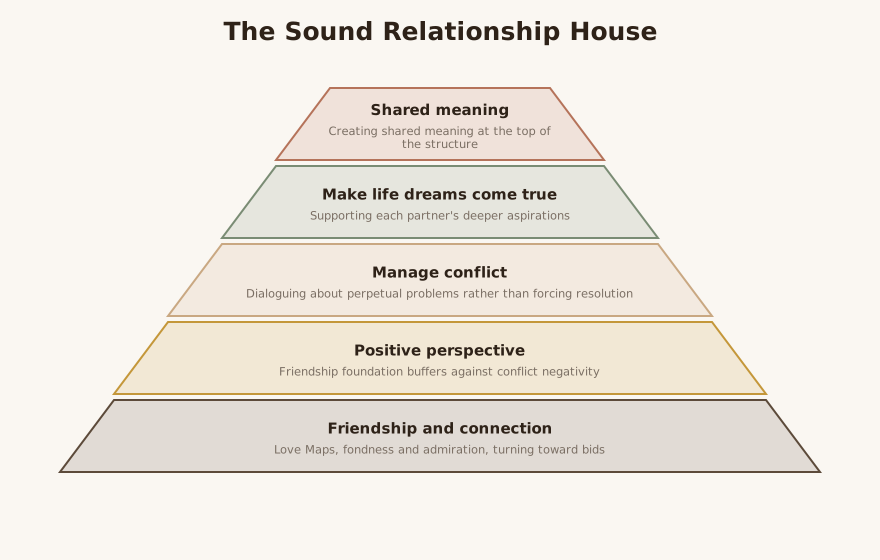
Gottman Method Couples Therapy (GMCT) is a structured, assessment-driven modality within the discipline of couples and family therapy, belonging to the broader family of relational and systems-oriented approaches 1. Unlike approaches that begin primarily from theory, the Gottman Method was derived inductively from decades of observational research on what distinguishes stable, satisfied couples from those who deteriorate or divorce 2. The clinical model translates those empirical findings into a treatment architecture — the “Sound Relationship House” — and into targeted interventions aimed at the specific interaction patterns the research identified as toxic or protective 3.
In practice, GMCT sits alongside other contemporary couple modalities such as Emotionally Focused Therapy and Integrative Behavioral Couples Therapy, sharing their relational focus while remaining distinctive in its heavy emphasis on formal assessment, behavioral skill-building, and physiological regulation during conflict LLM. It is delivered by licensed couples therapists, typically in conjoint sessions with both partners present, and is structured enough to be taught and replicated across clinicians 1.
Creators & Lineage
The method was developed by Dr. John Gottman, a research psychologist, together with Dr. Julie Schwartz Gottman, a clinical psychologist, who jointly founded the Gottman Institute and translated the research program into a clinical model 1. John Gottman’s work is best known for the longitudinal study of couples in an observational “love lab,” where micro-coded interaction data were used to identify behaviors that predicted divorce versus marital stability 2. Julie Gottman’s clinical expertise shaped how those findings became usable interventions for working therapists 1.
The lineage of GMCT intersects several established traditions. Its behavioral skill-building heritage connects it to Behavioral Couples Therapy and Integrative Behavioral Couples Therapy, while its attention to emotional connection, bids for attunement, and the building of trust resonates with attachment theory and Emotionally Focused Therapy LLM. What sets the Gottman approach apart in this lineage is its insistence on grounding each component in observational predictors rather than starting from a single unifying theory of attachment or reinforcement 2.
Core Principles
The organizing framework of GMCT is the Sound Relationship House, a layered model in which each “floor” represents a domain of relationship functioning that the therapy seeks to strengthen 3. The lower levels emphasize friendship and connection — building “Love Maps” (detailed knowledge of a partner’s inner world), nurturing fondness and admiration, and “turning toward” rather than away from a partner’s bids for attention 7. Built on these is the positive perspective, sometimes called positive sentiment override, in which the friendship foundation buffers couples against negativity during conflict 7.
Higher floors address conflict management, making life dreams come true, and creating shared meaning, while two “weight-bearing walls” of trust and commitment run alongside the entire structure 3. A central premise is that not all conflict is solvable; the Gottmans distinguish “perpetual” problems rooted in enduring differences from “solvable” ones, and the goal is to help couples dialogue about perpetual issues rather than resolve them by force 7.
A second core principle is the identification of corrosive communication patterns. The “Four Horsemen” — criticism, contempt, defensiveness, and stonewalling — are framed as the strongest behavioral predictors of relationship breakdown, with contempt regarded as the single most damaging 6. Treatment teaches partners to recognize each Horseman and to substitute its antidote: gentle start-up in place of criticism, a culture of appreciation in place of contempt, taking responsibility in place of defensiveness, and physiological self-soothing in place of stonewalling 6.
Interventions & Techniques
GMCT typically begins with a thorough, structured assessment phase rather than diving immediately into problem-solving 1. Assessment commonly includes a conjoint history-taking session, individual interviews with each partner, standardized questionnaires, and direct observation of the couple attempting to discuss an area of conflict so the therapist can identify the presence of the Four Horsemen and the state of the Sound Relationship House 1.
Interventions are then matched to the floors of the house that are weak 3. Friendship-building work uses Love Map exercises, rituals of connection, and structured practice in turning toward bids 7. Conflict-management work teaches gentle start-up, accepting influence from one’s partner, repair attempts during arguments, and physiological self-soothing to manage flooding — the state of autonomic overwhelm in which productive dialogue becomes impossible 7. For perpetual problems, the therapist guides “dreams within conflict” conversations to surface the deeper hopes and meanings beneath gridlocked positions 7. At the upper floors, couples work on honoring each other’s life dreams and building shared rituals, goals, and symbols of meaning 3.
LLM-generated illustrative example (not a guideline): A couple repeatedly fights about household chores. Rather than negotiating a chore chart immediately, the therapist slows the conversation and discovers that for one partner “a clean home” represents safety carried over from a chaotic childhood, while for the other “rest on weekends” represents being valued rather than used. Reframing the chore fight as a perpetual problem about safety versus feeling valued lets the couple dialogue with curiosity instead of contempt LLM.
Evidence Base
The maturity of the evidence base for GMCT is best described as established but still maturing: there is a strong observational research foundation for the predictive constructs, and a growing but more limited body of controlled outcome studies for the treatment itself 2. The predictive science — that patterns such as contempt forecast divorce — derives from longitudinal observational research and is the most robust part of the literature 2.
Controlled outcome studies are accumulating but remain fewer and smaller than for some comparison modalities LLM. A pilot randomized controlled trial compared Gottman Method Couples Therapy against treatment-as-usual specifically for couples recovering from infidelity, providing one of the more rigorous direct tests of the approach in a high-stakes clinical population 4. Other studies, including quasi-experimental work, have reported improvements in marital adjustment and couples’ intimacy following Gottman couple therapy 5. The Gottman Institute itself maintains a summary of effectiveness research supporting the model’s clinical claims 2. Clinicians should weigh that several outcome studies are small, are conducted by researchers connected to the model, or use designs short of large multi-site RCTs, and should present the evidence to couples honestly rather than overstating it LLM.
Populations & Indications
GMCT is designed for couples across a range of relationship structures and life stages, including married partners, cohabiting partners, and premarital couples preparing for commitment 1. The model has been applied with same-sex couples, consistent with research indicating that the same relationship dynamics and predictors largely generalize across couple types LLM. It is indicated for couples presenting with relationship distress, chronic conflict, erosion of friendship and intimacy, and emotional disengagement 7.
A specific indication of note is recovery after infidelity and betrayal, where the model offers a structured trust-rebuilding pathway and where it has been tested directly against treatment-as-usual 4. More broadly, the method targets the loss of intimacy and friendship that underlies many couples’ decline, aiming to rebuild the lower floors of the Sound Relationship House before tackling conflict 7.
Problems-for-Work
GMCT maps cleanly onto the presenting problems clinicians most often see in couples work LLM. For communication problems and frequent arguments, the therapist names the Four Horsemen as they appear in session and coaches the antidotes, replacing criticism with gentle start-up and defensiveness with taking responsibility 6. For emotional disengagement and loss of friendship, Love Map and turning-toward work rebuilds the connection that buffers conflict 7.
For infidelity and betrayal, the work follows a structured atone-attune-attach sequence of rebuilding trust and commitment, the load-bearing walls of the house, and this application has direct trial support 4. For perpetual conflict over parenting or finances, the “dreams within conflict” method reframes gridlock as a dialogue about underlying values rather than a problem to be won 7. For declining marital adjustment and intimacy, the broader Sound Relationship House intervention has shown improvement in studies of adjustment and intimacy outcomes 5.
LLM-generated illustrative example (not a guideline): A couple presents two years after one partner’s affair, stuck in cycles where the betrayed partner asks repeated questions and the involved partner shuts down (stonewalling). The therapist sequences the work: first genuine atonement and transparency to rebuild trust, then attunement exercises so each can hear the other’s pain without defensiveness, before any conversation about renewing physical intimacy LLM.
Contraindications, Cautions & Cultural Humility
Conjoint couples therapy of any model, including GMCT, is generally contraindicated where there is ongoing situational or characterological intimate partner violence that makes honest disclosure unsafe, and clinicians should screen for violence individually before proceeding LLM. Active untreated substance dependence, ongoing undisclosed affairs, or one partner’s covert intent to exit the relationship can also undermine the conjoint work and may need to be addressed first LLM. The structured, skills-heavy format assumes couples can engage in directed exercises and tolerate observation of their conflict, which may need adaptation for couples in acute crisis or with significant individual psychopathology LLM.
Cultural humility is essential because the underlying research was developed largely within particular cultural and linguistic contexts, and constructs such as “accepting influence,” directness in conflict, or what counts as a “ritual of connection” carry culturally specific meanings LLM. Clinicians should hold the framework loosely enough to honor each couple’s norms around gender roles, family involvement, emotional expression, and the meaning of commitment, rather than imposing a single template of a healthy relationship LLM. The therapist’s task is to use the structure as a map, not a verdict, and to remain curious about how each couple defines a good partnership LLM.
Treatment-Plan Suggestions & SMART Objectives
| Goal | SMART objective (example) | Mechanism |
|---|---|---|
| Reduce destructive conflict communication | Within 8 sessions, both partners will identify their primary “Horseman” in session and demonstrate its antidote in 2 observed conflict discussions | Replacing criticism/contempt/defensiveness/stonewalling with antidotes 6 |
| Rebuild friendship and connection | Over 6 weeks, the couple will complete one Love Map or fondness-and-admiration exercise weekly and report it in session | Strengthening lower floors of the Sound Relationship House 7 |
| Manage physiological flooding | Within 4 sessions, each partner will recognize early flooding cues and use an agreed self-soothing break at least twice during conflict | Self-soothing to restore capacity for dialogue 7 |
| Dialogue about perpetual problems | By session 10, the couple will hold one “dreams within conflict” conversation about a gridlocked issue without escalation | Surfacing values beneath perpetual conflict 7 |
| Rebuild trust after betrayal | Over 12 sessions, the involved partner will maintain transparency agreements and complete atonement steps, with the betrayed partner reporting measurable trust gains | Repairing the trust/commitment walls 4 |
| Improve intimacy and marital adjustment | Within 12 weeks, both partners will show improved scores on a standardized adjustment/intimacy measure | Whole-house intervention improving adjustment and intimacy 5 |
| Increase shared meaning | Over 8 weeks, the couple will define one shared ritual and one honored life dream for each partner | Building the upper floors of the house 3 |
Common Misconceptions
A frequent misconception is that the goal of GMCT is to teach couples to “resolve” all their conflicts; in fact the model holds that most relationship conflict is perpetual and the aim is constructive dialogue, not elimination of disagreement 7. Another is that the Four Horsemen are merely a catchy label rather than empirically derived predictors — in the model they represent behaviors tied to research on relationship breakdown, with contempt singled out as especially corrosive 6.
Clinicians sometimes assume the method is purely about communication skills, but a large portion of the work is relational and emotional — building friendship, fondness, and shared meaning — not just technique drills 7. Finally, the strength of the predictive research is sometimes conflated with an equally large outcome literature; the treatment-effectiveness evidence, while supportive, is still maturing and should be represented as such 2.
Training & Certification
The Gottman Institute, founded by the Gottmans, is the primary body that disseminates training in the method and maintains its clinical and research materials 1. Clinicians typically learn the approach through a sequence of structured training levels that build from the core constructs and assessment through advanced clinical application, culminating in a certification track for those who complete the full curriculum and demonstrate competence LLM. Because “Gottman” branding is widely used, clinicians and couples should distinguish formally trained or certified therapists from those who simply incorporate popularized concepts such as the Four Horsemen LLM.
Key Terms
- Sound Relationship House — the layered architectural model of relationship functioning that organizes assessment and treatment in GMCT 3.
- Four Horsemen — criticism, contempt, defensiveness, and stonewalling; behavioral predictors of relationship breakdown, with contempt the most damaging 6.
- Antidotes — the corrective behaviors taught to replace each Horseman (gentle start-up, appreciation, taking responsibility, self-soothing) 6.
- Love Maps — a partner’s detailed knowledge of the other’s inner world; a foundational friendship system 7.
- Turning toward — responding positively to a partner’s bids for connection rather than turning away or against 7.
- Flooding — autonomic overwhelm during conflict that blocks productive dialogue and calls for self-soothing 7.
- Perpetual vs. solvable problems — the distinction between enduring differences to be dialogued about and situational issues that can be resolved 7.
- Positive perspective / sentiment override — the buffering effect of a strong friendship foundation on conflict 7.
Resources & Further Reading
▶ Watch — a video introduction to this concept:
- The Gottman Method (overview) — The Gottman Institute
- The Effectiveness of the Gottman Method — Research
- Sound Relationship House in Gottman Method Couples Therapy (Encyclopedia of Couple and Family Therapy)
- A Pilot RCT: Gottman Method vs Treatment-as-Usual for Infidelity (Irvine et al., 2024)
- Effectiveness of Gottman Couple Therapy on Marital Adjustment and Intimacy (PMC)
- Four Horsemen of the Apocalypse — The Gottman Institute (video)
- The Sound Relationship House Theory (Gottman Institute white paper, PDF)
Reflective / Supervision Questions
- When you observe a Horseman in a couples session, how readily can you name it without inducing shame in the partner who showed it, and what helps you maintain that balance? LLM
- How do you decide which floor of the Sound Relationship House to intervene on first when several appear weak, and what guides sequencing for a couple in acute crisis? LLM
- How do you talk with couples about the difference between the strong predictive research and the still-maturing outcome evidence without undermining their hope or your credibility? 2
- Where might the model’s culturally embedded assumptions (about influence, directness, or rituals) clash with a particular couple’s values, and how do you adapt? LLM
- How do you screen for intimate partner violence and other contraindications before committing to conjoint Gottman work? LLM