
Type & Discipline
Gottman Method Communication Concepts are a cluster of observational constructs drawn from clinical psychology and the empirical study of couples LLM. They are not a freestanding therapy but a descriptive and diagnostic vocabulary — the Four Horsemen, softened start-up, physiological flooding, and repair attempts — that sits inside the broader Gottman Method Couples Therapy and is taught widely across couples work LLM. The constructs originated in laboratory research that coded what distressed and stable couples actually do during conflict, linking specific behaviors to later relationship dissolution 1. Because they are behaviorally anchored and observable, they translate easily into session-by-session assessment and feedback for practicing therapists LLM.
Creators & Lineage
The concepts come primarily from John Gottman and his long-running collaboration with psychophysiologist Robert Levenson, whose 1992 study tied marital interaction patterns and physiological arousal to later dissolution 1. John Gottman later formalized these observations into a broader theory of marital stability and breakup, articulating how negative interaction sequences predict trajectories over time 2. Julie Gottman co-developed the clinical application and the training infrastructure now disseminated through The Gottman Institute LLM. The lineage intersects behavioral couples therapy (its observational, behavior-coding heritage) and attachment theory, and it is frequently contrasted with emotionally focused therapy (EFT), which targets attachment-driven emotional cycles rather than discrete communication behaviors LLM.
Core Principles
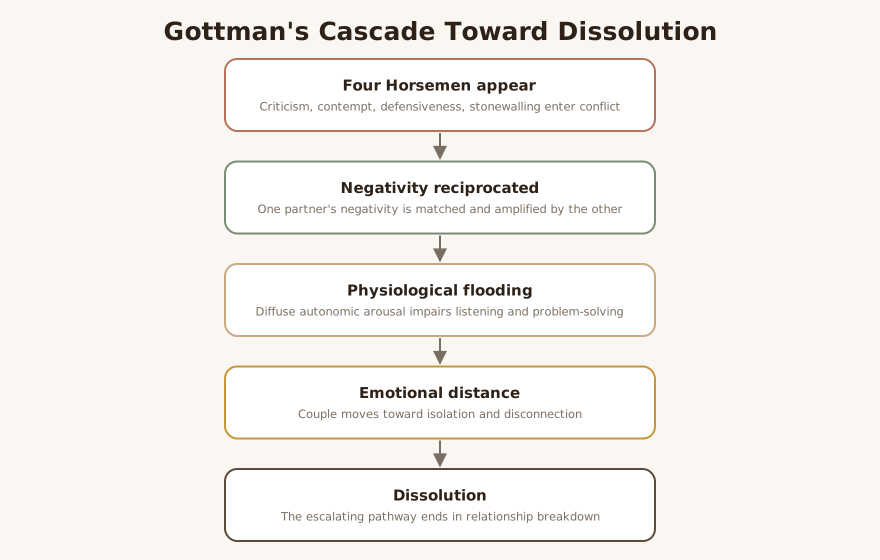
The central principle is that how couples handle conflict — not whether they have it — discriminates stable from distressing relationships 1. Four corrosive communication behaviors, the “Four Horsemen,” are especially predictive: criticism, contempt, defensiveness, and stonewalling 3. Contempt — communicating disgust or superiority — is treated as the single strongest predictor of relationship breakdown 3. A second principle is physiological: during escalating conflict, partners can become “flooded,” a state of diffuse autonomic arousal that impairs listening and problem-solving and is associated with poorer outcomes 1. A third principle is sequential: negative behaviors tend to cascade, with one partner’s negativity reciprocated and amplified, moving a couple along a pathway toward emotional distance, isolation, and eventual dissolution 5. The framework also holds that these patterns are modifiable — each Horseman has a specific “antidote” — so the constructs are simultaneously diagnostic and prescriptive 3.
Interventions & Techniques
Each Horseman is paired with a concrete antidote that clinicians coach directly 3. Criticism (attacking a partner’s character) is replaced with softened or gentle start-up — stating a feeling and a specific positive need without blame 3. Contempt is countered by building a culture of appreciation and fondness so that disgust gives way to expressed respect 3. Defensiveness (counter-attacking or playing victim) is met by taking responsibility for even a small part of the problem 3. Stonewalling (withdrawing and shutting down) is addressed through self-soothing: recognizing flooding, taking a structured break of at least twenty minutes, and doing something genuinely calming before re-engaging 3. The handout materials operationalize these antidotes into partner-facing language couples can rehearse between sessions 6. Layered over the antidotes are repair attempts — any statement or gesture that de-escalates tension — which the framework treats as a critical skill to identify, amplify, and teach partners to send and to receive 4.
LLM-generated illustrative example (not a guideline): A clinician notices that whenever one partner says “You never help,” the other rolls their eyes and counters with “Well you never thank me.” The therapist names the criticism-and-defensiveness loop in the moment, then coaches a softened start-up — “I felt overwhelmed last night; I’d love a hand with bedtime” — and asks the listener to find one piece of the concern to own LLM.
Evidence Base
The maturity of these constructs is best described as established: they are clinically adopted, extensively taught, and grounded in observational research linking conflict behavior to later dissolution 1. The foundational longitudinal work followed couples over years and connected behavioral coding plus physiological measures to relationship outcomes, lending the framework genuine empirical roots 1. The theory of marital dissolution and stability extended this into a structured account of how negativity accumulates toward breakup 2. Honesty requires noting the limits: the most dramatic claims — widely cited divorce-prediction accuracies above 90% — derive largely from the Gottman lab’s own samples and have drawn methodological criticism for post-hoc model fitting, prediction of pre-selected outcomes, and modest independent replication LLM. The descriptive validity of the Four Horsemen as common, recognizable distress markers is far better supported than any single point-estimate of predictive accuracy LLM. Clinicians should present the constructs as robust clinical heuristics rather than as a calibrated actuarial tool LLM.
Populations & Indications
The constructs were developed with and apply most directly to couples — married, premarital, and cohabiting partners — presenting with conflict, communication breakdown, or eroding intimacy LLM. They are routinely applied with same-sex couples, and the underlying conflict dynamics appear across relationship configurations rather than being specific to heterosexual marriage LLM. The vocabulary also transfers usefully to family work, where criticism, contempt, defensiveness, and stonewalling describe parent-child and sibling interactions, though the empirical base is strongest for adult dyads LLM. Indications include chronic relationship conflict, frequent arguments, resentment, defensiveness, emotional withdrawal, and a partner’s report of “the same fight over and over” LLM. The framework is well suited to couples who can tolerate in-session feedback and behavioral rehearsal LLM.
Problems-for-Work
The constructs map cleanly onto presenting problems and give therapists a shared language for treatment targets LLM. For criticism and contempt patterns, the work is to convert character attacks into specific complaints and to rebuild expressed appreciation 3. For defensiveness, the target is shifting from counter-attack to partial responsibility-taking 3. For emotional withdrawal / stonewalling, the work centers on recognizing flooding and using self-soothing breaks rather than shutting down 3. For communication problems and frequent arguments, softened start-up and repair attempts become the primary skills practiced 3. For resentment and loss of intimacy, the culture-of-appreciation antidote and amplified repair attempts are the levers 3.
LLM-generated illustrative example (not a guideline): A partner who reports “I just go silent because there’s no point” is helped to notice a racing heart and the urge to leave as flooding cues, agree on a hand signal for a 30-minute break, and name a return time so withdrawal becomes a negotiated pause rather than abandonment LLM.
Contraindications, Cautions & Cultural Humility
Skills-based communication coaching is contraindicated as a first move when intimate partner violence, coercive control, or active safety risk is present, because teaching a frightened partner to “soften start-up” can increase risk and implies symmetrical responsibility where there is none LLM. Untreated active addiction, acute psychiatric crisis, or one partner secretly committed to leaving can also undermine the work and warrant screening before conjoint communication training LLM. Culturally, the antidotes encode particular norms — direct verbal expression of needs, sustained eye contact, comfort with confrontation — that are not universal; what reads as “stonewalling” may be a culturally normative cooling-off practice, and silence is not always withdrawal LLM. Contempt’s facial markers and the meaning of repair gestures also vary across cultures, so clinicians should calibrate to each couple’s communication norms rather than impose the model’s defaults LLM. The framework can pathologize ordinary conflict if applied rigidly, so naming patterns should be done collaboratively and non-shamingly LLM.
Treatment-Plan Suggestions & SMART Objectives
| Goal | SMART objective (example) | Mechanism |
|---|---|---|
| Reduce criticism | Within 6 sessions, partners convert at least 3 of 5 observed complaints into softened start-ups during in-session role-play | Replaces character attack with specific need 3 |
| Reduce contempt | Over 8 weeks, each partner logs and shares 2 expressions of appreciation per day, reviewed weekly | Builds culture of fondness countering disgust 3 |
| Reduce defensiveness | By session 8, the listening partner takes partial responsibility in 60% of coded conflict exchanges | Interrupts counter-attack cycle 3 |
| Manage flooding | Within 4 weeks, partners identify physiological cues and use a 20+ minute self-soothing break before re-engaging | Lowers diffuse autonomic arousal 1 |
| Increase repair | Over 6 sessions, partners send and verbally accept at least 1 repair attempt per conflict discussion | Amplifies de-escalation skill 4 |
| Reduce reciprocated negativity | By session 10, observed negative-affect reciprocity drops measurably in recorded exchanges | Disrupts the escalation cascade 5 |
| Restore intimacy | Within 8 weeks, partners report 1 positive connection ritual completed daily | Rebuilds fondness/closeness 3 |
Common Misconceptions
A frequent misconception is that conflict itself is the problem; the framework holds that conflict is normal and that the style of conflict is what matters 1. Another is that the Four Horsemen predict divorce with near-certainty for any given couple, when the headline accuracy figures are lab-specific and contested LLM. Clinicians sometimes treat stonewalling as deliberate punishment, missing that it is often a physiological shutdown under flooding rather than a strategic move 3. The model is also mistaken for the entirety of Gottman Method Couples Therapy, when these communication concepts are one layer within a larger clinical system LLM. Finally, the antidotes are not one-time fixes but skills requiring sustained practice and rehearsal 6.
Training & Certification
The communication concepts can be learned and applied by any couples or family clinician from published descriptions and handouts, and do not require formal certification to use as assessment and coaching tools LLM. Structured training in the full Gottman Method is offered through The Gottman Institute as tiered clinical workshops (commonly described as Levels 1 through 3) and a separate certification track for therapists who complete supervised consultation and case review LLM. Many practitioners integrate the Four Horsemen and repair work into their existing modality without pursuing certification, while certification signals fidelity to the full method LLM. Clinicians new to the constructs benefit from reviewing the Institute’s primary explanatory materials and demonstration video to anchor accurate definitions before coaching couples 3.
Key Terms
Four Horsemen — criticism, contempt, defensiveness, and stonewalling; the four communication behaviors most associated with relationship distress and dissolution 3. Contempt — communication conveying disgust or superiority, treated as the strongest single predictor of breakdown 3. Softened (gentle) start-up — raising an issue with a feeling and specific positive need rather than blame, the antidote to criticism 3. Flooding — diffuse physiological arousal during conflict that impairs reasoning and listening 1. Repair attempt — any de-escalating statement or gesture that interrupts conflict escalation 4. Negative-affect reciprocity / cascade — the tendency for one partner’s negativity to provoke and amplify the other’s, moving the couple toward distance and dissolution 5.
Resources & Further Reading
▶ Watch — a video introduction to this concept:
- Gottman, J. M., & Levenson, R. W. (1992). Marital processes predictive of later dissolution (PubMed) 1
- Gottman, J. M. — A Theory of Marital Dissolution and Stability (full PDF) 2
- The Four Horsemen: Criticism, Contempt, Defensiveness, and Stonewalling — The Gottman Institute 3
- The Four Horsemen of the Apocalypse — The Gottman Institute (video) 4
- Cascade Model of Relational Dissolution — Wikipedia 5
- The Four Horsemen handout (PDF) — Keeping It Real CF / Gottman materials 6
Reflective / Supervision Questions
- When you name a Horseman in session, are you doing it collaboratively and non-shamingly, or could the couple experience it as the therapist taking sides? LLM
- How do you distinguish culturally normative cooling-off from clinically significant stonewalling in the couples you see? LLM
- Have you screened for intimate partner violence and coercive control before teaching symmetrical communication skills? LLM
- How do you handle a partner who weaponizes the framework, labeling everything the other does as “contempt”? LLM
- When you cite predictive findings to a couple, are you representing them honestly given the methodological caveats? LLM
- Which of your own conflict habits surface as countertransference when a couple escalates in front of you? LLM