
Type & Discipline
The Family Life Cycle is a developmental framework — an organizing lens for understanding individuals and families in motion through time — rather than a discrete treatment protocol 1. It sits at the intersection of family sociology and family therapy, drawing on the observation that families, like individuals, pass through predictable and normatively expectable stages 5. Each stage carries characteristic developmental tasks, and the transitions between stages are where the system is most likely to destabilize and generate symptoms 2. Clinically, it functions as a case-conceptualization and assessment scaffold: a way to locate a presenting problem within the family’s current developmental context rather than treating it as free-floating pathology 3. Because it is descriptive and heuristic, it is most useful when paired with a recognized treatment modality rather than deployed as a stand-alone intervention LLM.
Creators & Lineage
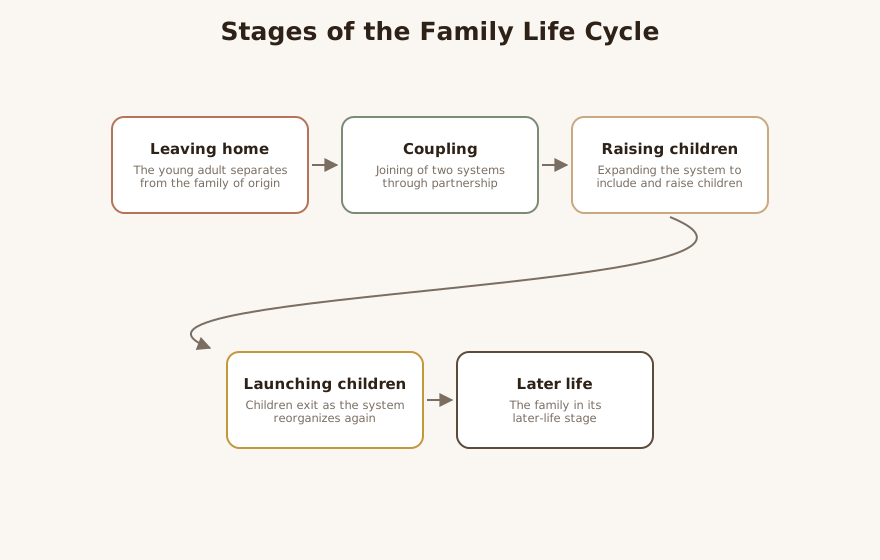
The sociologist Evelyn Duvall is generally credited with articulating an early stage-based model of family development in the mid-twentieth century, anchoring stages to the ages and milestones of children 5. Betty Carter and Monica McGoldrick then reframed the model through a family-systems lens, emphasizing emotional process, multigenerational transmission, and the relational reorganization demanded by each transition 6. Their model is the one most clinicians now recognize, often rendered as the well-known Carter & McGoldrick stage diagram 6. In successive editions of The Expanded Family Life Cycle, McGoldrick, Carter, and Nydia Garcia-Preto broadened the framework to foreground culture, class, gender, sexual orientation, and migration 2. The framework’s intellectual lineage runs through family systems theory and Bowen family systems theory — from which it borrows multigenerational and emotional-process concepts — as well as structural family therapy and developmental psychology 2. Reading it as a hybrid of sociological stage theory and systemic clinical thinking helps explain both its breadth and its descriptive (rather than predictive) character LLM.
Core Principles
The framework’s organizing claim is that the family is a multigenerational emotional system moving through time, and that development is best understood at the level of the system, not just the individual 5. Stress is conceptualized along two axes 2. Vertical stressors are transmitted down the generations — family patterns, attitudes, secrets, expectations, and legacies of trauma or migration 2. Horizontal stressors unfold across time and include both predictable developmental transitions and unpredictable events such as illness or untimely death 2. Symptoms are most likely to emerge when a horizontal transition intersects with a heavily loaded vertical theme 2. A second principle is that transitions, not stable stages, are the high-risk moments: the system must renegotiate membership, roles, and rules to accommodate entrances and exits 6. A third is that the framework is normative but not prescriptive — the “stages” describe culturally common sequences, not a required or healthy path 1. Used well, it reframes a client’s distress as a difficulty negotiating a transition rather than as an individual deficit 3.
Interventions & Techniques
The framework is applied chiefly through assessment and reformulation rather than a fixed set of techniques 3. Clinicians often begin by locating the family at its current stage and naming the developmental tasks that stage requires 6. A genogram is the signature tool, mapping at least three generations to surface vertical stressors, repeating patterns, and coincidences of timing across the system 2. Normalizing the distress of transition — telling a couple that the arrival of a first child predictably strains the dyad — reduces shame and reframes the problem as developmental rather than characterological 3. Tracking the intersection of horizontal and vertical stress helps the clinician hypothesize why a symptom surfaced now 2. The framework then hands off to active intervention within a recognized modality: structural work to realign subsystems and boundaries, Bowenian coaching toward differentiation, or psychoeducation about the tasks of the stage LLM.
LLM-generated illustrative example (not a guideline): A 16-year-old’s escalating defiance is reframed not as oppositional pathology but as a “launching” transition the family has not yet renegotiated — the parents are still operating with rules suited to a younger child, and the adolescent’s push for autonomy is developmentally on time LLM.
Evidence Base
The honest characterization is that the family life cycle is an established framework with mature clinical adoption but limited outcome evidence as a treatment 1. It is universally taught, embedded in family-therapy training, and validated primarily by clinical utility, face validity, and decades of practitioner use rather than by randomized controlled trials 5. There is no body of efficacy research showing that “family life cycle therapy” produces superior outcomes, because it is not a manualized therapy in that sense LLM. Its empirical support is closer to that of a developmental-descriptive model: studies and clinical literature have used family stages as a meaningful context for understanding individual development and family stress 5. The framework’s value, therefore, is conceptual — it improves formulation and treatment planning — and clinicians should not overstate it as an evidence-based intervention LLM. Where it strengthens engagement and normalization, those are plausible but not rigorously quantified mechanisms 3.
Populations & Indications
The framework applies broadly because every family is somewhere in the cycle, but it is most clinically useful around transition points 6. Adolescents leaving home and their parents — the launching and “empty nest” transitions — are a classic indication, as the system reorganizes around departure and renegotiated autonomy 2. Newly married or newly committed couples face the task of forming a new dyad and renegotiating ties to families of origin 6. Parents at the arrival of children must absorb new members and roles, a frequently destabilizing horizontal stressor 2. Families in later life confront retirement, declining health, caregiving, and loss, with shifting generational hierarchies 4. Blended families face the framework’s expanded territory: divorce, remarriage, and the merging of subsystems on different developmental timelines 2. Across all of these, couples and families presenting with conflict tied to a recent or impending transition are strong candidates for this lens 3.
Problems-for-Work
- Life transition stress / developmental crises — Naming the current stage’s tasks reframes distress as expectable, e.g., a couple overwhelmed after a first birth is helped to see the strain as a predictable dyad-to-triad reorganization 2.
- Family conflict — Conflict is located in a stuck transition, e.g., parents and a teen clashing because household rules have not been updated for the launching stage 3.
- Parent-child relational problem — Mapping vertical patterns reveals how a parent’s own family-of-origin experience is being replayed in the current generation 2.
- Empty nest distress — The launched-children stage is normalized while the couple is helped to redefine the marital relationship after parenting recedes 4.
- Marital distress — Locating the couple in the cycle distinguishes a relational deficit from a transition-driven strain that many couples share 3.
- Caregiver burden — In later-life families, shifting hierarchies and role reversal are surfaced and renegotiated rather than left implicit 4.
- Adjustment disorder — The framework supplies the “identifiable stressor” context, linking symptom onset to a specific developmental or unpredictable transition 1.
Contraindications, Cautions & Cultural Humility
The framework has no physical contraindications, but it carries a significant conceptual hazard: the original stage models were built around a normative white, middle-class, heterosexual, intact nuclear family, and applying that template uncritically can pathologize families who deviate from it 2. The expanded model exists precisely to correct this, foregrounding culture, class, gender, sexual orientation, immigration, and diverse family forms — single-parent, blended, multigenerational, and LGBTQ+ individuals families do not follow the classic sequence and should not be measured against it 2. Clinicians should treat the stages as a heuristic about common sequences, never as a developmental yardstick of health 1. Cultural humility means asking how a given family defines its own transitions and life tasks rather than importing assumptions about when a child should “leave home” or what coupling should look like 3. There is also a temporal-bias caution: cohort, economic conditions, and historical change reshape the timing and even the existence of stages 5.
LLM-generated illustrative example (not a guideline): In some immigrant families, multigenerational cohabitation and delayed “launching” are culturally normative strengths, not signs of enmeshment; reading them through the classic model risks mislabeling a healthy arrangement as developmentally stuck LLM.
Treatment-Plan Suggestions & SMART Objectives
| Goal | SMART objective (example) | Mechanism |
|---|---|---|
| Normalize a developmental transition | Within 4 sessions, couple will identify 3 expectable tasks of their current stage and rate distress as transition-related, reducing self-blame scores 3 | Reframing symptom as developmental, reducing shame 3 |
| Renegotiate family roles at launching | Within 8 weeks, family will establish 2 revised household agreements reflecting the adolescent’s increased autonomy LLM | Realigning subsystem boundaries to stage tasks 6 |
| Surface vertical stressors | By session 3, complete a 3-generation genogram identifying 2 recurring multigenerational patterns 2 | Making transmitted patterns explicit and workable 2 |
| Redefine the couple after children launch | Within 6 sessions, couple will schedule and complete 4 shared dyadic activities and report renewed connection 4 | Reconstituting the marital subsystem post-parenting 2 |
| Reduce caregiver burden in later life | Within 6 weeks, family will distribute 3 specific caregiving tasks and the primary caregiver will report lowered burden 4 | Renegotiating generational hierarchy and roles 4 |
| Integrate a blended-family subsystem | Within 10 weeks, stepfamily will agree on parenting roles and report fewer weekly conflicts 2 | Merging subsystems on differing timelines 2 |
| Link symptom onset to a stressor | By session 2, client and clinician will articulate the transition coinciding with symptom onset 1 | Establishing the developmental context of distress 1 |
Common Misconceptions
A frequent error is treating the stages as a fixed, universal, or required sequence; they are culturally common patterns, not a developmental law 1. A second is assuming the framework prescribes what a healthy family looks like — it describes typical transitions, it does not certify normalcy 2. A third is conflating the framework with an evidence-based treatment: there is no outcome literature establishing “family life cycle therapy” as efficacious, and presenting it that way overstates its status LLM. Clinicians also sometimes locate distress only in the visible horizontal transition while ignoring the vertical, multigenerational loading that explains its intensity 2. Finally, some treat the original nuclear-family stages as still authoritative; the expanded model explicitly supersedes that narrow template 2.
Training & Certification
There is no certification in the family life cycle itself, because it is a framework taught within broader clinical training rather than a credentialed modality LLM. It is standard curriculum in marriage and family therapy, social work, and counseling programs, and is typically learned alongside genogram construction and family-systems theory 3. Clinicians deepen competence through the expanded-model texts, supervised family and couples work, and training in the parent modalities — Bowen family systems and structural family therapy — within which it is operationalized 2. Practitioners seeking formal credentials pursue family-therapy licensure or certification in a specific systemic modality, using the life-cycle framework as a conceptual through-line rather than the certifiable endpoint LLM.
Key Terms
- Family life cycle — The sequence of normatively expectable developmental stages a family moves through over time 5.
- Developmental task — The specific reorganization a family must accomplish to move through a given stage 6.
- Transition — The high-risk passage between stages, requiring renegotiation of membership, roles, and rules 6.
- Vertical stressors — Patterns, expectations, and legacies transmitted down the generations 2.
- Horizontal stressors — Developmental and unpredictable events unfolding across time 2.
- Launching — The stage of children leaving home and the system reorganizing around departure 2.
- Genogram — A multigenerational map used to surface vertical patterns and timing 2.
Resources & Further Reading
▶ Watch — a video introduction to this concept:
- The family life cycle — APA PsycNet record
- The Expanded Family Life Cycle: Individual, Family, and Social Perspectives (McGoldrick, Carter, Garcia-Preto)
- The Family Life Cycle: A Framework for Understanding Client Contexts (Therapy Trainings)
- Exploring the Family Life Cycle — APA Division 43 newsletter (2011)
- Family Life Cycle Stages: A Context for Individual Life Stages (Journal of Family Social Work)
- The family life-cycle model (Carter & McGoldrick, 2003) — diagram (ResearchGate)
Reflective / Supervision Questions
- Where is this family in the life cycle, and which transition is currently active or stalled? 6
- Am I reading a presenting symptom as individual pathology when it may be a stuck developmental transition? 3
- What vertical stressors — multigenerational patterns, legacies, secrets — are loading the current horizontal transition? 2
- Am I applying the classic nuclear-family stages as a yardstick, and how does this family define its own transitions and tasks? 2
- How do this family’s culture, class, migration history, and structure reshape the timing and meaning of the “expected” stages? 2
- Within which billable modality am I operationalizing this lens, and is my documentation framed accordingly? LLM