
Type & Discipline
Functional Family Therapy (FFT) is a manualized, short-term, phase-based family intervention designed primarily for adolescents (roughly ages 11-18) presenting with behavioral, conduct, delinquency, and substance use problems 3. It sits within family therapy and community mental health and is most commonly delivered through juvenile justice, child welfare, and behavioral health systems rather than as a freestanding private-practice service 2. The model is a relational, systems-oriented treatment that integrates a strong behavioral and cognitive-behavioral skills component, making it a hybrid of systemic and behavioral traditions 5.
FFT is typically delivered in 8-12 sessions for mild cases and up to roughly 26-30 sessions for more severe presentations, usually over a three- to six-month window 2. Sessions are most often conducted with the whole family in the home or clinic, with the therapist carrying a deliberately small caseload to preserve fidelity and engagement 5. It is a brand-protected, organizationally licensed program: agencies contract with the purveyor (FFT LLC) for training, supervision, and adherence monitoring rather than individual clinicians simply reading the manual 1.
Creators & Lineage
FFT was developed in the late 1960s and early 1970s by James Alexander and Bruce Parsons, who sought a brief, testable family intervention for delinquent adolescents at a time when family work was largely unstructured 5. Thomas Sexton later became a central figure in codifying the clinical model, expanding the dissemination infrastructure, and articulating FFT for routine clinical practice 4. The model has been refined over five decades of clinical trials and community implementation, which is part of why it carries a substantial evidence pedigree 1.
Its lineage draws on several streams. From family systems theory it inherits the premise that adolescent behavior is embedded in and maintained by family relational patterns rather than residing solely “in” the youth 5. From behavioral family therapy and cognitive behavioral therapy it borrows contingency management, communication and problem-solving skills training, and cognitive reframing techniques used in the later phases 5. FFT is frequently grouped alongside Multisystemic Therapy (MST) as one of the prominent family-based, ecologically informed treatments for serious adolescent conduct problems, and the two are often compared and co-listed in evidence registries 2.
Core Principles
The organizing idea of FFT is that problem behavior serves a function within the family’s relational system, typically regulating interpersonal distance (connection or autonomy) among members 5. Rather than trying to eliminate the function, the therapist works to help the family meet that same relational function through more adaptive behavior 4. This functional, non-pathologizing stance is the conceptual signature of the model LLM.
A second core principle is that change is sequential and phase-dependent: families cannot do skills-based behavior change work until negativity and blame have been reduced and motivation established 5. The model is therefore explicitly structured into three phases with distinct goals, therapist activities, and assessment targets 2.
A third principle is relational reframing and reduction of negativity and blame. The therapist actively interrupts the family’s blaming, hopeless narrative and reattributes meaning so members can see one another’s behavior in less malevolent, more understandable terms 5. Finally, FFT emphasizes matching to the family rather than imposing a fixed protocol: interventions are individualized to each family’s relational functions, culture, and circumstances while preserving adherence to the phase structure 4.
Interventions & Techniques
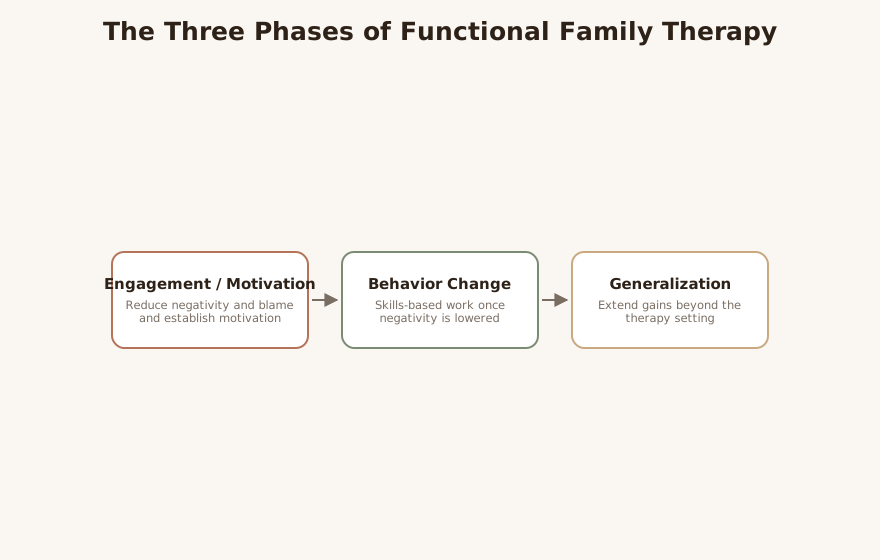
FFT progresses through three sequential phases, each with characteristic techniques 2.
Phase 1 — Engagement and Motivation. The early sessions aim to reduce the negativity, blame, and hopelessness families bring to treatment and to build a strong alliance with every member, not just the identified patient 5. The therapist’s central tools here are relational reframing (offering alternative, less blaming meanings for behavior), pointing out strengths, and interrupting blaming sequences in the room 5. Establishing a balanced alliance and reducing within-family negativity in this phase predicts retention and downstream outcomes 5.
Phase 2 — Behavior Change. Once motivation is established, the therapist introduces individualized skills: parenting and contingency management, communication training, problem-solving, conflict management, and supervision strategies, matched to the family’s relational style 5. The “matching to function” principle governs how skills are delivered so that new behaviors still satisfy the underlying relational needs of each member 4.
Phase 3 — Generalization. The final phase extends gains beyond the family and protects against relapse. The therapist helps the family apply new skills to recurring problems, maintain change, and engage relevant community systems such as school, probation, and other supports 5. Relapse-prevention planning and linkage to community resources are emphasized here 2.
LLM-generated illustrative example (not a guideline): A 15-year-old’s escalating curfew violations might be reframed in Phase 1 not as “he doesn’t respect us” but as a clumsy bid for autonomy that the family has not yet found a safe way to grant; in Phase 2 the family negotiates a graduated-privilege contract that gives the teen real autonomy contingent on transparency; in Phase 3 the same negotiation skill is applied to school re-entry meetings. LLM
Evidence Base
FFT’s evidence maturity is best described as established but increasingly scrutinized. It has long been listed favorably in major evidence registries: CrimeSolutions/NIJ rates it as effective for reducing youth recidivism and behavior problems 2, the Blueprints for Healthy Youth Development initiative has recognized it as a model or promising program 1, and the California Evidence-Based Clearinghouse for Child Welfare (CEBC) lists it with a supported scientific rating and high relevance to the child welfare population 6. Foundational randomized and quasi-experimental trials, summarized in the OJJDP Blueprints monograph, reported reductions in recidivism, sibling entry into the justice system, and cost savings relative to alternatives 5.
However, the most recent independent synthesis tempers this picture. A 2023 systematic review and meta-analysis of FFT for youth aged 11-18 with behavior problems found that, while results were generally favorable, the pooled effects were smaller and the evidence less uniformly strong than the program’s reputation implies, with heterogeneity across studies and concerns about study quality and independence of evaluations 3. Honest clinical communication should therefore present FFT as a well-supported, well-disseminated program whose effects in everyday practice may be more modest than the headline endorsements suggest 3. Fidelity appears to matter: outcomes in the literature are tied to adherence and competent delivery, which is one rationale for the model’s structured training and supervision requirements 5.
Populations & Indications
FFT is indicated for adolescents roughly aged 11-18 presenting with conduct problems, delinquency, oppositional and disruptive behavior, aggression, truancy, and substance use, together with their families and caregivers 3. It was developed for and is most validated with at-risk and delinquent youth, including those involved with or at risk of involvement in the juvenile justice system 2. It is also delivered within child welfare settings, where CEBC notes its relevance to families served by that system 6.
The “client” in FFT is the family unit, so a defining indication is the presence of a youth whose problems are embedded in disrupted family relationships, with at least one caregiver available to participate 5. Parents and caregivers are active treatment participants, not adjuncts, and their engagement is a prerequisite for the behavior-change phase 5.
Problems-for-Work
FFT is well-suited to a cluster of externalizing and relational problems that co-occur in adolescence 3.
- Conduct disorder and oppositional defiant disorder: the model’s behavior-change skills (contingency management, supervision, problem-solving) directly target the coercive cycles that maintain these patterns 5.
- Delinquency and aggression: reducing recidivism and antisocial behavior is the outcome on which FFT has most often been evaluated 2.
- Substance use disorders: adolescent substance use is addressed as a family-systemic problem alongside conduct and delinquency 3.
- Family conflict and parent-child relational problems: Phase 1 reframing and negativity reduction, followed by communication training, address the high-conflict relational climate itself 5.
- Truancy and disruptive behavior: the generalization phase enlists school and other systems to consolidate change in the youth’s wider ecology 5.
LLM-generated illustrative example (not a guideline): For a family referred after a youth’s possession charge and recurring school suspensions, an FFT therapist might frame the early goal as “lowering the heat at home so we can problem-solve,” then move to a monitoring-and-communication plan, then coordinate a behavior plan with the school during generalization. LLM
Contraindications, Cautions & Cultural Humility
FFT requires a participating family or caregiver system; it is not designed for youth with no available family member or for situations where family involvement is unsafe 5. Like most family-based models, active untreated risks such as ongoing abuse, acute suicidality, or psychosis generally require stabilization or specialized care before or alongside FFT, and clinicians should not treat a manualized family program as a substitute for crisis or safety intervention LLM.
Because FFT was developed and most heavily tested with justice-involved and at-risk youth, clinicians should be cautious about over-extending it to presentations or developmental stages outside its validated range without adapting expectations 3. The recent meta-analytic finding of more modest, heterogeneous effects argues against overselling outcomes to families 3.
Cultural humility is built into the model’s “matching to the family” principle, which calls for tailoring reframes and interventions to each family’s values, language, and relational norms rather than imposing a standardized script 4. In practice this means the therapist treats the family’s cultural framing of autonomy, respect, discipline, and help-seeking as data that shapes the intervention, and remains alert to the power dynamics inherent in court-mandated or child-welfare-referred treatment LLM.
Treatment-Plan Suggestions & SMART Objectives
| Goal | SMART objective (example) | Mechanism |
|---|---|---|
| Reduce family negativity and blame | Within 4 sessions, family members will reduce in-session blaming statements such that each parent voices one strength of the youth per session, per therapist tally | Phase 1 relational reframing and negativity reduction 5 |
| Build a balanced therapeutic alliance | By session 3, all attending members rate the therapist alliance as adequate or better on a brief check-in, with the youth attending 100% of scheduled sessions | Engagement-phase alliance balancing 5 |
| Improve parental monitoring/supervision | Within 6 weeks, caregivers will implement and document a written supervision plan (whereabouts, curfew, check-ins) used on at least 5 of 7 days | Phase 2 behavior change / contingency management 5 |
| Strengthen family communication | Within 8 sessions, the family will complete one structured problem-solving conversation per week using a taught format, with 3 of 4 ending in an agreed plan | Phase 2 communication and problem-solving training 5 |
| Reduce conduct/delinquent behavior | Over 12 weeks, the youth will have no new legal charges and reduce documented school disciplinary incidents by 50% from baseline | Skills generalization targeting recidivism 2 |
| Reduce substance use | Within treatment, the youth will increase substance-free days from baseline as verified by self-report and any required testing | Family-systemic substance use intervention 3 |
| Generalize gains across systems | By discharge, the family will hold at least one collaborative meeting with school or probation and have a written relapse-prevention/maintenance plan | Phase 3 generalization and community linkage 5 |
| Sustain change after termination | At a 1-month follow-up check, the family reports continued use of the supervision and communication plans without therapist prompting | Generalization and relapse prevention 2 |
Common Misconceptions
A frequent misconception is that FFT is individual therapy for the adolescent; in fact the family is the unit of treatment and caregiver participation is structurally required 5. Another is that FFT is open-ended; it is a short-term, time-limited program, typically completed within three to six months 2. A third is that the goal is to eliminate the “problem person” — instead the model assumes problem behavior serves a relational function and seeks more adaptive ways to meet that function 5.
Clinicians sometimes assume that because FFT appears on multiple evidence registries, its effects are large and uniform; the 2023 meta-analysis indicates effects are favorable but more modest and heterogeneous than that reputation implies 3. Finally, FFT is sometimes treated as a manual any therapist can self-teach; in practice it is a trained, supervised, fidelity-monitored model purveyed through a licensing organization 1.
Training & Certification
FFT is disseminated by a designated purveyor organization, and sites typically license the program rather than train individual clinicians in isolation 1. Implementation involves structured clinician training, ongoing supervision and consultation, and adherence/fidelity monitoring, often supported by a model-specific data and quality-assurance system 5. The structured training pipeline reflects the model’s evidence that competent, faithful delivery is tied to outcomes 5. Sexton’s clinical text is a primary professional resource for understanding the model’s principles and phase-based application in routine practice 4. Agencies and clinicians considering adoption should consult the program registries (Blueprints, CrimeSolutions, CEBC) and the official FFT purveyor for current training, certification, and site-requirement details 1.
Key Terms
- Function (of behavior): the relational purpose problem behavior serves within the family system, often regulating closeness or autonomy 5.
- Relational reframing: offering alternative, less blaming meanings for a member’s behavior to reduce negativity and build motivation 5.
- Phases (Engagement/Motivation, Behavior Change, Generalization): the three sequential stages structuring FFT, each with distinct goals and techniques 2.
- Matching to the family: individualizing interventions to each family’s relational functions and culture while maintaining model adherence 4.
- Fidelity/adherence: the degree to which delivery follows the model, monitored because it is linked to outcomes 5.
- Generalization: extending and maintaining family gains across community systems and over time 5.
Resources & Further Reading
▶ Watch — a video introduction to this concept:
- Functional Family Therapy (FFT) — Blueprints for Healthy Youth Development 1
- Program Profile: Functional Family Therapy (FFT) — CrimeSolutions, National Institute of Justice 2
- FFT for families of youth (age 11-18) with behaviour problems: A systematic review and meta-analysis (2023) 3
- Sexton TL. Functional Family Therapy in Clinical Practice (Routledge) 4
- Blueprints for Violence Prevention, Book Three: Functional Family Therapy — OJP/OJJDP 5
- Functional Family Therapy — California Evidence-Based Clearinghouse for Child Welfare (CEBC) 6
Reflective / Supervision Questions
- For this family, what relational function does the presenting problem behavior appear to serve, and how could that same function be met more adaptively? 5
- Have I genuinely reduced negativity and balanced my alliance across all members before attempting behavior-change work, or am I rushing the phases? 5
- How am I tailoring reframes and skills to this family’s culture and values rather than imposing a standardized script? 4
- Given that recent meta-analytic evidence shows more modest effects than the program’s reputation, am I setting realistic expectations with the family and referral source? 3
- If I am not delivering certified FFT, am I honestly framing this as FFT-informed family work within a recognized billable modality rather than claiming the branded program? 1
- What community systems (school, probation, child welfare) must be engaged in the generalization phase to sustain change, and have I planned for that? 5