
Type & Discipline
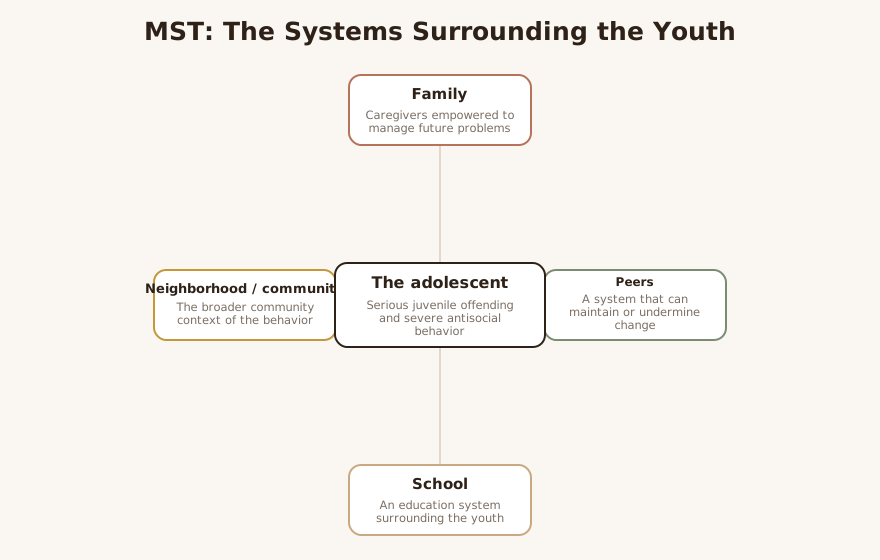
Multisystemic Therapy (MST) is a manualized, intensive, home- and community-based treatment model for adolescents with serious antisocial behavior, most prominently serious and chronic juvenile offenders 3. It sits at the intersection of family therapy and community intervention, and is best understood as a family- and ecologically-focused treatment rather than an individual psychotherapy 4. Rather than treating the adolescent in isolation, MST conceptualizes problem behavior as multiply determined by the interlocking systems in which the youth is embedded — family, peers, school, and neighborhood — and intervenes across those systems simultaneously 4LLM.
MST is delivered in the natural environment: the home, the school, and the community, rather than a clinic office, which is a defining structural feature distinguishing it from office-based modalities 3. It is time-limited and high-intensity, typically running roughly three to five months with low therapist caseloads and 24/7 availability of the treatment team 4. In clinical taxonomy, MST is properly classified as a standalone, branded, licensed evidence-based program rather than a generic technique that any clinician can simply adopt 4LLM.
Creators & Lineage
MST was developed by Scott Henggeler and colleagues at the Medical University of South Carolina, with the foundational randomized work published in the early 1990s positioning MST explicitly as an effective alternative to incarcerating serious juvenile offenders 1. The seminal Henggeler, Melton, and Smith trial demonstrated that family preservation using MST could reduce out-of-home placement and recidivism relative to usual juvenile justice services, establishing the model’s core promise: keeping serious offenders in their communities while reducing harm 1.
Theoretically, MST draws directly on Bronfenbrenner’s social-ecological theory, which frames human development as nested within concentric, interacting systems 4LLM. Its intervention logic also borrows from the family systems tradition and from structural family therapy — restructuring family hierarchies, boundaries, and parental authority — alongside strategic and behavioral parent-training techniques LLM. MST is frequently discussed alongside Functional Family Therapy, another evidence-based family intervention for delinquent and antisocial youth, and the two share a common lineage of family-focused, evidence-driven responses to serious youth delinquency 5LLM. The model’s identity, however, is distinct: where structural and functional family therapies are primarily family-focused, MST extends the unit of intervention outward to peers, school, and neighborhood 4LLM.
Core Principles
MST is organized around a published set of nine treatment principles that govern every case and structure clinical decision-making, and fidelity to these principles is treated as central to the model rather than optional 4LLM. In broad terms, these principles direct the therapist to understand the fit between identified problems and their broader systemic context, to emphasize the positive and use family strengths as levers for change, and to design interventions that are present-focused, action-oriented, and target specific, well-defined problems 4LLM.
The principles further require that interventions target sequences of behavior within and between the multiple systems that maintain the problem, that they be developmentally appropriate, and that they require daily or weekly effort from family members 4LLM. Effectiveness is evaluated continuously from multiple perspectives, with the provider team — not the family — held accountable for overcoming barriers to change 4LLM. A final principle emphasizes promoting generalization and the long-term maintenance of change by empowering caregivers to manage future problems across systems, which is the mechanism MST relies on to sustain gains after the short treatment window closes 4LLM.
LLM-generated illustrative example (not a guideline): A 15-year-old with chronic truancy, fighting, and early cannabis use is referred after a probation violation. Rather than enrolling him in an office-based anger-management group, the MST therapist maps the “fit” of the behavior — disengaged supervision at home, a delinquent peer group, a school that has effectively given up on attendance — and builds simultaneous interventions: restoring the caregiver’s monitoring and consequence structure, partnering with the school on a re-entry plan, and engineering reduced access to antisocial peers LLM.
Interventions & Techniques
MST does not deploy a single signature technique; it integrates empirically supported strategies — behavioral parent training, structural and strategic family interventions, and cognitive-behavioral techniques — selected and sequenced according to the case-specific “fit” analysis 4LLM. A core early move is empowering and equipping caregivers to monitor the adolescent, set consistent consequences, and reassert appropriate parental authority, since the caregiver is positioned as the primary agent of durable change 4LLM.
Because problem behavior is understood as multiply determined, interventions typically span several systems at once: improving family relations and communication, disrupting ties to deviant peers and building prosocial peer connections, increasing school or vocational engagement, and developing the youth’s and family’s natural support networks in the neighborhood 4LLM. The treatment is delivered by a master’s-level therapist carrying a low caseload, embedded in a team with weekly supervision and consultation, and available to families around the clock to manage crises in vivo 4. This intensive, in-home delivery — meeting families where conflict and risk actually occur — is itself a deliberate intervention design choice intended to maximize engagement and generalization 3LLM.
Evidence Base
The maturity of MST’s evidence base is best described as established. The model has been evaluated in multiple randomized controlled trials and carries strong ratings from independent registries: the National Institute of Justice’s CrimeSolutions has profiled and rated MST as an evidence-based program for serious juvenile offenders 3, and Blueprints for Healthy Youth Development — among the most stringent registries — has certified MST 4. The originating trials, beginning with Henggeler and colleagues, reported reductions in recidivism and out-of-home placement relative to usual services 1.
Meta-analytic evidence supports MST’s effectiveness while keeping expectations realistic about effect sizes. The van der Stouwe et al. (2014) meta-analysis found that MST produced significant, though generally small, positive effects on delinquency, psychopathology, substance use, family factors, and out-of-home placement, with moderation by factors such as the youth’s age and offense severity 6. An updated Campbell systematic review and meta-analysis synthesizing trials of MST for social, emotional, and behavioral problems in youth aged 10–17 likewise contributes to a more nuanced picture, in which benefits are real but modest and not uniform across all outcomes or replications 2.
Honesty about heterogeneity is warranted. Effects have at times been larger in developer-involved trials than in fully independent replications, and outcomes vary across countries and implementation contexts, a pattern the Canadian Department of Justice review of MST as a response to serious youth delinquency reflects in its measured appraisal 5LLM. The clinically responsible reading is that MST is a well-supported, registry-endorsed program whose benefits are most credible for the high-risk, serious-offender populations for which it was designed, with smaller and less certain effects when generalized beyond that core indication 6LLM.
Populations & Indications
MST was developed for and is best indicated for adolescents, roughly ages 10–17, who present with serious antisocial behavior — chronic and violent juvenile offenders being the prototypical population 12. It is also applied to at-risk youth and justice-involved youth more broadly, and to families and caregivers as the primary engine of change rather than as adjuncts to the youth’s treatment 4LLM.
Clinically, MST targets youth with conduct disorder, oppositional defiant disorder, and other disruptive behavior disorders, frequently complicated by substance use, aggression, truancy, and entrenched family conflict 2LLM. The model’s indication is strongest where the youth would otherwise be at risk of incarceration or out-of-home placement, because reducing those costly and harmful outcomes is precisely what MST was engineered and validated to do 13. It is, therefore, deliberately a high-intensity intervention reserved for high-need cases, not a first-line treatment for mild or transient adolescent misbehavior 4LLM.
Problems-for-Work
Juvenile delinquency and recidivism. MST directly targets re-offending by restructuring the systems that maintain antisocial behavior; reducing recidivism and out-of-home placement were the original validated outcomes 13. Application: the therapist tightens caregiver monitoring and consequences while disrupting access to delinquent peers LLM.
Conduct disorder and disruptive behavior disorders. These are core clinical targets, addressed through combined family, peer, and school interventions rather than youth-only treatment 24LLM.
Substance use. Adolescent substance use is an established MST target, with meta-analytic evidence of modest positive effects 6LLM. Application: reducing peer access to substances and increasing caregiver supervision and structured prosocial activity LLM.
Aggression and antisocial behavior. MST works on the behavioral sequences across home, school, and neighborhood that escalate into aggression, intervening at the level of contingencies and supervision 4LLM.
Truancy and school disengagement. School engagement is a standard system of intervention; the therapist partners directly with school staff on attendance and behavior plans 4LLM.
Family conflict. Family relations are both a target and a primary lever; improving communication, hierarchy, and consistency is central to the change model 46LLM.
Contraindications, Cautions & Cultural Humility
MST is not designed to be delivered freelance. It is a licensed program requiring trained teams, ongoing supervision, and fidelity monitoring, and attempts to approximate it without that infrastructure are not MST and cannot claim its evidence 4LLM. Clinicians should be cautious about generalizing MST’s results to populations far outside its validated scope — for example, very young children or youth without serious antisocial behavior — since the evidence is strongest for serious offenders and weaker as one moves away from that indication 6LLM.
A central caution is the heterogeneity of outcomes across studies and settings: independent and international replications have not always matched developer-led trials, so practitioners and systems should set realistic expectations and rely on the smaller, more conservative meta-analytic estimates 56LLM. MST also presupposes a caregiver who can be engaged as the agent of change; situations involving severe caregiver impairment, active abuse, or absent caregiving may require safety planning or alternative arrangements before the model’s logic can operate LLM.
Cultural humility is essential because MST operates inside families’ homes and neighborhoods, where clinician assumptions about parenting, discipline, supervision, and “prosocial” peer and community life are not culturally neutral LLM. Effective practice requires partnering with caregivers’ own values and existing natural supports rather than imposing a normative template, consistent with MST’s own emphasis on family strengths and indigenous community resources 4LLM. Justice-involved youth are also disproportionately drawn from marginalized communities, so clinicians should remain alert to structural inequities shaping the very systems MST seeks to mobilize LLM.
Treatment-Plan Suggestions & SMART Objectives
| Goal | SMART objective (example) | Mechanism |
|---|---|---|
| Reduce delinquent/offending behavior | Over 16 weeks, eliminate new law-enforcement contacts and probation violations, verified by probation records at discharge | Caregiver monitoring + consequence structure + reduced antisocial peer contact 13 |
| Strengthen caregiver monitoring | Within 4 weeks, caregiver implements a written daily check-in and consequence plan with ≥80% consistency per weekly review | Behavioral parent training; restored parental authority 4 |
| Disrupt deviant peer association | Within 8 weeks, youth reduces unsupervised time with delinquent peers to near zero and adds ≥2 prosocial activities weekly | Peer-system intervention; structured prosocial engagement 46 |
| Improve school engagement | Within 6 weeks, increase attendance to ≥90% and establish a school-home communication plan | School-system intervention; caregiver-school partnership 4 |
| Reduce substance use | Over treatment, reduce self- and collateral-reported substance use frequency, corroborated where indicated | Reduced access + supervision + family contingencies 6 |
| De-escalate family conflict | Within 6 weeks, family reports fewer high-conflict episodes and uses a shared problem-solving routine weekly | Structural/strategic family intervention; communication skills 46 |
| Prevent out-of-home placement | Maintain the youth safely at home through discharge with a caregiver-led maintenance plan | Family preservation; generalization principle 14 |
| Sustain gains post-discharge | By discharge, caregiver independently manages ≥2 emergent problems across systems without therapist intervention | Generalization and empowerment principle 4 |
Common Misconceptions
A frequent misconception is that MST is an individual therapy for the adolescent; in fact the family and surrounding systems are the unit of intervention, and the caregiver is the primary agent of change 4LLM. A related error is assuming MST is office-based — it is deliberately delivered in the home and community, where the relevant behavior and risk occur 3. Some assume it is open-ended or long-term, when it is in fact a short, intensive, time-limited model of roughly three to five months 4.
Another misconception is that any clinician can “do MST” by adopting its principles informally; the model is licensed, team-based, and fidelity-monitored, and informal approximations are not MST 4LLM. Finally, MST is sometimes oversold as a near-cure for delinquency. The meta-analytic reality is more modest: effects are statistically significant but generally small, vary across outcomes and settings, and are most robust for the serious-offender population the model was built for 62LLM.
Training & Certification
MST is a proprietary, licensed model; it is delivered by organizations that establish MST teams and operate under a structured quality-assurance system rather than by individually self-certifying clinicians 4LLM. Therapists are typically master’s-level practitioners who carry deliberately small caseloads, receive weekly group supervision and expert consultation, and are supported by ongoing fidelity monitoring as part of the model’s quality-assurance infrastructure 4. Registries that have evaluated and endorsed MST — including CrimeSolutions and Blueprints — treat this trained-team-with-fidelity-monitoring structure as integral to the program, which is why faithful implementation, not just familiarity with the principles, is what the evidence base actually supports 34LLM.
Key Terms
Multisystemic / social-ecological perspective — the view, rooted in Bronfenbrenner’s theory, that behavior is determined by multiple interacting systems (family, peers, school, neighborhood) and must be addressed across them 4LLM.
Fit assessment — the case-specific analysis of how identified problems fit within their broader systemic context, used to drive intervention selection 4LLM.
Fidelity / quality assurance — the structured monitoring, supervision, and consultation system ensuring that MST is delivered as designed; central to claiming MST’s evidence 4LLM.
Family preservation — the goal of keeping serious offenders safely at home and in their community as an alternative to incarceration or out-of-home placement 1.
Generalization principle — the explicit aim of empowering caregivers to maintain and extend gains across systems after the short treatment window ends 4LLM.
Recidivism — re-offending; the primary justice outcome MST is designed to reduce 13.
Resources & Further Reading
▶ Watch — a video introduction to this concept:
- Henggeler, Melton & Smith (1992): Family preservation using multisystemic therapy — an effective alternative to incarcerating serious juvenile offenders 1
- Updated systematic review & meta-analysis: MST for social, emotional and behavioural problems in youth age 10–17 (Campbell Systematic Reviews) 2
- CrimeSolutions (National Institute of Justice): Program Profile — Multisystemic Therapy (MST) 3
- Blueprints for Healthy Youth Development: Multisystemic Therapy (MST) 4
- Department of Justice Canada: Multisystemic Therapy as a Response to Serious Youth Delinquency (JustResearch No. 12) 5
- van der Stouwe et al. (2014): The effectiveness of Multisystemic Therapy — a meta-analysis (Clinical Psychology Review) 6
Reflective / Supervision Questions
- For this referral, have I genuinely mapped the “fit” of the problem behavior across family, peer, school, and neighborhood systems, or am I defaulting to a youth-focused individual lens 4LLM?
- Is the caregiver positioned and equipped as the primary agent of durable change, and if not, what is blocking that — skill, engagement, safety, or my own assumptions 4LLM?
- Am I representing the evidence honestly to the family and team, including that MST effects are real but generally small and strongest for serious offenders 6LLM?
- If I am delivering family-based interventions outside a licensed MST program, am I describing the work accurately rather than over-claiming the “MST” label and its evidence 4LLM?
- Where might my judgments about parenting, supervision, and “prosocial” peers and community reflect cultural assumptions rather than the family’s own values and natural supports 4LLM?
- What is my concrete generalization plan — how will this caregiver independently manage the next cross-system problem after discharge 4LLM?