
Type & Discipline
Ethnomethodology is a theoretical and methodological tradition within sociology, specifically within the microsociology of everyday life 1. Its name combines “ethno” (the members of a social group) with “method,” and it literally means the study of the methods people use to produce and recognize their social world 5. The discipline is concerned not with grand social structures but with the moment-to-moment practical reasoning through which ordinary people accomplish orderly interaction 1. It treats the commonsense knowledge that members of a society rely on as a topic for investigation rather than a resource the analyst takes for granted 6.
For clinicians it is essential to be clear from the outset that ethnomethodology is a research perspective on social order, not a psychotherapy, a diagnostic system, or a treatment protocol LLM. It earns a place in a clinical wiki because the questions it asks – how do people know what one another mean, and what happens when those tacit methods diverge – map directly onto the relational and cross-cultural problems clinicians encounter daily LLM. Used well, it is a lens that sharpens case formulation; used carelessly, it is an academic theory imported beyond its evidence base LLM.
Creators & Lineage
Ethnomethodology was founded by the American sociologist Harold Garfinkel, who coined the term and laid out the program in his 1967 work Studies in Ethnomethodology 3. Garfinkel developed the approach in part as a critical response to the dominant structural-functionalist sociology of his teacher Talcott Parsons, shifting attention from how norms are imposed on actors to how actors actively produce social order in the first place 1. His central claim was that social order is not a pre-given fact but an ongoing accomplishment that members continuously achieve through shared, largely invisible methods 3.
The tradition sits within the broader stream of interpretive sociology and shares intellectual kinship with symbolic interactionism, which likewise locates meaning in interaction rather than in fixed structures LLM. It draws on phenomenology, particularly the work of Alfred Schutz on the commonsense lifeworld, and it gave rise to conversation analysis as a closely allied empirical method for studying talk 5. These lineages – symbolic interactionism, social constructionism, conversation analysis, and the narrative therapy tradition that absorbed constructionist ideas – form the family of approaches a clinician will recognize as adjacent to ethnomethodology LLM.
Core Principles
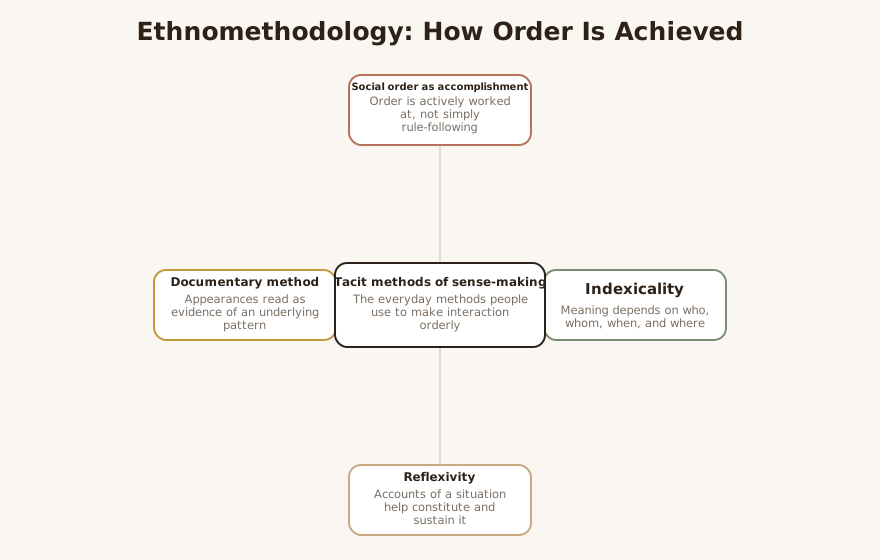
The foundational principle is that social order is an accomplishment: people do not simply follow rules handed down to them, they actively work to make situations recognizable, orderly, and sensible to one another 3. Closely tied to this is the concept of indexicality – the idea that the meaning of any utterance or action depends on its context, so the same words mean different things depending on who says them, to whom, when, and where 6. Because meaning is indexical, understanding is never automatic; it is achieved through interpretive work LLM.
A second key principle is reflexivity: the accounts and descriptions people give of a situation do not merely report on that situation, they help constitute and sustain it 6. When a family member says “we always do it this way,” the statement is not a neutral observation but part of how the family keeps doing it that way LLM. A third principle is the documentary method of interpretation, in which people treat particular appearances as evidence of an underlying pattern, and then use that presumed pattern to interpret further appearances – a circular process that lets interaction feel coherent 5.
Underlying all of this is the reciprocity of perspectives, the working assumption people make that they share a common world and would see things the same way if they stood in each other’s position LLM. Ethnomethodology highlights how much shared, unstated background knowledge – what Garfinkel called the “seen but unnoticed” – every ordinary exchange depends on 3. When that background is genuinely shared, interaction flows; when it is not, sense-making breaks down LLM.
Interventions & Techniques
Ethnomethodology is a research program rather than a clinical toolkit, so its “techniques” are investigative methods, the most famous of which is the breaching experiment 4. In a breaching experiment, the researcher deliberately violates a taken-for-granted background expectation in order to make the normally invisible methods of social order visible through the disruption they cause 4. Garfinkel had students do things like behave as lodgers in their own family homes or respond to casual greetings by demanding clarification of exactly what was meant; the resulting confusion, indignation, and effort to restore normalcy revealed how much tacit work usually holds interaction together 4.
Beyond breaching, ethnomethodologists use close observation of naturally occurring activity and detailed analysis of recorded conversation to document how members organize turns at talk, repair misunderstandings, and accomplish recognizable activities 5. The orientation is descriptive and non-evaluative: the aim is to specify how people do what they do, not to judge whether they are doing it correctly 6.
Translated cautiously into clinical practice, the analytic stance – not the breaching method – is what is portable LLM. A clinician can adopt the ethnomethodological habit of treating each client’s commonsense assumptions as something to be examined rather than shared, and of asking how a couple or family “does” being a couple or family rather than assuming a single normative template LLM.
LLM-generated illustrative example (not a guideline): A couples therapist notices that one partner reads the other’s silence after work as “shutting me out,” while the silent partner experiences it as “finally relaxing at home.” Rather than adjudicating who is right, the clinician makes the tacit interpretive rule explicit: each partner is using a different documentary method to read the same behavior. Naming the divergence – not the silence itself – becomes the work LLM.
Clinicians must never conduct breaching experiments on clients; deliberately violating a client’s expectations to provoke confusion would be both clinically harmful and ethically indefensible LLM.
Evidence Base
The honest assessment is that ethnomethodology is an established tradition within academic sociology, but its maturity refers to its standing as a research perspective, not to any body of clinical outcome evidence LLM. Since its formalization in Garfinkel’s 1967 work, it has become a recognized and influential field with a substantial scholarly literature, dedicated journals, and a durable place in sociology curricula 1. In that disciplinary sense it is well established and has demonstrably reshaped how social scientists study everyday interaction 5.
What it does not have is randomized trials, effect sizes, or any evidence base as a psychotherapy, because it was never designed to be one LLM. There are no studies showing that an “ethnomethodological intervention” improves symptoms, relationship satisfaction, or acculturation outcomes, and a clinician should make no such claims LLM. The tradition has also drawn methodological criticism within sociology for being descriptive rather than explanatory and for resisting generalization beyond the specific settings it documents 6.
For the practicing therapist, the appropriate evidentiary posture is therefore modest: ethnomethodology can inform formulation and clinical curiosity, but any actual intervention should be delivered within an established, evidence-based modality whose own evidence base does the clinical work LLM. It is a way of thinking, not a thing that has been tested at the bedside LLM.
Populations & Indications
The conceptual indications for an ethnomethodological lens cluster around situations where the tacit background of shared understanding cannot be assumed LLM. Immigrants and refugees moving between cultures of origin and host cultures are a paradigm case: the “seen but unnoticed” expectations that organize a greeting, a refusal, or a family role differ across cultural worlds, so what looks like rudeness or withdrawal may be a mismatch of background methods rather than pathology LLM. Ethnic and cultural minorities navigating majority institutions face the same gap between their commonsense knowledge and the institution’s LLM.
Couples and families are well suited to this lens because they are precisely the small social orders that members continuously accomplish through shared methods, and where divergence in those methods is felt acutely LLM. People in cross-cultural settings – mixed-culture couples, international students, third-culture adults – routinely live in the space between background expectancies LLM. The lens is most relevant for verbally engaged adults able to reflect on their own meaning-making, since the work depends on making tacit interpretive processes explicit LLM.
Problems-for-Work
The problems this lens illuminates are interactional rather than intrapsychic, which makes it a useful complement to symptom-focused formulation LLM. Communication problems and interpersonal misunderstanding are the most direct fit: ethnomethodology reframes “we don’t communicate” as a breakdown in the shared methods two people use to make their utterances mutually intelligible, given that meaning is always indexical to context 6.
Relationship conflict and family conflict can be examined as clashes between competing accounts that each party uses to keep their version of the relationship orderly, exposing the reflexive way descriptions sustain the very patterns they describe 6. Cultural identity confusion and acculturation stress become legible as the strain of operating without a stable, shared background of taken-for-granted expectations LLM. Social adjustment difficulties can be reframed as a person not yet having acquired the local methods for producing recognizably “normal” conduct in a new setting LLM.
LLM-generated illustrative example (not a guideline): A refugee client reports that coworkers find him “cold” because he does not engage in the rapid small talk they expect, while in his culture of origin that same restraint signals respect. Using the lens, the clinician and client map the specific background expectancies that differ, then collaboratively practice the host setting’s methods – without framing the client’s original methods as deficient LLM.
Contraindications, Cautions & Cultural Humility
Because ethnomethodology is not a treatment, the central caution is against treating it as one LLM. Its signature research technique, the breaching experiment, is explicitly designed to provoke disorientation and distress by violating expectations, and it has no place in a therapeutic relationship; importing it would be coercive and harmful 4. The lens should never be used to destabilize a client’s sense-making for its own sake LLM.
The approach is least appropriate where a client’s distress is rooted in acute psychiatric crisis, trauma activation, or risk, where a stance of detached analytic curiosity about meaning-making would be a failure of clinical attunement LLM. It also presumes a capacity for verbal reflection that may not fit young children, people in acute states, or some neurodivergent presentations without significant adaptation LLM.
On cultural humility, ethnomethodology is in one sense a natural ally, because its core insistence on the indexical, locally produced nature of meaning is itself a corrective to assuming one’s own commonsense is universal 6. But this is also where the gravest risk lies: a clinician must not position themselves as the analyst who decodes the “real” methods behind a culturally different client’s behavior, which would reproduce the very power asymmetry humility demands we avoid LLM. The client is the authority on their own background expectancies; the clinician’s job is to make space for them to be articulated, not to interpret them from above LLM.
Treatment-Plan Suggestions & SMART Objectives
| Goal | SMART objective (example) | Mechanism |
|---|---|---|
| Reduce recurring miscommunication in a couple | Within 6 sessions, each partner will, in session, accurately restate the other’s intended meaning before responding in at least 3 of 4 observed exchanges | Surfaces divergent documentary methods so meaning is checked rather than assumed 5 |
| Lower acculturation-related social anxiety | Within 8 weeks, client will identify and rehearse 5 host-culture interaction expectancies and report use in 2 real settings per week | Builds explicit competence in local background expectancies LLM |
| Decrease family conflict over roles | Within 10 sessions, the family will co-author a written description of “how we want to do mornings,” reviewed and revised twice | Makes reflexive, order-producing accounts explicit and negotiable 6 |
| Improve client insight into interpersonal misunderstanding | By session 4, client will name 3 instances where the same behavior carried different meanings to self vs. other | Externalizes indexicality of meaning 6 |
| Support cultural identity integration | Over 12 weeks, client will articulate which background expectancies from each culture they choose to keep, adapt, or set aside, documented in a values worksheet | Reframes identity confusion as navigable method-selection LLM |
| Strengthen a refugee client’s workplace adjustment | Within 6 weeks, client will identify 4 tacit workplace norms with the clinician and self-rate comfort weekly on a 0-10 scale | Renders “seen but unnoticed” expectations visible and learnable 3 |
| Reduce blame escalation in conflict | By session 5, partners will replace 2 “you always” accounts with descriptions of differing interpretations, observed in session | Disrupts reflexive accounts that sustain conflict 6 |
Common Misconceptions
A first misconception is that ethnomethodology is a kind of ethnography or simply “studying ethnic methods”; in fact it studies the everyday methods any group of people uses to produce social order, regardless of ethnicity 5. A second is that the breaching experiment is the whole of ethnomethodology, when it is one dramatic demonstration technique among many descriptive methods, valued mainly for making the invisible visible 4.
A third, and for clinicians the most dangerous, misconception is that ethnomethodology is a therapy or a set of interventions; it is a sociological perspective with no clinical evidence base, and applying it as treatment overstates what it is LLM. A fourth is that it explains why people act as they do; ethnomethodology is pointedly descriptive, documenting how order is produced rather than offering causal or psychological explanation, which is also the basis of long-standing criticism that it under-explains 6. Finally, some assume it claims social order is arbitrary or fragile; the point is closer to the opposite – order is robust precisely because members work so persistently and skillfully to sustain it 3.
Training & Certification
There is no clinical certification in ethnomethodology, and any service that advertised “certified ethnomethodological therapy” would be misrepresenting the field LLM. As an academic tradition, it is learned through sociology coursework, graduate seminars, and primary reading, beginning with Garfinkel’s Studies in Ethnomethodology and continuing through the conversation-analysis literature it spawned 3. University sociology and social-science programs are where the methods are formally taught 1.
For a clinician, the realistic path is self-directed conceptual familiarity rather than credentialing: read accessible overviews to grasp the core ideas, then ensure that any clinical application is grounded in – and supervised within – whatever evidence-based modality actually licenses your practice LLM. Supervision should focus on keeping the lens in service of formulation and away from untested intervention LLM.
Key Terms
- Accomplishment – the view that social order is actively produced and sustained by members rather than given in advance 3.
- Indexicality – the dependence of meaning on the specific context in which words or actions occur 6.
- Reflexivity – the way accounts of a situation help constitute the situation they appear merely to describe 6.
- Documentary method of interpretation – treating particular appearances as evidence of an underlying pattern, then reading further appearances through that pattern 5.
- Background expectancies / “seen but unnoticed” – the taken-for-granted assumptions that organize ordinary interaction without being consciously attended to 3.
- Breaching experiment – a research technique that deliberately violates background expectancies to reveal the tacit work sustaining social order 4.
- Reciprocity of perspectives – the working assumption that participants share a common world and would see it alike if positions were swapped LLM.
Resources & Further Reading
▶ Watch — a video introduction to this concept:
- Ethnomethodology | sociology | Britannica
- Ethnomethodology Theory: Definition & Examples (Simply Psychology)
- Studies in Ethnomethodology — Harold Garfinkel (1967)
- Breaching experiment — Wikipedia
- Ethnomethodology | Encyclopedia.com
- Ethnomethodology — an overview | ScienceDirect Topics
Reflective / Supervision Questions
- When a client’s behavior strikes me as “odd” or “resistant,” how often am I reading it through my own background expectancies rather than theirs LLM?
- In my cross-cultural cases, do I make space for the client to articulate their own commonsense rules, or do I quietly assume I already understand them LLM?
- Where in my caseload am I reframing an interactional, meaning-mismatch problem as an individual deficit, and would an ethnomethodological lens change my formulation LLM?
- Am I keeping this perspective in its proper place – as a formulation aid inside an evidence-based modality – or am I drifting toward treating it as an intervention in its own right LLM?
- How do the accounts my couples and families give in session actively sustain the very patterns they complain about, and how might I help them author new ones 6?