
Type & Discipline
Conversation Analysis (CA) is an empirical, observational framework for studying the organization of naturally occurring talk-in-interaction 6. It originated in sociology — specifically the ethnomethodological tradition — rather than in psychology or psychotherapy 6. Its disciplinary home today spans sociology, linguistics, and communication science, and it functions as a research method rather than a therapeutic modality 7. CA does not prescribe what clinicians should do; it describes, in fine detail, what interactants actually do as they build conversation together 7.
The defining commitment of CA is that talk is structurally organized and that this structure can be recovered from recordings of real interaction rather than from intuition, self-report, or hypothetical examples 1. Analysts work from detailed transcripts of audio or video recordings, attending to features that casual listening discards — pauses measured in tenths of a second, overlaps, in-breaths, and the precise placement of one utterance relative to another 6. For the clinician, CA is best understood not as a treatment to deliver but as a lens that makes the micro-mechanics of one’s own sessions visible LLM.
Creators & Lineage
CA was founded by the sociologist Harvey Sacks in the 1960s, in close collaboration with Emanuel Schegloff and Gail Jefferson 6. Sacks’s intellectual lineage runs through Erving Goffman’s interest in the interaction order and, decisively, through Harold Garfinkel’s ethnomethodology, which studies the methods ordinary people use to produce orderly social life 6. From this inheritance CA took its core wager: that the seemingly chaotic flow of everyday talk is in fact a highly ordered accomplishment, and that order can be specified 1.
The field’s foundational technical statement is the 1974 paper by Sacks, Schegloff, and Jefferson on the systematics of turn-taking, which set out the model of how speakers exchange turns with remarkably little gap and overlap 1. Gail Jefferson developed the transcription system — still the field standard — that captures the timing, intonation, and overlap detail on which CA analysis depends 6. Across subsequent decades CA expanded from ordinary conversation into institutional settings, including medicine, courtrooms, and eventually psychotherapy 7.
The bridge into psychotherapy research is associated most strongly with Anssi Peräkylä, whose work applies CA to identify the interactional sequences through which therapeutic change is brought about 2. This line of research treats the therapy hour as a site of institutional talk with its own recurrent structures, and asks how clinical phenomena — interpretation, validation, resistance — are realized moment to moment 2.
Core Principles
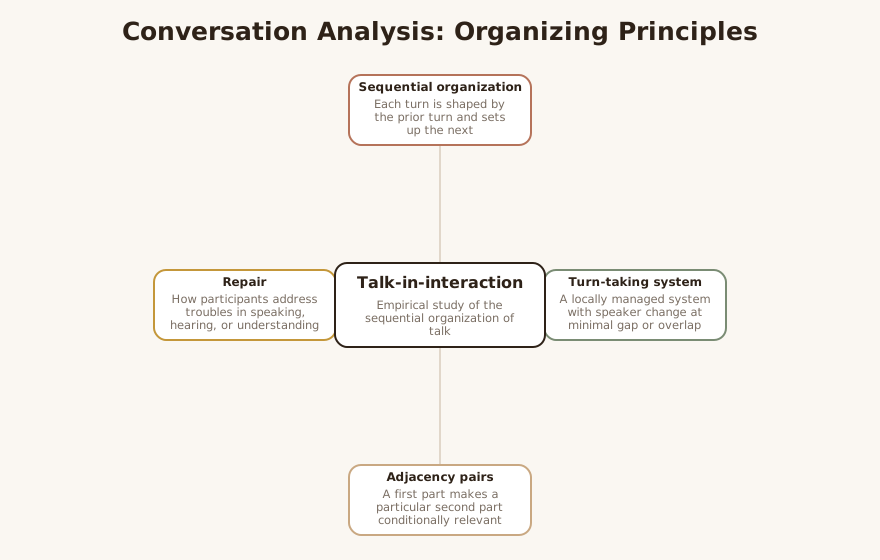
The first principle is that interaction is sequentially organized: each turn at talk is shaped by the turn that preceded it and sets up expectations for the turn that follows 7. Meaning is therefore not a property of an isolated utterance but of its placement in a sequence 7. A clinician’s question means something different depending on whether it follows silence, a disclosure, or a previous question, and CA insists on reading utterances in that sequential context LLM.
Second is the turn-taking system itself. Sacks, Schegloff, and Jefferson described turn-taking as a locally managed, party-administered system in which speaker change recurs with minimal gap or overlap, organized around points where a turn could legitimately end 1. Speakers continuously project where the current turn is headed and where it might be complete, which is how they manage to come in on time without explicit signaling 1.
Third is the adjacency pair: certain utterance types come in linked pairs, such that a first part makes a particular second part conditionally relevant — a question expects an answer, a greeting a return greeting, an invitation an acceptance or declination 7. When the expected second part is absent or delayed, that absence is itself meaningful and noticeable to participants 7.
Fourth is repair — the set of practices by which speakers address troubles in speaking, hearing, or understanding 7. Repair can be initiated and carried out by the speaker of the trouble source or by the recipient, and CA documents a systematic preference for self-repair over other-repair 7. Fifth is the field’s methodological stance: analysis stays close to the data and to the participants’ own displayed understandings, resisting the imposition of categories the interactants themselves do not orient to 6. This emic discipline — privileging what is demonstrably relevant to the speakers over the analyst’s prior theory — is what gives CA findings their distinctive evidential weight 5.
Interventions & Techniques
CA is a method of analysis, so its “techniques” are analytic procedures rather than clinical maneuvers 7. The core procedure is the production of a fine-grained transcript using the Jefferson conventions, capturing overlap, timed silences, sound stretches, emphasis, and intonation 6. The analyst then works through the data turn by turn, building observations from collections of similar sequences rather than from a single striking case 6.
A central analytic move is the next-turn proof procedure: because each turn displays the speaker’s understanding of the prior turn, the analyst can ground claims about what an utterance was doing in how its recipient demonstrably treated it 7. This anchors interpretation in the participants’ own conduct rather than the analyst’s speculation 7. In psychotherapy research, analysts assemble collections of a given practice — for example, instances of the therapist offering an interpretation — and trace how clients respond across the corpus, distinguishing affiliative uptake from resistance 2.
For clinical training and process research, CA can be scaled from the single turn to longer stretches of interaction, examining how a therapeutic effect is built across an extended sequence rather than in one exchange 3. This shift from turn-by-turn to “larger chunks” lets researchers connect micro-level practices to clinically meaningful units such as a worked-through interpretation or a repaired misunderstanding 3.
LLM-generated illustrative example (not a guideline): A clinician reviews a recorded session and notices that, after each of her reflections, the client produces a half-second pause before agreeing. Reading these placements as a CA analyst would, she treats the recurrent micro-delay as a possible marker of disaffiliation — the agreement is present but dispreferred-shaped — and adjusts to check the client’s actual stance rather than accept the surface “yes.” LLM
Evidence Base
The maturity question must be answered in two parts, because CA is established as a research method but is not itself a treatment with an outcome literature LLM. As a method for describing the organization of interaction, CA is mature and well-validated: it rests on more than half a century of cumulative empirical work, beginning with the foundational turn-taking systematics, and its descriptions of turn-taking, adjacency pairs, and repair have proven robust across languages and settings 1. The transcription and analytic conventions are standardized enough to support replication and accumulation across studies 6.
Applied to psychotherapy, CA has produced a substantial body of process research identifying the interactional sequences through which clinical phenomena are accomplished 2. This work demonstrates, with strong observational rigor, how interventions like interpretation and validation are delivered and received, and how alliance and resistance surface in the structure of talk 2. CA has been positioned explicitly within psychotherapy process research as a complement to outcome-focused methods 4.
The honest limitation is that CA tells us about mechanism and interactional form, not about whether a therapy works in the outcome-trial sense LLM. It is descriptive and microanalytic, not experimental, so it does not by itself establish that a given practice causes symptom improvement 4. Its evidential strength is in characterizing process with unusual fidelity; clinicians should value it for that and not mistake a rich description of in-session mechanics for efficacy evidence LLM.
Populations & Indications
Because CA is a method rather than a treatment, “populations” here means the interactional contexts to which it is usefully applied rather than diagnostic groups LLM. It has been applied across psychotherapy with adults and across modalities, since its object — the structure of talk — is present in any talking therapy 2. It is equally applicable to individual, couple, and family work, wherever clinical interaction is recorded and transcribable 3.
For practicing clinicians, the most direct indication is process scrutiny: situations where a clinician wants to understand the moment-to-moment fabric of their sessions, such as recurring alliance strain, interventions that reliably fall flat, or patterns of client withdrawal 2. It is also well suited to supervision and skills training, where transcript-level review can show a trainee exactly how their questions and reflections land 3. CA is indicated wherever the unit of clinical interest is the interaction itself rather than an intrapsychic construct measured by questionnaire LLM.
Problems-for-Work
CA reframes several familiar clinical problems as observable features of talk, which is precisely its practical gift to the clinician LLM.
- Alliance ruptures. CA locates ruptures in the sequential structure — in delayed, qualified, or absent second pair-parts — rather than only in the client’s reported feelings, giving the clinician a real-time signal to attend to 2.
- Resistance and disaffiliation. Client resistance to an interpretation can be read in the design of the responding turn, distinguishing genuine uptake from compliant-sounding deferral 2.
- Misattuned interventions. By tracing how a client treats an interpretation in the next turn, CA shows whether the intervention was received as intended, exposing misattunement that surface agreement would hide 2.
- Communication breakdown. The repair apparatus gives a precise vocabulary for how troubles in understanding are flagged and resolved in session, and where they are left unresolved 7.
- Building change across a sequence. Where a clinical shift unfolds over an extended exchange rather than a single turn, CA’s move to larger chunks of talk lets the clinician see how the change was assembled 3.
LLM-generated illustrative example (not a guideline): In supervision, a trainee and supervisor transcribe two minutes of session audio after the trainee reports the client “shuts down whenever we get close to the trauma.” The transcript shows the trainee consistently asking a follow-up question within the half-second after the client begins to slow and lengthen sounds — interactionally overriding the client’s incipient turn. Naming this as a turn-taking pattern, not a personality trait of the client, gives the trainee something concrete to change. LLM
Contraindications, Cautions & Cultural Humility
The principal caution is a category error: CA is not a therapy and should never be offered to a client as a treatment or substituted for an evidence-based modality LLM. Its proper clinical use is reflective and analytic — to study process — not to replace intervention 4. Clinicians should also resist over-reading micro-features; a single pause is not proof of resistance, and CA’s own discipline is to ground claims in collections and in participants’ displayed orientations rather than in isolated, dramatic moments 6.
A further caution concerns the leap from form to inference. CA describes how things are done interactionally; attributing a particular internal state or clinical meaning to a structural feature goes beyond what the method warrants unless the participants’ own subsequent conduct supports it 7. Practitioners borrowing CA insights informally should keep claims modest and tied to what the next turn actually shows 2.
On cultural humility, the timing, pausing, overlap, and turn-allocation norms that CA measures are not culturally neutral; what counts as a “long” silence or an “interrupting” overlap varies across linguistic and cultural communities LLM. CA was built primarily on particular conversational settings, and applying its templates across cultures without attention to local interactional norms risks pathologizing ordinary cultural difference as disaffiliation or trouble 1. The method’s own emic commitment — privileging the participants’ displayed understandings over the analyst’s assumptions — is itself a safeguard the culturally humble clinician should hold onto 6.
Treatment-Plan Suggestions & SMART Objectives
The following table illustrates how CA-informed observation can support process-oriented clinical goals; CA functions here as an analytic lens within an established modality, not as a standalone treatment LLM.
| Goal | SMART objective (example) | Mechanism |
|---|---|---|
| Reduce in-session alliance strain | Within 6 sessions, clinician will review one recorded segment per week and identify at least two delayed/qualified client responses to repair in the following session | Detecting ruptures via sequential markers (dispreferred-shaped second pair-parts) 2 |
| Improve client uptake of interpretations | Over 8 sessions, increase the proportion of interpretations followed by affiliative client uptake, tracked from session transcripts | Next-turn proof procedure makes reception observable and adjustable 2 |
| Strengthen repair of misunderstanding | Within 4 weeks, clinician will identify and explicitly repair at least one unresolved understanding-trouble per session | Repair organization gives a structure for flagging and resolving trouble 7 |
| Reduce clinician over-talk on sensitive content | Over 5 sessions, decrease instances of clinician turns initiated within the client’s incipient turn on trauma material | Turn-taking system clarifies projection of turn-completion points 1 |
| Build change across extended sequences | Across 3 sessions, map one “larger chunk” sequence where a therapeutic shift was collaboratively assembled | Scaling from turn-by-turn to larger units links micro-practice to clinical effect 3 |
| Sharpen trainee interviewing skill | Within a 10-week supervision block, supervisee will transcribe and analyze one 2-minute segment biweekly | Transcript-level review surfaces how questions and reflections land 3 |
| Distinguish compliance from genuine agreement | Within 6 sessions, clinician will flag and check at least two “delayed yes” responses per session | Sequential placement differentiates affiliative from dispreferred responses 7 |
Common Misconceptions
A first misconception is that CA is a kind of therapy or a set of clinical techniques to deploy in session; it is a research and analytic method for studying interaction, not an intervention model 7. A second is that CA is interpretive or impressionistic in the way some discourse work can be; in fact it is rigorously empirical, working from recordings and detailed transcripts and grounding claims in participants’ own displayed conduct 6.
A third misconception is that CA is merely about words or content. CA is centrally concerned with the organization of talk — timing, sequencing, turn allocation, and repair — and treats these structural features, not just the propositional content, as the primary data 1. A fourth is that strong observational findings about process amount to outcome evidence; CA characterizes how interaction is organized and how interventions are received, but does not by itself demonstrate that a therapy produces symptom change 4. Finally, some assume the analyst’s intuition drives the reading, when the method’s whole discipline is to subordinate analyst intuition to what the data and the next turn actually show 7.
Training & Certification
There is no clinical certification in Conversation Analysis, consistent with its status as a research method rather than a licensed therapeutic modality LLM. Competence is acquired through academic training in the method — learning the Jefferson transcription conventions, data sessions in which analysts collectively work through recordings, and supervised analysis of collections of sequences 6. This training is housed in sociology, linguistics, and communication programs rather than in clinical credentialing bodies 7.
For the practicing clinician, the realistic path is not certification but literacy: reading the foundational and applied process literature, learning to produce and read a basic transcript, and practicing transcript-level review of one’s own recorded sessions, ideally within supervision 3. The applied psychotherapy-CA literature provides accessible entry points for clinicians who want to bring this analytic sensibility into supervision and self-review without becoming full-time conversation analysts 2.
Key Terms
- Turn-taking — the locally managed system by which speakers exchange turns with minimal gap and overlap, organized around projectable points of possible turn completion 1.
- Adjacency pair — a paired sequence in which a first part makes a specific second part conditionally relevant, such as question–answer or greeting–greeting 7.
- Conditional relevance — the property whereby, once a first pair-part is produced, the absence of its expected second part becomes noticeable and accountable 7.
- Repair — the organized practices for addressing troubles in speaking, hearing, or understanding, with a systematic preference for self-repair 7.
- Sequential organization — the principle that each turn is shaped by the prior turn and projects the next, so meaning resides in placement 7.
- Next-turn proof procedure — the analytic anchor by which an utterance’s action is evidenced by how its recipient demonstrably treats it in the following turn 7.
- Jefferson transcription — the standardized notation capturing timing, overlap, emphasis, and intonation on which CA analysis depends 6.
- Ethnomethodology — the sociological tradition, founded by Garfinkel, studying the methods people use to produce orderly social action, from which CA descends 6.
Resources & Further Reading
▶ Watch — a video introduction to this concept:
- Sacks, Schegloff & Jefferson (1974), A simplest systematics for the organization of turn-taking for conversation
- Peräkylä (2019), Conversation Analysis and Psychotherapy: Identifying Transformative Sequences
- From turn-by-turn to larger chunks of talk: psychotherapeutic micro-processes using conversation analysis (PMC)
- Conversation Analysis and Psychotherapy Process Research (Springer chapter)
- Conversation Analysis (Simply Psychology)
- Conversation Analysis (Wikipedia)
- Conversation Analysis (H. Mazeland, University of Groningen — encyclopedia entry PDF)
Reflective / Supervision Questions
- When you review a recording of your own session turn by turn, where do your clients’ second pair-parts come late, qualified, or not at all — and what were you doing in the prior turn? 2
- How often do you accept a surface “yes” as agreement when its sequential placement suggests dispreferred deferral, and how would you check the difference? 7
- Where in your sessions do troubles in understanding go un-repaired, and what keeps you from initiating repair? 7
- Are there moments when you come in on a client’s incipient turn — interactionally overriding them — particularly on sensitive material? 1
- When a therapeutic shift happens across an extended exchange rather than one exchange, can you reconstruct how it was collaboratively built? 3
- How might the turn-taking and pausing norms you treat as “normal” differ for clients from other linguistic or cultural communities, and how could that bias your read of “resistance”? 6
- In supervision, how could transcript-level review change what you and your supervisee believe is happening in the room? 3