
Type & Discipline
Relational-Cultural Theory (RCT) is a developmental and clinical theory within clinical and counseling psychology, belonging to the family of feminist relational developmental theories.4 It posits that people grow through and toward relationships across the lifespan, and that culture powerfully shapes those relationships.1 Unlike intrapsychic models that treat the bounded, separate self as the unit of health, RCT locates both pathology and healing in the quality of connection between people.1 In practice it functions both as an explanatory framework and as a named therapeutic modality — relational-cultural therapy — applied across clinical, educational, and organizational settings worldwide.1
Creators & Lineage
RCT originated with psychiatrist Jean Baker Miller, whose 1976 book Toward a New Psychology of Women centered women’s relational experience rather than individualistic frameworks, selling over 200,000 copies and being translated into roughly twenty languages.6 In 1977 Miller convened a theory group at the Stone Center at Wellesley College with Judith V. Jordan, Irene Stiver, and Janet Surrey, meeting regularly to develop the model and “come into voice” through papers and presentations.6 The work emerged from second-wave feminism and multicultural psychology, drawing on feminist therapy and self-in-relation theory and resonating with attachment and liberation-psychology traditions.3 As the group recognized that relationships never exist in isolation from cultural context and power, they renamed the theory to foreground culture’s centrality — the shift from “self-in-relation” to “relational-cultural.”6 Contemporary developers include Linda Hartling, Amy Banks, and Maureen Walker.4
Core Principles
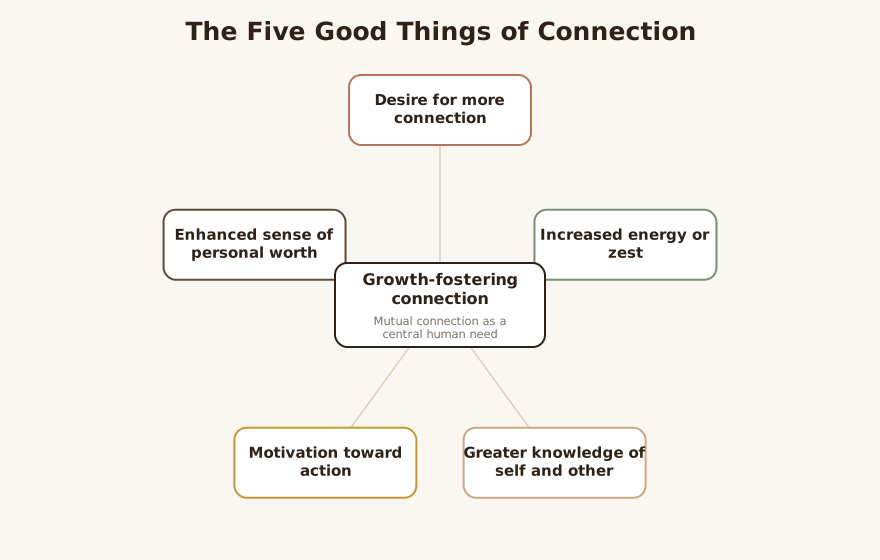
The organizing claim of RCT is that movement toward mutually growth-fostering connection is a central human need, and that chronic disconnection causes psychological suffering.1 Healthy connection yields what RCT calls the five good things: a desire for more connection, increased energy or zest, greater knowledge of self and other, motivation toward action, and an enhanced sense of personal worth.4 A central obstacle is the central relational paradox: people long for connection yet, believing parts of themselves are unacceptable, hide those parts — and in concealing them, undermine the very relationships they seek.4
RCT reads disconnection not only as interpersonal but as cultural and political. Condemned isolation describes the marginalized person’s experience of being shut out of the human community, in which dominant groups deploy shame and isolation to maintain power.3 Controlling images — objectifying stereotypes — become internalized by both dominant and subordinated groups, naturalizing hierarchy.3 Against “power-over” domination, RCT advances power-with: mutual, participatory relating that acknowledges power differentials while fostering shared empowerment and agency.3 Mutual empathy — openness to being affected by and affecting another — is the engine of authentic, rather than performative, relationship.3
Interventions & Techniques
RCT treats the therapeutic relationship itself as both indicator and healing mechanism; the work is relational rather than technique-driven.4 The clinician cultivates mutual empathy and authentic presence, allowing the client’s movement toward awareness that they matter to the therapist to unfold alongside the therapist’s own genuine responsiveness.4 LLM Naming disconnection — making explicit the strategies of concealment a client uses to stay safe — is itself an intervention, because it interrupts the central relational paradox. LLM Therapists also name oppression and controlling images explicitly, reframing what a client experiences as personal deficiency as a predictable response to systemic disconnection.3
Relational resilience is built by helping clients move from condemned isolation toward connection through validation, collective awareness, and sustained efforts at reconnection.3 The stance is collaborative and non-hierarchical, modeling power-with within the dyad itself.3
LLM-generated illustrative example (not a guideline): A client who “performs fine” at work but feels chronically unseen describes hiding their grief to avoid burdening others. The clinician names this as the central relational paradox in action — the very self-protection that prevents rejection is also producing the isolation the client dreads — and uses their own authentic emotional response in session to demonstrate that disclosure can be met rather than punished. LLM
Evidence Base
RCT is best described as an established framework rather than an extensively validated outcome model.1 It is widely taught, applied internationally across clinical and organizational settings, and has been recognized by an American Psychological Association co-editor as among the top ten psychological theories.1 That recognition reflects its conceptual influence, not a large base of controlled trials.1 LLM The supporting literature is predominantly theoretical, qualitative, and case-based; rigorous randomized controlled outcome data remain limited, and clinicians should present RCT to clients as a well-developed relational framework rather than a first-line evidence-based protocol for a specific disorder. LLM Its claims about the neurobiology of connection and the pain of disconnection are framed as consistent with the idea that “the brain grows in connection,” but this should be read as conceptual alignment rather than settled mechanism.3
Populations & Indications
RCT was developed first from women’s relational experience and remains especially resonant where suffering is bound up with marginalization, power imbalance, and isolation.6 It is well-suited to women, people of color, LGBTQ+ individuals individuals, and other marginalized or oppressed groups whose distress is shaped by sociocultural disconnection.3 LLM It is frequently indicated for survivors of relational trauma, clients in chronic isolation or loneliness, and those whose presenting problems are fundamentally interpersonal. LLM Because it reframes individual symptoms as symptoms of systemic disconnection rather than personal defect, it can be clarifying for clients carrying internalized stigma and shame.3
Problems-for-Work
RCT maps cleanly onto a range of clinical problems where disconnection is central. LLM
- Chronic disconnection / isolation and loneliness: the core target — moving the client from condemned isolation toward growth-fostering connection.3
- Shame and internalized stigma: naming controlling images and oppression externalizes self-blame the client has absorbed.3
- Depression and low self-esteem: rebuilding connection restores zest and the sense of personal worth named in the five good things.4
- Relationship conflict and interpersonal difficulties: identifying the central relational paradox reveals how self-protective concealment perpetuates conflict.4
- Effects of oppression and marginalization: reframing distress as a response to systemic disconnection rather than individual pathology.3
- Trauma: restoring relational safety after relational injury, using mutual empathy as a corrective experience. LLM
Contraindications, Cautions & Cultural Humility
RCT’s traditional focus on women and their relational experiences is also its principal limitation; clinicians should not assume its concepts generalize unmodified across all populations and contexts.4 LLM The model’s emphasis on authenticity and mutuality must be calibrated to clients for whom rapid relational openness feels unsafe — including some trauma survivors — so that the therapist’s authenticity does not become pressure to disclose. LLM Cultural humility is intrinsic to RCT itself: because the theory foregrounds power and marginalization, the clinician must continually examine their own location within “power-over” structures and resist importing dominant-culture assumptions into the dyad.3 LLM RCT is not a substitute for indicated trauma-focused, pharmacological, or risk-management care; it is best understood as a relational frame within which such care is delivered. LLM
Treatment-Plan Suggestions & SMART Objectives
| Goal | SMART objective (example) | Mechanism |
|---|---|---|
| Reduce condemned isolation | Client will initiate one authentic disclosure to a trusted person weekly for 8 weeks | Movement from disconnection toward connection3 |
| Interrupt the central relational paradox | Client will identify, in session, 3 self-protective concealment strategies within 4 weeks | Naming concealment that undermines connection4 |
| Externalize internalized stigma | Client will name 2 controlling images shaping their self-view by week 6 | Reframing oppression as systemic, not personal3 |
| Restore zest and worth | Client will log weekly instances of the “five good things” for 6 weeks | Tracking growth-fostering connection4 |
| Build relational resilience | Client will rehearse one repair after a relational rupture within 8 weeks | Reconnection after disconnection3 |
| Strengthen mutual empathy | Client will practice perspective-taking in one conflict per week for 6 weeks | Openness to affecting and being affected3 |
| Reduce isolation-driven low mood | Client will attend one connection-promoting group activity weekly for 8 weeks | Connection as healing mechanism4 |
Common Misconceptions
A frequent error is treating RCT as merely “being warm” or “building rapport”; mutuality and authentic presence are specific, theorized mechanisms, not generic supportiveness.4 LLM Another is reading RCT as anti-autonomy — it does not reject agency but relocates healthy agency within connection rather than in separation from others.6 A third misconception is that RCT applies only to women; while it began with women’s experience, it was deliberately expanded to center marginalized perspectives broadly.6 Finally, RCT is sometimes mistaken for a purely individual therapy, when its analysis is explicitly cultural and political, locating individual symptoms within systemic disconnection.3
Training & Certification
The Jean Baker Miller Training Institute (JBMTI), housed within the Wellesley Centers for Women at Wellesley College, is the primary home for RCT research and practitioner development.1 It advances the model through ongoing research, collaborative working papers, and training for mental-health professionals across disciplines.4 LLM RCT is taught as a theoretical and clinical orientation rather than as a single proprietary certification protocol; clinicians typically develop competence through JBMTI offerings, the working-paper literature, and supervised relational practice. LLM
Key Terms
- Five good things: the products of healthy connection — desire for more connection, zest, self/other knowledge, motivation to act, and sense of worth.4
- Central relational paradox: longing for connection while hiding unacceptable parts of the self, thereby undermining connection.4
- Condemned isolation: the marginalized person’s experience of being shut out of the human community.3
- Controlling images: objectifying stereotypes internalized by dominant and subordinated groups alike, naturalizing hierarchy.3
- Power-with vs. power-over: mutual, participatory relating that shares power, contrasted with domination.3
- Mutual empathy: openness to being affected by and affecting another person.3
Resources & Further Reading
▶ Watch — a video introduction to this concept:
- Relational-Cultural Theory — Jean Baker Miller Training Institute, Wellesley Centers for Women
- The Development of Relational-Cultural Theory — Wellesley Centers for Women
- Relational-Cultural Theory: Fostering Healthy Coexistence Through a Relational Lens — Beyond Intractability
- Relational-cultural therapy — Wikipedia
Reflective / Supervision Questions
- Where in this client’s story is suffering better explained by chronic disconnection than by intrapsychic deficit, and how does that shift my formulation? LLM
- What controlling images or experiences of marginalization is this client carrying, and am I naming them — or inadvertently reinforcing them? LLM
- How am I located within “power-over” structures relative to this client, and where can I practice power-with in the room? LLM
- Am I using my own authenticity and mutual empathy as a corrective relational experience, or am I pressuring a trauma survivor toward disclosure before it is safe? LLM
- Given the limited controlled-outcome base, how am I being honest with this client about what RCT offers and where it complements indicated evidence-based care? LLM