
Type & Discipline
Adventure Therapy (AT) is a challenge-based, experiential modality of psychotherapy in which structured outdoor and physical activity — ropes courses, expeditions, climbing, group initiatives, and wilderness programming — serves as the active medium of treatment rather than as recreation 5. It is best understood as a prescriptive, intentional use of adventure experiences to bring about change in the psychological, behavioral, and social functioning of clients, delivered by trained clinicians within a treatment frame 5. Unlike modalities that work primarily through conversation, AT places the client in real or perceived risk and then uses the activity, the group, and guided reflection as the levers of therapeutic change 5.
The discipline is genuinely interdisciplinary, sitting at the intersection of experiential education, group psychotherapy, and outdoor/adventure programming, with its own textbooks, meta-analyses, and professional associations 51. For practicing clinicians the most useful framing is this: AT is not a single technique but a coherent treatment approach with a defined theory base, an empirical literature, and credentialing pathways, distinguishing it from informal “outdoor activities” or team-building 5LLM. It overlaps with, but is not identical to, wilderness therapy — wilderness programming is one delivery setting within the broader adventure therapy family 5LLM.
Creators & Lineage
The lineage of Adventure Therapy runs through the experiential-education tradition more than through any single clinical school 6. Its most-cited progenitor is Kurt Hahn, the German-born educator who founded Outward Bound during the Second World War, originally to build the resilience and survival capacity of young merchant seamen 6. Outward Bound’s first school opened in Aberdovey, Wales, in 1941, and the model — placing people in demanding outdoor challenges to develop character, confidence, and compassion — expanded internationally, reaching the United States in 1962 6. Hahn’s conviction that experience and hardship could develop the whole person became the philosophical seed of adventure-based intervention 6LLM.
The translation of this educational tradition into a clinical, theory-driven psychotherapy is associated above all with Michael Gass and H.L. (“Lee”) Gillis, whose collaborative work — including, with Keith Russell, the standard textbook Adventure Therapy: Theory, Research, and Practice — codified AT’s theory, research base, and practice standards for a clinical audience 5. The empirical and meta-analytic consolidation of the field owes much to James (Jamie) Neill, whose benchmarking meta-analyses established quantitative reference points for adventure-program outcomes, and to the later Bowen and Neill meta-analysis that synthesized decades of outcome studies 21. Together these strands carried AT from Hahn’s character education to a measurable, professionalized modality 651.
Core Principles
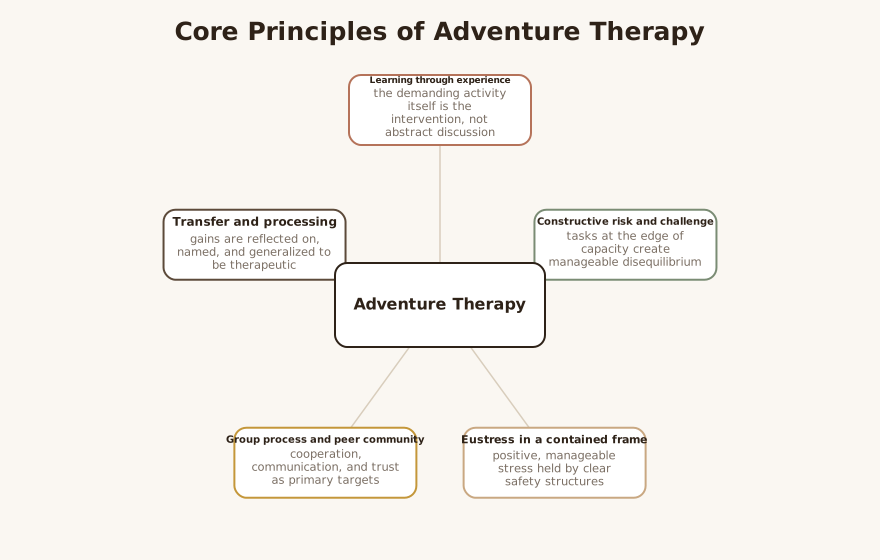
AT rests on a small set of interlocking principles 5. The first is learning through direct experience: change is produced by doing something demanding and then making sense of it, not by discussing it in the abstract — the activity is the intervention 5LLM. The second is the constructive use of risk and challenge: tasks are designed to sit at the edge of the client’s perceived capacity, creating a manageable state of disequilibrium that motivates new behavior and lets the client discover competence under stress 5LLM.
A third principle is eustress within a contained frame — the deliberate use of positive, manageable stress so that the client experiences arousal and uncertainty while held by clear safety structures, group support, and facilitation 5LLM. A fourth is the central role of group process and the peer community: many AT activities are interdependent, so cooperation, communication, leadership, and trust are not side effects but primary therapeutic targets 5LLM. A fifth is transfer and processing: the gains made on the rock face or rope course are only therapeutic insofar as they are reflected on, named, and intentionally generalized to the client’s life outside the program — the “what / so what / now what” of guided debrief 5LLM.
LLM-generated illustrative example (not a guideline): An adolescent who insists “I can’t do anything right” is belayed up a climbing wall by peers she has just learned to trust. She reaches a hold she was certain she could not. In the debrief, the facilitator does not praise the climb; she asks what made it possible and where else in the client’s life that same support and persistence might apply. The climb is the data; the processing is the treatment LLM.
Interventions & Techniques
AT’s toolkit is a graded sequence of structured experiences, each followed by facilitated reflection 5. Common components include:
- Group initiatives and low-element challenges — problem-solving tasks that require the group to cooperate, communicate, and plan, used early to build cohesion and surface interpersonal patterns 5LLM.
- High ropes and challenge courses — individually demanding elements (high beams, zip lines, climbing) that elicit fear and self-doubt within a belayed safety system, targeting self-efficacy and emotion regulation 5LLM.
- Expeditions and wilderness programming — multi-day backcountry trips in which natural consequences, shared hardship, and removal from familiar reinforcers create sustained therapeutic pressure and group interdependence 5LLM.
- Solo and reflective practices — periods of structured solitude used for self-examination and consolidation 5LLM.
- Facilitated debrief and metaphoric framing — the clinical heart of the work, in which the facilitator helps clients extract meaning, connect the experience to treatment goals, and build an “isomorphic” bridge between the adventure and real-life challenges 5LLM.
Across these, the facilitator uses framing (how a task is introduced and given meaning) and processing (how it is reflected on afterward) as the principal clinical levers, ranging along a continuum from letting the experience speak for itself to direct, frontloaded therapeutic metaphor 5LLM. Sequencing — moving from lower to higher challenge as group safety and individual readiness grow — is itself a deliberate technique 5LLM.
LLM-generated illustrative example (not a guideline): Before a trust-fall sequence, the clinician frames it explicitly: “Letting yourself fall is the same muscle as letting yourself ask for help — something several of you said you never do.” The frontloaded metaphor turns a physical exercise into rehearsal for a specific interpersonal goal, which is then named again in the debrief LLM.
Evidence Base
The evidence maturity of Adventure Therapy is best described as established: the field has its own meta-analytic literature spanning decades, not merely scattered case reports 12. Neill’s benchmarking work demonstrated that adventure-program outcomes could be quantified and compared against reference values, putting the field on an empirical footing 2. The most substantial synthesis, the Bowen and Neill meta-analysis, pooled a large body of adventure therapy outcome studies and found a moderate short-term effect, with outcomes that were generally maintained — and in some analyses continued to improve — at follow-up, which is notable given that many psychotherapy gains fade after termination 1.
Honest appraisal of that base matters. The Bowen and Neill synthesis also documented substantial heterogeneity and the influence of moderators — program length, population, and outcome domain among them — meaning effects vary considerably by who is treated and how the program is run 1. Much of the historical literature is quasi-experimental rather than randomized, and the field has been candid that methodological rigor is uneven 1LLM. More recent and more targeted evidence is accumulating: a meta-analysis of AT specifically for anxiety-related disorders examined its effectiveness in that domain, and a pragmatic controlled trial reported short- and long-term outcomes of an adventure therapy programme for people with borderline personality disorder, extending the evidence toward defined clinical populations 34. The defensible clinician’s summary is that AT is a well-supported, moderately effective modality with reasonable durability, whose effects are real but moderate and moderator-dependent — best presented to clients and teams as an established experiential treatment rather than a guaranteed or first-line stand-alone cure for any specific disorder 134LLM.
Populations & Indications
AT has been applied across a broad span of populations, with the deepest historical base in youth 1. The meta-analytic literature draws heavily on adolescents and at-risk or adjudicated youth, among whom AT has been used to target behavioral problems, self-concept, and social functioning 15. It is widely used with groups and families, given its inherently interpersonal design 5LLM. Adults are also served, including in clinical and rehabilitation contexts 5.
More recent work extends AT into defined clinical groups. It has been studied for anxiety-related disorders, where exposure to managed challenge maps conceptually onto graded approach to feared arousal 3. A pragmatic controlled trial has examined AT for adults with borderline personality disorder, a population for whom experiential, skills-relevant, group-based intervention is plausible 4. By extension within the field, AT is also commonly applied to substance-use populations, veterans, and people with depression or demoralization, settings consistent with its theory though variably represented in the highest-quality evidence 5LLM.
Problems-for-Work
- Behavioral and conduct problems. Structured challenge and immediate natural consequences provide in-vivo opportunities to practice impulse control and prosocial behavior, a long-standing target in the youth literature 1. Application: an adjudicated adolescent learns to wait, plan, and follow group safety rules because the activity will not proceed otherwise LLM.
- Low self-concept and self-efficacy. Mastering a feared, concrete task produces direct disconfirming evidence against “I can’t,” which is then consolidated in debrief 1LLM.
- Anxiety-related disorders. Graded exposure to manageable physiological arousal and uncertainty, within a safe frame, parallels exposure principles 3LLM.
- Emotional dysregulation and BPD features. Tolerating intense affect during challenge, with group support and reflection, rehearses distress tolerance and interpersonal effectiveness 4LLM.
- Interpersonal and social-skills deficits. Interdependent tasks make communication, trust, and conflict unavoidable and therefore workable in real time 5LLM.
- Substance use, depression, and demoralization. Re-engagement, competence experiences, and meaningful group connection counter withdrawal and hopelessness 5LLM.
Contraindications, Cautions & Cultural Humility
The most obvious cautions are physical: AT involves real activity and managed risk, so medical, orthopedic, cardiac, and mobility limitations, pregnancy, and certain medication effects must be screened and accommodated, and informed consent must be genuinely informed about the risks involved 5LLM. Psychologically, clients with acute psychosis, severe suicidality, active mania, or states in which arousal cannot be safely contained may be poorly served by deliberately stress-inducing activity without substantial adaptation or stabilization first 5LLM. Because AT manufactures stress on purpose, trauma history requires particular care: a poorly framed challenge can re-traumatize rather than empower, so titration, choice, and the ability to opt out are essential safety provisions 5LLM.
Cultural humility is central and easy to neglect. The wilderness-and-mountaineering imagery at AT’s roots is culturally specific, and assumptions about comfort with the outdoors, physical risk, bodily exposure, group touch, and “rugged” challenge vary widely across cultures, genders, disabilities, body sizes, religions, and trauma histories 65LLM. Access barriers are real: outdoor programs can implicitly assume able-bodiedness and a relationship to nature that not all clients share, and the field’s historical base skews toward particular populations 1LLM. The clinician’s task is to adapt the activity, framing, and setting to the client rather than treating the standard adventure frame as universally safe, neutral, or welcome 5LLM.
Treatment-Plan Suggestions & SMART Objectives
The following goals, objectives, and mechanisms are illustrative and must be individualized; the mechanisms reflect AT’s core model of experiential challenge, group process, and reflective transfer 5LLM.
| Goal | SMART objective (example) | Mechanism |
|---|---|---|
| Increase self-efficacy | Within 6 sessions, client will complete one self-selected high-challenge element and name two real-life situations the experience applies to, in 2 of 3 debriefs | Mastery of feared concrete tasks disconfirms “I can’t” and is consolidated in processing 1 |
| Improve distress tolerance | Over 8 weeks, client will remain engaged through one episode of high physiological arousal during a challenge without withdrawing, in 3 of 4 activities | Eustress within a contained frame builds tolerance of intense affect 54 |
| Strengthen interpersonal effectiveness | Within 10 group sessions, client will initiate one cooperative or help-seeking behavior per group initiative, logged by facilitator | Interdependent tasks make communication and trust workable in real time 5 |
| Reduce avoidance (anxiety) | Over 6 weeks, client will approach a graded sequence of feared challenges, advancing one level per week for 4 weeks | Graded approach to manageable arousal parallels exposure 3 |
| Improve emotion regulation (BPD features) | Within 12 sessions, client will use one taught regulation skill during a challenge and report its use in debrief, in 3 of 4 sessions | Skills rehearsed under real arousal with group support transfer to daily life 4 |
| Increase prosocial behavior (youth) | Over an expedition, client will follow group safety agreements without staff redirection on at least 4 of 5 days | Natural consequences and group interdependence shape conduct 1 |
| Generalize gains to daily life | By program end, client will identify and act on three “now what” commitments linking program experiences to home goals | Facilitated transfer and metaphoric framing bridge experience to life 5 |
Common Misconceptions
- “Adventure Therapy is just recreation or team-building.” It is a prescriptive, theory-driven psychotherapy delivered by trained clinicians, in which the activity is structured toward defined treatment goals and processed deliberately, not enjoyed for its own sake 5LLM.
- “The adventure does the work by itself.” The experience without facilitated reflection and transfer is recreation; the clinical change agent is the framing and processing that connect the activity to the client’s life 5LLM.
- “It has no real evidence.” AT has its own meta-analytic literature showing moderate, reasonably durable effects, plus emerging controlled trials in clinical populations — it is established, not experimental 124.
- “It’s a guaranteed, one-shot transformation.” Effects are moderate and moderator-dependent, vary by population and program design, and are best positioned as part of a treatment plan, not a single curative event 1LLM.
- “It requires extreme wilderness.” Much AT happens on ropes courses and in low-element group initiatives close to home; remote expeditions are one delivery format, not a requirement 5LLM.
Training & Certification
Practicing AT well requires a dual competency that few clinicians naturally possess: clinical training in psychotherapy and group process, plus technical, safety, and facilitation skill in the adventure activities themselves 5LLM. The field is professionalized, with a dedicated textbook articulating theory, research, and practice standards and with professional associations that support practitioners and program accreditation 5. Technical certifications (for example, challenge-course and belay competencies and wilderness medical training) are typically required alongside a primary mental-health license, and risk-management and safety standards are a non-negotiable part of competent practice 5LLM. Clinicians entering the field should expect supervised experiential training in facilitation and processing — not just activity instruction — and should verify current credentialing and accreditation expectations with the relevant adventure therapy professional body 5LLM.
Key Terms
- Adventure Therapy — the prescriptive use of adventure experiences to produce psychological, behavioral, and social change within a clinical treatment frame 5.
- Eustress — positive, manageable stress deliberately induced by challenge and held within a safe structure 5LLM.
- Challenge by choice — the principle that clients choose their level of participation in a challenge rather than being forced, central to safe and ethical practice 5LLM.
- Framing / frontloading — introducing an activity with meaning or metaphor so that it maps onto a therapeutic goal before it begins 5LLM.
- Processing / debrief — the facilitated reflection after an activity that extracts meaning and transfers it to life (“what / so what / now what”) 5LLM.
- Transfer (generalization) — the deliberate carrying-over of insights and skills from the activity to the client’s everyday context, without which AT remains recreation 5LLM.
- Group initiative — a cooperative problem-solving task requiring the whole group, used to surface and work interpersonal patterns 5LLM.
Resources & Further Reading
▶ Watch — a video introduction to this concept:
- A Meta-Analysis of Adventure Therapy Outcomes and Moderators (Bowen & Neill, 2013, The Open Psychology Journal)
- Reviewing and Benchmarking Adventure Therapy Outcomes: Applications of Meta-Analysis (Neill, 2003)
- Evaluating the Effectiveness of Adventure Therapy in Anxiety-Related Disorders: A Meta-Analysis (McLain, 2025)
- Short- and Long-Term Outcomes of an Adventure Therapy Programme on Borderline Personality Disorder: A Pragmatic Controlled Trial (PMC)
- Adventure Therapy: Theory, Research, and Practice (Gass, Gillis & Russell)
- History — Outward Bound
Reflective / Supervision Questions
- For a given client, can I articulate the specific treatment goal each activity serves, or am I defaulting to “the experience will be good for them”? 5LLM
- How rigorously am I doing the processing and transfer work, given that the debrief — not the climb — is where the therapy happens? 5LLM
- Have I screened adequately for physical, psychiatric, and trauma-related contraindications, and is “challenge by choice” genuinely operating, or is there subtle coercion to participate? 5LLM
- Whose relationship to the outdoors, the body, and physical risk am I assuming, and how might the standard adventure frame exclude or threaten this particular client? 65LLM
- Am I presenting AT’s evidence honestly — moderate, durable, but moderator-dependent — rather than as a guaranteed transformation? 1LLM
- Do I hold both halves of the dual competency this work demands, the clinical and the technical/safety, or am I leaning on one at the expense of the other? 5LLM