
Type & Discipline
Emotional Freedom Techniques (EFT), colloquially “tapping,” is a brief, manualized psychotherapeutic procedure in which the client stimulates a sequence of acupressure points with the fingertips while verbally holding a distressing memory, sensation, or belief in mind 6. It sits within the broader family of “energy psychology” methods, which posit that psychological distress is linked to disturbances in a putative bodily energy system 1. Procedurally, EFT braids together three recognizable elements: imaginal exposure to the target material, a cognitive self-statement that pairs the problem with self-acceptance, and the somatic tapping component 3. For the practicing clinician, the most useful framing is that EFT is a structured, low-intensity exposure-and-cognitive protocol wrapped around a contested somatic ritual whose independent contribution remains unproven LLM. It is delivered individually or in groups, in person or via telehealth, and is frequently taught to clients as a self-administered coping skill 4.
Creators & Lineage
EFT descends directly from Thought Field Therapy (TFT), developed by psychologist Roger Callahan in the 1980s, which paired tapping sequences (“algorithms”) with the idea of correcting energy-field perturbations 1. Gary Craig, an engineer and personal-development figure trained by Callahan, simplified TFT’s condition-specific algorithms into a single standardized recipe of tapping points and popularized it as Emotional Freedom Techniques, distributing it widely through a self-published manual 1. The method’s subsequent migration into research and professional discourse was driven substantially by David Feinstein, who has authored reviews positioning energy psychology as evidence-based, and Dawson Church, who founded an institute promoting and studying “Clinical EFT” and co-authored its principal systematic review 3. Popularizers such as Nick Ortner, through “The Tapping Solution,” have carried the technique into mainstream wellness media and self-help instruction 8. This lineage matters clinically: the same individuals who developed and commercially promote the method also produced much of its supporting evidence, a researcher-allegiance pattern that recurs throughout the literature 3.
Core Principles
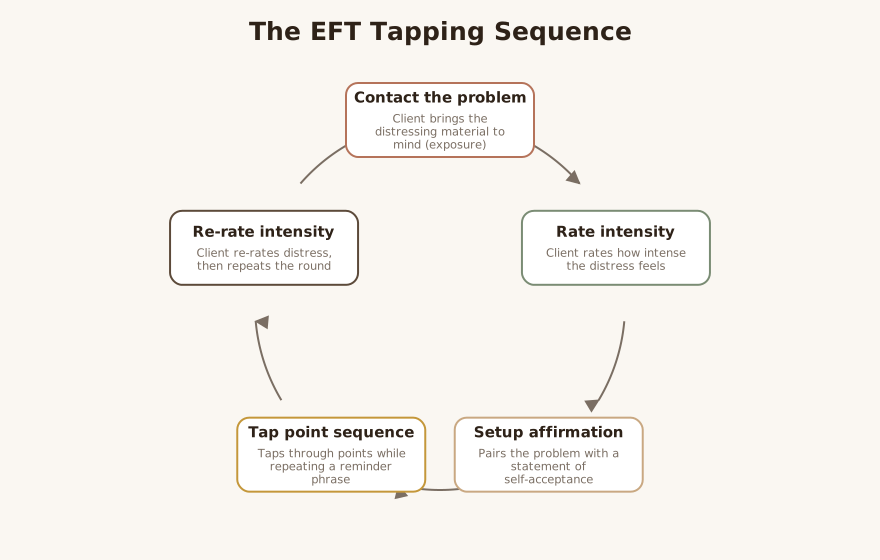
The animating theory of EFT is that “the cause of all negative emotions is a disruption in the body’s energy system,” and that tapping on meridian points while attending to distress restores balance and discharges the emotional charge 1. Meridians and “life energy” are prescientific constructs with no demonstrated anatomical or physiological correlate, and acupuncture-point maps cannot be reconciled across traditions or with modern anatomy 2. In practice, the operative principles a clinician actually deploys are more conventional: the client makes contact with the problem (exposure), rates its intensity, recites a “setup” affirmation pairing the problem with self-acceptance (cognitive reframing), and taps through a point sequence while repeating a reminder phrase, then re-rates intensity 6. Proponents increasingly describe EFT as a “complete” intervention integrating exposure and cognitive components rather than relying on energy claims alone 3. The honest synthesis is that EFT’s plausible mechanisms — graded exposure, cognitive restatement, paced breathing, attentional distraction, and a soothing self-touch ritual — are well-established, while its signature mechanism, the meridian tapping, is the part with no credible scientific basis 1.
Interventions & Techniques
The standard “Basic Recipe” begins by identifying a specific target — a memory, craving, physical sensation, or belief — and rating its distress on a 0–10 Subjective Units of Distress scale 6. The client states a “setup” phrase, typically “Even though I have [this problem], I deeply and completely accept myself,” while tapping the side of the hand 6. They then tap through a fixed sequence of points on the face and torso (eyebrow, side of eye, under eye, under nose, chin, collarbone, under arm, top of head) while repeating a brief reminder phrase that keeps the target activated 6. After one or more rounds, the distress is re-rated, and the procedure repeats until the rating drops, often re-aiming at new aspects that surface 6. Self-administration between sessions is explicitly encouraged, and group delivery is common, which partly explains the method’s scalability 4.
LLM-generated illustrative example (not a guideline): A clinician working with a client’s test anxiety might have them target the specific image of “blanking out when the exam starts,” rate it at 8/10, run two tapping rounds pairing that image with the self-acceptance setup, and then re-rate — using the drop in the rating as an in-session exposure metric while remaining transparent that the active work is contact with the feared image, not the meridians LLM.
From a mechanistic standpoint, the exposure and cognitive scaffolding here is largely indistinguishable from elements found in established trauma and anxiety treatments 5.
Evidence Base
The evidence base is best described as emerging and contested. Proponent-led syntheses report a substantial and growing literature: one systematic review counted 56 randomized controlled trials and multiple meta-analyses, reporting large effect sizes for anxiety, depression, and post-traumatic stress and claiming the method meets APA Division 12 criteria for an “efficacious” treatment 3. A 2024 meta-analysis of 18 trials found a large pooled effect on depressive symptoms (Hedges’ g ≈ 1.27) 4. Taken at face value, these are striking numbers 3.
The serious caveats, however, dominate any honest appraisal. The principal systematic review was authored by individuals who founded and lead EFT-promoting organizations and who authored many of the included studies, a profound conflict of interest for a review claiming to establish independence 3. Even the favorable 2024 depression meta-analysis rated roughly two-thirds of its included trials as having “some concerns” or “high” risk of bias, noted predominantly small samples and subthreshold rather than clinically diagnosed depression, and called explicitly for research into long-term effects and more severe conditions 4. Critically, the highest-quality dismantling work indicates that the location of the tapping points makes no difference to outcome, with effects attributable to well-known psychological mechanisms such as distraction and breathing — directly undercutting the claim that the meridian component is an active ingredient 1. Skeptical reviews emphasize that the underlying theory has no evidentiary support across biology, anatomy, physiology, or physics, that controls and blinding are typically inadequate, and that comparable effects appear when EFT is matched against other methods, consistent with nonspecific benefit rather than a unique mechanism 2. EFT is consequently characterized in reference literature as “generally” pseudoscience, even as some of its component procedures plausibly help 1. The defensible bottom line: clients often improve during EFT, but the best evidence attributes that improvement to its conventional exposure and cognitive elements rather than to tapping 2.
Populations & Indications
The literature has been applied most often to adults with anxiety and depressive symptoms, trauma-exposed populations including veterans with PTSD symptoms, and people with specific phobias 3. The 2024 depression meta-analysis drew on diverse samples including veterans, nursing students, older adults, and cancer survivors, suggesting the procedure has been trialed across varied groups, though largely with subthreshold symptom severity 4. EFT is also promoted for stress reduction, cravings, pain, and insomnia, though these indications rest on weaker and more heterogeneous evidence 3. Because it is brief, low-cost, and teachable as a self-help skill, it has appeal as an adjunctive or stepped-care option for mild-to-moderate distress and for clients who are drawn to body-based, self-directed practices LLM. It should not be positioned as a front-line treatment where well-validated alternatives exist LLM.
Problems-for-Work
EFT is most reasonably deployed against discrete, well-specified distress states where its exposure-and-cognitive scaffolding can do legitimate work LLM.
- Anxiety and acute physiological arousal: Pairing a feared cue with paced tapping and breathing can function as a graded exposure plus down-regulation exercise; large anxiety effects are reported, with the proviso that they likely reflect exposure and breathing rather than meridians 3.
- Depressive symptoms: Used adjunctively for mild-to-moderate or subthreshold depressive symptoms, where the meta-analytic signal is largest but bias is substantial 4.
- Specific phobia and post-traumatic intrusions: The structured contact with a feared image or memory mirrors exposure principles that are independently well-supported 5.
- Stress, cravings, and somatic distress: Offered as a portable self-soothing and attention-shifting routine for between-session regulation 6.
LLM-generated illustrative example (not a guideline): For a client with needle phobia ahead of a medical procedure, a clinician might use EFT rounds as a brief in-session exposure ladder — visualizing the clinic, then the needle, then the insertion — framing the tapping honestly as a structured way to stay in contact with each step rather than as an energetic correction LLM.
Contraindications, Cautions & Cultural Humility
The foremost caution is informed consent: clients deserve an honest account that EFT’s distinctive theory lacks scientific support and that benefit, where it occurs, is most plausibly due to conventional psychological processes 2. EFT is not an adequate stand-alone treatment for complex or severe trauma, and steering trauma survivors toward an unvalidated method in place of front-line, evidence-based exposure approaches risks meaningful harm through lost opportunity 5. As with any exposure-containing procedure, activating traumatic material without adequate stabilization and titration can flood a dysregulated client, and self-administration at home removes the clinical containment that makes exposure safe LLM. Practitioners should also resist overclaiming the biological assertions sometimes attached to EFT — gene-expression and hormonal claims rest on thin, allegiance-laden evidence 3. Cultural humility cuts two ways: acupressure-derived practices arise from traditions clients may value, and dismissiveness can rupture alliance, yet respect for a client’s worldview does not license presenting a contested mechanism as established fact LLM. The ethical stance is transparency about what is and is not known, paired with respect for client autonomy and preference 2.
Treatment-Plan Suggestions & SMART Objectives
| Goal | SMART objective (example) | Mechanism |
|---|---|---|
| Reduce anxiety reactivity | Client will reduce peak SUDS rating to a target trigger from 8 to ≤4 across 6 weekly sessions | Graded imaginal exposure plus paced breathing 3 |
| Lower depressive symptom burden | Client will report a 30% reduction on a self-report depression measure over 8 weeks of adjunctive tapping | Behavioral activation cue plus cognitive restatement 4 |
| Diminish phobic avoidance | Client will complete a 5-step feared-stimulus hierarchy while maintaining engagement over 5 sessions | Structured exposure to the feared image 5 |
| Build a portable self-regulation skill | Client will independently complete a tapping round to bring acute arousal below 4/10 on 4 of 5 logged occasions | Self-directed attentional shift and down-regulation 6 |
| Reduce trauma-related intrusions | Client will report intrusion frequency falling from daily to ≤2x/week over 8 weeks within a stabilization-first plan | Titrated contact with the memory plus self-acceptance framing 5 |
| Decrease somatic/stress distress | Client will lower a weekly stress rating by 2 points over 6 weeks of brief daily practice | Soothing self-touch ritual and breathing 6 |
| Strengthen self-acceptance language | Client will voice a non-judgmental self-statement during distress on 3 consecutive sessions | Cognitive reframing embedded in the setup phrase 3 |
Common Misconceptions
A frequent misconception is that the meta-analytic effect sizes settle the question of efficacy; in fact, the most-cited reviews carry severe conflict-of-interest and risk-of-bias problems that the favorable studies themselves acknowledge 3. A second is that the tapping points are the active ingredient — the strongest dismantling evidence shows their location does not matter, pointing instead to distraction, breathing, and exposure 1. A third is that EFT is “energy medicine” with a physiological basis; reference and skeptical sources are blunt that meridians and “life energy” have no scientific support and that the framework has “all the hallmarks of pseudoscience” 12. Conversely, clinicians sometimes overcorrect and assume EFT does nothing — yet clients frequently do improve, because the procedure smuggles in genuinely active conventional components 2. Finally, EFT is not an established equivalent to front-line PTSD treatments; methods like prolonged exposure carry a far stronger evidentiary pedigree 5.
Training & Certification
There is no single regulated credential for EFT; training is delivered through a patchwork of proprietary programs, certifying bodies, and self-help courses, several run by the same organizations that promote and research the method 3. Introductory instruction is widely available, including free demonstrations of the Basic Recipe by popularizers 8. Because certification confers no statutory authority, the meaningful competencies for a licensed clinician are the underlying ones: exposure delivery, cognitive technique, risk assessment, and stabilization, all of which transfer from established trainings 5. Clinicians considering EFT should weigh continuing-education claims critically given the commercial and allegiance interests woven through the field 3.
Key Terms
- Tapping / acupressure points: Fingertip stimulation of a fixed sequence of facial and torso points central to the EFT procedure 6.
- Meridians / “life energy”: The putative energy pathways invoked by EFT theory, for which no scientific evidence exists 1.
- Setup statement: The “Even though I have [problem], I deeply and completely accept myself” phrase pairing the target with self-acceptance 6.
- Subjective Units of Distress (SUDS): The 0–10 self-rating used to gauge and track distress across tapping rounds 6.
- Energy psychology: The broader family of methods, including TFT and EFT, premised on correcting bodily energy disturbances 1.
- Dismantling study: A design that removes or alters a component (e.g., tapping location) to test whether it is an active ingredient 1.
- Researcher allegiance: The bias arising when a method’s developers and promoters also generate and review its evidence 3.
Resources & Further Reading
▶ Watch — a video introduction to this concept:
- Emotional Freedom Techniques — Wikipedia
- Emotional Freedom Technique — Acupuncture for the Mind (Science-Based Medicine)
- Clinical EFT as an Evidence-Based Practice: A Systematic Review (Frontiers in Psychology, 2022)
- The Effectiveness of EFT for Depressive Symptoms: A Meta-Analysis (PMC, 2024)
- Prolonged Exposure Therapy for PTSD — APA Division 12
- What Is EFT Tapping? How To Do It and Benefits (Cleveland Clinic)
- Emotional Freedom Technique — RationalWiki
- How to Tap — with Nick Ortner of The Tapping Solution (YouTube)
Reflective / Supervision Questions
- How would I describe EFT’s evidence and mechanism to a client in a way that is honest about the pseudoscience characterization without dismissing their interest or rupturing the alliance? 1
- If I believe a client improves with EFT, can I articulate which conventional components — exposure, cognitive reframing, breathing, distraction — are likely doing the work? 2
- For a trauma presentation, what is my justification for offering EFT over a front-line, well-validated exposure treatment, and have I documented that reasoning? 5
- How do I account for researcher allegiance and risk of bias when I read a meta-analysis reporting very large effects? 34
- What stabilization and titration safeguards do I have in place before encouraging unsupervised self-administered tapping at home? 6