
Type & Discipline
Discursive psychology is not a therapy. It is a framework and a research methodology within discourse analysis and social psychology — a form of discourse analysis that focuses on psychological themes in talk, text, and images 1. Discourse can be defined straightforwardly as spoken or written communication, and discourse analysis as the analysis of such communication; but as a research methodology, discourse analysis is an umbrella term covering many forms with different foci, from how sentences are built (linguistics) to how talk-in-interaction is structured (conversation analysis) to how power operates in language (critical discourse analysis) 2. Discursive psychology is the strand of that family that applies these tools to questions of explicitly psychological relevance 2.
Its defining move is to treat discourse not as a window onto an inner mental world but as a “construction yard” in which psychological notions are built from linguistic materials and managed in interaction 1. Phenomena that mainstream psychology locates inside the person — memory, identity, emotion, blame, attitudes — are reframed as things people do with words, accomplished between people rather than expressed from within them 1.
For clinicians, the relevance is conceptual and analytic rather than procedural. Discursive psychology supplies a disciplined vocabulary for noticing what a client’s talk is doing in the room — claiming, excusing, blaming, defending, constructing a version of events as solid fact — independent of whether it accurately reports a hidden inner state LLM. It is a lens, not a manual LLM.
Creators & Lineage
The approach grew out of the “turn to language” that swept the social sciences in the 1980s, centered on the Discourse and Rhetoric Group at Loughborough University in the United Kingdom 1. Its first articulation came with Jonathan Potter and Margaret Wetherell’s 1987 book Discourse and Social Psychology: Beyond Attitudes and Behaviour, which promoted the analysis of talk and text as an important focus in its own right rather than as a route to inner cognitive processes 2. The label “discursive psychology” was popularized by Derek Edwards and Potter, most influentially in their 1992 book Discursive Psychology, which formally named and founded the approach and reread classic psychological topics — memory and causal attribution among them — as discursive and rhetorical actions rather than cognitive processes 14. Other major contributors include Charles Antaki, Alexa Hepburn, Liz Stokoe, and the rhetorical psychologist Michael Billig 1.
Methodologically, discursive psychology is a synthesis. It draws on conversation analysis (Harvey Sacks), ethnomethodology (Harold Garfinkel), classical rhetoric (Billig), speech act theory, and social constructionism 1. At its core sits a sustained critique of cognitivism — the assumption that cognitive processes are the primary shapers of human action — inherited directly from Edwards and Potter 2. Within counseling and clinical disciplines these ideas have been absorbed slowly and indirectly; the implications of discursive psychology specifically for counseling psychology have been examined in the literature 5, and they resonate strongly with narrative and social-constructionist therapies, though the framework itself remains anchored in research rather than treatment LLM.
Core Principles
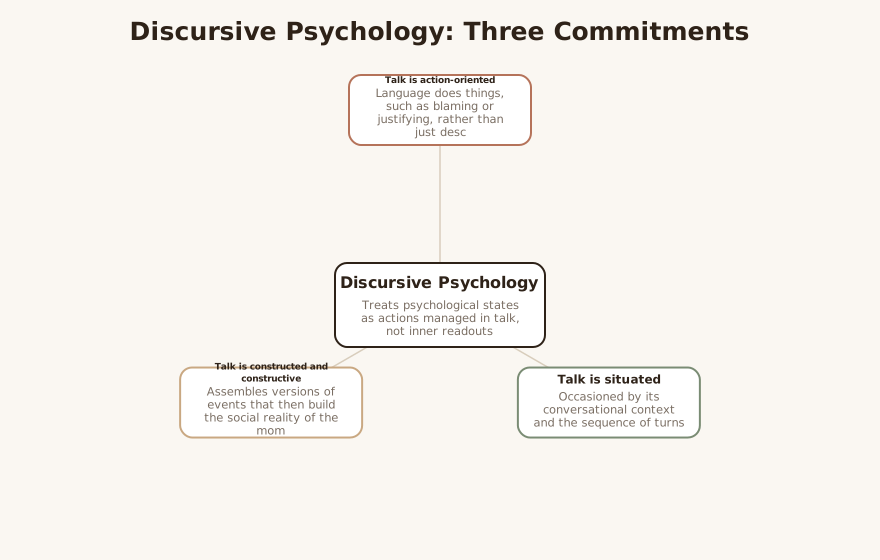
Discursive psychology is usually summarized through three interlocking commitments 1. The first is that talk is action-oriented: language is a medium for doing things — complaining, justifying, blaming, complimenting, demanding, acquiescing — not merely for describing them 2. The analytic question shifts from “what does this utterance reveal about the speaker’s mind?” to “what is this utterance doing, here, in this sequence?” 2.
The second is that talk is situated — occasioned by its immediate conversational context and embedded in the sequential organization of turns 1. Meaning is read from the local interactional environment (what came before, what response it invites) rather than imported from a theory of inner states 3. This is why discursive psychology insists on naturally occurring data and high-quality transcription that captures pauses, intonation, and turn-taking, not just the words 3.
The third is that talk is both constructed and constructive: people assemble versions of events, of themselves, and of others out of available linguistic resources, and those versions in turn build the social reality of the moment with real interactional consequences 1. Advocating for a position is therefore not treated as a readout of an inner “attitude” the person possesses; it is a social action performed in a particular context to particular effect 2.
Underlying all three is an explicit anti-cognitivism and a constructionist epistemology. Discursive psychology does not adhere to the view that meaning resides in objects and can be objectively discovered; it proceeds instead from the premise that meaningful reality is constructed in and through human interaction, with language at the heart of meaning-making 2. Psychological categories such as “depression” or “gender identity” are understood as brought into being in particular historical and cultural locations and as continuing to change as people rework them in interaction 2.
Potter has described the field as developing across three strands: strand one identifies interpretative repertoires — conceptually organized clusters of terms, phrases, and figures of speech used to build social action and often to maintain configurations of power; strand two attends to the social actions speakers perform and re-envisions psychological concepts such as attitudes, beliefs, and emotions as “socially managed” between people rather than located within them; and strand three brings the close, sequential attention to talk that is characteristic of conversation analysis — grammar, pauses, intonation, turn-taking 2. Critical discursive psychology (associated with Wetherell) extends this by connecting the fine-grained analysis of talk to the broader culturally and historically available discourses that enable and constrain how people can speak at all 2.
Interventions & Techniques
Discursive psychology is descriptive, not prescriptive; it does not arrive with a technique manual or a session protocol LLM. Clinically it is best used as an observational and formulation lens that is then delivered inside a recognized modality LLM. The translations below all require a host treatment frame rather than standing alone LLM.
- Tracking action over report. Instead of asking only what a client’s statement reveals about their inner state, the clinician notices what the statement is doing in the exchange — defending, accusing, soliciting reassurance, pre-empting blame 2LLM.
- Listening for fact construction. Discursive psychology attends closely to how speakers build a version of events as solid, factual, and independent of their own stake in it; a clinician can notice when “what happened” is being constructed as airtight and gently open it up to alternatives 1LLM.
- Mapping interpretative repertoires. Naming the recurring vocabularies a client reaches for — for example, an illness repertoire versus a moral-failing repertoire for the same behavior — can surface how a problem is being framed and which framings constrain change 2LLM.
- Reframing emotion as managed and displayed. Treating an emotional display as something organized and accomplished in interaction, rather than a simple leak of an inner feeling, can shift attention to its function and its effect on the listener 3LLM.
- Situating talk in its sequence. Reading a client’s utterance in light of what immediately preceded it — including the clinician’s own prior turn — guards against attributing to enduring traits what is in fact a local, occasioned response 3LLM.
- Connecting micro to macro. Critical discursive psychology invites the clinician to link a client’s individual talk to the wider cultural discourses (about gender, illness, worth, success) that supply and limit their available ways of speaking about themselves 2LLM.
LLM-generated illustrative example (not a guideline): A client recounts a conflict with a partner and narrates it as a sequence of bare, undeniable facts — “I came home, the dishes were there, I said one calm thing, and they exploded.” A discursively attuned clinician notices the version is built to be unimpeachable and to locate all accountability with the partner. Rather than disputing the facts, the clinician asks how the partner might tell the same minutes, opening space between the constructed version and other possible accounts LLM.
Evidence Base
Honesty requires a sharp split. As a framework within discourse analysis and social psychology, discursive psychology is established — it has a clear founding literature dating to the late 1980s and early 1990s, a recognized set of strands and methods, and standing as one of the major forms of qualitative research now undertaken by psychologists 12. That maturity refers to its standing as a methodology for analyzing talk and text, not to any clinical efficacy LLM.
As a clinical application, the picture is entirely different and far less developed. Discursive psychology is not itself an evidence-based therapy: there is no manualized “discursive psychology treatment” and no body of randomized controlled trials testing it as a discrete intervention LLM. Its primary literature is methodological and analytic rather than outcome-oriented; even its own quality criteria are about the soundness of analysis — documentation, demonstration, plausibility, coherence, fruitfulness — not about symptom change 2. Its most direct clinical contribution has been as a research lens trained on professional interaction: Potter and Hepburn applied it to interaction in medical settings, analyzing, for example, how crying on a child-protection helpline is organized and received within the turn-by-turn structure of the call 3. That work demonstrates the framework’s analytic value for understanding clinical talk, but it is descriptive research, not a treatment trial 3.
The practical upshot for clinicians is to treat discursive psychology as a conceptual and formulation tool — a way of hearing what session talk is doing — while drawing any efficacy claims from the established host modality in which it is embedded, not from discursive psychology itself LLM. It is also worth noting that the framework is methodologically demanding: it is described as among the most challenging of the qualitative methodologies, requiring familiarity with a wide range of linguistic resources and a tolerance for upending taken-for-granted assumptions about psychology 2.
Populations & Indications
The framework is most apt where the construction of meaning, identity, and accountability in talk is central to the clinical problem, rather than where the priority is symptom reduction through a manualized protocol LLM.
- Couples and families, where conflict often turns on competing constructed versions of “what really happened” and on how blame is assigned and resisted in the back-and-forth of talk LLM.
- Clients negotiating blame and accountability, for whom much of the therapeutic work is in how responsibility is claimed, deflected, or distributed in their accounts 1LLM.
- Clients in identity- and meaning-focused work, where rigid self-descriptions can be heard as constructions assembled from particular repertoires rather than fixed facts about the self 2LLM.
- Clients from marginalized or minoritized communities, where critical discursive psychology’s attention to the wider cultural discourses that constrain how a person can speak about themselves is especially relevant 2LLM.
- People navigating contested or stigmatized diagnoses, where the very category at issue can be examined as historically and culturally constituted rather than simply given 2LLM.
Problems-for-Work
- Relationship conflict. Target: surfacing how each partner constructs a factual, self-exonerating version of a shared event so the couple can hold multiple accounts at once. Application: the clinician notices when a narrative is built to be unimpeachable and invites the alternative telling 1LLM.
- Blame and accountability disputes. Target: tracking how responsibility is assigned and resisted in the talk itself rather than adjudicating who is “right.” Application: naming the move when an account pre-empts blame, and exploring what a less defended version might sound like 1LLM.
- Shame and self-criticism. Target: hearing a harsh self-description as a construction drawn from an available moral repertoire, not a fixed truth. Application: asking what other repertoire (illness, context, learning) could frame the same event 2LLM.
- Rigid identity narratives. Target: loosening a fixed self-story by treating it as one constructed version among possible others. Application: mapping the recurring vocabulary a client uses about themselves and testing its limits 2LLM.
- Internalized stigma. Target: linking a client’s self-talk to the broader cultural discourses that supply it. Application: connecting individual self-description to wider, historically situated ways of talking about the relevant category 2LLM.
- Therapeutic rupture and impasse. Target: reading an in-session impasse as occasioned by the immediate sequence of turns — including the clinician’s own — rather than as a client trait. Application: attending to what the clinician’s prior turn invited before attributing resistance 3LLM.
Contraindications, Cautions & Cultural Humility
Discursive psychology should never be used as a standalone treatment or as a substitute for a properly indicated modality; it is an adjunctive lens LLM. A central caution is anti-realism creep: while the framework holds that our knowledge of reality is built through ever-changing, historically and culturally situated discourses, most of its proponents do not deny the existence of a material world 2. Clinicians must keep that distinction firmly in mind — treating a client’s account as a construction worth examining must never slide into treating real harm, abuse, or trauma as “just a story.” The constructionist stance is an analytic posture toward talk, not a denial of events or suffering LLM.
A second caution is over-reading: the framework’s claim that psychological states are managed in talk does not license a clinician to dismiss a client’s reported feeling as merely strategic 3. Reframing an emotional display as occasioned and organized in interaction is a way of understanding its function, not a verdict that it is inauthentic 3LLM.
Cultural humility is intrinsic to the approach and, applied honestly, a real strength. Discursive psychology takes a critical stance toward taken-for-granted categories and treats concepts such as gender identity and diagnostic labels as historically and culturally specific, shaped by the discourses available in a given time and place 2. Critical discursive psychology pushes clinicians to ask whose discourses are dominant and how they enable or constrain a client’s ability to speak about their own experience 2. The same humility must extend reflexively to the clinician: interpreting what talk is “doing” depends heavily on familiarity with local customs and norms, and a clinician unfamiliar with a client’s community can easily misread the action a piece of talk is performing 2LLM.
Treatment-Plan Suggestions & SMART Objectives
| Goal | SMART objective (example) | Mechanism |
|---|---|---|
| Loosen a rigid self-narrative | Within 8 sessions, client will generate at least two alternative tellings of a recurring self-critical story in 4 of 5 sessions where it arises | Treating identity talk as constructed, not fixed 2LLM |
| Reduce blame-based escalation in a couple | Over 6 weeks, partners will pause and offer the other’s version of a disputed event before responding in 70% of in-session disagreements | Holding multiple constructed accounts rather than adjudicating fact 1LLM |
| Reframe self-criticism | Within 6 sessions, client will name which repertoire (moral-failing vs. illness vs. context) is framing a self-critical statement in 6 of 8 reviewed instances | Mapping interpretative repertoires that constrain change 2LLM |
| Interrupt fact-construction in conflict | Within 8 sessions, client will identify when their account is built to be “undeniable” in 3 logged situations per week | Noticing fact construction and stake 1LLM |
| Decouple emotion from inauthenticity attributions | Over 5 sessions, client will describe the interactional effect of an emotional display rather than judging its sincerity in 4 of 5 reviewed exchanges | Reframing emotion as situated and managed in interaction 3LLM |
| Repair in-session impasse | Within 6 sessions, dyad will trace an impasse back to the preceding turn (including the clinician’s) before labeling it resistance in 3 of 4 instances | Reading talk as occasioned by its local sequence 3LLM |
| Connect self-stigma to wider discourse | Within 10 sessions, client will link a stigmatizing self-statement to a broader cultural discourse in 5 logged situations | Connecting micro talk to macro discourses 2LLM |
Common Misconceptions
- “Discursive psychology is a type of therapy.” It is an established framework and research methodology within discourse analysis and social psychology; its clinical use is analytic and adjunctive, and efficacy claims must come from the host modality 12LLM.
- “It claims nothing is real — it’s all just talk.” Most proponents assume realism in ontology and do not deny a material world; the constructionist claim is about how meaning is built and known through discourse, not that events and suffering are fictional 2.
- “Treating emotion as discursive means the feeling is fake.” Re-envisioning emotion as socially managed describes how it functions and is displayed in interaction; it is not a judgment that the emotion is insincere 3LLM.
- “An attitude expressed in talk reveals a stable inner attitude.” Discursive psychology treats advocating a position as a social action performed in context, not as a readout of a fixed internal disposition the person carries 2.
- “It’s basically the same as narrative therapy or conversation analysis.” It overlaps with both and draws on conversation analysis methodologically, but it is a distinct framework with its own strands and its founding critique of cognitivism 12.
Training & Certification
There is no certification in “discursive psychology therapy,” because it is not a standalone clinical modality LLM. Competence develops along two routes. First, foundational literacy in the framework through its primary and pedagogical literature — Edwards and Potter’s founding 1992 text, the strand-based structure and analytic apparatus, and accessible overviews such as the APA Essentials of Discursive Psychology introduction 24. Practitioners also need genuine methodological skill: working with naturally occurring data, detailed transcription that captures pauses and intonation, and a set of analytic strategies spanning micro and macro levels — a demanding skill set that the literature flags as among the hardest of the qualitative methodologies 23. Second, formal training in the modalities that carry this lens clinically — narrative, systemic, and social-constructionist therapies — where the discursive sensibility deepens an existing, properly credentialed competency rather than replacing it LLM.
Key Terms
- Discursive psychology — a form of discourse analysis focused on psychological themes in talk, text, and images, treating discourse as a site where psychological notions are constructed and managed 1.
- Action orientation — the principle that talk performs social actions (blaming, justifying, complaining) rather than merely describing inner states 2.
- Situated / occasioned — meaning is read from the immediate conversational context and the sequential organization of turns 13.
- Constructed and constructive — speakers build versions of events and selves from linguistic resources, and those versions in turn shape the social reality of the moment 1.
- Anti-cognitivism — the founding critique rejecting the assumption that cognitive processes are the primary shapers of action 2.
- Interpretative repertoires — conceptually organized clusters of terms and figures of speech used to build social action 2.
- Socially managed psychological concepts — attitudes, beliefs, and emotions understood as practices accomplished between people rather than entities located within them 2.
- Fact construction / stake and interest — how speakers build versions of events as solid and factual while managing their own investment in them 1.
- Critical discursive psychology — an extension connecting fine-grained analysis of talk to the broader cultural and historical discourses that enable and constrain it 2.
- Naturally occurring data — talk and text recorded as it actually happens, with detailed transcription, the preferred material of discursive analysis 3.
Resources & Further Reading
▶ Watch — a video introduction to this concept:
- Discursive Psychology (Edwards & Potter, 1992) — SAGE Publications
- Discursive psychology — Wikipedia
- Essentials of Discursive Psychology (McMullen, 2021) — APA sample chapter (PDF)
- Potter & Hepburn (2005), Discursive psychology as a qualitative approach for analysing interaction in medical settings — PubMed
- Discursive Psychology: Implications for Counseling Psychology (Lester, Wong, O’Reilly, Kiyimba, 2018) — The Counseling Psychologist
- Discursive Psychology (te Molder) — Wiley International Encyclopedia of Language and Social Interaction
Reflective / Supervision Questions
- When I listen to a client’s account, can I distinguish what the talk is doing in the room (blaming, defending, soliciting) from what it ostensibly reports about their inner state? LLM
- Am I treating a client’s version of events as one construction worth examining alongside others, without sliding into dismissing real harm or suffering as “just a story”? LLM
- When I attribute a quality to a client — resistant, hostile, avoidant — have I checked whether that talk was occasioned by the immediately preceding turn, including my own? LLM
- Which interpretative repertoires does this client reach for repeatedly, and how do those vocabularies constrain the changes they can imagine? LLM
- How do the wider cultural discourses around this client’s identity, diagnosis, or community shape what they are able to say about themselves in here — and how do my own assumptions shape what I hear them doing? LLM
- Am I being honest with myself and supervisees that I am applying a discourse-analytic lens adjunctively, inside a credentialed host modality, rather than implying discursive psychology is an evidence-based treatment in its own right? LLM