
Type & Discipline
The Difficult Conversations Framework is a communication and negotiation framework rather than a psychotherapy, originating in the field of conflict resolution rather than clinical mental health 1. It was developed at the Harvard Negotiation Project, the same applied-research program that produced the principled-negotiation model in Getting to Yes 2. Its central claim is structural: what people experience as one hard exchange is in fact three distinct conversations layered together, each with its own logic and its own predictable errors 1. The framework belongs to the broader family of communication-skills approaches and sits alongside assertiveness training, Nonviolent Communication, and emotion-focused relational work as tools for managing interpersonal conflict 4. For therapists, it functions less as a treatment and more as a portable map that can be imported into recognized clinical modalities LLM.
Creators & Lineage
The framework was articulated by Douglas Stone, Bruce Patton, and Sheila Heen, all affiliated with the Harvard Negotiation Project, in their book Difficult Conversations: How to Discuss What Matters Most 1. Patton was also a co-author of Getting to Yes, anchoring the framework directly in the principled-negotiation tradition that distinguishes interests from positions 2. The lineage is interdisciplinary: it draws on negotiation theory, mediation practice, and a humanistic attention to emotion and self-concept that overlaps conceptually with emotion-focused and assertiveness-based clinical traditions 4. The Program on Negotiation at Harvard Law School continues to teach and disseminate the model as a core part of its negotiation and conflict-management curriculum 2. Its vocabulary – the “third story,” the “And Stance,” intentions versus impact – has since entered general management, mediation, and leadership-development settings 5.
Core Principles
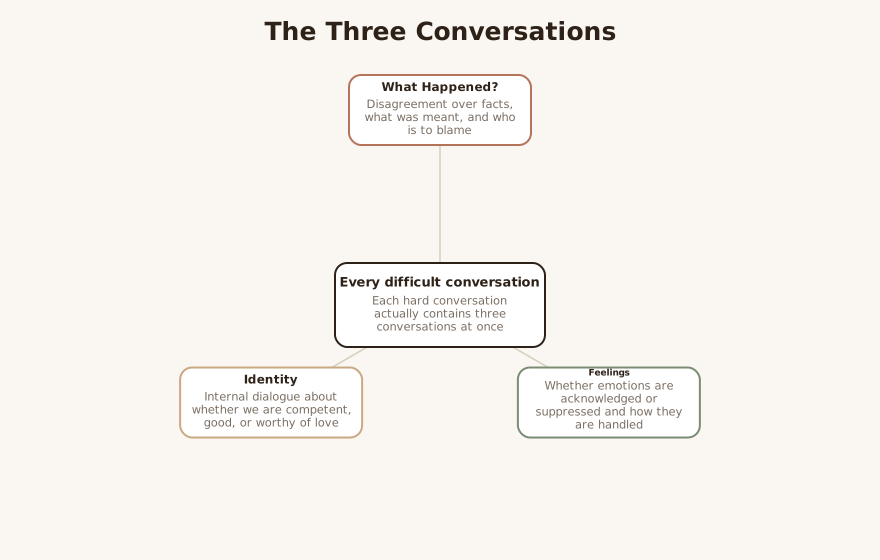
The organizing insight is that every difficult conversation contains three conversations running at once 1. The first is the “What Happened?” conversation, the disagreement about facts, what was said, what was meant, and who is to blame 1. The second is the Feelings conversation, which asks whether emotions are acknowledged or suppressed and how they will be handled 1. The third is the Identity conversation, the internal dialogue about what the situation says about us – whether we are competent, good, or worthy of love 1. A core move within the “What Happened?” conversation is abandoning the assumption that you know the other person’s intentions and recognizing that intentions are invisible, so we routinely infer bad intent from bad impact 4. The framework reframes blame as a search for fault and replaces it with the concept of contribution, which maps how each party’s actions combined to produce the result without assigning moral guilt 1. The decisive shift is from a message-delivery stance, in which one person arrives to prove a point, to a learning stance, in which the goal is to understand the other’s story and surface the “third story” a neutral observer would tell 4. Stone, Patton, and Heen further argue that strong feelings, once named, are usually a doorway rather than an obstacle to resolution 1.
Interventions & Techniques
Although it is not a clinical protocol, the framework supplies a set of concrete moves that translate readily into therapy-room skills LLM. The first is disentangling intent from impact: clients learn to describe the effect an action had on them without claiming to know the other person meant harm 4. The second is shifting from blame to contribution, often done by mapping each party’s role in the cycle rather than litigating fault 1. A third technique is starting from the third story – opening a conversation by naming the difference between the two parties’ perceptions rather than from one’s own version of events 4. The learning stance is operationalized through curiosity, paraphrasing, and asking what the other person is seeing that you are not 4. The “And Stance” lets a speaker hold two truths simultaneously – “I am angry, and I want to understand you” – replacing the false choice between honesty and connection LLM. Finally, the framework treats acknowledging feelings explicitly as a discrete step, since unspoken emotion tends to leak into the content of the conversation and distort it 1.
LLM-generated illustrative example (not a guideline): In couples work, a partner who would normally open with “You never help with the kids” is coached to use the third story: “I think we see the division of evening tasks really differently, and I want to understand how you see it.” The therapist frames this not as politeness but as a way to lower the other partner’s identity threat so the actual problem can be discussed LLM.
Evidence Base
The framework’s maturity is best described as established as a model, not as validated as a clinical treatment LLM. It is a widely adopted, durable, and broadly disseminated approach taught through the Harvard Program on Negotiation and applied across mediation, management, healthcare, and leadership settings 2. Its conceptual lineage is strong, drawing coherently on principled negotiation and on a humanistic understanding of emotion and identity 4. However, the available sources are a book, organizational teaching pages, and explanatory summaries – not controlled trials – and there is no body of randomized clinical-efficacy data demonstrating outcomes when the framework is used as a standalone therapeutic intervention 1. Therapists should therefore present it to clients honestly as a structured communication skill set with face validity and wide professional uptake, rather than as an evidence-based treatment for any diagnosis LLM. Its clinical value lies in giving conflict-related work a clear, learnable architecture that can be embedded inside modalities that do carry an evidence base LLM.
Populations & Indications
The framework was designed for adults navigating high-stakes interpersonal exchanges and generalizes across many relationship contexts 1. It fits naturally in work with couples, where recurring fights often stack a “what happened” dispute on top of unspoken feelings and identity threats LLM. It is applicable with families and with adolescents and their parents, where blame cycles and unexpressed emotion frequently drive escalation 5. In organizational and occupational-health contexts it supports coworkers and teams managing conflict, feedback, and workplace stress 5. It is also used by healthcare providers delivering difficult news or managing disagreement with patients and colleagues, a setting where intent-impact gaps are common LLM. Broadly, it suits any adult client whose presenting concern includes avoidance of conflict, chronic resentment, or difficulty being direct without becoming hostile LLM.
Problems-for-Work
The framework maps onto a cluster of interpersonal targets that recur across clinical caseloads LLM. For relationship conflict and communication difficulties, the three-conversations structure helps a client separate the factual dispute from the emotional and identity stakes that actually keep the fight alive 1. For anger management, naming the identity threat beneath the anger – “this makes me feel incompetent” – gives the client an off-ramp before escalation LLM. For interpersonal effectiveness deficits and assertiveness deficits, the “And Stance” lets clients be direct and warm at once rather than oscillating between passivity and aggression LLM. For avoidance of conflict, rehearsing a third-story opening lowers the anticipatory threat that drives the avoidance 4. For resentment, the move from blame to contribution reframes a grievance into a shared pattern the client can actually influence 1. For workplace stress, the framework gives clients a repeatable script for feedback and disagreement with supervisors and peers 5.
Contraindications, Cautions & Cultural Humility
The framework is not a treatment for psychopathology and should not displace indicated care for mood, trauma, or psychotic disorders LLM. A central caution involves safety: encouraging direct, vulnerable conversation is inappropriate where there is intimate-partner violence, coercive control, or risk of retaliation, and the “learning stance” should never be used to pressure a client toward engaging an abusive party LLM. The model implicitly assumes a relatively level power dynamic and a shared cultural premise that open emotional disclosure is desirable, which does not hold universally LLM. Norms about directness, hierarchy, saving face, and the public expression of feeling vary substantially across cultures, so a “learning stance” that looks collaborative in one context can read as intrusive or insubordinate in another LLM. Therapists should adapt pacing and disclosure expectations to the client’s cultural framework rather than treating the framework’s North American negotiation idiom as neutral LLM. For clients with significant social anxiety or trauma histories, graded exposure and affect-regulation skills should precede high-stakes conversation rehearsal LLM.
Treatment-Plan Suggestions & SMART Objectives
| Goal | SMART objective (example) | Mechanism |
|---|---|---|
| Reduce blame-driven escalation | Within 6 sessions, client will reframe two recurring conflicts using contribution language (each party’s role) instead of blame, demonstrated in session role-play 1 | Shifting from fault-finding to a shared-system view lowers defensiveness 1 |
| Separate emotion from content | Within 4 sessions, client will identify and name the underlying feeling in three logged conflicts before responding to the content 1 | Explicitly acknowledging feelings prevents emotional leakage into the dispute 1 |
| Build assertive directness | Over 8 weeks, client will deliver one “And Stance” statement per week that pairs an honest concern with a relational bid, tracked in a log LLM | Holding honesty and connection together replaces the passive-aggressive oscillation LLM |
| Reduce conflict avoidance | Within 5 sessions, client will initiate one previously avoided conversation using a third-story opening 4 | Rehearsing a neutral opening lowers anticipatory threat that maintains avoidance 4 |
| Correct intent-impact distortions | Across 4 sessions, client will describe impact without attributing intent in two real conversations 4 | Decoupling impact from inferred intent interrupts the assumption of bad faith 4 |
| Lower identity threat in conflict | By session 6, client will articulate the identity question (“what does this say about me?”) active in two conflicts and a more flexible self-statement 1 | Addressing the Identity conversation stabilizes the client during hard exchanges 1 |
| Improve workplace communication | Within 8 weeks, client will use the framework to prepare and conduct two feedback or disagreement conversations at work 5 | A repeatable structure reduces the stress and dread around occupational conflict 5 |
Common Misconceptions
A first misconception is that the framework is a clinical treatment with an outcome evidence base; in reality it is a mature communication model without controlled efficacy trials as a standalone therapy 1. A second is that the goal is to “win” or to deliver a perfectly worded message, when the framework’s actual aim is to move from message-delivery into mutual learning 4. A third is that the three conversations are sequential steps; they are concurrent layers that are present together in every difficult exchange 1. A fourth is that focusing on contribution means abandoning accountability, whereas contribution is meant to clarify each party’s role more precisely than blame does, not to dissolve responsibility 1. A fifth is that the Feelings conversation is optional politeness, when unexpressed emotion is precisely what tends to derail the factual conversation 1. Finally, some assume the approach requires both parties to know it, but a single participant can shift the conversation unilaterally by adopting the learning stance 5.
Training & Certification
There is no clinical license or credential specific to the Difficult Conversations Framework, and it is not a regulated therapeutic certification LLM. The primary entry point is the book itself, which lays out the full model and is published and disseminated as a practitioner text 1. Formal instruction is available through the Harvard Program on Negotiation, which teaches the framework within its negotiation and conflict-management offerings 2. A range of organizational consultancies and leadership-development providers also deliver workshops built around the three-conversations model 5. For therapists, the realistic path is self-study of the source material combined with supervision and deliberate integration into an existing, credentialed modality rather than a separate certification LLM.
Key Terms
- Three conversations: the claim that every difficult conversation simultaneously contains a “What Happened?” conversation, a Feelings conversation, and an Identity conversation 1.
- “What Happened?” conversation: the disagreement over facts, meaning, and blame – the surface content of the dispute 1.
- Feelings conversation: the layer concerning which emotions are present, whether they are acknowledged, and how they are handled 1.
- Identity conversation: the internal dialogue about what the situation implies about one’s competence, goodness, or worth 1.
- Learning stance: the orientation of seeking to understand the other’s story rather than to deliver a predetermined message 4.
- Third story: the account a neutral observer would give, used as a non-blaming way to open the conversation 4.
- Contribution (vs. blame): a map of how each party’s actions combined to produce a result, replacing the search for fault 1.
- Intent vs. impact: the recognition that intentions are invisible and should not be inferred from the impact of an action 4.
- And Stance: holding two seemingly opposed truths at once, such as honesty and care, instead of choosing between them LLM.
Resources & Further Reading
▶ Watch — a video introduction to this concept:
- Difficult Conversations: How to Discuss What Matters Most (Stone, Patton & Heen)
- Difficult Conversations (Program on Negotiation, Harvard Law School)
- Difficult Conversation (PON glossary, Harvard Law School)
- Summary of “Difficult Conversations” (Beyond Intractability)
- 3 Kinds of Difficult Conversations (Inscape Leadership)
Reflective / Supervision Questions
- When a client describes a conflict, can I hear which of the three conversations is driving the distress, and am I treating the loudest layer as the only one LLM?
- Where in my own practice do I default to a message-delivery stance with clients or colleagues rather than a learning stance LLM?
- Am I screening for power imbalance, coercive control, or safety risk before coaching a client toward a more direct conversation LLM?
- How does my own cultural framing of directness and emotional disclosure shape what I implicitly hold up to clients as healthy communication LLM?
- When I introduce contribution language, am I confident the client hears it as clarifying responsibility rather than excusing harm LLM?
- Which evidence-based modality am I anchoring this skills work inside, and is my documentation reflecting that anchor LLM?