
Type & Discipline
Structured diagnostic interviewing is an assessment technique, not a treatment, situated at the intersection of psychiatry and clinical psychology within the broader family of clinical assessment methods 1. Its defining feature is that diagnostic questioning is mapped directly onto formal nosological criteria — the DSM or ICD — and delivered in a fixed or guided sequence, so that the diagnosis a clinician reaches depends as little as possible on which questions that particular clinician happened to ask 1. The best-known instruments in this family are the Structured Clinical Interview for DSM Disorders (SCID), the Mini International Neuropsychiatric Interview (MINI), and the Schedule for Affective Disorders and Schizophrenia for School-Age Children (K-SADS) 2 3 4.
It is useful to distinguish two grades within the family LLM. Fully structured interviews specify the exact wording and order of questions and constrain the interviewer to that script, which supports administration by trained non-clinicians and is the design philosophy of the MINI 5. Semi-structured interviews supply required probes anchored to each diagnostic criterion but expect the clinician to use judgment, follow up, and rate the criterion as met or not met, which is the design philosophy of the SCID and the K-SADS 2 4. For clinicians the most accurate framing is that these tools standardize the diagnostic process to improve reliability, and that they range from rigid checklists to clinician-administered guided interviews depending on the instrument 1 5.
Creators & Lineage
The lineage of structured diagnostic interviewing runs directly through the architects of modern operationalized diagnosis LLM. Robert Spitzer, a central figure in the development of the DSM-III and its successors, was instrumental in the creation of the SCID, the instrument designed to let trained interviewers arrive at DSM diagnoses through a standardized, criterion-anchored interview 2. Michael First has been a principal author and editor of successive SCID editions, carrying the instrument forward as the DSM itself was revised, so that the SCID-5 corresponds to the criteria of DSM-5 1 2. The instrument is published and maintained through American Psychiatric Association Publishing, which situates it as an official companion to the diagnostic manual it operationalizes 1.
The MINI emerged from a different motivation: the need for a much shorter structured interview that could be administered efficiently in clinical and research settings, developed by David Sheehan and colleagues and explicitly validated against the more elaborate SCID 3 5. The K-SADS extends the same standardizing logic downward to children and adolescents, providing a semi-structured interview for assessing affective and other disorders in school-age youth, with input gathered from both the child and a parent or caregiver 4. Across all three, the intellectual inheritance is the same: the criterion-based, operationalized diagnostic tradition that the DSM made dominant, rendered into an interview protocol 1 4.
Core Principles
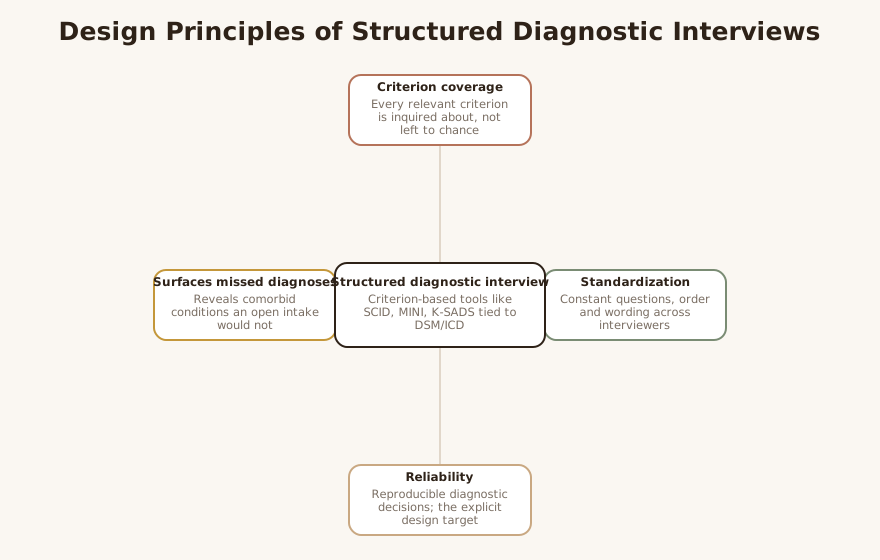
The first organizing principle is criterion coverage: the interview is built so that every relevant diagnostic criterion is systematically inquired about rather than left to whether it happens to come up in conversation 1. By tying each question to a specific criterion, the instrument guards against the well-documented tendency of unstructured clinical interviews to miss comorbid or less salient conditions because the clinician anchored early on a presenting complaint LLM. This is why structured interviews routinely surface diagnoses that an open clinical intake would not 5.
The second principle is standardization in the service of reliability: by holding the questions, their order, and often their exact wording constant across interviewers, the method reduces the idiosyncratic variation that makes two clinicians disagree about the same patient 1 3. The MINI’s validation against the SCID is itself an expression of this principle — a shorter instrument is judged acceptable to the degree that it reproduces the diagnoses of the established standard 3. Reliability here means reproducibility of the diagnostic decision, and it is the explicit design target of the whole family 1.
The third principle is the deliberate displacement of unaided clinical judgment from the diagnostic decision toward the rating of explicit criteria LLM. In a semi-structured instrument the clinician still judges whether a criterion is met, but the judgment is bounded and documented criterion by criterion rather than synthesized impressionistically 2. In a fully structured instrument such as the MINI, the design intent is that even a trained non-clinician can administer it and reach the same diagnosis, which is what makes it attractive for large studies and high-volume screening 5.
Interventions & Techniques
In practice, administering a SCID means working through modules organized by diagnostic class — mood, psychotic, anxiety, substance, trauma-related and others — asking the criterion probes, following up where clinical judgment requires it, and recording for each criterion whether it is present, absent, or subthreshold 2. The modular structure lets a clinician administer only the sections relevant to a referral question rather than the entire instrument, which is part of how the SCID is used flexibly in practice 2. The SCID PTSD module is a clear example: it can be administered on its own to make a standardized, criterion-anchored PTSD diagnosis rather than running the full interview 6.
The MINI is administered as a brief, highly structured set of screening and diagnostic questions, typically with yes/no gating questions that, when negative, allow the interviewer to skip the remainder of a diagnostic section 5. This skip-out structure is what makes it fast, and it is the principal reason the MINI is favored when many participants must be diagnosed quickly or when administration falls to research assistants rather than senior clinicians 5. The K-SADS is administered semi-structured to youth and caregivers, integrating information across informants to reach a developmentally appropriate diagnostic picture 4.
LLM-generated illustrative example (not a guideline): A clinician at a research clinic needs to confirm a major depressive disorder diagnosis and rule out a bipolar spectrum condition before enrollment. Using the SCID mood module, they work criterion by criterion through the current depressive episode, then administer the mania and hypomania probes in full rather than relying on the patient’s self-label, and find a past hypomanic episode the intake had missed — changing the working diagnosis from unipolar depression to bipolar II disorder. LLM
Evidence Base
The maturity of structured diagnostic interviewing is best described as established: these instruments have decades of psychometric development behind them and function as the research gold standard against which other diagnostic methods are benchmarked 1 3. The clearest signal of this status is methodological: when a newer, briefer instrument like the MINI is introduced, its credibility is established precisely by demonstrating validity and reliability against the SCID as the reference standard 3. The SCID’s role as that reference standard, and its maintenance in lockstep with successive DSM editions, reflects the same settled status 1 2.
Honesty about maturity requires several caveats, however LLM. First, reliability is not validity: a structured interview can produce highly reproducible diagnoses that are reproducibly tied to a diagnostic category whose own validity is contested, so reproducibility of the decision should not be mistaken for correctness of the underlying construct LLM. Second, even reliability is imperfect; agreement varies by disorder and by the training of the interviewer, and harder-to-rate categories yield lower agreement than well-bounded ones 3 LLM. Third, there is a substantial gap between research use and routine clinical adoption: the full SCID is time- and training-intensive, which is exactly the limitation the MINI was built to address, and many ordinary clinical settings continue to rely on unstructured intakes despite the documented reliability advantages of the structured approach 5 LLM. The evidence base, in short, strongly supports these instruments as the most reliable way to reach a criterion-based diagnosis, while leaving real questions about validity, inter-rater agreement for some categories, and feasibility in everyday care 3 5.
Populations & Indications
The clearest indication is the research or clinical context in which a reliable, criterion-based diagnosis matters more than speed, such as study enrollment, baseline characterization of a sample, or a complex differential that an unstructured intake has not resolved 2 3. The SCID is built for trained clinician administration to adults across the major diagnostic classes and is well suited to settings where diagnostic accuracy carries weight, including forensic, disability, and second-opinion evaluations 2 LLM. The standalone SCID PTSD module indicates the same logic applied narrowly: trauma-exposed adults, including veterans, for whom a defensible, standardized PTSD diagnosis is required 6.
Where throughput is the constraint, the indication shifts toward the MINI: high-volume screening, primary care, and large research samples where many participants must be diagnosed efficiently and where administration may fall to non-clinicians 5. For children and adolescents, the K-SADS is the indicated instrument, designed to assess affective and related disorders in school-age youth while drawing on both the young person and a caregiver as informants 4. Across all of these, the common thread is a setting in which the cost of a missed or idiosyncratic diagnosis is high enough to justify the time the structured method takes LLM.
Problems-for-Work
Because this is an assessment technique, its problems-for-work are diagnostic rather than therapeutic LLM. The most direct is diagnostic uncertainty: when a presentation is ambiguous or a prior diagnosis does not fit, working through the relevant SCID modules forces systematic coverage of the criteria and reduces premature closure 2. A second is differential diagnosis between conditions that are easy to conflate, such as major depressive disorder versus bipolar II disorder, where the structured probing of past hypomania is exactly what an impressionistic interview tends to skip 2 LLM.
A third problem-for-work is suspected but unrecognized comorbidity, where the criterion-by-criterion coverage of a structured interview surfaces conditions an anchored intake would miss 5. A fourth is treatment non-response that prompts re-diagnosis: re-administering the relevant modules can reveal that the original formulation was incomplete LLM. A fifth is the need for a standardized, defensible PTSD diagnosis, for which the SCID PTSD module is purpose-built 6. A sixth is research-sample characterization, where the MINI’s speed and the SCID’s depth each have a place depending on whether throughput or granularity dominates 3 5.
LLM-generated illustrative example (not a guideline): A patient referred with “treatment-resistant depression” has not responded to two antidepressant trials. Rather than escalating pharmacology, the clinician administers the relevant SCID modules and finds that the criteria for posttraumatic stress disorder are fully met and were never assessed at the original intake — reframing the non-response as an under-recognized comorbidity rather than a refractory mood disorder. LLM
Contraindications, Cautions & Cultural Humility
Structured diagnostic interviewing is an assessment, not an activating intervention, so the cautions are about misuse rather than harm from the procedure itself LLM. The chief caution is treating the instrument as a substitute for clinical judgment: a structured interview standardizes the questions, but the diagnosis it yields is only as good as the criteria it encodes and the rapport, candor, and accuracy of the information it elicits 1 LLM. A fully structured, non-clinician-administered instrument in particular can produce a confidently wrong diagnosis if a gating question is misunderstood, so the output should be integrated with collateral information and clinical formulation rather than read off mechanically 5 LLM.
A second caution concerns the underlying nosology: because reliability does not establish validity, a clinician should hold the resulting label as a reliable mapping to a DSM/ICD category, not as a final truth about the person, and should remain alert to presentations that the categorical system fits poorly 3 LLM. Cultural humility is essential here, because diagnostic criteria and the idioms in which distress is expressed are culturally situated; a structured script can flatten culturally normative experiences into apparent symptoms, and the clinician must interpret criterion endorsements in cultural and linguistic context rather than at face value LLM. With children, the multi-informant design of the K-SADS is a safeguard, but it also requires the clinician to weigh discrepant accounts thoughtfully rather than defaulting to one informant 4 LLM.
Treatment-Plan Suggestions & SMART Objectives
In an assessment technique the “objectives” are diagnostic-process objectives that precede and inform the treatment plan, not treatment goals in themselves LLM.
| Goal | SMART objective (example) | Mechanism |
|---|---|---|
| Establish a reliable working diagnosis | Within the intake assessment, complete the relevant SCID modules and document each criterion as met or not met | Criterion-anchored, standardized interviewing reducing idiosyncratic judgment 2 |
| Resolve a specific differential | Administer the full mood module, including past hypomania probes, to distinguish major depressive disorder from bipolar II disorder | Systematic coverage of criteria an unstructured intake tends to skip 2 |
| Detect unrecognized comorbidity | Screen all major diagnostic classes via a structured interview and report any additional conditions identified | Comprehensive criterion coverage surfacing conditions an anchored intake misses 5 |
| Standardize a PTSD diagnosis | Administer the SCID PTSD module and document criterion-level findings for the trauma diagnosis | Module-level, criterion-based assessment of posttraumatic stress disorder 6 |
| Diagnose efficiently at scale | Administer the MINI to each participant at study entry and record diagnoses within the allotted time | Brief, skip-structured fully standardized interview enabling high throughput 5 |
| Characterize a youth presentation | Complete the K-SADS with the child and a caregiver and integrate informants into a diagnostic summary | Semi-structured, multi-informant interviewing for school-age youth 4 |
| Re-evaluate after non-response | Re-administer the relevant modules and document any change from the original diagnostic formulation | Structured re-assessment correcting incomplete initial diagnosis LLM |
| Benchmark a briefer instrument | Compare MINI-derived diagnoses against SCID diagnoses for a sample and report concordance | Validation of a short instrument against the established reference standard 3 |
Common Misconceptions
A first misconception is that a structured interview removes the need for clinical skill; in semi-structured instruments the clinician still rates each criterion and must probe, interpret, and integrate, and even fully structured instruments require accurate administration and informed interpretation 2 5. A second is that high reliability proves a diagnosis is correct; reliability is reproducibility of the decision, and a reproducible diagnosis can still rest on a construct of contested validity 3 LLM. A third is that the SCID and the MINI are interchangeable; they trade depth against speed, the SCID being a clinician-administered semi-structured interview and the MINI a brief, highly structured one designed for rapid administration 5.
A fourth misconception is that these instruments are only research tools with no clinical value; their reliability advantages apply directly to complex clinical diagnosis, even though time and training costs limit routine adoption 1 5. A fifth is that a structured interview is a self-report questionnaire; it is an interview administered and scored by a person, which is part of why it outperforms checklists for diagnostic accuracy LLM. A sixth is that the instrument’s structure makes culture irrelevant; the criteria and the expression of symptoms remain culturally situated and demand interpretation in context LLM.
Training & Certification
Competent use of a semi-structured instrument such as the SCID requires training in the underlying diagnostic criteria and in the conventions of the interview itself, since the clinician must know when a probe has elicited enough to rate a criterion and when to follow up 2. The SCID is published with associated user guides and training materials through American Psychiatric Association Publishing, reflecting that administration is a learned skill rather than a matter of reading questions aloud 1. Academic departments that develop and study these instruments, such as the group at Columbia associated with the SCID, have historically been centers for that training and for the research that maintains the instruments 2.
The fully structured MINI was deliberately designed to lower this training threshold so that, after appropriate orientation, even non-clinicians can administer it reliably, which is central to its appeal for large studies 5. The K-SADS, as a semi-structured child instrument, similarly requires training in both the criteria and the multi-informant interviewing it depends on 4. As a practical standard, supervised practice on early administrations and ongoing calibration against more experienced raters are prudent before treating one’s structured-interview diagnoses as definitive, particularly for categories where inter-rater agreement is known to be lower 3 LLM.
Key Terms
- Structured interview: A diagnostic interview with fixed question wording and order, constraining the interviewer and supporting administration by trained non-clinicians, as in the MINI 5.
- Semi-structured interview: A criterion-anchored interview that supplies required probes but expects clinical judgment in following up and rating, as in the SCID and K-SADS 2 4.
- SCID: The Structured Clinical Interview for DSM Disorders, a clinician-administered semi-structured interview that operationalizes DSM criteria, maintained in step with successive DSM editions 1 2.
- MINI: The Mini International Neuropsychiatric Interview, a brief, highly structured diagnostic interview validated against the SCID for use where speed and high throughput matter 3 5.
- K-SADS: The Schedule for Affective Disorders and Schizophrenia for School-Age Children, a semi-structured, multi-informant interview for diagnosing affective and related disorders in youth 4.
- Module: A self-contained, diagnostic-class section of a structured interview that can be administered on its own, such as the SCID PTSD module 2 6.
- Reference standard: An established instrument, typically the SCID, against which newer or briefer diagnostic instruments are validated 3.
- Skip-out structure: Gating questions whose negative answers allow the interviewer to bypass the rest of a diagnostic section, central to the MINI’s brevity 5.
Resources & Further Reading
▶ Watch — a video introduction to this concept:
- Structured Clinical Interview for DSM-5 (SCID-5) — American Psychiatric Association Publishing
- Structured Clinical Interview for DSM Disorders (SCID) — Columbia University Department of Psychiatry
- The validity of the MINI according to the SCID-P and its reliability (European Psychiatry, 1997)
- Schedule for Affective Disorders and Schizophrenia (K-SADS) — overview (ScienceDirect Topics)
- What Is the Difference Between SCID and MINI? (ProEm Health)
- SCID PTSD Module — U.S. Department of Veterans Affairs, National Center for PTSD
Reflective / Supervision Questions
- For a given client, does the diagnostic question genuinely call for a structured interview, or am I reaching for it where an unstructured formulation would serve the client better? 2 LLM
- When I rely on a structured diagnosis, am I distinguishing the reliability of the decision from the validity of the underlying category, and communicating that distinction in my formulation? 3 LLM
- For a complex differential such as major depressive disorder versus bipolar II disorder, am I administering the full relevant module rather than stopping once a plausible label appears? 2
- How am I interpreting criterion endorsements in cultural and linguistic context, rather than reading a structured script at face value? LLM
- With youth, how am I weighing discrepant accounts across the child and caregiver informants the K-SADS draws on? 4 LLM
- Have I calibrated my own administration and rating against a more experienced rater, especially for categories where inter-rater agreement is known to be weaker? 3 LLM