
Type & Discipline
Coordinated Specialty Care (CSC) is a multi-component service framework rather than a single psychotherapy — it is a team-based package of coordinated interventions for people in the early course of psychosis, not a discrete clinician-delivered technique 1. It belongs to the discipline of community psychiatry and to the broader family of early intervention in psychosis 7. CSC is described as “a recovery-oriented, team approach to treating early psychosis that promotes easy access to care and shared decision-making among specialists, the person experiencing psychosis, and family members” 1. Its organizing logic is that the period immediately following a first psychotic episode is a critical window in which intensive, coordinated, person-centered care can change the long-term trajectory of the illness 7.
What distinguishes CSC from usual community treatment is not any one of its parts but the way they are integrated LLM. Rather than referring a young person separately to a prescriber, a therapist, a case manager, and a vocational service — each operating in isolation — CSC assembles these roles into a single coordinated team that shares information, aligns goals, and engages the person and family together around recovery 1. The model is delivered flexibly across home, community, and outpatient settings and is typically time-limited, with most programs running for roughly two to five years before transition to less intensive care 5.
Creators & Lineage
CSC emerged from the National Institute of Mental Health’s Recovery After an Initial Schizophrenia Episode (RAISE) initiative, “a large-scale research initiative testing coordinated specialty care treatments” that NIMH launched in 2008 to determine the best ways to promote recovery and reduce the long-term disability associated with psychotic disorders 1. RAISE was conceived as a project that would not only test a treatment model but also study how to implement it in real-world U.S. community settings, so that effective early care could actually reach the people who needed it 7. The initiative is closely associated with NIMH leadership including Robert Heinssen, who helped shepherd the RAISE program, and with investigators John Kane and Lisa Dixon, who led its two major studies LLM.
RAISE comprised two complementary trials: the RAISE Early Treatment Program (RAISE-ETP), which tested the NAVIGATE CSC model, and a connection/implementation study 7. The NAVIGATE model and the RAISE findings became the template from which most U.S. CSC programs — and the named state programs such as OnTrackNY — were subsequently built 5. CSC’s lineage draws together several established traditions LLM. From early intervention in psychosis internationally, it inherits the conviction that the early course of psychosis is a uniquely treatable window 7. From assertive community treatment and case-management models it takes its team structure and outreach orientation 2. From supported employment and education (the Individual Placement and Support tradition) it incorporates rapid return to work and school 2. From family psychoeducation it adopts the systematic inclusion of relatives, and from the recovery model it takes its emphasis on shared decision-making, hope, and the person’s own goals 1.
Core Principles
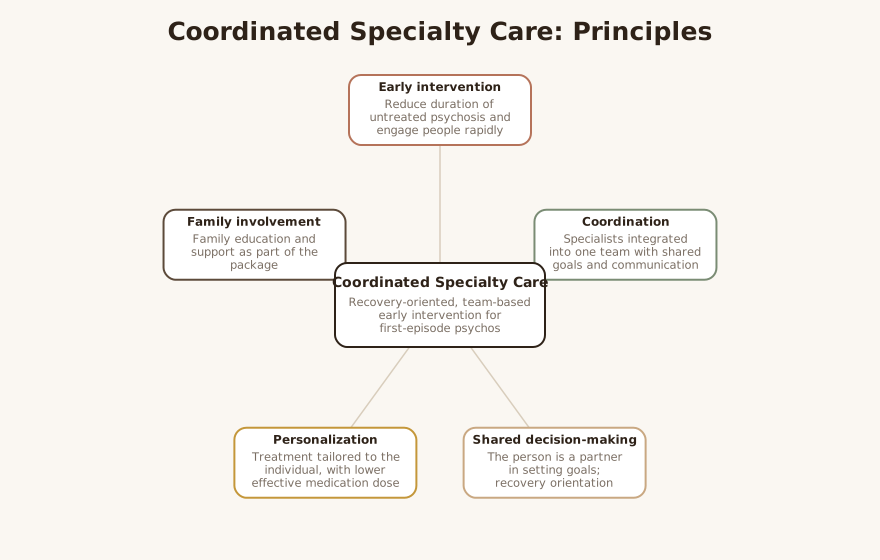
CSC is organized around a small set of principles that recur across descriptions of the model LLM. The first is early intervention: because Americans with psychosis typically experience “symptoms for more than a year before receiving treatment,” and because “people tend to do better when they receive effective treatment as early as possible,” CSC prioritizes reducing the duration of untreated psychosis and engaging people rapidly after a first episode 1. The second is coordination — the integration of distinct specialists into one team with shared goals and communication, so that medication, therapy, family work, and vocational support reinforce rather than fragment one another 1.
The third principle is shared decision-making and recovery orientation: the person experiencing psychosis is a partner in setting goals, and the team works toward the life the person wants rather than symptom suppression alone 1. The fourth is personalization — treatment, and medication in particular, is tailored to the individual, with an emphasis on lower effective doses and minimizing side-effect burden in this medication-naive, early-illness population 6. The fifth is family inclusion, treating relatives as allies who need education and skills rather than as bystanders 1. Together these principles explain why CSC is best understood as a coordinated system of care built around a young person and their family, rather than a stack of unrelated referrals LLM.
Interventions & Techniques
CSC is conventionally described as resting on five core components, delivered by a coordinated team 1. Medication management provides personalized pharmacologic treatment, with attention in early psychosis to using the lowest effective antipsychotic dose and to shared decision-making about benefits and side effects 6. Individual psychotherapy uses cognitive and behavioral approaches tailored to the person’s recovery goals — often framed as resilience-focused, helping the person understand their experiences, manage symptoms, and build skills 1. Family education and support provides relatives with education about psychosis and skills training to support their family member and reduce strain 1. Supported employment and education offers coaching and individualized support to help the person return to work or school 1. Case management assists with practical problems and access to services, holding the coordination together 1.
These components are not delivered in parallel silos; the defining “technique” of CSC is their integration through team-based, person-centered coordination 1. In practice this means a small multidisciplinary team — typically including a team leader, a prescriber, a therapist, a supported-employment/education specialist, and a peer or case-management role — meeting regularly, sharing a care plan, and engaging the person and family together 2. The model is delivered where the person is, across home, community, and clinic, and is designed to be flexible and low-barrier to keep young people engaged 5.
LLM-generated illustrative example (not a guideline): A 19-year-old who experienced a first episode of psychosis during his first semester of college might work with the prescriber on a low-dose antipsychotic chosen to minimize sedation, meet weekly with a therapist on understanding his experiences and managing residual voices, attend a family education group with his parents, and work with the supported-education specialist to negotiate a medical withdrawal and a re-entry plan — all coordinated by one team that meets weekly and shares his goals, rather than four providers who never speak to each other LLM.
Evidence Base
The evidence maturity for CSC is best described as established LLM. The pivotal evidence comes from the NIMH RAISE initiative, which demonstrated that “coordinated specialty care was more effective than typical care”: participants receiving CSC “stayed in treatment longer and experienced greater improvement in their symptoms, interpersonal relationships, and quality of life” and “were more involved in work and school” 1. The RAISE-ETP / NAVIGATE trial specifically found improved quality of life, reduced symptom severity, and greater educational and vocational engagement over two years compared with usual care 5. A notable moderating finding was that benefit was greatest for people with a shorter duration of untreated psychosis, reinforcing the model’s emphasis on early engagement 5.
Beyond the original trials, real-world program data support effectiveness LLM. A Pennsylvania review of 230 CSC participants documented decreases in reported psychosis symptoms, improvements in quality of life and recovery, and decreases in psychiatric hospitalizations at 6 and 12 months, and New York’s OnTrackNY program reported fewer hospitalizations and better connections to education and employment within 12 months 5. A study in Psychiatric Services examining fidelity to the common elements of CSC found that adherence to those core elements was associated with better client outcomes, underscoring that the model’s benefits depend on delivering its defining components faithfully 3.
Honesty about the evidence requires several qualifications LLM. Implementation, not efficacy, is the principal gap: only an estimated 10 to 25 percent of people with first-episode psychosis actually receive care in a CSC program, so the population-level impact is constrained by access 5. Effects are real but not uniform — benefit is moderated by factors such as duration of untreated psychosis, and outcomes depend on fidelity to the model rather than on the CSC label alone 35. Much of the strongest evidence concerns the first two years of care, and questions remain about how to sustain gains after the time-limited program ends LLM. The fair summary is that CSC has randomized-trial support, replication in large state programs, and the status of recommended standard of care for early psychosis, while access and long-term maintenance are the live challenges 7.
Populations & Indications
CSC is indicated for people experiencing a first episode of psychosis, the population for whom the model was designed and tested 1. Because first-episode psychosis most often emerges in adolescence and young adulthood, CSC programs predominantly serve young people, roughly in the teens through twenties and early thirties, and are built to be developmentally appropriate and engaging for that age group 7. The relevant clinical population includes people with early schizophrenia-spectrum and other primary psychotic disorders who are in the critical early window after a first episode 1.
CSC is also explicitly relevant for people with first-episode psychosis and co-occurring substance use disorders, a common and clinically important combination 4. SAMHSA’s evidence-based resource guide addresses how CSC programs can integrate care for first-episode psychosis alongside co-occurring substance use, treating substance use as a part of the clinical picture rather than an exclusion criterion 4. Across these groups, the common indication is not a single diagnosis but a clinical situation: a person early in the course of a psychotic illness, ideally with a short duration of untreated psychosis, for whom coordinated, recovery-oriented, time-limited intensive care can alter the trajectory 5. Families and caregivers are also a target of the model, since family education and support are a core component rather than an optional add-on 1.
Problems-for-Work
CSC lends itself to a characteristic set of clinical problems, each addressed through the structure of the team-based model LLM:
- First-episode psychosis — the entire CSC package is organized around stabilizing and supporting recovery from a first psychotic episode through integrated medication, therapy, family, and vocational care 1.
- Long duration of untreated psychosis — CSC’s early-intervention orientation targets rapid engagement after symptom onset, and the evidence that shorter untreated duration predicts better outcomes makes reducing this delay a direct aim of the work 15.
- Disengagement from treatment — the low-barrier, flexible, shared-decision-making design is meant to keep young people in care, and RAISE found CSC participants “stayed in treatment longer” than those in usual care 1.
- Disruption of work and education — the supported employment and education component provides coaching to “return to work or school,” directly addressing the vocational and academic derailment common after a first episode 1.
- Family strain and burden — family education and skills training are a core component, equipping relatives to support their family member and reducing household strain 1.
- Co-occurring substance use disorders — CSC programs can integrate care for substance use alongside first-episode psychosis rather than excluding it, consistent with SAMHSA guidance 4.
- Relapse and psychiatric hospitalization — real-world CSC data document decreases in psychiatric hospitalizations, an outcome the coordinated model is designed to reduce 5.
LLM-generated illustrative example (not a guideline): For a young woman whose problem-for-work is disruption of education after a first episode, the CSC team’s supported-education specialist might help her arrange reduced course loads and disability accommodations while the therapist works on managing concentration difficulties and the prescriber adjusts dosing to limit cognitive side effects — a coordinated effort aimed at keeping her connected to school rather than dropping out LLM.
Contraindications, Cautions & Cultural Humility
CSC has few absolute contraindications, but several cautions follow from its design LLM. The model is built specifically for the early course of psychosis; it is not a fit for chronic, long-standing illness for which other rehabilitation models are more appropriate, and its time-limited structure means it is designed as a launch into recovery rather than indefinite care 5. A core caution is fidelity: because outcomes are associated with adherence to the common elements of CSC, a program that adopts the label without delivering the integrated components cannot assume the studied benefits, and clinicians should be wary of “CSC in name only” 3.
Medication requires particular care in this population LLM. Early-psychosis patients are often medication-naive and more sensitive to antipsychotic side effects, which is why CSC emphasizes personalized, lower-dose prescribing and shared decision-making rather than aggressive standard dosing 6. Clinicians should also hold the model’s recovery and shared-decision-making commitments alongside, not in place of, their ongoing assessment of risk, including suicide and safety, which CSC does not eliminate LLM. Cultural humility is essential: first-episode psychosis disproportionately affects young people from diverse backgrounds, and what counts as engagement, an acceptable explanatory model, an appropriate family role, or a meaningful vocational goal is culturally shaped LLM. The strength of CSC’s shared-decision-making design is precisely that it can center the person’s and family’s own understandings — but only if the team actively makes room for them rather than imposing a normative template LLM.
Treatment-Plan Suggestions & SMART Objectives
| Goal | SMART objective (example) | Mechanism |
|---|---|---|
| Engage and retain in early care | Client will attend at least 8 of 10 scheduled CSC team contacts over the next 12 weeks | Low-barrier, coordinated, shared-decision-making care promotes treatment retention 1 |
| Optimize medication with shared decisions | Client and prescriber will establish a personalized, lowest-effective-dose antipsychotic plan and review side effects within 4 weeks | Personalized low-dose prescribing reduces side-effect burden in early psychosis 6 |
| Build symptom-management skills | Client will identify and practice three coping strategies for residual symptoms in individual therapy over 8 weeks | Resilience-focused individual psychotherapy tailored to recovery goals 1 |
| Re-engage with work or school | Client will complete a supported-education/employment plan and take one concrete return-to-school or work step within 8 weeks | Supported employment/education coaching for return to work or school 1 |
| Strengthen family support | Client’s family will attend at least four family education or skills sessions within 12 weeks | Family education and skills training reduce strain and improve support 1 |
| Reduce hospitalization risk | Client will co-develop an early-warning and crisis-response plan with the team and have no avoidable inpatient admission over 6 months | Coordinated care associated with decreased psychiatric hospitalizations 5 |
| Address co-occurring substance use | Client will set a substance-use goal with the team and review progress at each monthly review for 3 months | Integrated CSC care for co-occurring substance use disorders 4 |
| Sustain gains at transition | Client will complete a written transition plan to continuing care before CSC discharge | Time-limited model requires planned step-down to maintain recovery 5 |
Common Misconceptions
A frequent misconception is that CSC is a type of psychotherapy — it is a coordinated, team-based service framework of which individual psychotherapy is only one of five core components, alongside medication, family work, supported employment/education, and case management 1. Another is that CSC is just intensive case management or a bundle of separate referrals; its defining feature is the integration of specialists into one team that shares goals and decisions, not the mere co-location of services 1.
People also wrongly assume that medication in CSC follows standard adult dosing; in early, often medication-naive psychosis the model emphasizes personalized, lower effective doses and shared decision-making to limit side effects 6. A further misconception is that any program calling itself CSC will produce the trial outcomes — the evidence is tied to fidelity to the common elements, so a program that omits core components cannot assume the same results 3. Some also believe CSC has limited reach because it does not work; in fact the principal gap is access, with only an estimated 10 to 25 percent of people with first-episode psychosis receiving CSC, not a lack of effectiveness 5. Finally, it is a mistake to think co-occurring substance use rules a person out of CSC — guidance explicitly addresses integrating CSC with care for co-occurring substance use disorders 4.
Training & Certification
CSC is implemented at the program and team level rather than through a single individual clinical credential LLM. Because the model is a coordinated team of distinct roles — typically a team leader, prescriber, therapist, supported-employment/education specialist, and case-management or peer role — “training” in CSC generally means building and training a fidelity-adherent team and adopting a structured CSC curriculum such as the NAVIGATE model developed through RAISE 2. The RAISE initiative was deliberately designed to study implementation so that the model could be adopted in routine U.S. community settings, and it produced manuals and resources to support that adoption 7.
In practice, CSC programs are often established and supported through state mental-health systems and dissemination efforts, with named programs such as OnTrackNY serving as implementation exemplars and training hubs 5. NIMH has documented the rapid adoption of CSC across the United States, reflecting a national infrastructure of program development and support rather than reliance on individually certified CSC practitioners 7. For an individual clinician, joining CSC usually means training into a specific team role within a fidelity-monitored program, and clinicians should expect that maintaining fidelity to the common elements — not merely holding an existing license — is what makes the care “CSC” 3.
Key Terms
- Coordinated Specialty Care (CSC) — a recovery-oriented, team-based approach to early psychosis emphasizing easy access and shared decision-making among specialists, the person, and family 1.
- RAISE — Recovery After an Initial Schizophrenia Episode, the NIMH research initiative that developed and tested CSC beginning in 2008 1.
- First-episode psychosis (FEP) — the period following a person’s first psychotic episode, the target window for CSC 1.
- Duration of untreated psychosis (DUP) — the time between symptom onset and the start of effective treatment; shorter DUP is associated with better CSC outcomes 5.
- NAVIGATE — the structured CSC model tested in the RAISE Early Treatment Program 7.
- Supported employment and education — the CSC component providing coaching to help the person return to work or school 1.
- Family education and support — the CSC component providing relatives with education and skills training 1.
- Fidelity — adherence to the common elements of CSC, which is associated with better client outcomes 3.
Resources & Further Reading
▶ Watch — a video introduction to this concept:
- Recovery After an Initial Schizophrenia Episode (RAISE) — NIMH
- Evidence-Based Treatments for First Episode Psychosis: Components of CSC (NIMH RAISE PDF)
- Fidelity to Common Elements of Coordinated Specialty Care: Outcomes of Clients With First-Episode Psychosis (Psychiatric Services)
- First-Episode Psychosis and Co-Occurring Substance Use Disorders — SAMHSA Evidence-Based Resource Guide
- Coordinated Specialty Care for First-Episode Psychosis: Evidence Roundup (Center for Health Care Strategies)
- Special Report: What Is ‘Coordinated Specialty Care’? (Psychiatric News / APA)
- RAISE-ing the Standard of Care for Schizophrenia: The Rapid Adoption of CSC in the United States (NIMH Science Update)
Reflective / Supervision Questions
- For a given young person entering our program, are we delivering genuine Coordinated Specialty Care with all five integrated components, or a set of parallel referrals wearing the CSC label? 3
- How are we actively working to shorten the duration of untreated psychosis in our community, given that shorter untreated time predicts better outcomes? 5
- In what ways are we honoring shared decision-making and the person’s own recovery goals, particularly around medication, rather than defaulting to standard adult dosing in a medication-naive population? 6
- Are families being treated as core members of the recovery team through education and support, or as peripheral to the work? 1
- For clients with co-occurring substance use, are we integrating that care within CSC, or are we excluding or fragmenting it? 4
- As clients approach the end of our time-limited program, how are we planning transitions so that early gains are sustained rather than lost at step-down? 5
- Where do our clients’ cultural contexts change what engagement, an acceptable explanatory model, or a meaningful vocational goal looks like, and are we leaving room for that in the shared plan? LLM