
Cognitive Behavioral Therapy for Psychosis (CBTp) applies the principles of Beckian cognitive therapy to the experiences most clinicians were once trained to treat only pharmacologically: delusions, hallucinations, and the demoralization that surrounds them. LLM Rather than aiming to eliminate symptoms outright, CBTp targets the distress, conviction, and behavioral disruption tied to psychotic experiences, working collaboratively within a normalizing, stress-vulnerability framework. 5 This article orients practicing therapists to what CBTp is, what the evidence honestly supports, and how to deliver it responsibly within a recognized billable modality.
Type & Discipline
CBTp is a condition-specific adaptation of cognitive behavioral therapy, situated within clinical psychology and delivered as an active, structured, time-limited individual psychotherapy. 4 It is positioned as an adjunct to routine pharmacological treatment rather than a replacement for antipsychotic medication. 4 The Society of Clinical Psychology (APA Division 12) lists CBT for schizophrenia among treatments with research support, reflecting its standing as an established psychosocial intervention. 1 In practice it is a manualized but formulation-driven approach: the structure is shared across cases, while the content is individually tailored to each person’s beliefs, voices, and goals. 4
Creators & Lineage
CBTp descends directly from Aaron T. Beck’s cognitive therapy, which was extended from depression and anxiety into the domain of psychotic symptoms by a generation of largely UK-based researchers. LLM David Kingdon and Philippa Garety are among the key figures who adapted cognitive and behavioral methods to delusions and hallucinations and embedded them in the stress-vulnerability model of psychosis. LLM That model — which holds that psychotic symptoms emerge from an interaction between individual vulnerability and environmental stressors — remains central to how CBTp is formulated and explained to clients. 5 The lineage therefore runs from generic CBT and Beckian cognitive therapy, through the stress-vulnerability model, into a symptom-focused protocol; later third-wave approaches such as Acceptance and Commitment Therapy share conceptual territory in their emphasis on changing one’s relationship to anomalous experiences rather than disputing their content. LLM
Core Principles
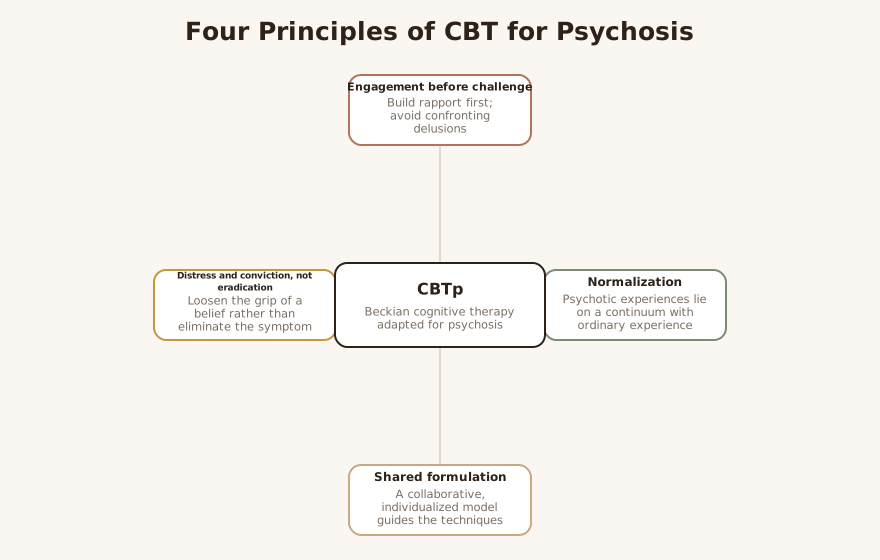
The first principle is engagement before challenge. The therapeutic relationship is treated as foundational to all subsequent intervention, and rapport is built before any belief is examined. 5 Confrontation of delusions is explicitly avoided in favor of collaborative, guided exploration. 5
The second is normalization. CBTp frames psychotic experiences as lying on a continuum with ordinary experience, helping clients understand that many people without a psychotic disorder report unusual thoughts or perceptions under stress, sleep deprivation, or sensory deprivation. 5 This reduces shame and catastrophic self-appraisals and makes symptoms feel like understandable responses rather than evidence of a fundamental defect. 5
The third is shared formulation. Therapist and client build a collaborative, individualized model of how symptoms arose and what maintains them, which then guides the choice of techniques. 4 Because each formulation is bespoke, two clients carrying the same diagnosis may receive substantially different interventions. 4
The fourth is a focus on distress and conviction, not eradication. The clinical goal is to loosen the grip of a belief or voice and reduce associated suffering and disability, which is conceptually distinct from making the experience disappear. LLM
Interventions & Techniques
CBTp guidelines describe five recurring components: engagement and alliance, psychoeducation about illness and medication, cognitive work on schemas and cognitive errors, behavioral skills training, and relapse prevention. 4
For delusions, core techniques include Socratic questioning, gentle exploration of the evidence for and against a belief, generation of alternative explanations through guided discovery, and behavioral experiments that test predictions against real-world outcomes. 4 The stance is collaborative empiricism rather than disputation. 5
For hallucinations, techniques include voice-monitoring diaries, examining and modifying beliefs about the origin, power, and intent of voices, and structured coping strategies such as distraction or refocusing. 4 Much of the therapeutic leverage comes from changing appraisals of the voice (for example, that it is omnipotent) rather than from silencing it. LLM
For negative symptoms, the toolkit shifts toward behavioral activation: activity scheduling, mastery-and-pleasure techniques, graded task assignment, and assertiveness or social-skills training. 4
Treatment is typically delivered as an individualized, tailor-made course lasting roughly 6-9 months, with sessions flexibly pitched from around 15 to 30 minutes to accommodate concentration and tolerance. 4 The arc generally moves from an engagement phase, through assessment and shared formulation, into symptom-focused intervention, and finally into relapse prevention with identification of early warning signs. 5
LLM-generated illustrative example (not a guideline): A client believes their neighbor is broadcasting thoughts through the walls. Rather than arguing, the therapist asks what first led to that conclusion, what would be expected if it were true, and what alternative explanations exist; together they design a small behavioral experiment — noting whether the “broadcasts” occur when the neighbor is verifiably away — to gently test conviction. LLM
Evidence Base
The maturity of CBTp is best described as established but modest, and clinicians should be candid about both halves of that statement. LLM For delusions, a meta-analysis and meta-regression across time found a pooled effect of approximately g = -0.36 versus treatment as usual — a small-to-medium effect favoring CBTp. 2 Notably, effectiveness for delusions increased with year of publication, and this time effect survived adjustment for study methodological quality, suggesting genuine refinement of the approach rather than an artifact of better trials. 2
The picture is weaker for broader outcomes. A meta-analysis of functioning, distress, and quality of life found a small but significant end-of-trial effect on functioning (about 0.25) that did not persist at follow-up; a distress effect that became nonsignificant after correcting for publication bias; and essentially no benefit for quality of life. 3 These findings temper claims that CBTp produces durable, life-wide change. 3
The field also carries a substantive internal critique. Thomas argues that CBTp trials suffer from high internal variability because individualized formulations target heterogeneous symptom clusters, making it hard to isolate active ingredients, and that omnibus measures like the PANSS may capture much that the intervention never targeted. 6 Competing meta-analyses have ranged from finding “no evidence” in well-conducted blinded trials to effects “only in the small range,” even as others report good effects for hallucinations. 6 The honest synthesis: CBTp is a recommended, evidence-supported adjunct with reliable small-to-medium effects on specific symptoms, especially delusions, but it is not a cure and its benefits for global functioning and quality of life are limited and sometimes fragile. 236
Populations & Indications
Guidelines recommend CBTp most clearly for chronic schizophrenia with residual symptoms, as an adjunct to pharmacotherapy. 4 It is also indicated in first-episode psychosis, where it can aid symptom improvement and medication adherence. 4 In clozapine-resistant or treatment-resistant presentations, it is reserved for special cases, such as persistently distressing hallucinations where other options are contraindicated. 4 Across the clinical spectrum, indicated populations include people with schizophrenia, schizoaffective disorder, first-episode psychosis, bipolar disorder with psychotic features, treatment-resistant psychosis, and older adolescents and young adults at clinical high risk for psychosis. 47 CBTp is framed as broadly applicable to people experiencing distressing psychotic symptoms regardless of diagnostic label, consistent with its symptom-focused, transdiagnostic logic. 7
Problems-for-Work
CBTp is organized around discrete, distressing targets rather than a diagnosis alone. LLM Typical problems-for-work include:
- Delusions and persecutory beliefs — reducing conviction and distress through guided discovery and behavioral experiments. 4
- Auditory hallucinations — reappraising the power and meaning of voices and building coping strategies. 4
- Negative symptoms and social withdrawal — restoring activity and engagement through scheduling and graded tasks. 4
- Distress related to psychotic symptoms — the central, cross-cutting target of the modality. LLM
- Comorbid depression, social anxiety, and demoralization — addressed with standard cognitive and behavioral methods adapted to the psychosis context. LLM
- Medication nonadherence — supported through psychoeducation and collaborative problem-solving. 4
LLM-generated illustrative example (not a guideline): For a client whose voices say “you’re worthless,” work might focus less on whether the voice is “real” and more on the appraisal that the voice is all-powerful and must be obeyed — testing, in session, whether the predicted catastrophe actually follows from not complying. LLM
Contraindications, Cautions & Cultural Humility
CBTp is not a substitute for pharmacological treatment and should be offered as an adjunct, particularly given limited support during acute, florid phases. 4 In prodromal or ultra-high-risk populations, guidelines caution that CBTp cannot be routinely recommended and should be applied judiciously pending further research. 4 Clinicians should also temper expectations: durable gains in functioning and quality of life are not reliably demonstrated, so framing CBTp as a guaranteed path to recovery overstates the evidence. 3
Cultural humility is essential when distinguishing pathological beliefs from culturally or spiritually sanctioned experiences. LLM What counts as a “delusion” or “voice” can be shaped by religious, cultural, and community context, and a normalizing, collaborative stance — rather than a confrontational one — reduces the risk of misclassifying meaningful experience as illness. 5 Active suicidal ideation, common in this population, requires standard risk assessment and safety planning alongside symptom-focused work. LLM
Treatment-Plan Suggestions & SMART Objectives
| Goal | SMART objective (example) | Mechanism |
|---|---|---|
| Reduce distress from persecutory beliefs | Over 12 weeks, client will reduce self-rated distress about the target belief from 8/10 to 4/10 on a weekly log | Guided discovery and evidence review loosen conviction and associated distress 4 |
| Lower conviction in a specific delusion | Within 16 sessions, client completes 2 behavioral experiments testing the belief and rates conviction change after each | Behavioral experiments test predictions against real-world outcomes 4 |
| Re-appraise power/meaning of voices | Over 8 weeks, client will identify and verbally challenge 1 belief about the voice’s power each session | Modifying appraisals of voice origin, power, and intent reduces distress 4 |
| Increase coping with hallucinations | Client will use a chosen coping strategy during ≥4 voice episodes per week, logged in a diary, within 6 weeks | Monitoring plus coping strategies improve perceived control 4 |
| Reduce negative symptoms / withdrawal | Client will schedule and complete 3 pleasurable or mastery activities weekly for 8 consecutive weeks | Behavioral activation and activity scheduling counter avolition 4 |
| Normalize symptoms / reduce shame | Within 4 sessions, client will articulate a stress-vulnerability account of their experiences in their own words | Normalization places symptoms on a continuum with ordinary experience 5 |
| Improve medication adherence | Over 8 weeks, client reports ≥90% adherence on a self-report log and reviews barriers each session | Psychoeducation and collaborative problem-solving address ambivalence 4 |
| Strengthen relapse prevention | By end of treatment, client produces a written early-warning-signs plan with ≥3 personalized triggers and responses | Identifying early warning signs supports relapse prevention 4 |
Common Misconceptions
“CBTp tries to argue people out of their delusions.” It does the opposite: confrontation is avoided, and the work is collaborative, normalizing, and experiment-based. 5
“CBTp replaces medication.” Guidelines position it as an adjunct to pharmacotherapy, not a standalone cure. 4
“The goal is to make voices or beliefs disappear.” The primary target is distress and conviction; reduced suffering and disability can occur even when an experience persists. LLM
“The evidence is uniformly strong.” Effects are real but modest and symptom-specific — small-to-medium for delusions, weaker for distress, and minimal for quality of life — and the field actively debates active ingredients and outcome measurement. 236
“Any CBT therapist can deliver it without adaptation.” CBTp requires specific adaptation and trained clinicians; poor dissemination and a workforce bottleneck are recognized obstacles. 6
Training & Certification
CBTp is a manualized intervention, and structured treatment manuals — such as the VA MIRECC manual — codify its phases and techniques for clinician training. 5 Dedicated training resources and fact sheets exist through academic centers to support workforce development. 7 A documented barrier to access is that CBTp has historically required highly trained psychologists, contributing to chronic under-dissemination despite long-standing guideline recommendations. 6 Clinicians new to the modality should seek supervised practice with a manual and, where available, formal CBTp training, rather than assuming general CBT competence transfers directly. LLM
Key Terms
- Stress-vulnerability model — the framework that psychotic symptoms arise from interaction between individual vulnerability and environmental stress. 5
- Normalization — situating psychotic experiences on a continuum with ordinary experience to reduce shame and catastrophic appraisal. 5
- Shared formulation — a collaborative, individualized model of symptom origin and maintenance that guides intervention. 4
- Guided discovery / Socratic questioning — collaborative questioning that helps clients examine evidence and generate alternatives without confrontation. 4
- Behavioral experiment — a structured real-world test of a belief’s predictions. 4
- Conviction — the degree of belief in a delusion, a primary CBTp outcome distinct from the belief’s presence. 2
Resources & Further Reading
▶ Watch — a video introduction to this concept:
- Cognitive Behavioral Therapy (CBT) for Schizophrenia — Society of Clinical Psychology (APA Division 12) 1
- Meta-analysis and Meta-regression of CBT for Psychosis Across Time: Effectiveness for Delusions (Schizophrenia Bulletin Open) 2
- CBT for schizophrenia — outcomes for functioning, distress and quality of life: a meta-analysis (PMC) 3
- Clinical Practice Guidelines for Cognitive Behavioral Therapy for Psychotic Disorders (PMC) 4
- Cognitive Behavioral Therapy for Psychosis (CBTp): A Treatment Manual (VA MIRECC, Yulia Landa, 2017) 5
- What’s really wrong with cognitive behavioral therapy for psychosis? (PMC) 6
- Cognitive Behavioral Therapy for Psychosis (CBTp) Fact Sheet — Stanford INSPIRE 7
Reflective / Supervision Questions
- When I notice the urge to correct or reassure a client about a belief, can I redirect toward guided discovery instead of confrontation? 5
- Have I distinguished, with cultural humility, between a pathological belief and a culturally or spiritually meaningful experience? LLM
- Are my treatment-plan objectives anchored to distress, conviction, and functioning rather than to symptom eradication? LLM
- Given the modest and sometimes fragile evidence for functioning and quality of life, am I setting realistic expectations with the client and the care team? 3
- Am I delivering CBTp as a true adjunct to psychiatric care, with coordinated risk assessment for suicidal ideation? 4
- Where does my own CBTp competence need supervised development before I take on more complex or treatment-resistant presentations? 6