
Type & Discipline
The label “Community Music Therapy / Therapeutic Drumming” actually spans two related but distinct practices, and clinicians should hold the difference clearly LLM. Community Music Therapy (CMT) is a theory-driven orientation within the profession of music therapy that emphasizes participation, performance, and social-musical connection in and beyond institutional walls 4. Music therapy proper is defined by the American Music Therapy Association as “the clinical & evidence-based use of music interventions to accomplish individualized goals within a therapeutic relationship by a credentialed professional who has completed an approved music therapy program” 1. Therapeutic drumming — the facilitated drum circle — is a specific group activity that may be delivered either inside formal music therapy or as a lay-facilitated wellness program by non-therapists 6. The disciplinary home is music therapy, with strong roots in group psychotherapy and community psychology 4. Keeping the credentialed-versus-recreational distinction in view determines what a given clinician can ethically and legally claim to be doing LLM.
Creators & Lineage
CMT crystallized as a named orientation in the early 2000s through the work of Mercedes Pavlicevic and Gary Ansdell, whose edited volume Community Music Therapy gathered the founding arguments of the movement 5. Brynjulf Stige, Ansdell, Cochavit Elefant, and Pavlicevic later extended the framework in Where Music Helps: Community Music Therapy in Action and Reflection, which remains a defining text for the field 4. The lineage draws on traditional music therapy, on group psychotherapy’s attention to interpersonal process, and on community psychology’s emphasis on context, empowerment, and systems rather than individual pathology alone LLM. Therapeutic drumming as a structured group method has a parallel, more applied lineage: programs such as Remo’s HealthRHYTHMS were developed to make recreational music-making accessible to facilitators from many professions, explicitly without requiring musical training 6. The Percussive Arts Society has codified community drumming facilitation guidelines that sit alongside, rather than within, the clinical tradition 7.
Core Principles
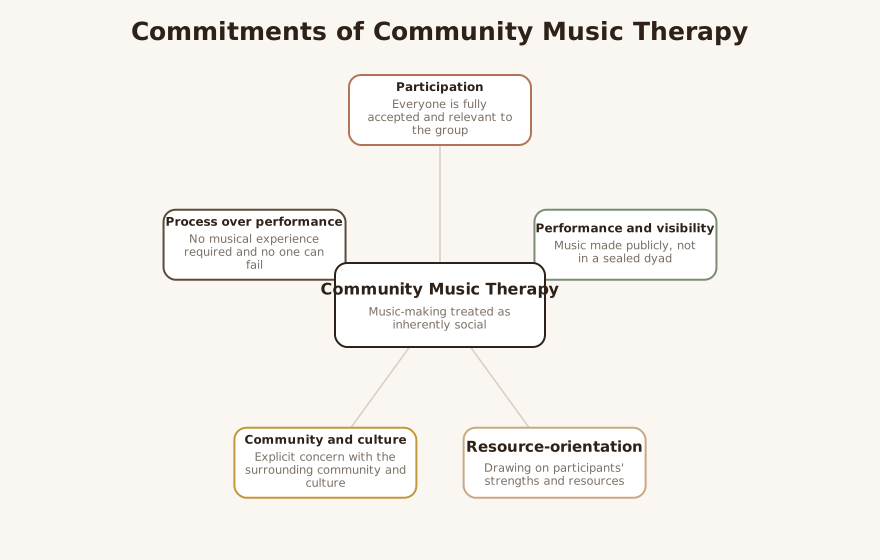
CMT reframes music-making as inherently social rather than as a private, sealed dyad of therapist and client 4. Its core commitments include participation, performance and visibility, resource-orientation, and an explicit concern with the surrounding community and culture 5. Where conventional therapy may treat symptoms within the consulting room, CMT treats connection, belonging, and identity as legitimate clinical targets in their own right LLM. Therapeutic drumming operationalizes these values through a few simple principles. Facilitation and compassion come before musical skill, and the facilitator functions as a mentor and guide rather than a performer 7. Sessions prioritize psychological safety, acceptance, and the sense that every participant is “fully accepted and relevant to the group” regardless of background 7. The emphasis is on process, not performance, so that participation requires no prior musical experience and no one can fail 6. These principles make the work unusually low-threshold for ambivalent or guarded clients LLM.
Interventions & Techniques
In practice, a therapeutic drumming group is built from a small set of repeatable techniques LLM. Participants typically each receive a hand drum such as a djembe and engage in call-and-response exercises, instruction in rhythmic patterns, and free improvisatory drumming 2. A modest portion of session time — roughly a fifth in one structured protocol — is given to talking and instruction, with the remainder devoted to playing 2. Facilitators are advised to choose music with strong rhythmic centers and steady time signatures, and to scale activities to the age and ability of the group 7. Material that is sexually, culturally, or politically charged is deliberately excluded to protect inclusivity 7. Within CMT more broadly, techniques extend beyond drumming to group singing, ensemble playing, and public performance, all chosen to maximize shared participation 4. The non-verbal, embodied nature of rhythm allows expression and co-regulation without dependence on language 3.
LLM-generated illustrative example (not a guideline): In a 90-minute group, a facilitator might open with a unison pulse to establish safety, move into call-and-response to invite individual voices, allow a short improvisation where “mistakes” are reframed as exploration, and close with a grounding rhythm and brief verbal check-in LLM.
Evidence Base
Two honest claims must be held together LLM. First, music therapy is an established profession with formal credentialing and an evidence-based mandate 1. Second, the controlled evidence specific to therapeutic drumming is still preliminary LLM. The most cited trial is a quasi-experimental, non-randomized study of 45 mental health service users (30 drumming, 15 control) attending weekly 90-minute sessions over 10 weeks 2. It reported reductions in depression of about 38% and anxiety of about 20% by week 10, alongside a 23% gain in social resilience, with gains maintained at three-month follow-up while controls did not change 2. Saliva analysis suggested a shift toward an anti-inflammatory immune profile, with interleukin-4 rising significantly, though the authors describe these biological changes as relatively small 2. Limitations are substantial: no randomization, higher baseline depression in the drumming group, and immune samples collected only from the drumming arm 2. A companion qualitative study found recovery operating through drumming features, group dynamics, and inclusive learning, framing the work as “creative practice as mutual recovery” 3. Treat the symptom data as promising and hypothesis-generating rather than definitive LLM.
Populations & Indications
Music therapy interventions are individualized and applied across wellness, stress management, pain, emotional expression, memory, and communication goals 1. CMT and therapeutic drumming have been used with a wide range of populations LLM. The controlled and qualitative evidence cited here centers on adults using mental health services, including people with serious mental illness and their carers 23. HealthRHYTHMS describes use across schools, healthcare facilities, corporate, and community settings, spanning diverse ages and abilities 6. By clinical extension and the resource-oriented logic of CMT, the format is frequently applied with older adults and people living with dementia, children and adolescents, veterans with PTSD, people in addiction recovery, people with developmental disabilities, and marginalized community groups 57. Indications cluster around social isolation, low mood, anxiety, stress, emotional dysregulation, low self-esteem, and social skills deficits — situations where shared, embodied, non-verbal participation may lower the barrier to engagement LLM.
Problems-for-Work
Drumming and CMT lend themselves to problems where connection and regulation matter as much as symptom reduction LLM. For social isolation, the group itself is the intervention: shared rhythm produces belonging and new social interaction within a single session 3. For depression and anxiety, the available data suggest meaningful reductions over a 10-week course in a mental-health population 2. For emotional dysregulation, the embodied, non-verbal channel of drumming offers physical release and co-regulation without requiring clients to find words 3. For low self-esteem and social skills deficits, a process-not-performance frame lets clients succeed without prior skill, reframing mistakes as acceptable exploration 63.
LLM-generated illustrative example (not a guideline): A withdrawn adolescent in a school group who resists talk-based work might first engage through call-and-response drumming, experience a low-stakes success, and use that shared moment as an opening for relational and verbal work later LLM.
Contraindications, Cautions & Cultural Humility
There are few absolute contraindications, but several real cautions LLM. Loud percussive sound and sustained group stimulation can overwhelm clients with sensory sensitivities, acute trauma activation, or certain neurological conditions, so volume, duration, and an opt-out should be planned LLM. Group formats are inappropriate when a client cannot yet tolerate shared space or when confidentiality and acute risk demand individual care LLM. Facilitators are explicitly cautioned against judging, manipulating, or analyzing participants, and against material that is sexually, culturally, or politically charged 7. Cultural humility is central: drumming traditions carry deep cultural meaning, and community drumming guidelines frame the work as a way to “break through cultural, racial, and religious differences” while encouraging respect and inclusion rather than appropriation 7. The most important ethical caution for a generalist clinician is scope: completing a drumming facilitator program “does not certify you to be a music therapist or practice music therapy” 6.
Treatment-Plan Suggestions & SMART Objectives
| Goal | SMART objective (example) | Mechanism |
|---|---|---|
| Reduce social isolation | Client attends 8 of 10 weekly group sessions and initiates one peer interaction per session within 10 weeks | Shared rhythm builds belonging and new social contact 3 |
| Decrease depressive symptoms | Client’s self-rated depression score declines by a clinically meaningful margin over a 10-week group course | Active participation and mood elevation in music-making 2 |
| Reduce anxiety | Client reports lower anxiety on a standardized scale by week 10 and at follow-up | Non-verbal expression and physiological down-regulation 2 |
| Improve emotional regulation | Client uses a grounding rhythm to self-soothe in 3 of 4 observed moments of arousal within 8 weeks | Embodied, non-verbal release and co-regulation 3 |
| Build social skills | Client takes one leadership/call-and-response turn per session for 4 consecutive sessions | Structured turn-taking in a safe, accepting group 7 |
| Increase self-esteem | Client identifies one personal success per session in verbal check-in across 6 sessions | Process-not-performance frame where no one fails 6 |
| Strengthen resilience | Client’s resilience score improves over a 10-week course | Mastery, mutual support, and shared identity 23 |
Common Misconceptions
A first misconception is that any drum circle is “music therapy”; in fact, recreational drumming and credentialed music therapy are distinct, and facilitator training does not license one to practice music therapy 61. A second is that musical talent is required — participation explicitly needs no prior musical experience, and the design ensures no one can fail 6. A third is that the symptom evidence is settled; the strongest drumming trial is non-randomized with a small sample and modest biological effects, so it should be read as preliminary 2. A fourth is that the point is the music itself, when CMT’s founders argue the therapeutic work lies in participation, belonging, and community as much as in sound 45. A fifth is that the facilitator should demonstrate skill; guidelines instead place facilitation and compassion ahead of musicianship 7.
Training & Certification
Two tracks exist LLM. To practice music therapy, including CMT, a clinician completes an AMTA-approved program and holds the board credential, working within an evidence-based therapeutic relationship 1. To facilitate recreational therapeutic drumming, programs such as HealthRHYTHMS offer short trainings — an intensive two-day, roughly 15-hour workshop open to doctors, nurses, social workers, counselors, teachers, musicians, and others, with no musical background required and a certificate of training rather than clinical licensure 6. The Percussive Arts Society publishes facilitation guidelines and recommends foundational texts for group drumming practice 7. Generalist therapists most often pursue the facilitation track and then deliver the activity inside their existing licensed scope rather than as standalone music therapy LLM.
Key Terms
- Community Music Therapy (CMT): A resource- and participation-oriented orientation extending music therapy beyond the individual into community contexts 4.
- Resource-orientation: Emphasis on strengths, relationships, and community resources rather than deficit and pathology 5.
- Drum circle / therapeutic drumming: A facilitated group activity using hand drums for connection and well-being, often process- not performance-focused 6.
- Call-and-response: A structured rhythmic exchange used to invite individual participation within group safety 2.
- MT-BC: The board credential identifying a professional qualified to practice music therapy 1.
- Mutual recovery: Recovery understood as a shared, relational process among patients and carers 3.
Resources & Further Reading
▶ Watch — a video introduction to this concept:
- American Music Therapy Association — What is Music Therapy?
- Effects of Group Drumming Interventions on Anxiety, Depression, Social Resilience and Inflammatory Immune Response (PLOS ONE)
- Making music for mental health: how group drumming mediates recovery (PMC)
- Where Music Helps: Community Music Therapy in Action and Reflection (Stige, Ansdell, Elefant, Pavlicevic)
- Community Music Therapy (Pavlicevic & Ansdell, eds.)
- HealthRHYTHMS Group Empowerment Drumming — Remo
- Suggested Guidelines for Community Group Drumming — Percussive Arts Society
Reflective / Supervision Questions
- Am I clear, in my own documentation, whether I am facilitating recreational drumming within my licensed scope or claiming to practice music therapy, and is that claim accurate to my credentials? 16
- How do I hold the tension between promising but preliminary symptom evidence and a client’s hope that drumming will “fix” their depression? 2
- Which clients in my group might be sensorily or trauma-overwhelmed by sustained percussion, and what opt-out and grounding plan do I have ready? LLM
- Whose musical and cultural traditions am I drawing on, and am I doing so with humility, respect, and inclusion rather than appropriation? 7
- When is connection and belonging the legitimate clinical target, and when am I avoiding harder symptom- or risk-focused work by staying in the circle? 43