
CETA (the Common Elements Treatment Approach) is a transdiagnostic, modular psychotherapy built so that one trained provider can treat several co-occurring mental health problems within a single course of care.1 It was designed specifically for delivery by lay counselors in low- and middle-income countries (LMIC), where specialist clinicians are scarce and a single client commonly presents with overlapping trauma, depression, anxiety, and substance use.14 For practicing therapists in well-resourced settings, CETA is worth knowing for two reasons: it is a clean, empirically supported model of how the “common elements” of the cognitive-behavioral family can be flexibly recombined for comorbid presentations, and it is one of the better-evidenced examples of task-sharing — extending evidence-based care through non-specialist providers.12
Type & Discipline
CETA is a standalone, manualized treatment modality, not a single technique.1 Its home discipline is global mental health, and it sits within the broader family of global mental health delivery models that use task-sharing (sometimes called task-shifting) to close the treatment gap.45 Mechanistically it belongs to the cognitive-behavioral therapy (CBT) family: every CETA element is drawn from established CBT-based and trauma-focused protocols, then stripped to its active, transportable core.16 What distinguishes it from a conventional disorder-specific protocol is that it is explicitly transdiagnostic — built to address a range of presentations (trauma, depression, anxiety, harmful substance use, and related functional impairment) within one flexible framework rather than requiring a separate manual per diagnosis.46
Creators & Lineage
CETA was developed by the Applied Mental Health Research Group (AMHR) at the Johns Hopkins Bloomberg School of Public Health, with Laura Murray, PhD, and Paul Bolton, MBBS, as its principal clinical and research architects.47 The intellectual lineage runs directly from mainstream CBT and from trauma-focused cognitive behavioral therapy (TF-CBT), whose components Murray and colleagues had previously helped adapt and test in low-resource settings.1 The animating problem was the treatment gap: in many LMIC contexts there are too few specialists to deliver multiple distinct, disorder-specific manuals, and clients rarely present with a single, tidy diagnosis.1 The design response was to identify the elements common across effective CBT-family treatments and assemble them into one approach that a non-specialist could learn and that could be matched to whatever combination of problems a given client brought.14 The University of Washington’s RISE group describes CETA as designed “based on the latest literature, but specifically for low-resource countries,” developed in partnership with the Johns Hopkins AMHR.5
Core Principles
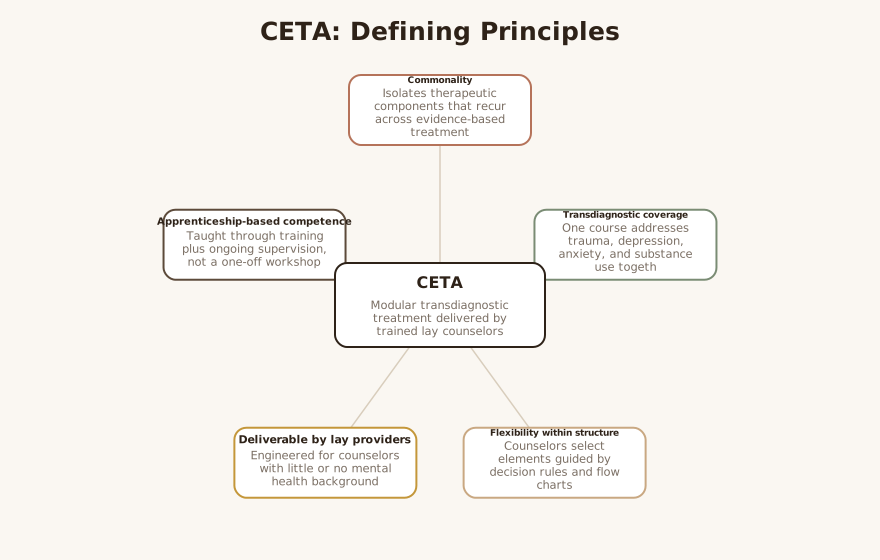
Several principles define CETA. First, commonality: rather than treating each disorder with its own protocol, CETA isolates the therapeutic components that recur across evidence-based treatments and treats those as the working units.16 Second, transdiagnostic coverage: a single course can address trauma, depression, anxiety, and substance use together, which matches the high comorbidity seen in real-world, especially trauma-exposed, populations.42 Third, flexibility within structure: counselors do not follow a fixed linear protocol; they select which elements to use and in what order, guided by the client’s presenting problems and by structured clinical decision-making rules and flow charts that keep non-specialists safe and on-model.1 Fourth, deliverability by lay providers: the entire system — language, decision aids, and especially the training and supervision structure — is engineered so that counselors with little or no prior mental health background can deliver it with fidelity.14 Fifth, apprenticeship-based competence: CETA is taught through an apprenticeship model of in-person training plus ongoing supervision, not a one-off workshop.46
Interventions & Techniques
CETA’s elements are recognizable to any CBT-trained clinician; the innovation is in their packaging and sequencing logic. The commonly described components include:6
- Engagement and education — building the relationship and providing psychoeducation about the problem and the treatment.6
- Anxiety management — relaxation and arousal-reduction strategies such as breathing and grounding.6
- Behavioral activation — increasing engagement in valued, mood-lifting activity, the core mechanism for depression.6
- Cognitive coping (“thinking differently”) — identifying and shifting unhelpful thoughts.6
- Confronting fears and trauma memories — gradual/imaginal and in-vivo exposure to feared situations and trauma narratives.6
- Problem-solving — structured steps for addressing concrete life difficulties.6
- Safety assessment and planning — risk screening and safety work woven throughout.6
- Harmful substance use intervention — a dedicated component targeting alcohol and other substance use.6
A CETA episode typically runs roughly 8–12 weekly sessions of about an hour, individually tailored: in the Burmese refugee trial counselors delivered an average of 9.7 sessions (range 7–13); the Somali youth adaptation averaged about 8.8 sessions.23 The counselor begins with engagement and uses decision rules to choose the next elements based on the client’s problem profile — for example, leading with behavioral activation for predominant depression, with cognitive coping and exposure when trauma and avoidance dominate, and adding the substance use or safety components as indicated.16 This element-selection-by-flow-chart is what lets one approach cover heterogeneous, comorbid presentations without a separate manual for each.1
LLM-generated illustrative example (not a guideline): A displaced adult presents with nightmares, low mood, social withdrawal, and heavy evening drinking. Within CETA, the counselor opens with engagement and education, schedules graded valued activities (behavioral activation) to lift mood and re-establish routine, introduces the substance-use component to address the drinking that is reinforcing avoidance, and only then moves into gradual exposure to trauma memories once safety and stabilization are in place LLM.
Evidence Base
CETA’s evidence base is best characterized as established for adult trauma-affected populations in LMIC settings, with a growing but younger evidence base for youth and for violence-related outcomes.236 The foundational development paper (Murray et al., 2014, Cognitive and Behavioral Practice) reported pilot data from adult torture and systematic-violence survivors in southern Iraq and on the Thailand–Burma border, with high rates of reliable improvement in depression, posttraumatic stress, and functioning, and documented that lay counselors maintained fidelity to the model.1 The strongest single trial is the single-blind randomized controlled trial among Burmese refugees in Mae Sot, Thailand (Bolton, Murray et al., 2014, PLoS Medicine): 347 trauma survivors, CETA delivered by 20 lay counselors versus a wait-list control with safety monitoring.2 Effect sizes were large for the primary outcomes — depression d = 1.16 and posttraumatic stress d = 1.19 — and moderate for anxiety (d = 0.79), functional impairment (d = 0.63), and aggression (d = 0.58); alcohol use did not differ significantly between groups.2 An open trial of the youth adaptation (CETA-Youth) across three Somali-region refugee camps in Ethiopia reported large pre-post effects for posttraumatic stress (d = 1.71), internalizing (d = 1.37), externalizing (d = 0.85), and well-being (d = 0.75).3
Beyond symptom reduction, a randomized trial in Zambia found CETA reduced physical and sexual intimate partner violence against women, alongside reductions in harmful alcohol use and improvements in couple communication and trust.6 The honest reading of this evidence: the within-disorder effects in the flagship adult RCT are strong and the model travels across very different cultures and provider backgrounds, but several supporting studies are open (uncontrolled) pre-post designs, the alcohol/substance-use signal has been inconsistent in symptom trials, and most evidence comes from humanitarian and LMIC contexts rather than high-income outpatient clinics.231
Populations & Indications
CETA was built for, and is best evidenced in, adults exposed to trauma, torture, and systematic violence, particularly refugees and forcibly displaced populations.12 It has been tested with Burmese refugees in Thailand, torture survivors in Iraq, and community members in Colombia, among others.52 The CETA-Youth adaptation extends the model to children and adolescents, adding elements for externalizing/conduct symptoms and structured parental involvement.3 It has also been applied with survivors and perpetrators of intimate partner violence in violence-prevention programming.6 The core indication is a client with comorbid or mixed presentations — co-occurring posttraumatic stress, depression, anxiety, harmful substance use, and functional impairment — where a transdiagnostic, lay-deliverable approach is preferable to stacking multiple specialist protocols.42 It is delivered in community-based settings and can be adapted for individual or group formats and for in-person or remote (telephone/videoconference) delivery.4
Problems-for-Work
CETA’s elements map cleanly onto discrete problems-for-work, which is part of why it generalizes well to ordinary clinical practice:
- Posttraumatic stress and avoidance — addressed primarily through gradual exposure to feared situations and trauma memories, supported by anxiety management.62
- Depression and withdrawal — addressed through behavioral activation and cognitive coping.6
- Anxiety and physiological arousal — addressed through anxiety-management/relaxation and exposure.62
- Harmful substance use — addressed through the dedicated substance-use component, often early when use is maintaining avoidance.6
- Aggression and interpersonal violence — reduced in the Burmese RCT (aggression d = 0.58) and targeted directly in the Zambia IPV trial.26
- Functional and role impairment — improved in the Burmese RCT (d = 0.63), reflecting that activation, problem-solving, and symptom relief restore daily functioning.26
- Acute risk and safety — managed through the safety assessment and planning component running throughout treatment.6
Contraindications, Cautions & Cultural Humility
CETA is a structured exposure-containing treatment, so the usual cautions apply: active, unmanaged suicidality or acute risk should be stabilized first, which is precisely why safety assessment is a through-line rather than a single session.6 The model’s strength — lay delivery — is also its principal caution: outcomes depend heavily on the apprenticeship training and ongoing supervision infrastructure, and CETA is not intended to be self-administered or delivered by undersupervised counselors.14 Exposure components in particular require competent supervision to be done safely. Fidelity has held up in trials, but it was supported by structured decision rules and active local supervision, not by the manual alone.1 Cultural humility is built into the development method: CETA was iteratively adapted with local counselors and supervisors in each setting, and its measures and components were tested within those communities rather than imported wholesale.15 Clinicians adopting CETA-derived ideas outside its validated contexts should not assume the effect sizes transfer automatically, and should attend to local idioms of distress, language, and the meaning of trauma narration. The substance-use evidence is mixed, so substance use should not be assumed resolved by symptom-focused work alone.2
Treatment-Plan Suggestions & SMART Objectives
| Goal | SMART objective (example) | Mechanism |
|---|---|---|
| Reduce trauma-related avoidance | Within 8 weeks, client completes 3 graded exposure tasks to previously avoided situations, rating distress before/after each | Gradual exposure extinguishes conditioned avoidance 6 |
| Lift depressed mood and re-engage in life | Over 6 weeks, client schedules and completes ≥3 valued activities per week, tracked on an activity log | Behavioral activation 6 |
| Lower physiological arousal | Within 4 weeks, client demonstrates a relaxation/grounding skill and uses it during ≥2 high-arousal moments weekly | Anxiety management 6 |
| Shift unhelpful trauma-linked beliefs | Within 8 weeks, client identifies and reframes ≥2 recurring unhelpful thoughts in session and between sessions | Cognitive coping (“thinking differently”) 6 |
| Reduce harmful alcohol/substance use | Over 8 weeks, client reduces drinking days by an agreed target and applies one refusal/coping strategy weekly | Substance-use component 6 |
| Improve daily functioning | Within 10 weeks, client resumes ≥1 occupational or caregiving role rated as impaired at intake | Problem-solving plus symptom reduction 2 |
| Maintain safety | Each session, client and clinician review a written safety plan and update it if risk changes | Continuous safety assessment and planning 6 |
| Resolve a concrete life stressor | Within 5 weeks, client completes the structured problem-solving steps for one prioritized problem | Problem-solving 6 |
Common Misconceptions
“CETA is just CBT renamed.” It uses CBT-family elements, but the defining features are its transdiagnostic element-selection logic and its engineering for lay delivery under supervision — not new techniques.16 “It’s a fixed, sequential protocol.” It is deliberately flexible; counselors choose elements and order via decision rules tailored to the client’s problem profile.1 “Only specialists can deliver it.” The entire point is that trained, supervised non-specialists deliver it with fidelity and large effects.12 “It only works for one disorder.” Its design and evidence target comorbid presentations spanning trauma, depression, anxiety, and substance use simultaneously.42 “It treats substance use as reliably as trauma.” The substance-use signal has been less consistent than the trauma and depression effects in symptom trials, even though a dedicated component exists.26 “It’s only relevant in LMIC humanitarian settings.” It was developed there, but its element-based, transdiagnostic logic is directly instructive for high-comorbidity caseloads anywhere.1
Training & Certification
CETA is taught through an apprenticeship model rather than a single workshop.46 Typical full training runs roughly 8–10 days of in-person instruction using practice groups, followed by close supervision on the first client and ongoing (often weekly) supervision throughout the counselor’s provision.46 CETA Global describes tiered options: full CETA training (with ongoing supervision), select-element training for specific components, and a single-session CETA used for preventive programming.4 The model can be configured for individual or group delivery and for remote (phone/video) supervision and delivery.4 Training, certification, and implementation support are coordinated through CETA Global and affiliated groups, with the originating research base at the Johns Hopkins Center for Global Mental Health / Applied Mental Health Research Group.47
Key Terms
- Transdiagnostic — treating across multiple diagnoses with shared components rather than one manual per disorder.4
- Common elements — the active therapeutic components recurring across effective CBT-family treatments, used as CETA’s working units.1
- Task-sharing / task-shifting — extending care by training non-specialist (lay) providers to deliver evidence-based treatment under supervision.45
- Apprenticeship model — competence built through training plus continued supervision, not a one-off workshop.4
- Behavioral activation — increasing engagement in valued activity to relieve depression.6
- Gradual exposure — paced confrontation of feared situations and trauma memories to reduce avoidance.6
- Fidelity — adherence to the model as designed; maintained by lay counselors in CETA trials with structured decision aids and supervision.1
Resources & Further Reading
▶ Watch — a video introduction to this concept:
- Murray et al. (2014), A Common Elements Treatment Approach for Adult Mental Health Problems in LMIC — Cognitive and Behavioral Practice1
- Bolton, Murray et al. (2014), Transdiagnostic RCT among Burmese Refugees in Thailand — PLoS Medicine2
- Murray et al. (2018), Evaluation of CETA for youth in Somali refugee camps — Global Mental Health3
- CETA Global — What is CETA?4
- RISE Mental Health, University of Washington — CETA5
- Prevention Collaborative — CETA programme example6
- Johns Hopkins Center for Global Mental Health — Publications & Resources7
Reflective / Supervision Questions
- In my own caseload, how often do I run parallel disorder-specific protocols for one comorbid client where a transdiagnostic, element-selection approach might be cleaner? LLM
- When I sequence interventions, am I making the ordering logic explicit (as CETA’s decision rules do), or is it implicit and hard to supervise? LLM
- CETA’s effects depend on ongoing supervision, not the manual alone — what does my own supervision structure provide when I deliver exposure-based work? LLM
- The substance-use evidence in CETA is mixed; in my practice, do I assume symptom-focused trauma work will resolve co-occurring substance use, and is that assumption warranted? LLM
- CETA was iteratively adapted with local providers in each culture — how do I adapt language, idioms of distress, and trauma narration for clients whose context differs from the populations my methods were validated in? LLM
- Which CETA elements (behavioral activation, gradual exposure, cognitive coping, problem-solving) am I most and least confident delivering, and how would I deepen the weaker ones? LLM