
Type & Discipline
The bystander effect is a construct in social psychology, situated within the family of group-influence phenomena rather than within any school of psychotherapy 3. It describes the empirical observation that an individual’s probability of helping a person in distress decreases as the number of other witnesses increases 1. It is not a therapeutic modality, a diagnosis, or a technique; it is an explanatory framework that clinicians borrow to make sense of behavior, design psychoeducation, and process the aftermath of inaction LLM. Its companion mechanism, diffusion of responsibility, names the specific psychological process by which the felt obligation to act is divided among everyone present, so that no single person feels personally accountable 1.
For practicing therapists, the value of the construct is interpretive and educational LLM. It rarely appears as a presenting problem in its own name, but it frequently underlies the guilt, shame, moral injury, and assertiveness difficulties that clients do bring to treatment LLM. Understanding the mechanism lets a clinician normalize a client’s freeze response, reframe self-blame, and build concrete skills for acting under social pressure LLM.
Creators & Lineage
The construct was formalized by John Darley and Bibb Latané in a 1968 experiment that operationalized helping behavior under varying group sizes 1. Participants who believed they were the only witness to a (staged) seizure-like emergency helped quickly and almost universally, whereas those who believed several others were also present helped far less often and far more slowly 1. The authors interpreted this not as apathy but as a structural feature of group situations: responsibility diffuses, and the cost of inaction is shared rather than borne by one person 1.
Latané and Darley extended this work in their 1970 monograph The Unresponsive Bystander: Why Doesn’t He Help?, which laid out a decision-tree model of intervention and consolidated the program of research 6. The popular origin story ties the work to the 1964 murder of Kitty Genovese and the widely circulated claim that 38 witnesses did nothing 7. That narrative is part of the lineage, but the historical “38 witnesses who did nothing” account has since been substantially corrected as exaggerated and in important respects inaccurate, and clinicians should not present it as settled fact 7. The lineage thus includes both the durable experimental finding and a cautionary lesson about how a vivid but distorted anecdote can outrun the data LLM.
Core Principles
Three interlocking mechanisms are generally invoked to explain the effect 3. The first is diffusion of responsibility: with more witnesses present, each person feels a smaller share of the obligation to act 1. The second is pluralistic ignorance: people look to others to define an ambiguous situation, and when everyone is outwardly calm, each observer privately concludes that no emergency exists 4. The third is evaluation apprehension: the fear of intervening incorrectly and being judged by onlookers raises the perceived social cost of acting 4.
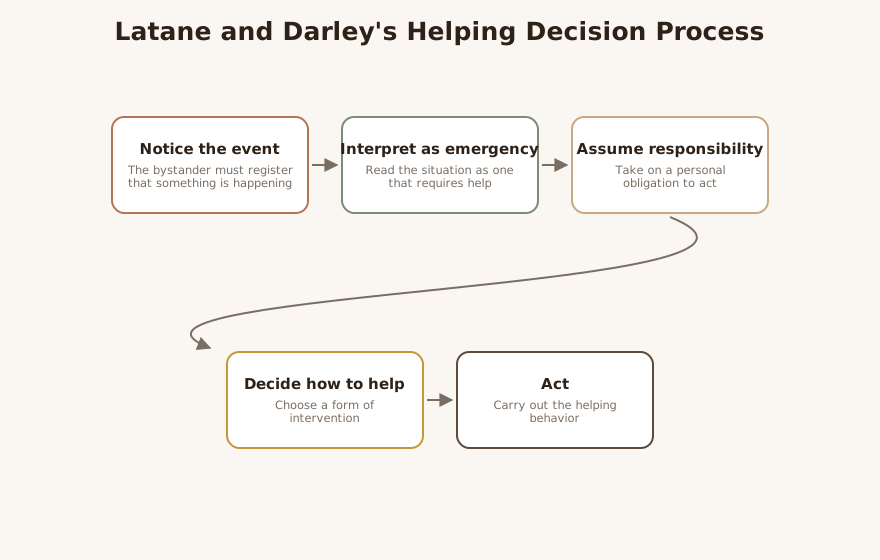
Latané and Darley framed helping as the outcome of a sequential decision process in which a bystander must notice the event, interpret it as an emergency, assume personal responsibility, decide how to help, and then act 6. A “no” at any step halts helping, and the presence of others can derail the process at multiple points 6. A further principle, social modeling, operates throughout: the visible inaction of others functions as information that doing nothing is the appropriate response 5. Together these mechanisms reframe non-helping as a predictable situational product rather than a character flaw, which is the single most clinically useful idea the construct offers LLM.
Interventions & Techniques
Because the bystander effect is a construct and not a treatment, its clinical “interventions” are ways of operationalizing the concept inside established modalities rather than a freestanding protocol LLM. The most direct application is psychoeducation: teaching a client the diffusion-of-responsibility mechanism to externalize self-blame and reframe a freeze response as a situational and physiological default rather than a moral failure 3. This pairs naturally with cognitive restructuring of the rigid, globalized self-judgments (“I am the kind of person who does nothing”) that often follow an episode of inaction LLM.
A second application is assertiveness and “upstander” skill-building: rehearsing the specific behaviors that counteract diffusion, such as naming the emergency aloud, assigning responsibility to a named individual (“you in the blue jacket, call 911”), and acting first to break the spell of group inaction 5. These skills are taught and practiced as components within an established modality rather than as a therapy unto themselves LLM. A third application is naming group-process dynamics within family or group therapy, where the clinician makes the diffusion explicit so that no member can quietly assume someone else will raise the difficult issue LLM.
LLM-generated illustrative example (not a guideline): A client who witnessed a collapse on a crowded train and did not move replays the moment with intense shame. The clinician offers psychoeducation on diffusion of responsibility and pluralistic ignorance, then uses cognitive restructuring to test the belief “I’m a coward,” and finally rehearses a concrete script the client could use next time. The goal is not to litigate the past but to reduce shame and increase future agency LLM.
Evidence Base
The maturity of this construct is best described as established 2. The original 1968 demonstration has been replicated and extended across decades, and the 2011 meta-analysis by Fischer and colleagues synthesized this large literature and confirmed a reliable overall bystander effect 2. The phenomenon is one of the more robust findings in social psychology and is treated as foundational in undergraduate and professional curricula 7.
Honesty about the evidence requires two important qualifications LLM. First, the meta-analysis found the effect is moderated rather than universal: it is attenuated, and can even reverse, when the emergency is clearly dangerous, when the perpetrator is physically present, or when intervention carries high physical cost, because in such situations bystanders may recognize that help is unlikely from anyone else and that collective presence offers safety 2. Second, the founding anecdote is unreliable: the “38 unresponsive witnesses” account of the Kitty Genovese case has been substantially debunked, and the experimental evidence, not the news story, is what carries the construct 7. The honest summary for clinicians is that the effect is real and well-replicated, but it is a probabilistic situational influence with documented boundary conditions, not an iron law 2.
Populations & Indications
The construct is most clinically relevant for clients whose presenting concerns involve inaction under social pressure LLM. Trauma survivors carrying inaction guilt — those who froze during an assault, an accident, or an episode of abuse and now condemn themselves for not acting — are a primary indication, because the construct directly normalizes the freeze and reduces self-blame LLM. Adolescents in bullying contexts are another, since school-based bystander dynamics map closely onto the mechanism and respond to upstander skill-building 3.
Healthcare workers, first responders, and members of high-acuity teams are indicated where diffusion of responsibility within a group contributed to a delayed or missed response and subsequent moral distress LLM. Clients with broad assertiveness deficits benefit from the construct as a frame for understanding why speaking up feels uniquely hard when others are present 4. Finally, members of therapy and family groups are an indication in a structural sense: the clinician uses the concept to keep responsibility from quietly evaporating across the group LLM.
Problems-for-Work
Several concrete problems-for-work flow from this construct LLM. Bystander guilt is the most common: a client holds themselves responsible for not helping in a situation where group dynamics powerfully suppressed action, and treatment works to recalibrate that appraisal 1. For example, a nurse who assumed a colleague had already escalated a deteriorating patient can examine how diffusion operated on the whole team rather than locating all fault in herself LLM.
Moral injury from failure to intervene is a deeper variant in which the inaction collides with the client’s core values, producing not just guilt but a fractured sense of self LLM. Failure-to-intervene shame targets the global, identity-level self-condemnation that often follows and benefits from cognitive restructuring LLM. Assertiveness deficits become workable when the client sees that acting first breaks the diffusion, as when a client rehearses being the one person who names a problem in a meeting rather than waiting for someone else 5. Diffusion of responsibility in families is a relational problem-for-work, as when no family member follows through on a vulnerable relative’s care because each assumes another will LLM.
Contraindications, Cautions & Cultural Humility
The chief caution is misuse as exculpation versus over-application as blame LLM. Used well, the construct relieves disproportionate self-blame; used poorly, it can either let a client evade legitimate accountability or, conversely, be wielded by the clinician to imply the client “should have known better,” which compounds shame LLM. The clinician’s task is to hold both the situational reality and the client’s values without collapsing into either LLM.
A second caution is trauma-sensitivity: with survivors who froze, introduce the mechanism only after sufficient safety and stabilization, because premature psychoeducation can feel like the freeze is being explained away LLM. There is no diagnostic contraindication to teaching a concept, but timing and framing matter LLM. Cultural humility is essential because helping norms, the meaning of intervention, and the costs of speaking up vary across cultures, communities, and contexts of marginalization; for clients from groups for whom intervening with authorities carries real danger, “inaction” may have been adaptive and protective rather than a failure LLM. The construct also derives largely from Western laboratory samples, and the clinician should treat it as a hypothesis to explore with the client, not a verdict to impose 2.
Treatment-Plan Suggestions & SMART Objectives
| Goal | SMART objective (example) | Mechanism |
|---|---|---|
| Reduce inaction-related guilt | Within 6 sessions, client will articulate the diffusion-of-responsibility mechanism and rate guilt intensity ≤4/10 on at least two recalled events | Psychoeducation reattributes inaction from character to situation 1 |
| Decrease shame-based self-judgment | Over 8 weeks, client will identify and reframe 3 global self-condemnations into specific, situational appraisals | Cognitive restructuring of identity-level distortions LLM |
| Build upstander/assertiveness skills | Within 4 sessions, client will rehearse and use a direct-naming script (“you, call 911”) in at least one role-play and one real situation | Behavioral rehearsal counteracts diffusion and evaluation apprehension 5 |
| Counter pluralistic ignorance | Within 5 sessions, client will name two cues that an ambiguous situation is an emergency despite others’ calm | Recognition that others’ inaction is unreliable information 4 |
| Process moral injury | Over 10 sessions, client will complete a values-based narrative reconciling the event with self-identity, reporting reduced moral distress | Meaning-making restores coherence between action and values LLM |
| Reduce family diffusion | Within 6 sessions, family will assign explicit, named responsibility for one recurring care task | Making responsibility explicit prevents its diffusion LLM |
| Improve emergency self-efficacy | Within 4 sessions, client will report increased confidence (≥7/10) in their ability to act if a future emergency arises | Skill rehearsal raises perceived behavioral control 5 |
Common Misconceptions
A first misconception is that non-helping reflects apathy or moral defect 3. The research reframes it as a situational product of diffusion, pluralistic ignorance, and evaluation apprehension, which is precisely why the construct is therapeutically useful 1. A second is that the effect is universal and invariant 2. The meta-analysis shows it is moderated and can shrink or reverse in clearly dangerous emergencies, so clinicians should avoid presenting it as a law that determines behavior 2.
A third misconception is the “38 witnesses” myth as established history 7. The Genovese narrative has been substantially corrected, and the construct rests on experimental evidence rather than that anecdote 7. A fourth, important for clients, is that knowing about the effect inoculates a person against it LLM. Awareness helps, but durable change comes from rehearsed behavioral skills — naming the emergency and assigning responsibility — not from insight alone 5.
Training & Certification
There is no certification in the bystander effect, because it is a construct rather than a modality, and no credentialing body governs its clinical use LLM. Competence comes instead from grounding in social-psychology fundamentals and from proficiency in the established modalities through which the construct is applied LLM. A clinician who is competent in cognitive behavioral therapy, in assertiveness training, in trauma-informed care, and in group or family work already possesses the vehicles for delivering the relevant interventions LLM.
Practically, the most useful preparation is to read the primary sources so the concept is delivered accurately, to know its boundary conditions, and to be able to correct the Genovese myth when clients raise it 2. Many applied bystander-intervention curricula exist in adjacent fields such as violence prevention and workplace training, and clinicians may draw on these for skill content, but they are programs of education rather than clinical certifications 4.
Key Terms
Bystander effect — the reduced likelihood that any individual will help as the number of witnesses increases 1. Diffusion of responsibility — the division of felt obligation across all witnesses, so no one feels personally accountable 1. Pluralistic ignorance — privately concluding there is no emergency because everyone else appears calm 4. Evaluation apprehension — inhibition of action from fear of being judged for intervening incorrectly 4. Decision model of helping — Latané and Darley’s five-step sequence (notice, interpret, assume responsibility, decide, act) 6. Upstander — a person who deliberately intervenes rather than remaining a passive bystander 5. Moral injury — distress from acting, or failing to act, in ways that violate one’s moral values LLM.
Resources & Further Reading
▶ Watch — a video introduction to this concept:
- Darley & Latané (1968) — Bystander Intervention in Emergencies: Diffusion of Responsibility (JPSP)
- Fischer et al. (2011) — The Bystander-Effect: A Meta-Analytic Review (Psychological Bulletin)
- Latané & Darley (1970) — The Unresponsive Bystander: Why Doesn’t He Help?
- Bystander Effect in Psychology — Simply Psychology
- Bystander Effect — Psychology Today (Basics)
- Bystander Effect (video) — Khan Academy (MCAT Social Psychology)
- Bystander Effect — Wikipedia
Reflective / Supervision Questions
- When a client describes freezing in an emergency, how do I distinguish normalizing the freeze from inadvertently excusing avoidance, and which does this client need more right now? LLM
- How do I time psychoeducation about diffusion of responsibility so it lands as relief rather than as explaining away a survivor’s pain? LLM
Where in my own group practice does diffusion of responsibility operate — around follow-up on high-risk clients, mandated reporting, or care coordination — and who is quietly assuming someone else will act? LLM How do cultural and power-related factors shape what “helping” and “intervening” could safely mean for this particular client, and am I treating the construct as a hypothesis or imposing it as a verdict? 2 Finally, when a client invokes the Kitty Genovese story, am I prepared to correct the myth while preserving the valid underlying mechanism? 7