
Type & Discipline
Moral disengagement is a construct in social-cognitive psychology, not a therapy modality or a discrete intervention 6. It names the set of cognitive operations through which people selectively switch off the moral self-sanctions that would otherwise restrain harmful conduct 3. It belongs to the broader family of moral psychology and is embedded in Albert Bandura’s social cognitive theory of self-regulation 6. For practicing clinicians, the most accurate framing is this: moral disengagement is a descriptive and explanatory lens — a vocabulary for the specific rationalizations a client uses to keep acting against their own stated values without feeling like a bad person 4. It is not, on its own, a protocol you deliver, and the construct should not be presented to clients or in documentation as an established treatment in itself LLM.
The clinical usefulness of the construct is in formulation rather than prescription LLM. When a client minimizes harm they caused, reassigns blame to the person they hurt, or hides behind “everyone does it,” moral disengagement gives the clinician a structured way to recognize, name, and target those specific maneuvers within an existing evidence-based modality LLM.
Creators & Lineage
The construct was developed by Albert Bandura, who articulated it most fully in his 1999 paper “Moral Disengagement in the Perpetration of Inhumanities” 1. Bandura’s central claim is that people adopt standards of right and wrong that operate as internal guides and deterrents, and that conduct is normally regulated by anticipated self-sanctions — self-censure for transgression and self-respect for adherence 3. Moral disengagement is the process by which those self-sanctions are selectively disengaged from harmful conduct, so that a person can engage in injurious behavior and still “live in peace with themselves” and maintain positive self-regard 3.
The construct sits downstream of Bandura’s larger social cognitive theory, which treats moral agency as socially situated rather than a fixed internal trait 6. Within that theory, self-regulation has three sub-functions: self-monitoring of conduct, judgmental evaluation of that conduct against internal standards, and a self-reactive influence (the self-sanction itself) 5. Moral disengagement works by selectively deactivating one or more of these sub-functions at specific points in the self-regulatory chain, which is why Bandura organizes the mechanisms by where in that chain they intervene 5. His later book-length treatment, Moral Disengagement: How People Do Harm and Live With Themselves, extended the framework into everyday institutional and commercial contexts 3. The lineage therefore runs from self-efficacy and self-regulation, through social cognitive theory, into this specific account of how moral self-control is selectively suspended 6.
Core Principles
The first principle is that moral disengagement does not require changing one’s moral standards 4. People do not abandon their values; they convince themselves that those values do not apply to the act in question 4. This is what makes the construct clinically distinctive — the client genuinely still holds the standard, which is precisely why the maneuver is so hard to see and so resistant to simple values-clarification LLM.
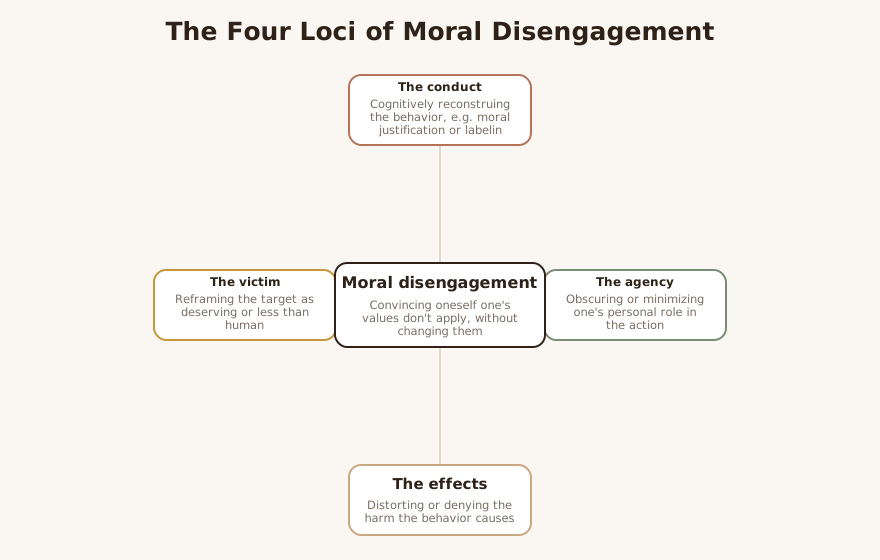
The second principle is that the mechanisms are organized by where they intervene in the self-regulatory process 5. Bandura groups them by four loci: the conduct itself (cognitively reconstruing the behavior), the agency of action (obscuring or minimizing one’s personal role), the effects/consequences of the behavior (distorting or denying the harm), and the victim (reframing the target as deserving or less than human) 5. A clinician who learns these four loci has a map: any given rationalization is doing its work at one of these four pressure points LLM.
The third principle is that moral disengagement is typically gradual and self-reinforcing 5. People do not usually leap to egregious harm; the mechanisms operate within a sociostructural context that incrementally normalizes conduct, so that each disengaged act lowers the threshold for the next 5. Clinically, this incremental quality matters: the client in front of you may have arrived at a position they would once have found unthinkable, one small reframe at a time LLM.
A fourth principle is that humane personal standards alone are not sufficient protection — disengagement allows otherwise decent people to do harmful things, which is why the construct was originally developed to explain inhumanities committed by ordinary people rather than by uniquely cruel individuals 1.
Interventions & Techniques
It is important to state plainly that Bandura’s framework is descriptive; it does not come with a manualized clinical intervention 6. What follows are clinician-facing applications of the construct, synthesized for therapeutic use, not validated techniques drawn from a moral-disengagement treatment manual LLM.
The foundational clinical move is detection and naming — learning to hear the eight mechanisms in a client’s account LLM. Across the four loci, the mechanisms are: moral justification (reframing harm as serving a worthy purpose) 5; euphemistic labeling (sanitized language that obscures harm, as when killing becomes “wasting” or harm becomes “collateral damage”) 5; advantageous comparison (contrasting one’s conduct against something worse to make it look benign) 5; displacement of responsibility (viewing the act as dictated by an authority rather than chosen) 5; diffusion of responsibility (spreading accountability across a group so no one feels personally responsible) 5; distorting or disregarding consequences (minimizing, ignoring, or denying the harm done) 5; dehumanization (denying the victim’s full humanity) 5; and attribution of blame (claiming the victim deserved or provoked their fate) 5.
A second application is Socratic and curious inquiry that gently makes the maneuver visible without inviting shame, since direct confrontation typically strengthens the defense LLM. A third is restoring the consequence chain — re-engaging the “effects” locus by helping the client contact, in tolerable doses, the actual impact of their behavior on real others LLM. A fourth is re-humanizing work that reverses dehumanization and victim-blaming by rebuilding perspective-taking and empathy, which the literature identifies as a protective factor against disengagement 4. These applications map naturally onto established modalities — cognitive behavioral therapy for the reconstrual mechanisms, mentalization- and empathy-based work for the victim mechanisms — rather than constituting a standalone treatment LLM.
LLM-generated illustrative example (not a guideline): A client on a court-ordered program describes an assault by saying, “He had it coming, and honestly I barely touched him compared to what other guys do.” The clinician hears two mechanisms — attribution of blame and advantageous comparison — and, rather than arguing, reflects: “It sounds like two things are helping this sit okay with you: that he caused it, and that others do worse. I’m curious what it would be like to set those two aside for a minute and just look at what happened.” LLM
Evidence Base
The honest summary is that the construct is well established while a treatment built on it is not LLM. Moral disengagement has decades of empirical support as a measurable individual-differences variable and has been operationalized in validated instruments, including Bandura’s Moral Disengagement Scale and related measures such as Civic Moral Disengagement 6. The bulk of the evidence is correlational and predictive: moral disengagement reliably correlates with the behaviors it was theorized to enable 6.
Specifically, moral disengagement is positively associated with bullying in children and adolescents, with moral justification and victim-attribution among the most strongly related mechanisms, and it is also associated with cyber-aggression 6. Higher moral disengagement predicts a greater likelihood of unethical decision-making in workplace and organizational contexts 6. It has been studied in relation to aggression and armed conduct, athletic cheating and doping, and a range of self-serving everyday transgressions 6. Individual-difference moderators — empathy, moral identity, cynicism, and locus of control — show predictive value, and stronger moral identity or higher empathy are associated with lower susceptibility 4.
What the evidence base does not establish is that targeting moral disengagement in therapy reduces harmful behavior, or that any specific clinical protocol reliably lowers a client’s disengagement LLM. The construct is a robust explanatory and assessment tool, not a demonstrated mechanism of therapeutic change, and clinicians should be candid about that gap LLM. A documented limitation is that the original theory emphasized extraordinary circumstances, which can obscure the more mundane, everyday operation of the mechanisms in routine clinical material 5.
Populations & Indications
Because the construct emerged to explain harm done by ordinary people, it is broadly applicable wherever a clinical picture includes harm to others paired with preserved self-regard 1. The populations in whom moral disengagement has been most studied — and where it is most clinically relevant — include adolescents and youth presenting with bullying, cyberbullying, or aggression 6. It is highly pertinent to justice-involved and antisocial populations, where minimization and blame-shifting are common features 6. It applies to athletes in the context of doping and antisocial play 6, and to adults in organizational or workplace contexts where unethical conduct is at issue 6.
More generally, moral disengagement is indicated as a formulation lens whenever a client repeatedly acts against their own stated values while reporting little guilt, when remorse is conspicuously absent after harm, or when an account of an incident is saturated with euphemism, comparison, and blame LLM. It is equally usable as a self-reflective tool for clinicians and supervisees noticing their own rationalizations 4.
Problems-for-Work
Aggression and interpersonal harm. Where a client’s aggression is sustained by moral justification or dehumanization of the target, the work is to re-engage self-sanction at the conduct and victim loci 5. Application: tracing how a partner came to be seen as “the enemy” who therefore could be treated harshly LLM.
Bullying and cyberbullying. Given the documented link between disengagement and (cyber)bullying, work targets the victim-attribution and consequence-minimizing mechanisms most implicated 6. Application: with an adolescent, restoring awareness of the real impact of online posts the client experienced as consequence-free LLM.
Delinquency and antisocial behavior. Here diffusion and displacement of responsibility (“the group decided,” “I was told to”) are frequent, and the work returns agency to the client 5. Application: distinguishing what the group did from what this client specifically chose LLM.
Lack of remorse / minimization. Where consequences are disregarded or distorted, the work is to contact the harm in tolerable doses 5. Application: a structured, paced review of the actual effects of an action the client has narrated as “no big deal” LLM.
Externalizing blame onto victims. Attribution of blame is directly addressed by separating provocation from response and rebuilding the client’s ownership of their conduct 5. Application: validating that the client felt provoked while still holding that the response was theirs to choose LLM.
Contraindications, Cautions & Cultural Humility
The single largest caution is misuse as a moral verdict LLM. Labeling a client “morally disengaged” can become a covert way for a clinician to enact their own contempt, and the construct’s roots in explaining atrocity make pejorative misuse especially easy 1. The clinical stance must be formulation, not judgment LLM.
A second caution: do not confuse trauma-related survival cognition with moral disengagement LLM. A trauma survivor’s vigilance, dehumanizing appraisals of a past perpetrator, or self-protective numbing can superficially resemble these mechanisms but require a fundamentally different, safety-first response LLM. Relatedly, the construct should be distinguished from moral injury, where the distress arises precisely because self-sanction is intact and active, not disengaged LLM.
Cultural humility is essential because what counts as harm, who counts as an authority, and how responsibility is distributed across an individual versus a collective vary substantially across cultures LLM. Bandura himself framed moral agency as socially situated, so a clinician must be careful not to read culturally normative collectivism or deference to authority as evidence of pathological diffusion or displacement of responsibility 6. Confrontational techniques can also rupture alliance and intensify defenses, and are contraindicated where the alliance is fragile or where shame is already high LLM.
Treatment-Plan Suggestions & SMART Objectives
The following are illustrative clinical translations, not a validated protocol; moral disengagement is a construct addressed within established modalities LLM.
| Goal | SMART objective (example) | Mechanism |
|---|---|---|
| Increase awareness of own rationalizations | Within 6 sessions, client will identify, in session, at least 2 of their own disengagement maneuvers (e.g., euphemism, comparison) when reviewing a recent conflict | Self-monitoring at the conduct locus 5 |
| Restore personal agency | Over 8 weeks, client will, in 3 narrated incidents, distinguish what a group did from what they personally chose | Reversing displacement/diffusion of responsibility 5 |
| Re-engage with consequences | Within 4 sessions, client will tolerate a paced review of one incident’s actual impact and articulate that impact in their own words | Reversing distortion/disregard of consequences 5 |
| Rebuild perspective-taking | Over 10 sessions, client will complete 3 perspective-taking exercises that describe a harmed party’s experience without blame-language | Reversing dehumanization and victim-blame 4 |
| Reduce victim-blaming language | Within 6 sessions, client will reframe 2 “they deserved it” statements into accounts that separate provocation from chosen response | Reversing attribution of blame 5 |
| Strengthen moral identity as a protective factor | Over 12 weeks, client will articulate and apply 2 personal values to a real decision, reducing reliance on advantageous comparison | Bolstering moral identity / empathy 4 |
| Generalize gains to high-risk contexts | Within 8 sessions, client will pre-identify their likely disengagement maneuver before entering 2 anticipated high-risk situations | Pre-empting gradual/incremental disengagement 5 |
Common Misconceptions
“Moral disengagement means the person has no morals.” It is the opposite: the mechanisms exist precisely because the person still holds moral standards and must neutralize them to act, without changing those standards 4.
“It only explains atrocities and war.” Although the framework was developed around inhumanities, the same mechanisms operate in everyday, self-serving conduct, and over-focusing on extreme cases obscures their ordinary presence 5.
“It’s a personality disorder or a diagnosis.” Moral disengagement is a social-cognitive construct and an individual-differences variable measured by scales, not a DSM/ICD diagnosis 6.
“It’s a conscious, cynical lie.” Much disengagement operates as genuine self-persuasion that lets people maintain positive self-regard, not as deliberate deception, though it can also be used deceptively 3.
“There’s a proven therapy that fixes it.” The construct is well validated descriptively, but no standalone evidence-based treatment for reducing moral disengagement is established LLM.
Training & Certification
There is no certification in “moral disengagement therapy,” because it is a construct rather than a credentialed modality LLM. Clinicians develop competence by grounding themselves in the primary literature — Bandura’s 1999 paper and his later book — and by learning to recognize the eight mechanisms in clinical material 1. Practical fluency is best built within training in the modalities that already contain the relevant techniques, such as cognitive behavioral, mentalization-based, and empathy-focused approaches, and within forensic or offense-focused supervision where minimization and blame are routine targets LLM. Familiarity with the validated measurement scales is useful for those doing assessment or research 6.
Key Terms
Self-sanctions — the internal rewards (self-respect) and punishments (self-censure) that normally regulate conduct against one’s standards 3.
Self-regulation — Bandura’s three-part process of self-monitoring, judgmental evaluation, and self-reactive influence through which standards govern behavior 5.
Locus — the point in the self-regulatory chain (conduct, agency, effects, or victim) where a given mechanism intervenes 5.
Euphemistic labeling — sanitized language that masks the harm of an act 5.
Advantageous comparison — making conduct look benign by contrasting it with something worse 5.
Displacement vs. diffusion of responsibility — attributing the act to an authority’s dictate versus spreading accountability across a group 5.
Dehumanization — denying the victim’s full humanity to remove them from the scope of moral concern 5.
Attribution of blame — casting the victim as the cause, so the harm appears deserved 5.
Resources & Further Reading
▶ Watch — a video introduction to this concept:
- Bandura, A. (1999). Moral Disengagement in the Perpetration of Inhumanities — Personality and Social Psychology Review 1
- Bandura (1999) — full-text PDF 2
- Albert Bandura — Moral Disengagement (author’s own page) 3
- Moral Disengagement — Ethics Unwrapped (UT Austin) 4
- Moral Disengagement — ScienceDirect Topics overview 5
- Moral disengagement — Wikipedia 6
Reflective / Supervision Questions
- When I hear a client minimize harm, can I distinguish which of the four loci their rationalization is operating on, and does that change my next move? LLM
- Am I using “moral disengagement” as a formulation, or has it quietly become a way for me to morally condemn this client? LLM
- Where in my own clinical practice do I use euphemism, comparison, or diffusion of responsibility to keep a hard decision comfortable? LLM
- How do I tell the difference between a trauma survivor’s protective appraisals and genuine moral disengagement, and does my treatment plan reflect that distinction? LLM
- Given that disengagement builds gradually, can I help this client see the small reframes that brought them here, rather than only the final act? LLM
- Am I being honest with the client and in my documentation that this lens informs the work but is not itself an evidence-based treatment? LLM