
Type & Discipline
Existential Analysis, in the form developed by Alfried Längle and the Vienna-based society he founded, is a psychotherapeutic method rather than a philosophy or a diagnostic system, defined as a phenomenological, person-oriented psychotherapy whose aim is to enable a person to experience life freely, arrive at authentic decisions, and deal responsibly with self and world 12. It sits at the intersection of counseling psychology, psychotherapy, and applied philosophy, and is delivered as a verbally induced, dialogical process between therapist and client treated as partners 1. For the practicing clinician its distinctive feature is not a technique package but a stance: letting oneself be guided by what the client is saying without interpreting it, simply trying to understand it, while working to mobilize the person’s own capacity to decide 12.
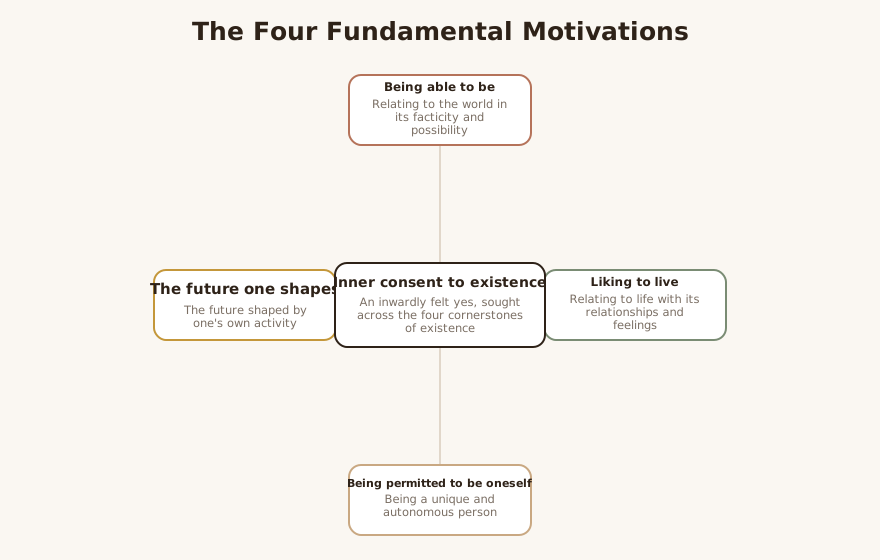
The framework’s organizing claim is that a fulfilled existence depends on the person being able to give an inner “yes” — an inner consent — to what they live and what they do, and that this consent is structured at four levels 2. These four “fundamental existential motivations” double as a clinical map: in Längle’s account they form a matrix of psychopathological disorders and provide a practical background for clinical interventions, which is what makes the model immediately useful for case conceptualization rather than only for philosophical reflection 2.
Creators & Lineage
The founder of Existential Analysis (and of logotherapy) is Viktor Frankl, the Viennese neurologist and medical doctor born on March 26, 1905, who established the psychotherapeutic school known as Logotherapy and Existential Analysis and who became internationally recognized for the technique of paradoxical intention 3. Frankl’s central conviction was anthropological and attitudinal: that life questions us, every day and every hour, and that the essential of our life depends on the answers we give to the demands of each situation 2. In Frankl’s own conception, logotherapy and existential analysis are two faces of one school — logotherapy the meaning-centered method of help, existential analysis the underlying anthropological theory of the person 4.
The figure responsible for the four-fundamental-motivations model is Alfried Längle, M.D., Ph.D., born in 1951 in Austria, who studied both medicine and psychology and works in private practice in Vienna as a psychotherapist 3. Längle had a close collaboration with Viktor Frankl from 1983 to 1991, and since 1983 he has been the founder and president of the International Society for Logotherapy and Existential Analysis (the Gesellschaft für Logotherapie und Existenzanalyse, GLE) in Vienna, as well as the founder of the state-approved training school of Existential-Analytical Psychotherapy 3. Längle and the Vienna society substantially expanded the method, developing Personal Existential Analysis and, over roughly two decades of phenomenological clinical work, articulating the four fundamental motivations as the structure model for modern Existential-Analytical Psychotherapy 12. It is worth noting for honest lineage that Frankl eventually distanced himself, theoretically and personally, from the GLE, so the modern model is best understood as Längle’s development out of Frankl rather than as Frankl’s own system 3.
Today logotherapy is described as a special segment of Existential Analysis — the meaning-centered portion — while Längle’s broader framework situates meaning as the fourth of four motivations rather than as the single key to existence 14. The intellectual roots run explicitly through phenomenology, especially Heidegger and Merleau-Ponty, whose insistence on letting phenomena “speak themselves” Längle adopts as the method’s epistemology 2.
Core Principles
The first principle is inner consent. Seen psychologically, the key to a fulfilled existence is finding a way of living to which one can give an inwardly felt or spoken “yes” — not only to what one does but to what one lives 2. This consent emerges from a double dialogue: an outer dialogue asking what appeals to me, challenges me, or is needed in this situation, and an inner dialogue contacting the deepest and freest feelings that arise, so that intention and felt response correspond 2. The therapeutic project, reduced to its shortest description, is to help a person find a way of living where they can give inner consent to their own actions 2.
The second principle is that existence rests on four fundamental realities, the four “cornerstones” of existence: the world in its facticity and possibility, life with its relationships and feelings, being oneself as a unique and autonomous person, and the future shaped by one’s own activity 2. These are called existential precisely because they demand our own inner position toward them; they ask for a decision about how we will relate to them, and we must work on our reality until we can consent to it 2.
The third principle is the structured, hierarchical nature of the motivations: each builds on the one before, so that being able to be at all precedes liking to live, which precedes being permitted to be oneself, which precedes finding meaning 24. A person must first secure a place in the world before they can fill it with life, find themselves within it, and then transcend themselves toward what their life is for 2.
The fourth principle is the phenomenological attitude as the method’s engine. Following Husserl’s idea of epoché, the therapist sets aside judgments, theories, and prior knowledge to view the facts as they show themselves, verifying findings not by measurement but by the dialogical proof of having understood well 2. Because the essence of the person is free will, the work is centrally about mobilizing the person’s decisiveness and preparing the prerequisites that make a free “yes” possible 2.
Interventions & Techniques
The core method is phenomenological dialogue: the therapist follows what the client is saying without interpreting it, working to understand the subjective and unique meaning of a situation, a sentence, or a gesture rather than fitting it to theory 12. Treatment proceeds via phenomenological analysis of the emotions as the center of experience, combined with biographical work and empathic listening, on the premise that the deepest emotions arising in a situation carry information the person must take seriously 24.
The structured elaboration of this work is Personal Existential Analysis (PEA), the existential and phenomenological method that Längle and the GLE developed for processing emotionally charged experience and neurotic difficulty toward renewed inner consent 14. At the level the sources establish, PEA is a phenomenological way of working through what a person feels in a situation so that a free, authentic response can emerge; clinicians trained in the method learn a more articulated procedure, but the published description here keeps it at the level of processing emotion toward an inner “yes” rather than a fixed sequence of named phases 1LLM.
Across the four motivations, the clinician’s task is diagnostic in the descriptive sense and then reparative: locating which existential condition is unmet, and helping the client either secure the missing precondition or take up the corresponding active “yes” 2. For the first motivation the active part is to accept what is given and endure what cannot be changed; for the second, to turn toward life and, where there is loss, to grieve; for the third, to encounter others while delimiting and standing by oneself; for the fourth, to bring oneself into correspondence with the situation and dedicate oneself to a value 2.
LLM-generated illustrative example (not a guideline): A client says he feels “fine on paper” but flat and unmoved by everything. Rather than challenging this cognitively, the clinician slows down and asks what he still lets himself be touched by, and what he takes time for. As they dwell phenomenologically on a memory of his daughter laughing, the client’s eyes fill — a felt “yes” to life surfacing where the second motivation had gone quiet LLM.
Evidence Base
Honesty requires distinguishing two senses of “established.” As an institutionally and theoretically mature approach, Existential Analysis is firmly established: it descends from a major psychotherapeutic school, is organized through an international society founded in 1983 with a state-approved training school, and rests on a substantial primary literature including Längle’s own systematic articulation of the model from two decades of phenomenological clinical work 123. In this sense it is a recognized, taught modality with a defined method 1.
What the provided sources do not contain is randomized controlled outcome data or reported effect sizes; the literature documents the model, its anthropology, and its phenomenological method rather than controlled trials 12. Längle is himself candid that the existential-phenomenological paradigm is unusual for those accustomed to manuals, questionnaires, and empirically proven techniques, and that it verifies findings through subjective, dialogical understanding rather than objective measurement 2. The defensible clinical position, therefore, mirrors that of other established-but-not-RCT-validated existential approaches: present it as a coherent, widely taught, theoretically rich framework with a real method, while being explicit that disorder-specific efficacy has not been demonstrated here and, where stronger empirical support is needed, integrating it alongside an evidence-based modality LLM.
Populations & Indications
The approach is oriented to adults across the full range of psychotherapy and counseling presentations, because its four motivations are framed as universal conditions of any human existence rather than as features of a narrow diagnostic group 12. Längle presents the four motivations as the framework within which all kinds of psychic problems can be situated and treated, which makes the model broadly applicable as a structuring lens 4.
It is particularly apt for clients whose difficulty is bound up with the existential conditions themselves: people facing life transitions and disrupted security (the first motivation), those who have lost the capacity to be touched by or value their lives (the second), people struggling with identity, authenticity, and self-worth (the third), and those confronting emptiness or a loss of meaning (the fourth) 25. Because the method foregrounds emotional honesty and the person’s own free decision, it fits clients who are psychologically curious, verbally reflective, and able to tolerate open inquiry into their relationship to existence 12.
Problems-for-Work
The model maps presenting problems directly onto unmet motivations, which is its most practical clinical contribution 2. When the first motivation is unmet — protection, space, and support are lacking — the result is restlessness, insecurity, and fear, so the framework speaks to anxiety disorders and the anxious, can-I-be? quality of insecurity 12.
LLM-generated illustrative example (not a guideline): A client who relocated for work describes chronic, diffuse dread and the sense that “the floor could give way.” The clinician works the first motivation, helping the client name where she has protection, space, and support, and where she might let herself trust and accept the new ground under her LLM.
When the second motivation is unmet — relationship, time, and closeness are missing — longing gives way to coldness and finally to depression, and the indicated work is to help the client turn toward life and grieve what has been lost 12. When the third motivation is unmet — attention, justice, and appreciation are absent — the results are solitude, shame, hysterical/histrionic presentations, and personality disorders, and the work centers on encounter, self-delimitation, and recovering self-worth 12.
LLM-generated illustrative example (not a guideline): A client oscillates between dramatic bids for attention and collapse into shame about “being too much.” The clinician works the third motivation: where has she been truly seen and treated justly, and where can she stand by what is genuinely hers and refuse what is not LLM.
When the fourth motivation is unmet — there is no field of activity, no larger context, no value to realize — the result is emptiness, frustration, despair, and frequently addiction and dependency, and the work is to recover a place where the person feels needed and a value worth dedicating themselves to 12. The model thus also engages grief, identity crisis, low self-worth, and loss of meaning as expressions of unmet conditions rather than as freestanding symptoms 2.
Contraindications, Cautions & Cultural Humility
The most important caution is that this is an open-ended, insight-oriented, emotionally demanding approach, so it is a poor primary fit during acute crisis, active psychosis, acute suicidality, or significant instability, where safety, containment, and stabilization take priority over phenomenological exploration of existence LLM. The framework’s reframing of distress as an unmet existential condition should never be used to defer standard risk assessment or evidence-based and pharmacological care when those are indicated LLM.
Längle’s own model notes that when a fundamental condition is unmet, “coping reactions” — avoidance, overactivity, aggression, and a freezing or death-imitating paralysis — take over to secure life, which is a useful reminder that defensive behavior is protective in origin and should be met with understanding rather than confrontation 2. Because the work depends on the client’s free decision and felt “yes,” pressing for consent the person does not feel would contradict the method itself 2LLM.
On cultural humility, the four motivations are presented as universal, but what counts as adequate protection, valued relationship, justified self-worth, or a meaningful larger context is culturally and relationally shaped, so the clinician should hold the model as a map and let the client define the terrain 2LLM. In collectivist and relational value systems, for instance, the third motivation’s “being permitted to be oneself” is lived within obligations to family and community rather than as individual self-assertion, and the clinician should not mistake culturally endorsed belonging for an unmet need for autonomy 5LLM.
Treatment-Plan Suggestions & SMART Objectives
| Goal | SMART objective (example) | Mechanism |
|---|---|---|
| Restore basic security (1st motivation) | Within 8 sessions, client will identify 3 concrete sources of protection, space, and support and report one daily practice of “letting the ground hold” | Securing the preconditions of “can I be?”; acceptance and endurance 2 |
| Rebuild capacity to value life (2nd motivation) | Over 10 weeks, client will spend deliberate time on 2 valued relationships or activities weekly and note what touches them | Turning toward life; relationship, time, and closeness 2 |
| Process loss through grief (2nd motivation) | Within 6 sessions, client will describe a significant loss in session on 3 occasions without self-correction | Grieving as the active “yes” where there is loss 2 |
| Strengthen self-worth and authenticity (3rd motivation) | Over 8 weeks, client will name 2 situations of being seen/treated justly and practice one act of self-delimitation weekly | Encounter and self-delimitation building one’s own worth 2 |
| Reduce shame-driven self-concealment (3rd motivation) | Within 10 sessions, client will disclose one previously hidden aspect of self and describe the response | Recovering the right to “may I be like this?” 12 |
| Recover meaning and direction (4th motivation) | Within 12 sessions, client will identify one field of activity where they feel needed and one value to realize, and take a weekly action toward it | Self-transcendence; dedication to a future value 2 |
| Increase living with inner consent (cross-cutting) | Over 8 weeks, client will identify 2 decisions made without an inner “yes” and renegotiate one toward felt agreement | Aligning intention with the deepest felt response 2 |
Common Misconceptions
A first misconception is that Existential Analysis is the same thing as logotherapy; in the modern framework logotherapy is a special, meaning-centered segment of Existential Analysis, and meaning is only the fourth of four motivations rather than the single key to existence 14. A second is that the approach is purely abstract or philosophical; in fact its method is concrete and emotion-centered, working phenomenologically with the deepest feelings that arise in a situation 2. A third is that “inner consent” means doing whatever feels good; it means a felt correspondence between one’s intentions and one’s freest, deepest emotions, which can include consenting to endure what is difficult or unalterable 2.
A fourth misconception is that the four motivations are independent options; they are hierarchical and cumulative, so a person cannot stably “find meaning” while the security, vitality, or self-worth beneath it is missing 24. A fifth is that the model is only a theory of pathology; it is first a structure of healthy existence, and its diagnostic matrix is derived from what happens when each existential condition goes unmet 2. Finally, clinicians sometimes assume the phenomenological stance means having no structure; the four motivations supply a clear structure for inquiry even as the therapist brackets theory in the moment-to-moment encounter 2LLM.
Training & Certification
Existential Analysis is trained and credentialed through the international society Längle founded and the state-approved training school of Existential-Analytical Psychotherapy he established, with the GLE coordinating training and practice internationally 13. Längle has been the society’s founder and president since 1983, and the GLE’s network is the recognized route to formal training in the method 13.
For clinicians outside that network, the model is most often encountered as a conceptual framework that can inform case formulation within one’s existing license and scope, with the primary literature — especially Längle’s articulation of the fundamental motivations — as foundational reading 2LLM. As with any borrowed framework, the ethical requirement is competence and honest scope: it should inform formulation within one’s licensed practice, and should not be represented as a standalone empirically validated treatment unless one has trained in the method through its recognized routes 2LLM.
Key Terms
Existential Analysis — a phenomenological, person-oriented psychotherapy aiming to enable free experience, authentic decision, and responsible dealing with self and world 12. Inner consent (Zustimmung) — the inwardly felt or spoken “yes” to what one does and lives, the psychological key to a fulfilled existence 2. Four fundamental motivations — the four cornerstones of existence (world, life, being oneself, future) toward which a person is continually motivated 2. First motivation (“can I be?”) — the condition of being able to exist, requiring protection, space, and support; its failure produces fear and anxiety 12. Second motivation (“do I like to live?”) — the condition of valuing life, requiring relationship, time, and closeness; its failure produces depression 12. Third motivation (“may I be myself?”) — the condition of authentic identity, requiring attention, justice, and appreciation; its failure produces solitude, shame, hysteria, and personality disorders 12. Fourth motivation (“what is it for?”) — the condition of meaning, requiring a field of activity, a larger context, and a value to realize; its failure produces emptiness and addiction 12. Personal Existential Analysis (PEA) — the phenomenological method for processing emotional experience toward renewed inner consent 14. Phenomenological attitude (epoché) — setting aside judgment and theory to let phenomena show themselves 2. Coping reactions — the protective patterns (avoidance, overactivity, aggression, freezing) that arise when a fundamental condition is unmet 2.
Resources & Further Reading
▶ Watch — a video introduction to this concept:
- Existential Analysis — GLE-International (introduction)
- Existential Fundamental Motivation (A. Längle, Trondheim 2002)
- Viktor Frankl — Advocate for Humanity (Längle & Sykes, JHP 2006)
- What is Existential Analysis — Existential Analysis Society of Canada
- Four Pillars of a Fulfilled Existence — Existential Embodied Psychology
Reflective / Supervision Questions
- For this client, which of the four motivations is most unmet right now, and am I working at that level or skipping ahead to meaning before security or vitality is in place 2?
- When I hear distress, am I asking which existential condition (protection, relationship, appreciation, value) is missing, rather than only naming a symptom 2?
- Am I genuinely bracketing my theory to let this client’s experience show itself, or am I quietly interpreting them into a familiar framework 2?
- Where am I pressing for a decision or a “yes” the client does not yet feel, and how do I tell consent from compliance 2?
- With a client from a collectivist or relational culture, am I mistaking culturally endorsed belonging or obligation for an unmet need for autonomy 5?
- Is this open-ended existential work appropriate for this client’s current risk and stability, or is containment and evidence-based care the priority right now LLM?
- When a client’s coping reaction reads to me as resistance, can I see the protective intention behind it and meet it with understanding 2?