
Type & Discipline
Brief Strategic Family Therapy (BSFT) is a manualized, time-limited family therapy model situated within the discipline of family/systemic therapy 2. It belongs to the structural-strategic tradition, integrating the structural family therapy emphasis on family organization, hierarchy, boundaries, and alliances with the strategic emphasis on problem-focused, practical, present-oriented interventions 2. The defining unit of treatment is the family as an interdependent system rather than the symptomatic adolescent in isolation 2. BSFT is typically delivered across roughly 12 to 16 sessions, though real-world implementation runs longer, and it is designed to be brief, directive, and behaviorally focused 21.
It is most often used as an adolescent-focused intervention: the identified patient is usually a teenager presenting with externalizing behavior, drug use, or delinquency, but the locus of intervention is the repetitive interactional pattern surrounding that behavior 2. BSFT has been designated a model program and listed on the U.S. federal National Registry of Evidence-Based Programs and Practices, marking it as an established, recognized intervention rather than an emerging one 2.
Creators & Lineage
BSFT was developed by José Szapocznik and colleagues at the University of Miami’s Center for Family Studies, beginning in 1978 2. Szapocznik, now chair emeritus and professor of public health sciences at the Miller School of Medicine, has remained the central figure in the model’s development, research, and dissemination 4. The model grew directly out of clinical work with Cuban and other Hispanic immigrant families in Miami who were experiencing acculturation-driven conflict between more rapidly acculturating adolescents and their parents 2. This origin is not incidental: cultural context and the immigrant family experience are woven into the model’s assumptions about hierarchy, loyalty, and generational tension 2.
The lineage is explicitly hybrid. BSFT draws its theory of family structure—subsystems, boundaries, alliances, and hierarchy—from structural family therapy, and its directive, pattern-targeting technique from strategic family therapy 2. Over roughly twenty-five years, the model evolved through a sustained interplay among theory, research, and clinical practice, refining both its conceptual base and its intervention protocols 6. The work has been supported over decades by the National Institute on Drug Abuse, the National Institute of Mental Health, and SAMHSA’s substance-abuse treatment and prevention centers 4. BSFT sits alongside related family-based models for youth problem behavior, including multisystemic therapy and functional family therapy, sharing with them a systemic frame and an emphasis on engaging the whole family 2.
Core Principles
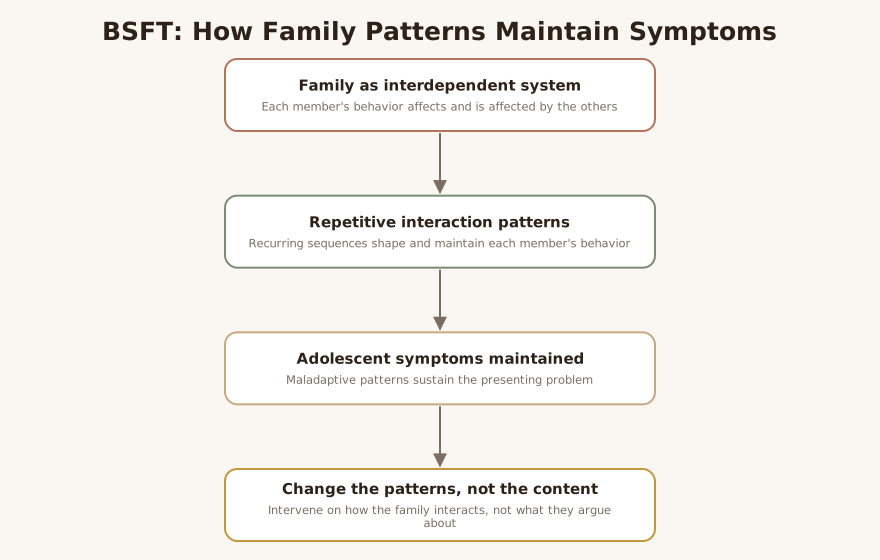
BSFT rests on three foundational systemic principles. First, the family functions as an interdependent system in which each member’s behavior affects and is affected by the others 2. Second, repetitive patterns of interaction among family members shape and maintain each member’s behavior, including the adolescent’s symptoms 2. Third, interventions should target and change the maladaptive interaction patterns while strengthening the adaptive ones, rather than focusing on the content of any single argument 2.
This last principle is the model’s clinical signature. As Szapocznik puts it, “We are not concerned with what families argue about. Instead, we focus on how they interact” 4. The therapist attends to process over content—who speaks to whom, who is allied with whom, how conflict escalates or is detoured—and intervenes at the level of these recurring sequences 42. The model assumes that the same interactional problems that maintain an adolescent’s symptoms also operate to keep families out of treatment, which leads to BSFT’s distinctive, structured approach to engagement 2.
Interventions & Techniques
BSFT organizes its technique around a small set of core therapeutic operations 2. Joining is the establishment of a therapeutic alliance with each individual member and with the family as a unit, conveyed through acceptance and respect; the therapist enters the family system without prematurely siding with any member 24. Diagnostic enactment (tracking and diagnosis) involves encouraging family members to interact naturally in session so the therapist can directly observe—rather than only hear reported—the maladaptive and adaptive patterns; enactments are emphasized early but used throughout treatment 2. Reframing transforms negative affect into something workable, for example reinterpreting a parent’s anger as an expression of caring concern, which builds motivation for change 2. Restructuring is the active change of maladaptive interactions through redirecting communication, shifting alliances and boundaries, building conflict-resolution skills, and strengthening parenting 2.
A signature contribution of BSFT is its specialized engagement technique 2. Recognizing that the family interactional problems blocking treatment entry mirror those maintaining the adolescent’s symptoms, BSFT therapists work the system to get reluctant members in the door 2. In controlled work, 93% of families in the BSFT engagement condition were successfully engaged in treatment, compared with 42% under standard engagement approaches 2. The model also has historical roots in “one-person family therapy,” in which the therapist works systemically even when only one family member initially attends, though restructuring the whole family remains the goal 2.
LLM-generated illustrative example (not a guideline): In an enactment, a clinician asks a mother and her 15-year-old son to “talk together right now about last weekend’s curfew.” The therapist watches the father interrupt repeatedly while the mother withdraws and the son escalates. Rather than litigating the curfew, the therapist later reframes the father’s interruptions as “wanting so badly to protect his son that he jumps in,” then restructures by coaching the parents to present a single, joined message—shifting a cross-generational alliance back toward an executive parental subsystem LLM.
Evidence Base
BSFT’s evidence maturity is best described as established: multiple randomized trials, federal model-program designation, and decades of programmatic research support it, while the size and consistency of its symptom-level effects remain debated 216. The strongest and most consistent findings concern engagement and retention—getting and keeping difficult-to-reach families in treatment 12.
The largest test is a multisite randomized trial within NIDA’s Clinical Trials Network comparing BSFT to treatment as usual (TAU) in 480 adolescents aged 13 to 17 across eight community sites; the sample was ethnically diverse (213 Hispanic, 148 White, 110 Black), 79% male, and most (72%) were referred from juvenile justice 13. Both therapists and families were randomized, and drug use was tracked monthly for twelve months 1. BSFT significantly outperformed TAU on engagement and retention: adolescents in TAU were about 2.5 times more likely to fail to engage and 1.41 times more likely to fail to be retained, with failure-to-engage rates of 11.4% (BSFT) versus 26.8% (TAU) and failure-to-retain rates of 40.0% versus 56.6% 1.
The substance-use findings are more modest and should be reported honestly. There were no significant differences in drug-use trajectories between conditions; at twelve months the median self-reported days of drug use was significantly higher in TAU (3.5) than BSFT (2), a difference whose clinical significance is genuinely questionable 1. BSFT showed superior parent-reported improvements in family functioning over time, but adolescents in both conditions reported significant improvement with no between-group difference 1. The authors note important limitations: low baseline drug-use rates created floor effects, and treatment lasted far longer than the intended approximately four months (median about eight months), potentially confounding interpretation 1. The fair summary is that BSFT’s standout, replicated strength is engagement and retention, with smaller, less certain effects on substance use itself 12.
Populations & Indications
BSFT was designed for adolescents (roughly ages 12 to 17) presenting with externalizing problems and their families 21. Its primary indications are adolescent drug use, conduct and behavior problems, delinquency, and sexual risk behavior, together with the family dysfunction that surrounds these 2. It was developed with and for Hispanic and Latino immigrant families and is explicitly culturally informed, but trials report effectiveness across ethnic and cultural groups and across diverse family structures, including single-parent, multigenerational, and stepfamilies 21.
The model is indicated when family interactional patterns appear to maintain the adolescent’s symptoms and when engaging or retaining the family in care is itself a barrier 2. Parents and caregivers are core participants, not adjuncts; restructuring the parental/executive subsystem is often the engine of change 2. Because much of the evidence base draws on juvenile-justice-referred youth, BSFT is also a reasonable fit for adolescents entering treatment through court or school mandates 1.
Problems-for-Work
BSFT is most directly applicable to the following clinical problems, each approached as a function of family interaction rather than an isolated individual deficit 2.
- Adolescent substance use disorder. The therapist targets the family patterns (e.g., disengaged monitoring, parental conflict that detours through the teen) that maintain use, while engaging reluctant members 21.
- Conduct disorder, oppositional defiant disorder, and disruptive behavior disorders. Work focuses on restoring an effective parental hierarchy and reducing coercive escalation cycles 2.
- Delinquency and at-risk behavior. Especially relevant for justice-referred youth, where retention is fragile and family engagement is decisive 1.
- Family conflict and parent-child relational problems. The model addresses process—alliances, boundaries, and conflict sequences—rather than the content of disputes 42.
- Communication problems and school refusal. Enactment and restructuring redirect communication and rebuild parental authority around school attendance 2.
LLM-generated illustrative example (not a guideline): A 14-year-old with escalating school refusal and cannabis use lives with a mother and grandmother who disagree about discipline. BSFT framing would treat the cross-generational split (grandmother undermining the mother’s limits) as the maintaining pattern, use enactment to make the split visible, and restructure toward a unified caregiver stance before addressing the school plan LLM.
Contraindications, Cautions & Cultural Humility
BSFT is a family-systems intervention and presumes that bringing family members together is safe and clinically appropriate; where there is active intimate-partner violence, child abuse, or acute safety risk, conjoint family sessions may be contraindicated or require safety planning and modification before family interactional work proceeds LLM. The model’s directive restructuring of hierarchy and alliances should not override mandated-reporting obligations or safety assessment LLM. As with any family model, severe untreated parental psychopathology or substance use may need to be stabilized for the family to participate meaningfully LLM.
Cultural humility is central rather than optional here. BSFT was built from work with Hispanic immigrant families and treats acculturation-related generational conflict as a legitimate clinical focus, so clinicians should attend to the family’s own cultural definitions of hierarchy, respect, and loyalty rather than imposing a generic template 2. The evidence for effectiveness across ethnic groups is encouraging, but it does not relieve the clinician of the work of understanding each family’s specific cultural and migration context 21. Reframing and restructuring should be done collaboratively and respectfully, in line with the model’s emphasis on joining through acceptance and respect 2.
Treatment-Plan Suggestions & SMART Objectives
| Goal | SMART objective (example) | Mechanism |
|---|---|---|
| Engage the full family in treatment | Within 2 weeks, at least two key family members attend a joint session, documented by attendance | BSFT engagement technique addressing patterns that block entry 2 |
| Strengthen the parental/executive subsystem | Within 4 sessions, parents jointly set and state one consistent house rule in session without the adolescent mediating | Restructuring alliances and hierarchy 2 |
| Reduce coercive conflict escalation | Within 6 sessions, family completes one in-session conflict discussion to resolution without escalation, per therapist rating | Enactment plus conflict-resolution skill building 2 |
| Shift the meaning of negative affect | By session 3, parent reframes one recurring complaint as a concern statement during an enactment | Reframing negative affect into constructive interaction 2 |
| Reduce adolescent substance-use days | Over 12 weeks, self-reported days of use decrease relative to baseline, tracked monthly | Family restructuring of patterns maintaining use 12 |
| Improve family functioning | By discharge, caregiver-reported family-functioning measure improves from baseline | Cumulative restructuring of interaction patterns 1 |
| Retain family through course of care | Family completes at least the planned course of sessions without premature dropout | Ongoing joining and retention focus 1 |
| Restore school engagement | Within 4 weeks, parents implement a joined attendance plan and attendance increases | Restructuring parental authority around school 2 |
Common Misconceptions
A frequent misconception is that BSFT primarily works to resolve the specific issues families argue about; in fact the model deliberately targets how members interact rather than the content of disputes 4. Another is that BSFT is exclusively for Hispanic families because of its origins; while it was developed with Hispanic immigrant families and is culturally informed, trials support its use across ethnic groups and family structures 21. A third misconception is that BSFT reliably produces large reductions in adolescent drug use; the replicated strength is engagement and retention, while substance-use effects in the major trial were modest and complicated by floor effects 1. Finally, some assume the whole family must always be present from the start; BSFT’s engagement work and its one-person-family-therapy heritage allow the therapist to begin systemically even when initial attendance is incomplete, while still aiming to involve the family 2.
Training & Certification
BSFT is a manualized model with a published practitioner text co-authored by Szapocznik and Hervis through the American Psychological Association, which clinicians use to learn its structure and operations 5. Its development and dissemination have been anchored at the University of Miami’s family-studies group and supported by federal agencies including NIDA, NIMH, and SAMHSA 42. The provided sources document the model’s manualized nature and its federal model-program designation but do not specify the details of a formal certification pathway or credentialing body 25. Clinicians seeking to deliver BSFT with fidelity should pursue training and supervision consistent with the published manual and established training resources, and verify current certification requirements directly with the model’s developers 52.
Key Terms
- Joining — establishing alliance with each member and the family as a whole through acceptance and respect 2.
- Diagnostic enactment — having the family interact in session so maladaptive and adaptive patterns can be directly observed and diagnosed 2.
- Reframing — shifting the meaning of negative affect (e.g., anger as caring concern) to build motivation for change 2.
- Restructuring — actively changing maladaptive interactions by redirecting communication and modifying alliances, boundaries, and parenting 2.
- Engagement technique — structured BSFT methods to bring resistant family members into treatment, addressing the same patterns that maintain symptoms 2.
- Maladaptive interaction pattern — repetitive sequences among members that maintain the adolescent’s symptoms; the primary target of intervention 2.
Resources & Further Reading
▶ Watch — a video introduction to this concept:
- Brief Strategic Family Therapy: An Intervention to Reduce Adolescent Risk Behavior (PMC) 2
- BSFT Versus Treatment as Usual: Results of a Multisite Randomized Trial (PMC) 1
- Brief strategic family therapy for adolescent drug abusers: a multi-site effectiveness study (PubMed) 3
- Twenty-Five Years of Interplay Among Theory, Research and Practice (Clinical Child and Family Psychology Review) 6
- Empowering Families Through Brief Strategic Family Therapy (University of Miami) 4
- Brief Strategic Family Therapy, Szapocznik & Hervis (APA Books) 5
Reflective / Supervision Questions
- When I formulate this family, am I tracking the content of their conflicts or the recurring process of how they interact, as BSFT requires? 4
- Which family member am I implicitly allied with, and is my joining genuinely balanced across the system? 2
- If a key family member is not attending, what interactional pattern is keeping them out, and how can I work that pattern to engage them rather than treating absence as resistance? 2
- Given that BSFT’s evidence is strongest for engagement and retention and more modest for substance-use reduction, are my treatment goals and outcome measures calibrated honestly to what the model reliably delivers? 1
- How am I attending to this family’s specific cultural, generational, and migration context rather than applying a generic structural template? 2
- Before convening conjoint sessions, have I screened for safety concerns that would contraindicate or require modifying family interactional work? LLM