
Type & Discipline
Biblical (nouthetic) counseling is a movement within evangelical pastoral counseling, not a secular psychotherapy, and it belongs to the broader family of Christian counseling movements.1 Its defining commitment is the sufficiency of Scripture for soul care: the conviction that the Bible alone should form the basis of counseling and that the appropriate counselor is the pastor or trained church member rather than the mental-health professional.1 The word “nouthetic” derives from the Greek nouthesia (admonition, instruction, confrontation), and the movement took its founding text’s title from Romans 15:14, where believers are described as “competent to counsel one another.”1 For a secular clinician, the single most important framing is this: nouthetic counseling is not a modality you will deliver; it is a worldview and a prior treatment experience that some of your clients will carry into your office, and understanding it is a matter of cultural competence rather than technique acquisition.LLM
It is worth stating at the outset what nouthetic counseling explicitly opposes, because that opposition is its identity. Adams’s program rests on a sharp antithesis between Christian and secular thought, treating the major secular psychological systems as standing in opposition to Scripture rather than as resources to be integrated.1 This places the movement at one pole of a long-running debate inside Christianity over whether and how the church may “learn from psychology.”3 A therapist who does not grasp this antithesis may misread an evangelical client’s wariness of therapy as mere resistance, when it may instead reflect a coherent, taught conviction.LLM
Creators & Lineage
The movement’s founder is Jay Edward Adams (1929–2020), an American Reformed minister with degrees in classics, theology, and a Ph.D. in speech, who converted to Christianity as a teenager and went on to author over 100 books.2 In 1968 Adams co-founded the Christian Counseling and Educational Foundation (CCEF) in suburban Philadelphia, which functioned as “a kind of laboratory for his studies,” and in 1970 he published Competent to Counsel, the book that launched the modern biblical counseling movement.1 Competent to Counsel sold roughly 400,000 copies and has been widely translated; one Reformed reviewer compares its disruptive role to Martin Luther’s “ninety-five theses” for reforming the practice of soul care.4
Two intellectual influences are repeatedly named. From the theologian Cornelius Van Til, Adams drew presuppositional apologetics — the epistemological stance that Christian and non-Christian thought begin from incompatible first principles — which underwrites his rejection of secular psychology’s authority.34 From the psychologist O. Hobart Mowrer, whom Adams encountered in 1965, he absorbed a critique of the medical model of mental illness and a focus on personal responsibility; the encounter reinforced rather than created his rejection of psychological models.2 Adams argued that the three primary secular systems — those of Freud, Rogers, and Watson/Skinner — stood in opposition to Scripture.1
The movement did not stop with Adams. A widely used shorthand distinguishes “Biblical Counseling 1.0” (Adams) from “Biblical Counseling 2.0,” associated with David Powlison and Ed Welch at CCEF, who refined the model.3 The second generation kept the sufficiency-of-Scripture commitment but addressed the standard criticisms of Adams’s approach: an over-reliance on Van Tillian presuppositionalism that negated God’s “common grace” in secular psychology; a reductionism that over-focused on sin and behavior change while neglecting internal dynamics; and a thin account of external influences such as family and “unbidden suffering.”3 Powlison’s The Biblical Counseling Movement: History and Context (2010) is the standard internal history.3 Heath Lambert’s The Biblical Counseling Movement after Adams (2011) offered a “mild critique” to which Adams reportedly responded acerbically, being “resistant to the idea that his basic approach can be improved upon biblically.”3 Lambert later led the certifying body, the National Association of Nouthetic Counselors (NANC), which renamed itself the Association of Certified Biblical Counselors (ACBC) — a name change that itself signals the field’s broadening from “nouthetic” toward “biblical” counseling.5
Core Principles
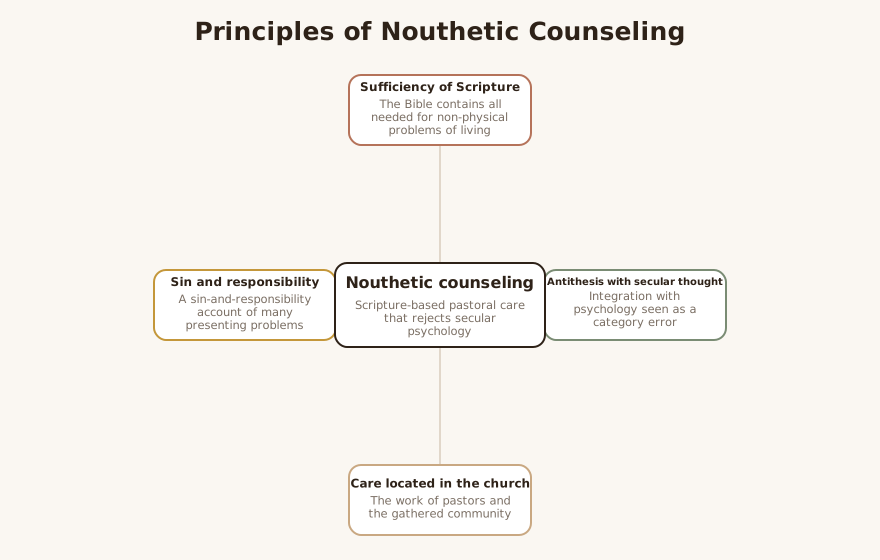
The load-bearing principle is the sufficiency of Scripture: the Bible is held to contain everything necessary for understanding and changing the non-physical problems of living, so that secular psychology is not merely supplementary but, in its theories of persons and change, a rival to be rejected.13 A second principle is the antithesis between Christian and secular thought, inherited from Van Til, which frames integration with psychology as a category error rather than a prudent borrowing.34
A third principle is the locus of care in the church. Counseling is properly the work of pastors and the gathered community, not of a separate professional guild; Adams objected that psychology had “intruded into the sphere of the pastor and the church.”4 Adams welcomed genuinely medical intervention for organic illness but denied that psychologists should “attempt to change persons” or “change values and beliefs” without biblical warrant — a distinction between the body (medicine’s domain) and the soul (the church’s domain) that runs throughout the model.4
A fourth principle, especially in the first generation, is a sin-and-responsibility account of many presenting problems. Where a secular clinician sees a disorder, first-generation nouthetic counseling was inclined to see patterns of behavior to be confronted and changed through repentance and obedience — which is why critics charged it with treating clinical depression “as sin,” sometimes making things worse.3 The second generation softened this by attending to the “dynamics of the heart,” motivation, and suffering, but the underlying moral-spiritual frame remained.3
Interventions & Techniques
Nouthetic technique flows from its name: nouthetic confrontation means direct, verbal, Scripture-based admonition aimed at producing change, in contrast to nondirective or insight-oriented secular methods.1 The counselor identifies sinful or unbiblical patterns, instructs from Scripture, and calls the counselee to repentance and concrete obedience, often with structured “homework” between sessions — a behavioral, change-oriented emphasis that critics have called reductionistic when it crowds out attention to internal dynamics and suffering.3 Because the source material on this movement is historical and theological rather than clinical-manualized, secular readers should treat any description of “technique” as a characterization of a pastoral practice tradition rather than a standardized protocol.3LLM
For the secular therapist, the practically relevant skill is not performing these techniques but recognizing their fingerprints in a client’s history. A client who reports being told their depression was a sin to repent of, who was given Bible-passage homework, or who was counseled by a pastor rather than referred out, has likely encountered some form of this tradition.4LLM
LLM-generated illustrative example (not a guideline): A new client says, “My pastor counseled me for two years. He said my anxiety was a failure to trust God, and gave me verses to memorize. It didn’t work and I felt like a worse Christian.” A culturally competent clinician does not dismiss the pastor or the faith; the clinician validates the client’s sincere effort, gently separates moral failure from a treatable condition, and explores how the client’s faith might now become a resource rather than a verdict. LLM
Evidence Base
Honesty requires a clear statement: the maturity label “established” describes nouthetic/biblical counseling as an established movement — a half-century-old, widely disseminated, organizationally institutionalized tradition within evangelicalism — and not as an evidence-based treatment in the clinical-trials sense.14 The provided sources are historical, theological, and organizational; none reports controlled outcome data, effect sizes, or randomized comparisons against active treatments.12345 To my knowledge there is no meaningful base of controlled efficacy research for nouthetic counseling, and a secular clinician should not represent it to clients as empirically validated psychotherapy.LLM
What is well documented is influence and reach: Competent to Counsel sold on the order of 400,000 copies, Adams wrote over 100 books, and the movement sustains a certifying body and a journal.14 The movement’s claims to effectiveness are made on theological grounds — the sufficiency and authority of Scripture — rather than on empirical ones, which is itself a defining feature worth understanding.3 The most rigorous engagement available in these sources is internal and critical: thoughtful members of the tradition acknowledge that first-generation practice could be “reductionistic,” could treat clinical depression as sin “only [to make] things worse,” and could neglect suffering and external influences.3 That internal self-critique, rather than any external trial, is the closest thing to an evidence-quality discussion in the source base.3LLM
Populations & Indications
The “population” for this article is not who receives nouthetic counseling in a church, but which of your clients make this knowledge clinically necessary. The relevant clients are evangelical, Reformed, and conservative Protestant Christians, particularly those who have previously been counseled by a pastor or church member rather than a licensed professional.1LLM Clients raised in communities that teach the sufficiency of Scripture may arrive distrusting secular therapy on principle, having been taught that psychology is a rival to faith.13LLM
The “indication” for deploying this competence is any encounter in which a client’s faith framework and the clinical care you offer appear to be in tension: a client who frames their depression or anxiety as sin or as a failure of faith, who carries shame about needing therapy, or who is quietly testing whether you will respect their convictions.3LLM Recognizing the nouthetic background lets you locate that tension precisely and respond to it with humility rather than reflexive correction.4LLM
Problems-for-Work
The presenting problems where this knowledge becomes load-bearing cluster around the collision between a sin-and-sufficiency framework and a clinical one.3 For faith-based shame about mental illness, recognizing that a client may have been taught their symptoms are sin allows the clinician to disentangle moral failure from a treatable condition without attacking the client’s faith.3LLM For distrust of secular therapy, naming the client’s likely prior teaching — that psychology opposes Scripture — turns an invisible obstacle into something workable in the alliance.1LLM
For religious guilt and the moral framing of depression or anxiety, the clinician can hold space for the client’s spiritual world while introducing the possibility that suffering is not always sin — the very critique the movement’s own second generation raised against its founder.3LLM For mismatch between faith framework and clinical care, the work is often to help the client integrate, rather than choose between, their faith and treatment.LLM For religious or spiritual trauma, where prior confrontational counseling left a client feeling condemned or “a worse Christian,” the work centers on repair and on rebuilding a non-punitive relationship to faith.3LLM
Contraindications, Cautions & Cultural Humility
The principal caution runs in the secular clinician’s own direction. It is easy, and clinically harmful, to treat a client’s nouthetic background as ignorance to be corrected; doing so reenacts exactly the kind of unilateral, confrontational stance the client may already have found wounding.3LLM Cultural humility here means taking the client’s faith seriously as a source of meaning and strength, not merely as pathology or as an obstacle to “real” treatment.LLM
A second caution concerns honesty about evidence in both directions. The clinician should neither overstate secular psychotherapy as settled certainty nor endorse nouthetic counseling as validated; the movement’s own thoughtful members concede that treating clinical depression as sin can make things worse, and that point can be raised collaboratively rather than polemically.3LLM A third caution is to avoid forcing a choice between faith and care. Many evangelical clients can hold both, and framing therapy as anti-faith may push a client back toward the very approach that did not help them.LLM Finally, scope-of-practice humility cuts the other way too: clinicians are not pastors, and pressing theological arguments — even good ones — is outside the clinical role; the more durable move is to respect the client’s faith leaders while clearly offering what clinical care can add.4LLM
Treatment-Plan Suggestions & SMART Objectives
| Goal | SMART objective (example) | Mechanism |
|---|---|---|
| Build trust with a faith-wary client | Within 4 sessions, client identifies one way faith and therapy can coexist, stated in their own words | Validating the worldview reduces the taught antithesis between psychology and Scripture 13 |
| Disentangle symptom from sin | By session 6, client distinguishes “depression as a condition” from “depression as moral failure” in a written reflection | Reframing the sin-only account the movement’s own 2.0 generation critiqued 3 |
| Reduce faith-based shame | Over 8 weeks, client reports a measurable drop in self-rated guilt about needing help | Normalizing care and separating need-for-help from spiritual deficiency 4 |
| Repair prior counseling injury | Within 5 sessions, client articulates what felt harmful in past confrontational counseling and one thing they want different here | Processing the rupture from nouthetic confrontation 13 |
| Integrate faith as a resource | By session 10, client names two faith practices that support, rather than condemn, their recovery | Recasting faith from verdict to support 3 |
| Clarify roles of clinician and pastor | Within 3 sessions, client states what they will bring to therapy vs. to their faith community | Respecting the church locus of care while defining the clinical contribution 4 |
| Address spiritual struggle directly | Over treatment, client explores doubt or anger toward God without fearing it confirms sin | Holding suffering as legitimate, per the 2.0 critique of reductionism 3 |
Common Misconceptions
A first misconception is that nouthetic counseling is simply “Christian therapy” or “faith-integrated CBT.” It is not integrative; its founding stance is the rejection of secular psychology on the basis of an antithesis between Christian and secular thought.13 A second is that the movement is monolithic. In fact it contains a real internal development from Adams’s “1.0” to the “2.0” of Powlison and Welch, who explicitly addressed the founder’s blind spots regarding suffering, internal dynamics, and common grace.3 A third misconception, common among secular clinicians, is that a client’s nouthetic background means the client is anti-intellectual or naive; the movement is built on a coherent (if contested) theological epistemology drawn from Van Til, and the client may have thought carefully about these issues.4LLM A fourth is that “nouthetic” and “biblical counseling” are interchangeable in all contexts — “nouthetic” is the older, Adams-specific term and the narrower confrontational emphasis, while “biblical counseling” is the broader, current umbrella, as the NANC-to-ACBC renaming illustrates.53
Training & Certification
Secular mental-health clinicians neither need nor should seek certification in this movement; the relevant “training” is cultural-competence reading, not credentialing.LLM Within the movement itself, certification is offered by the Association of Certified Biblical Counselors (ACBC), formerly the National Association of Nouthetic Counselors (NANC), which Adams helped form and which Heath Lambert later led.53 The foundational training texts are Adams’s Competent to Counsel (1970) and the later corrective works of the second generation, including David Powlison’s history of the movement.43 These are theological and ministry credentials operating inside churches and seminaries, distinct from state professional licensure, and they do not confer authority to practice psychotherapy as defined by clinical licensing boards.LLM
Key Terms
Nouthetic — from Greek nouthesia (admonition, instruction, confrontation); direct, Scripture-based counseling aimed at change.1 Sufficiency of Scripture — the conviction that the Bible contains all that is needed to understand and change the non-physical problems of living, rendering secular psychology a rival rather than a resource.13 Antithesis — the Van Tillian premise that Christian and non-Christian thought proceed from incompatible first principles, used to justify rejecting secular psychology.34 Common grace — the theological idea (emphasized by critics of Adams) that God’s truth may appear even in secular work, opening a door to learning from psychology.3 Biblical Counseling 1.0 / 2.0 — shorthand for Adams’s founding model versus the refined approach of Powlison, Welch, and others.3 Presuppositionalism — Cornelius Van Til’s apologetic method underpinning the movement’s epistemology.34 ACBC (formerly NANC) — the movement’s certifying body, whose renaming tracks the shift from “nouthetic” to “biblical” counseling.5
Resources & Further Reading
▶ Watch — a video introduction to this concept:
- Dr. Jay E. Adams — Institute for Nouthetic Studies
- Jay E. Adams — Wikipedia
- Developments in Biblical Counseling (Williams, Journal of Biblical Counseling, CCEF)
- Books That Merit Re-Reading: Competent to Counsel (Reformed Faith & Practice, RTS)
- Honoring Jay Adams (1929–2020) — Association of Certified Biblical Counselors
Reflective / Supervision Questions
- When a client frames their depression or anxiety as sin or as a failure of faith, can I separate the symptom from the moral verdict without implicitly attacking the client’s beliefs? 3LLM
- Do I notice in myself an impulse to “correct” a client’s nouthetic worldview — and if so, how is that different from the confrontational stance the client may already have found harmful? 3LLM
- Am I being honest with clients about evidence — neither overselling secular psychotherapy as certainty nor implying that faith-based counseling is empirically validated? 4LLM
- How do I respect a client’s pastor and faith community while still being clear about what clinical care can offer that pastoral counseling did not? 4LLM
- For a client wounded by prior confrontational counseling, what would it look like to help them reclaim faith as a resource rather than a source of condemnation? 13LLM