
Type & Discipline
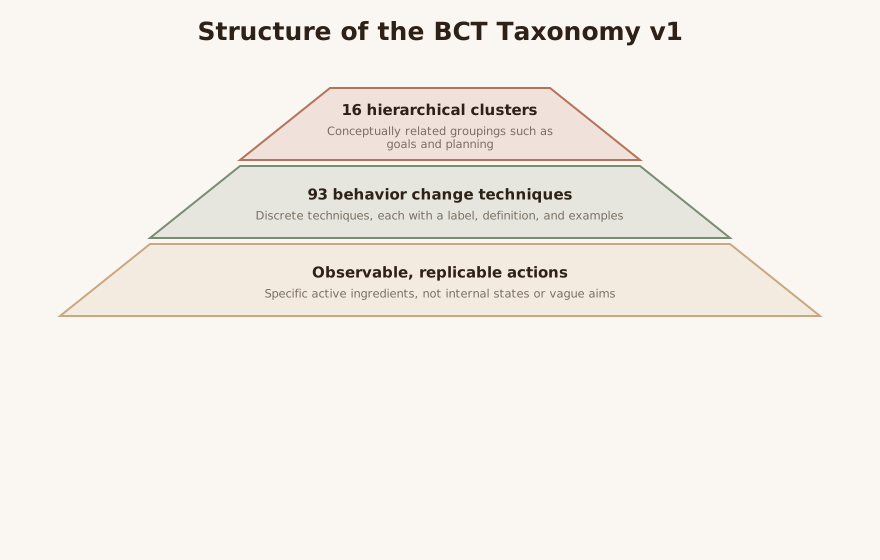
The Behaviour Change Technique Taxonomy v1 (BCTTv1) is a framework — specifically a consensus classification system — rather than a therapy modality.1 It originates in health psychology and behavioral science, where it was developed to standardize how the active components of behavior-change interventions are named, defined, and reported.1 The taxonomy catalogues 93 distinct behavior change techniques (BCTs) organized into 16 hierarchical groupings or clusters.2 A BCT is defined as the smallest active, observable, replicable component of an intervention that can, in favorable circumstances, bring about behavior change on its own.3 Importantly for clinicians, BCTTv1 is descriptive infrastructure: it tells you what an intervention contains, not which intervention to deliver or how well it works.LLM
For practicing therapists, the value is conceptual leverage. When a treatment plan says “we worked on motivation,” BCTTv1 forces precision — was that goal setting, self-monitoring, feedback on behavior, prompts, or social support? — and that precision is what makes a plan reproducible and auditable.LLM
Creators & Lineage
BCTTv1 was led by Susan Michie at University College London, with a core team including Michelle Richardson, Marie Johnston, Charles Abraham, Jill Francis, Wendy Hardeman, Martin Eccles, James Cane, and Caroline Wood.1 Development was funded by the UK Medical Research Council between roughly 2010 and 2013.3 The work responded directly to a long-standing problem in the field: behavior-change interventions were described so vaguely in trials that they could not be replicated or compared, undermining the precise reporting that reporting standards such as CONSORT call for.1
BCTTv1 sits within a broader behavior-change science lineage. It is conceptually paired with the Behaviour Change Wheel and the COM-B model (Capability, Opportunity, Motivation–Behaviour), Michie’s framework for understanding the conditions that must be in place for behavior to occur, and draws on theoretical traditions including social cognitive theory.LLM Where COM-B and the Behaviour Change Wheel help you diagnose why a behavior is or is not happening and select broad intervention functions, BCTTv1 specifies the granular techniques used to deliver those functions.LLM More recently, the taxonomy has been carried forward into ontology and computational work, including efforts to formalize behavior-change knowledge for synthesis across thousands of studies.4
Core Principles
The first principle is specificity: an intervention should be describable as a defined set of discrete techniques, each with a label, a precise definition, and examples, so that two independent observers reading the same protocol identify the same components.1 This is the difference between “provided counseling” and “set behavioral goals (1.1), arranged self-monitoring of behavior (2.3), and provided social support — practical (3.2).”LLM
The second principle is observability and replicability: a BCT must be an observable, replicable action, not an internal state or a vague aim.3 “Increase self-efficacy” is a target; “model or demonstrate the behavior” and “verbal persuasion about capability” are the BCTs that might be used to pursue it.LLM
The third principle is hierarchical organization: the 93 techniques are clustered into 16 conceptually related groupings — for example goals and planning, feedback and monitoring, social support, shaping knowledge, natural consequences, comparison of behavior, associations, repetition and substitution, and reward and threat.2 The hierarchy aids learning and retrieval without implying that techniques within a cluster are interchangeable.LLM
The fourth principle is cross-domain neutrality: the same taxonomy applies whether the target is smoking, diet, physical activity, or medication adherence, which is what makes it a shared language across health behaviors.3
Interventions & Techniques
The taxonomy itself is the menu; the “intervention” is the selection and combination of techniques. Representative, frequently used BCTs include:
- Goals and planning — goal setting (behavior), goal setting (outcome), problem solving, action planning, review of behavioral goals.2
- Feedback and monitoring — self-monitoring of behavior, self-monitoring of outcomes of behavior, feedback on behavior, feedback on outcome(s) of behavior, biofeedback.2
- Social support — social support (unspecified), social support (practical), social support (emotional).2
- Shaping knowledge — instruction on how to perform the behavior, information about antecedents.2
- Natural consequences — information about health consequences, salience of consequences.2
- Associations and habit — prompts/cues, habit formation, habit reversal.2
- Repetition and substitution — behavioral practice/rehearsal, behavior substitution, graded tasks.2
- Comparison of behavior — demonstration of the behavior, social comparison.2
In practice, you would code or design by asking: what is the target behavior, and which of these 93 techniques are present or planned?1 The official taxonomy provides the canonical labels and definitions, and a companion smartphone application and online training modules support correct application.3
LLM-generated illustrative example (not a guideline): A clinician supporting a patient with type 2 diabetes who is not checking blood glucose might assemble: action planning (“when, where, how often will you test?”), self-monitoring of behavior (a logbook), feedback on behavior (reviewing the log together), prompts/cues (pairing testing with breakfast), and social support–practical (involving a partner). Naming these BCTs explicitly makes the plan transparent and reproducible. LLM
Evidence Base
Maturity here is best described as established for its intended purpose, which is specification and reliable coding — not as evidence that any single BCT produces clinical outcomes.LLM BCTTv1 was built through an international Delphi-type consensus exercise: in the reported process, 14 experts rated the labels and definitions drawn from existing classification systems, and 18 experts performed open-sort grouping tasks based on similarity of active ingredients, yielding the consensual 93 techniques in 16 clusters.1
Reliability was tested empirically. Among the 26 most frequently occurring techniques, 23 achieved adjusted kappas of 0.60 or above when six researchers coded intervention descriptions, indicating substantial inter-rater agreement.1 Reliability testing has been a continuing focus of the program, confirming that trained coders can apply the taxonomy consistently to specify intervention content.5 The authors framed BCTTv1 as “a step change” in methods for specifying interventions while explicitly noting it remains open to refinement.1
What the evidence base does not establish is comparative efficacy of individual BCTs; the taxonomy is the tool that enables such meta-analytic and synthesis questions to be asked, including through later ontology-based syntheses.4 Clinicians should therefore treat BCTTv1 as a reliable descriptive and design framework, and look to outcome trials and meta-analyses for evidence on which combinations work for which behaviors.LLM
Populations & Indications
BCTTv1 was developed for, and is most applicable to, health behavior change across populations.1 It is widely used by health behavior intervention designers building programs for adults seeking lifestyle change, public health populations, and people with chronic illness who must sustain self-management behaviors.3 It is particularly relevant for patients with adherence challenges, where the target — taking medication, attending appointments, completing home practice — is concrete and observable.LLM It is also a standard descriptive framework in interventions for smokers and people with substance use, and for promoting physical activity and healthier diet.1
For a behavioral health clinician, the indication is less about diagnosis and more about whether the therapeutic target is a behavior that can be specified, monitored, and modified — making it a natural fit alongside cognitive-behavioral and motivational approaches.LLM
Problems-for-Work
- Medication and treatment nonadherence — specify and plan around prompts/cues, action planning, self-monitoring, and feedback rather than generic “education.”LLM
- Smoking cessation — goal setting, behavior substitution, social support, and information about health consequences are commonly coded components of effective programs.1
- Physical inactivity — graded tasks, self-monitoring of behavior, goal setting (behavior), and review of goals.2
- Unhealthy diet — self-monitoring of outcomes (e.g., weight), action planning, and restructuring the physical environment.2
- Substance use — behavior substitution, problem solving, and social support, often layered onto a recognized psychotherapy.LLM
- Poor self-management of chronic illness — instruction on how to perform the behavior plus self-monitoring and feedback loops.2
- Habit formation — habit formation, prompts/cues, and behavioral practice/rehearsal for durable routines.2
LLM-generated illustrative example (not a guideline): For a patient repeatedly missing a daily SSRI dose, a clinician could move from “discuss importance of adherence” to a specified plan: prompts/cues (phone alarm linked to an existing routine), self-monitoring (a simple adherence chart), feedback on behavior at each session, and social support–practical (a family reminder), each named as a BCT in the chart note. LLM
Contraindications, Cautions & Cultural Humility
BCTTv1 has no clinical contraindications because it is a classification framework, not a treatment administered to a patient.LLM The cautions are about misuse. First, it is descriptive, not prescriptive — the presence of a BCT label says nothing about whether the technique is appropriate, dosed correctly, or evidence-based for that person.1 Second, mechanical application risks reducing relational, trauma-informed care to a checklist of techniques, stripping out the therapeutic alliance that the taxonomy does not capture well.LLM Third, reliable coding requires training; untrained use produces inconsistent labeling and a false sense of precision.3
Cultural humility matters in selection and delivery. Techniques such as social comparison, feedback, or salience of (negative) consequences can land very differently across cultural contexts, health literacy levels, and trauma histories, and may feel shaming if applied insensitively.LLM The taxonomy was developed primarily within Western academic health psychology, so clinicians should adapt which techniques they choose and how they frame them to fit the patient’s values, autonomy, and lived context rather than assuming universality.LLM
Treatment-Plan Suggestions & SMART Objectives
| Goal | SMART objective (example) | Mechanism |
|---|---|---|
| Improve medication adherence | Patient will take prescribed medication ≥6 of 7 days/week for 4 consecutive weeks, verified by adherence log reviewed each session | Prompts/cues + self-monitoring of behavior + feedback on behavior 2 |
| Increase physical activity | Patient will complete 3 sessions of 20-minute walking per week for 6 weeks, recorded in an activity tracker | Goal setting (behavior) + graded tasks + self-monitoring 2 |
| Reduce smoking toward cessation | Patient will reduce from 15 to ≤5 cigarettes/day within 4 weeks and set a quit date by week 6 | Goal setting + behavior substitution + information about health consequences 1 |
| Improve diet self-management | Patient will plan and log one balanced meal daily for 3 weeks, reviewed collaboratively | Action planning + self-monitoring of behavior + feedback 2 |
| Build a sustainable health habit | Patient will pair a 5-minute breathing practice with morning coffee for 21 of 28 days | Habit formation + prompts/cues + behavioral practice/rehearsal 2 |
| Strengthen adherence supports | Patient will identify and brief one support person within 2 weeks and report two assists/week | Social support (practical) + social support (emotional) 2 |
| Increase problem-solving for lapses | Patient will generate a written if-then plan for two high-risk situations within 2 sessions | Problem solving + action planning 2 |
Common Misconceptions
- “BCTTv1 is a therapy or a manualized program.” It is a classification of techniques; it does not specify sequence, dose, theory of change, or who should receive it.1
- “More BCTs means a better intervention.” Counting techniques is not a quality or efficacy metric; the taxonomy enables specification, not evaluation.1
- “A BCT label proves the technique works.” Reliable labeling and demonstrated outcomes are different questions; BCTTv1’s established evidence is for reliable specification, not for the efficacy of any single technique.5
- “The 16 clusters are interchangeable bins.” The hierarchy groups conceptually similar techniques for usability but techniques within a cluster are distinct and not substitutable.2
- “Anyone can code interventions accurately at sight.” Acceptable reliability was achieved by trained researchers; the developers provide training precisely because untrained coding drifts.3
Training & Certification
There is no clinical license or certification attached to BCTTv1; competence is about reliable application.LLM The developers established and tested two training formats — one-day workshops and four-session distance group tutorials — both shown to improve practitioners’ ability to identify BCTs in intervention descriptions.3 The official site (bct-taxonomy.com) hosts online training modules, the canonical list of 93 labels and definitions, intervention guides, and a companion smartphone application to support correct use.3 For clinicians, a practical path is to complete the online training and practice coding a few of your own treatment plans against the taxonomy until your labeling stabilizes.LLM
Key Terms
- Behaviour change technique (BCT): the smallest active, observable, replicable component of an intervention that can on its own, in favorable circumstances, produce behavior change.3
- Grouping/cluster: one of the 16 higher-order categories under which the 93 BCTs are organized for retrieval and learning.2
- Active ingredient: the specific component presumed to do the causal work of an intervention — the conceptual basis for the open-sort grouping during development.1
- Delphi-type consensus: the structured, multi-round expert process used to agree the labels, definitions, and clustering.1
- Adjusted kappa: the inter-rater agreement statistic used to demonstrate that trained coders identify the same BCTs (≥0.60 for 23 of the 26 most frequent techniques).1
- COM-B / Behaviour Change Wheel: the companion diagnostic framework for selecting intervention functions that BCTs then operationalize.4
Resources & Further Reading
▶ Watch — a video introduction to this concept:
- Michie et al. (2013), Annals of Behavioral Medicine — primary publication1
- Michie et al. (2013) — full-text open-access PDF (City, University of London)2
- BCT Taxonomy — official site, training and app (bct-taxonomy.com)3
- Behaviour change techniques taxonomy v1 — Wellcome Open Research4
- Testing reliability of BCTTv1 — ResearchGate record5
- BCT Taxonomy (v1) — Semantic Scholar record6
Reflective / Supervision Questions
- When I write “we worked on motivation” in a note, which specific BCTs did I actually deliver, and could a colleague reproduce them from my documentation?LLM
- Am I selecting techniques because they fit this patient’s COM-B profile and cultural context, or because they are familiar to me?LLM
- Where might techniques like social comparison, feedback, or salience of consequences risk shaming or eroding autonomy for this particular client?LLM
- Have I confused reliable labeling of a technique with evidence that it works for this behavior and this person?5
- How would coding my last three treatment plans against BCTTv1 change how I write SMART objectives going forward?LLM
- Where does the therapeutic relationship do work that the taxonomy cannot capture, and how do I keep that central?LLM