
Type & Discipline
The axis mundi (“axis of the world”) is not a therapy, a technique, or a diagnosis. It is a construct drawn from the history and comparative study of religions — a scholarly category for a recurring symbolic structure found across human cultures. 1 In religious studies the term is technical, encompassing the images themselves, their function and meaning, and the experiences associated with them. 1 Translated literally, it names the pivot point between earth and sky. 5
For practicing clinicians, that origin matters. We are borrowing a symbol, not importing a validated protocol. LLM The axis mundi sits in the family of myth and symbolic geography, alongside other “world-ordering” images, and its relevance to psychotherapy is metaphorical and integrative rather than empirical. LLM Understanding what the construct actually meant to the scholars who named it protects us from over-claiming and helps us use it with the precision and humility it deserves. LLM
Creators & Lineage
The construct is most associated with the Romanian historian of religions Mircea Eliade, whose mid-20th-century comparative work greatly expanded the term and made it central to the study of myth and sacred space. 4 His widely read synthesis, The Sacred and the Profane: The Nature of Religion, is the text most clinicians will encounter when tracing the idea to its source. 2 3 Eliade also developed the concept earlier in Patterns in Comparative Religion (1958), which remains the primary scholarly framework for the axis mundi. 1
Eliade’s larger architecture is what gives the symbol its therapeutic resonance. He distinguished sacred space — ordered, connected to a transcendent reality, a cosmos — from profane space, the ordinary, undifferentiated, chaotic world. 6 A hierophany is the moment “something sacred shows itself,” allowing an ordinary object to manifest the divine, as in Moses and the burning bush. 6 Within this scheme, the axis mundi is “the central pivot of the earth or of the entire cosmos,” linking earthly and transcendent realms through trees, mountains, or persons. 6
For our purposes, the lineage runs forward from Eliade into depth and transpersonal traditions. The construct sits comfortably beside Jungian analytical psychology and its notion of a centering Self archetype, transpersonal psychology, the Internal Family Systems conception of a grounded, leading Self, and contemporary mindfulness-based interventions that cultivate a stable center of awareness. LLM None of these are the axis mundi, but each shares its core intuition: that orientation and wholeness depend on a felt center. LLM
Core Principles
A center founds the world. Eliade held that every inhabited region has a center — “a place that is sacred above all.” 4 The creation of sacred space repeats a cosmogony: ordered cosmos is established out of primordial chaos, and that ordering is what makes the space feel absolutely real. 6 Clinically, the parallel is the move from felt chaos to felt order around a stable point. LLM
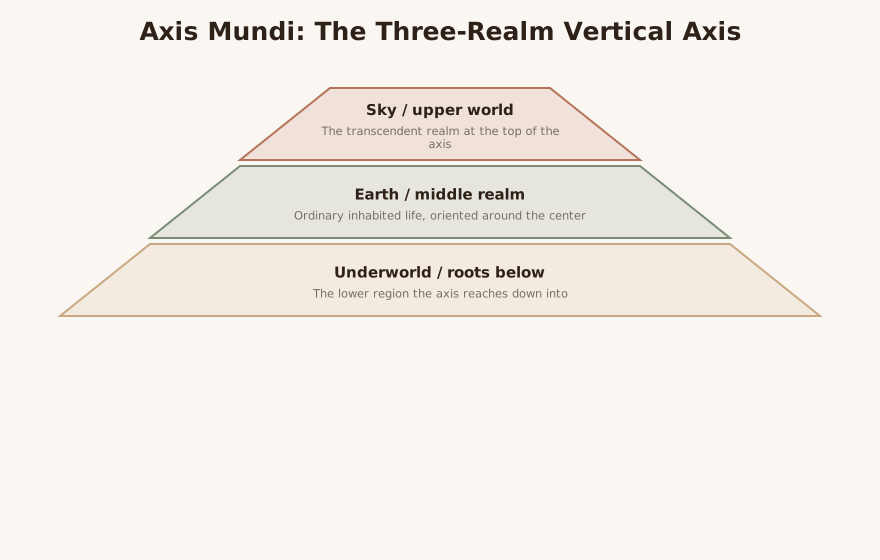
The axis connects realms. Across cultures the axis mundi bridges three cosmic regions — sky (upper world), earth (middle realm), and underworld (the roots below). 4 It marks the place “where being is most fully manifest” and where passage between heaven, earth, and the underworld becomes possible. 1 These are described as places of dynamic union where beings of different natures meet. 1
Orientation depends on a center. The construct may originate in the universal human perception that one’s own location is “the center of the world,” providing psychological orientation between known order and unknown chaos. 4 This is the principle most portable into therapy: a person without a center is disoriented; establishing a center restores the capacity to navigate. LLM
The body can be the axis. The human form itself can function as a world axis — through systems such as the chakras and the Kabbalistic Sefirot — and embodied practices like yoga and tai chi proceed from “the premise of the human body as axis mundi.” 5 Anyone or anything suspended on the axis between heaven and earth becomes, in this symbolic logic, a repository of potential knowledge. 5
Interventions & Techniques
The axis mundi yields no manualized technique. What it offers is a organizing image that can be woven into existing, evidence-based interventions. LLM Several adaptations follow naturally from the principles above.
-
Center-finding / grounding work. Inviting a client to locate a felt center — often the body’s vertical axis, breath, or midline — operationalizes “the body as axis mundi” as a grounding anchor. 5 This dovetails with standard somatic and mindfulness grounding rather than replacing it. LLM
-
The vertical line. Because the axis runs sky–earth–underworld, clinicians can use a literal or imagined vertical line (crown to ground) as an orienting cue for posture, breath, and attention, echoing the upper/middle/lower structure of the symbol. 4 LLM
-
Symbolic mapping / imagery. Trees, mountains, pillars, and ladders are the canonical forms of the axis. 4 A client can be invited to identify or draw a personal “center of the world” image, an externalization device borrowed from narrative and art-based practice. LLM
-
Ritual of orientation. Eliade frames sacred space as a threshold and a re-establishment of order from chaos. 6 Small intentional rituals — lighting a candle, a fixed grounding sequence at session start — can be framed as building a personal center. 6 LLM
-
Movement as centering. Sacred movement traditions explicitly enact the body as axis mundi to connect with the divine, as analyzed in the study of Kathak dance. 7 Movement, breath, and rhythm can be recruited to help a dysregulated client re-find center. LLM
LLM-generated illustrative example (not a guideline): With a client who dissociates under stress, a clinician might say, “Let’s find your center — feel the line from the top of your head down through your seat to the floor, like the trunk of a tree.” This uses the axis-as-tree image purely as a grounding scaffold layered onto standard orientation work. LLM
Evidence Base
Be honest with clients and in documentation: the axis mundi is a metaphorical and theoretical construct, not an empirically validated intervention. LLM Its primary literature is descriptive scholarship in the history of religions — Eliade’s comparative analyses and reference summaries of them — not clinical trials. 1 4 There are no randomized controlled trials of “axis mundi therapy,” because no such standalone therapy exists. LLM
What does have an evidence base is the company the construct keeps. LLM Grounding and centering procedures, mindfulness-based interventions, and somatic stabilization are independently supported, and the axis mundi functions here only as an explanatory or motivational frame layered onto those established methods. LLM The one peer-reviewed scholarly source applying the construct to embodied practice analyzes Kathak dance as axis mundi at the level of cultural and phenomenological interpretation, not clinical outcome. 7
The honest framing for supervision and notes: the axis mundi is a borrowed metaphor with strong cross-cultural and theoretical pedigree but no direct outcome evidence, and its clinical value rises or falls with the validated technique it accompanies. LLM
Populations & Indications
The construct is most useful where the presenting difficulty is fundamentally one of orientation, grounding, or meaning — exactly the territory where a “center of the world” image resonates. LLM Drawing on the principle that a center provides orientation between order and chaos, candidate populations include: 4
- People in spiritual crisis and those navigating spiritual struggle, for whom sacred-center language is native and validating. LLM
- Trauma survivors and clients experiencing disorientation or dissociation, where a felt center supports stabilization. 5 LLM
- Clients in transpersonal therapy, where the construct’s lineage is already part of the model. LLM
- Bereaved individuals, for whom loss has collapsed a felt center and meaning must be rebuilt. LLM
- Adults seeking meaning and grounding, including demoralized clients searching for a stable reference point. LLM
Indication is strongest when the client’s own worldview includes symbolic, spiritual, or embodied language; the image is an invitation, not a prescription. LLM
Problems-for-Work
The axis mundi maps cleanly onto several problems-for-work, each with a brief application sketch. LLM
- Disorientation / loss of grounding — use the body’s vertical axis as a literal anchor to re-establish “where I am.” 5 LLM
- Dissociation — the center-finding and tree/pillar imagery supports return to present, embodied experience. 5 LLM
- Existential distress / loss of meaning — the sacred-center frame supplies a structure for rebuilding orientation between chaos and order. 6 LLM
- Anxiety — a stable felt center offers a reference point from which to observe and tolerate arousal. LLM
- Spiritual struggle — sacred-space and hierophany language meets clients in their own idiom without imposing content. 6 LLM
- Demoralization — re-centering reframes a collapsed world as one that can be re-founded. 4 LLM
- Identity disturbance — the axis as the “most fully manifest” point becomes a metaphor for a continuous, locatable self. 1 LLM
- Difficulty with self-regulation / centering — movement, breath, and the body-as-axis image scaffold down-regulation. 7 LLM
LLM-generated illustrative example (not a guideline): For a bereaved client describing the world as “scattered,” a clinician might co-construct a personal “center” image — a remembered mountain — to anchor meaning-making across sessions, used alongside standard grief work. LLM
Contraindications, Cautions & Cultural Humility
Respect provenance. The axis mundi is built from specific sacred traditions — Mount Meru, Yggdrasil, the cross, Mount Kailash, the Ka’aba, the Temple Mount, the Bodhi tree. 4 5 Using these images casually risks appropriation or flattening living religions into therapeutic props. LLM Borrow the structure (a felt center, a vertical axis) and let clients supply content from their own tradition rather than importing someone else’s symbols. LLM
Match the client’s worldview. Sacred and cosmic language can alienate or distress secular, religiously injured, or differently-believing clients. LLM Offer the image tentatively and drop it if it does not land. LLM
Watch for spiritual bypass. A “transcendent center” can be misused to vault over, rather than process, trauma or grief; keep the metaphor in service of stabilization and meaning-making, not avoidance. LLM
Stabilize before depth. With dissociation, grounding to a present-moment bodily center is appropriate, but elaborate imagery or “ascent” metaphors should wait until the client is stable. LLM
Do not over-claim. Never present the axis mundi as an evidence-based treatment; present it as an explanatory image accompanying validated methods. LLM
Treatment-Plan Suggestions & SMART Objectives
| Goal | SMART objective (example) | Mechanism |
|---|---|---|
| Improve grounding | Client will use a body-centered grounding cue (vertical axis) in 4 of 5 distressing moments per week over 6 weeks, self-rated in a log | Body-as-axis attention as a present-moment anchor 5 |
| Reduce dissociation | Client will return to embodied present using a center/tree image within 2 minutes during 3 sessions over 8 weeks | Orientation around a stable felt center 5 |
| Rebuild meaning | Client will articulate one personally meaningful “center of life” anchor by session 8 | Re-founding order from felt chaos 6 |
| Lower anxiety | Client will report a 2-point SUDS drop after a centering sequence in 70% of practice trials over 4 weeks | Stable reference point for observing arousal LLM |
| Address spiritual struggle | Client will name one sacred or meaningful image that supports orientation by session 6 | Hierophany / sacred-space framing in client’s own idiom 6 |
| Strengthen self-continuity | Client will describe a consistent “core self” reference point in 3 consecutive sessions | Axis as the “most fully manifest” continuous point 1 |
| Improve self-regulation | Client will complete a breath-and-movement centering practice 4x/week for 6 weeks | Movement/body as axis for down-regulation 7 |
Common Misconceptions
- “The axis mundi is a therapy.” It is a comparative-religions construct, not a clinical method; therapeutic use is borrowed and metaphorical. 1 LLM
- “It only means a tree or a mountain.” The axis appears as tree, mountain, pillar, cross, ladder, tower, vine, smoke column — and the human body itself. 4 5
- “It is one religion’s idea.” It is cross-cultural, documented across many traditions and forms. 4
- “It is evidence-based on its own.” No outcome trials exist for the construct; supporting evidence belongs to the grounding and mindfulness methods it accompanies. LLM
- “Eliade proved it scientifically.” Eliade offered a comparative, interpretive framework, not experimental validation. 1 LLM
Training & Certification
There is no certification in the axis mundi and none is needed, because it is a concept rather than a procedure. LLM Clinicians wanting to use it well should ground themselves first in Eliade’s primary framing of sacred space, hierophany, and the center — readily available in The Sacred and the Profane. 2 3 6 Competence then comes from the validated modalities the metaphor accompanies: training and supervision in mindfulness-based interventions, somatic/grounding approaches, Internal Family Systems, or transpersonal therapy. LLM Cultural-humility and spiritual-competency training is strongly advised given the construct’s roots in living sacred traditions. LLM
Key Terms
- Axis mundi — the symbolic center/axis of the world connecting earthly and transcendent realms. 1 6
- Sacred vs. profane space — ordered, transcendent-connected cosmos versus ordinary, undifferentiated chaos. 6
- Hierophany — a manifestation of the sacred in an ordinary object or event. 6
- Imago mundi — sacred space experienced as an image of the world, positioned at its center. 6
- Center of the world — the orienting point each inhabited region is felt to possess. 4
- Cosmos vs. chaos — ordered, meaningful reality versus formless disorder; sacred-making moves from the latter to the former. 6
- Body as axis mundi — the human form as the world axis, as in chakra and Sefirot systems and embodied practice. 5
Resources & Further Reading
▶ Watch — a video introduction to this concept:
- Axis Mundi — Encyclopedia.com (Encyclopedia of Religion)
- Mircea Eliade, The Sacred and the Profane — bibliographic record (Goodreads)
- Mircea Eliade, The Sacred and the Profane — full text (Internet Archive)
- Axis mundi — Wikipedia
- Axis Mundi — New World Encyclopedia
- Mircea Eliade: The Nature of the Sacred — course notes
- Sacred Movement: Connecting with the Divine — Kathak as Axis Mundi
Reflective / Supervision Questions
- When I reach for a “center of the world” image, am I borrowing the client’s symbolic world or imposing my own? LLM
- Have I been explicit — with myself, the client, and the record — that this is a metaphor layered onto validated methods, not a treatment in itself? 1 LLM
- Am I using the sacred center to support stabilization and meaning, or risking spiritual bypass of trauma and grief? LLM
- Does this client’s worldview welcome cosmic/sacred language, or would secular grounding language serve them better? LLM
- How do I honor the living traditions these symbols come from while keeping the clinical frame respectful and humble? 4 LLM
- For this client’s problem-for-work, what is the validated intervention the axis mundi is accompanying — and would the work stand without the metaphor? LLM