
Type & Discipline
This article describes a family of living religions and ritual-healing systems, not a psychotherapy. Santería (also called Lucumí or “the religion of the orishas”), Brazilian Candomblé, and Haitian Vodou are the most widely practiced Afro-Atlantic traditions, alongside related forms such as Cuban Palo, Umbanda, and Dominican and Puerto Rican espiritismo 45. They belong to the discipline of religion and ritual healing rather than clinical mental health, and they predate and operate independently of any behavioral-health framework LLM. For the practicing therapist, the relevant fact is that for millions of Afro-Caribbean, Afro-Latino, and African diaspora people these systems are the primary idiom through which suffering, illness, misfortune, and recovery are understood and addressed 27.
The clinical posture this article recommends is therefore not “how to use Afro-diasporic religion as an intervention” but “how to recognize, respect, and collaborate with it when it is part of a client’s life” LLM. Treating these traditions as exotic, dangerous, or delusional is a clinical error rooted in the same colonial misreadings that have stigmatized them for two centuries 7.
Creators & Lineage
These religions have no single founder; they were forged collectively by enslaved Africans and their descendants. Santería developed in 19th-century Cuba among enslaved Yoruba people, who mapped their orisha deities onto Roman Catholic saints — a “correspondence” practice that gives the tradition its name 4. Haitian Vodou emerged in colonial Saint-Domingue from the fusion of West African Vodun (the word means “spirit” in Fon) with Catholicism among Dahomean, Kongo, and Yoruba peoples 57. Candomblé arose in Brazil from parallel Yoruba, Fon, and Bantu sources. The historical lineage is therefore one of ritual and indigenous healing traditions carried across the Atlantic and reconstituted under enslavement 2.
This lineage matters clinically because it is inseparable from trauma and resistance. The 1791 Bois-Caïman Vodou ceremony preceded the Haitian Revolution by a week, establishing the tradition as a force of liberation, not merely worship 7. The strategic display of Catholic imagery let enslaved practitioners maintain African spirituality under surveillance — what scholars call the capacity to move between religious systems without merging them 7. Contemporary scholars including Roberto Strongman and Aisha Beliso-De Jesús have given the field new conceptual vocabulary, theorizing the diasporic body as the site where these religions are made and remade across national borders 13. The tradition thus sits at the intersection of community-based healing, religion and spirituality in mental health, and multicultural counseling 2.
Core Principles
The foundational principle across these traditions is ashé (Yoruba) or axé (Portuguese) — a divine energy that pervades the universe and circulates among all beings, requiring balance through proper living and ritual for well-being to be maintained 2. Reality is conceived as “one piece” with visible and invisible elements coexisting and continuously interacting; the boundary between the material and spiritual worlds is permeable, not sealed 2. Vodou states this directly: “everything is spirit” 5.
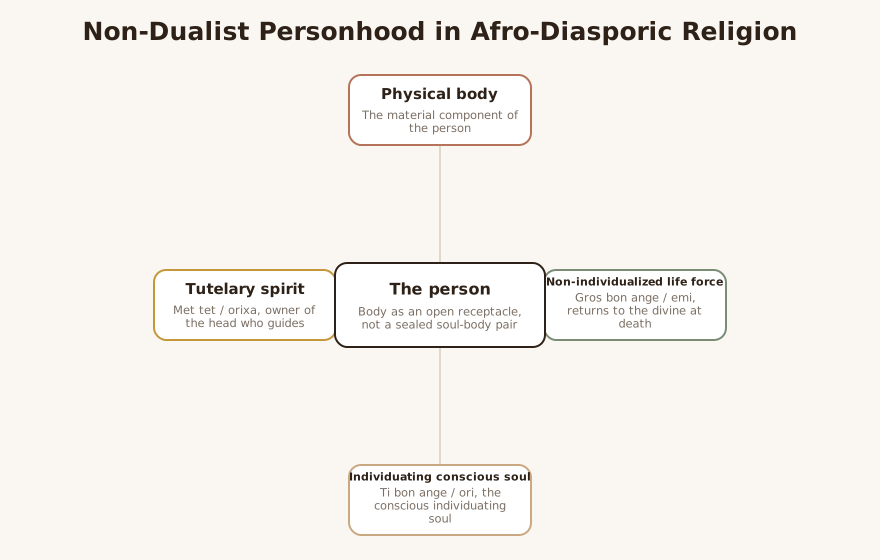
A second principle is a non-dualist model of personhood. These traditions reject the Western split between a single soul and a body, identifying instead three or more components: the physical body; a non-individualized life force (Vodou gros bon ange, Yoruba emi) that returns to the divine at death; an individuating conscious soul (ti bon ange, ori); and a tutelary spirit or “owner of the head” (mèt tèt, orixá) who guides and protects the person 2. Strongman names this configuration transcorporeality — an understanding of psyche, soul, and gender as multiple, removable, and external to the body, so that the body functions as an open receptacle rather than a sealed container for one fixed self 3.
Third, these are embodied, communal, and reciprocal systems. Worship is enacted through dancing, singing, drumming, and gesture far more than through doctrine or text 26. Moral life is organized around obligations to family, community, and elders, and around reciprocal relationships with ancestors (Egún) and spirits, rather than hierarchical submission to a single deity 2. Notably, evil is treated as an integral part of the cosmic order rather than an external enemy, and spirits can both heal and harm — a moral realism quite different from Abrahamic framings 2.
Interventions & Techniques
Within these traditions, “healing” is accomplished through identifiable ritual technologies — useful for clinicians to recognize, not to perform LLM.
- Divination. In Santería, a trained priest (babalawo) consults the Ifá oracle by interpreting consecrated palm nuts to discern the orishas’ responses to a question or problem 4. Vodou oungan and manbo serve as “official interpreters” of the spirits’ language, guiding people through life’s complexities 7. Divination functions as diagnosis, meaning-making, and prescription in one act LLM.
- Drumming, dance, and possession trance. At drum ceremonies (Santería bembé), initiated devotees may lose ordinary consciousness and become mediums through whom the orishas communicate, heal, and prophesy 4. In Vodou, specific lwa are recognized by particular drum rhythms, dance steps, greetings, and objects 7. Anthropologists frame possession not as pathology but as “a form of language” that lets a person recognize their place in society and render events intelligible 7.
- Offerings and sacrifice. Practices range from pouring water (jétédlo) and presenting food at home altars to elaborate feasts and animal sacrifice (manje-lwa), all framed as maintaining reciprocal balance with the spirits 47.
- Initiation and spiritual kinship. Knowledge transfers through family inheritance and formal initiation (Vodou kanzo), creating lifelong godparent and “children of the spirits” (ounsi) relationships within a congregation or sosyete led by a priest or priestess 57.
- Copresence. Beliso-De Jesús theorizes the felt presence of orishas, spirits, and the dead in and through practitioners’ bodies as copresence — a sensorial, embodied phenomenon that ties together transnational practice and the making of diaspora identity 1.
Evidence Base
Honesty about “evidence” requires distinguishing two questions LLM. As religious and cultural systems, these traditions are firmly established: they are documented across centuries, span millions of practitioners, are recognized as part of humanity’s cultural patrimony, and their free exercise has been affirmed at the highest legal levels — the U.S. Supreme Court upheld Santería practitioners’ religious-freedom rights in 1993 47. The scholarly literature in anthropology, philosophy, and religious studies is mature and substantial 12367.
As a clinical mental-health treatment, however, there is no body of randomized or controlled outcome research, and these traditions do not present themselves as one LLM. The relevant evidence is anthropological and phenomenological: practitioners affirm identity, acknowledge historical trauma, find existential meaning, and access spiritual resources for life’s difficulties through engagement with the system 7. Scholars describe well-documented psychological and social functions — meaning-making, identity consolidation, community belonging, and the symbolic processing of historical pain — without claiming these constitute validated therapy 7. The defensible clinical statement is therefore: these are established healing traditions with strong ethnographic support for their integrative and supportive functions, and no standing as an evidence-based psychotherapy LLM.
Populations & Indications
The relevant populations are Afro-Caribbean and Afro-Latino communities, African diaspora practitioners, immigrant communities, and religious or spiritual communities for whom these traditions are a living practice 457. People raised in Cuban, Haitian, Dominican, Puerto Rican, Brazilian, and broader West African diaspora contexts may hold these frameworks even when they also identify as Catholic, given the syncretic history 45.
For the clinician, the “indication” is not to deliver the tradition but to assess for and integrate it LLM. It is most relevant when a client frames distress in spiritual terms, attributes symptoms to spiritual causes, draws strength from ritual or community, or is navigating identity and belonging as an immigrant or diaspora member 27. Clients seeking culturally-rooted healing may experience the most benefit when therapy explicitly makes room for, rather than competing with, their spiritual world LLM.
Problems-for-Work
LLM-generated illustrative example (not a guideline): A Haitian-American client presents with insomnia and intrusive dread following a family death. She describes the deceased as “not at rest” and feels she has failed an obligation to the lwa. A culturally humble clinician treats the sleep disturbance and grief with standard care while supporting her wish to consult her manbo and complete a remembrance ritual, framing the two as complementary rather than rival accounts LLM.
- Grief and bereavement. The “cult of the dead” and ancestral connection give mourning a structured, communal idiom; ritual obligation to the deceased can be a resource or, if unmet, a source of guilt 7.
- Spiritual distress. Symptoms experienced as spiritual intrusion or imbalance call for collaboration with the client’s ritual specialist rather than reframing as cognitive distortion 27.
- Community and social disconnection. The sosyete and spiritual-kinship networks are concrete, mobilizable social support 7.
- Identity and cultural belonging. Practice affirms diaspora identity and lets practitioners “recall their painful and unique history,” directly addressing acculturative stress 71.
- Trauma and adversity. Because these traditions are historically bound to enslavement and resistance, they can hold and metabolize collective trauma 7.
- Anxiety, distress, and coping with illness or crisis. Divination offers a sense of guidance and predictability, and ritual restores a felt sense of balance during crises 42.
Contraindications, Cautions & Cultural Humility
There is no “contraindication” to a client’s religion; the cautions are about clinician error LLM. The dominant risk is pathologizing: early anthropology dismissed Vodou as “primitive and barbaric” and missionaries portrayed it as obscene and demonic, framings that reflected colonial ideology rather than lived practice 7. Importing those biases — reading possession trance as psychosis, or ritual as superstition — replicates that harm and ruptures the alliance LLM. Possession is described by practitioners and scholars as patterned, meaningful “language,” not loss of contact with reality, and should not be reflexively coded as a dissociative or psychotic symptom without careful, culturally informed assessment 7.
A second caution is the popular conflation of these religions with “black magic,” curses, or “witchcraft” — a stereotype that practitioners themselves generally frown upon 7. Animal sacrifice is a legally protected, regulated ritual practice, not evidence of dangerousness 4. Clinicians should also resist romanticizing or appropriating: these are initiatory traditions with their own authorities, and the therapist’s role is collaboration, not interpretation of doctrine they have not been trained in LLM. Because spirits in these cosmologies can both heal and harm, a client’s spiritual fear is real to them and warrants respectful, non-dismissive exploration 2. Practically, genuine cultural humility means asking the client to teach you their framework, deferring to their babalawo, oungan, manbo, or pai/mãe de santo on spiritual matters, and watching your own countertransference LLM.
Treatment-Plan Suggestions & SMART Objectives
| Goal | SMART objective (example) | Mechanism |
|---|---|---|
| Reduce clinician–client cultural rupture | Within 2 sessions, clinician completes a spiritual/cultural assessment and documents the client’s tradition, ritual specialist, and spiritual explanatory model 27 | Explanatory-model alignment; therapeutic alliance LLM |
| Integrate spiritual support into grief work | Over 6 weeks, client identifies and engages at least one ritual or community practice (e.g., remembrance ceremony) and reports reduced guilt re: obligation to the deceased by 50% on a self-report scale 7 | Communal mourning structure; meaning-making 7 |
| Reduce social isolation | Within 8 weeks, client re-establishes contact with at least two members of their sosyete or spiritual-kinship network and attends one communal event 7 | Activation of culturally congruent social support 7 |
| Distinguish spiritual experience from clinical symptom | Within 3 sessions, clinician and client collaboratively map which experiences the client attributes to spiritual vs. medical causes, with no pathologizing language in the record 7 | Cultural formulation; reduced misdiagnosis 7 |
| Strengthen culturally rooted coping for anxiety | Over 4 weeks, client pairs a personally meaningful ritual/embodied practice (drumming, dance, prayer) with a clinical coping skill and rates distress before/after 26 | Embodied regulation; perceived balance/axé 2 |
| Support identity consolidation | Within 10 sessions, client articulates how their tradition supports diaspora identity and names two specific strengths drawn from it 17 | Identity affirmation; narrative integration 7 |
| Coordinate with spiritual authority | Within 4 weeks, with consent, clinician establishes a respectful line of communication or shared understanding with the client’s ritual specialist on goals LLM | Collaborative care; reduced treatment conflict LLM |
Common Misconceptions
- “It’s the same as witchcraft / black magic.” Magic and witchcraft are generally frowned upon by practitioners; the equation is a colonial and pop-culture distortion 7.
- “Possession is a psychotic or dissociative break.” Possession is a patterned, meaningful ritual “language” through which spirits communicate, not a symptom of loss of reality testing 74.
- “It conflicts with being Catholic/Christian.” The traditions are syncretic by origin; practitioners often move fluidly between systems, displaying Catholic devotion while serving the orishas or lwa 457.
- “There’s a single doctrine or holy book.” These are practice-centered, embodied, and oral traditions transmitted through ritual and initiation, not creed or scripture 26.
- “The self is a single soul in a body.” These cosmologies hold a multiple, partly external soul — the basis of Strongman’s transcorporeality — which is precisely why possession is coherent within them 32.
- “It’s primitive or marginal.” It is an established, legally protected, globally practiced tradition recognized as cultural patrimony 47.
Training & Certification
There is no clinical certification in these traditions, and clinicians should not seek to “credential” themselves in them LLM. Religious authority is conferred only through initiation within the tradition — becoming a babalawo or oriaté in Santería, an oungan or manbo in Vodou, or a pai/mãe de santo in Candomblé — via extended seclusion, ritual, and godparent transmission, not coursework 457. These are the legitimate spiritual specialists with whom a therapist collaborates 7.
What clinicians should train in is cultural humility and structured cultural assessment LLM. Practical preparation includes graduate and continuing education in multicultural counseling and religion/spirituality in mental health, supervised practice using the DSM-5 Cultural Formulation Interview, and reading the anthropological and philosophical literature on these traditions to build an accurate, non-stereotyped frame 2731. The aim is competence in working alongside the tradition, never in performing it LLM.
Key Terms
- Ashé / Axé — divine energy pervading the universe; balance is maintained through right living and ritual 2.
- Orisha / Orixá / Lwa — the deities or spirits served in Santería/Candomblé and Vodou, respectively, each with distinct attributes 45.
- Transcorporeality — Strongman’s term for psyche/soul/gender as multiple, removable, and external to the body 3.
- Copresence — Beliso-De Jesús’s term for the embodied felt presence of spirits and the dead in practitioners’ bodies 1.
- Gros bon ange / ti bon ange / mèt tèt — components of personhood: life force, individual soul, and tutelary “owner of the head” 2.
- Bembé / sevi lwa — drum ceremony (Santería) and “serving the spirits” through song, dance, and gesture (Vodou) 45.
- Babalawo / oungan / manbo / pai-mãe de santo — initiated ritual specialists and diviners 47.
- Sosyete / kanzo / ounsi — congregation, Vodou initiation, and “children of the spirits” (initiates) 7.
- Possession trance — patterned ritual state in which a spirit communicates, heals, or prophesies through a devotee 47.
Resources & Further Reading
▶ Watch — a video introduction to this concept:
- Santería Copresence and the Making of African Diaspora Bodies (Beliso-De Jesús, Cultural Anthropology, 2014)
- Philosophy of African Diaspora Religions (Internet Encyclopedia of Philosophy)
- Queering Black Atlantic Religions: Transcorporeality in Candomblé, Santería, and Vodou (Strongman, Duke University Press)
- Santeria | Definition, Meaning, History, & Facts (Encyclopaedia Britannica)
- Vodou | Definition, History, West African Vodun, & Facts (Encyclopaedia Britannica)
- Afro-Brazilian Religions and the Prospects for a Philosophy of Religious Practice (Religions, MDPI, 2023)
- Haitian Vodou — Open Encyclopedia of Anthropology
Reflective / Supervision Questions
- When a client describes a possession experience or a spiritual cause for their symptoms, what is my immediate internal reaction, and where does it come from? LLM
- Can I articulate this client’s explanatory model in their own terms before offering mine? 2
- Have I confused this tradition with stereotypes of “magic” or “voodoo” anywhere in my assessment or documentation? 7
- Am I treating the client’s ritual specialist as a collaborator or as competition? 7
- Where am I tempted to romanticize, exoticize, or appropriate, rather than respectfully defer? LLM
- Have I framed the religion as a client strength and support while keeping my documented intervention within a recognized, billable modality? LLM
- How does the historical trauma embedded in these traditions — slavery, resistance, stigma — show up in this client’s presentation, and am I holding that context? 7