
Type & Discipline
Ego-state therapy is a psychodynamic, hypnoanalytic approach in which the techniques of group and family therapy are turned inward to resolve conflicts between the “ego states” that constitute a “family of self” within a single person 1. It sits at the intersection of clinical psychology and clinical hypnosis: hypnosis is the access method, while the change processes borrow from behavioral, cognitive, analytic, and humanistic traditions 1. The construct at the heart of this article — the distinction between covert and overt ego states — is what differentiates ego-state therapy from purely conversational parts work and locates it within dissociation-based practice 7. As a construct rather than a freestanding manualized protocol, it is most usefully understood as a map of personality organization that a clinician applies within hypnosis LLM.
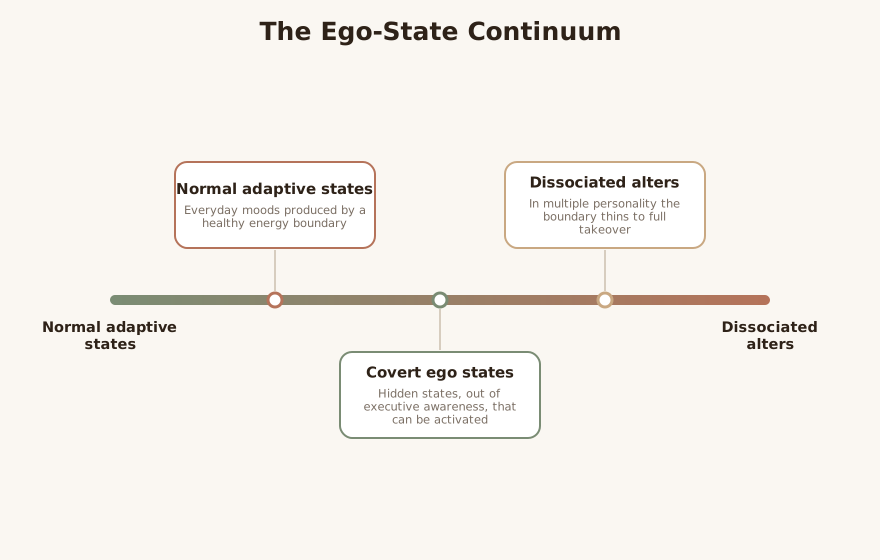
The defining theoretical claim is dimensional: personality is normally organized into part-selves that differ only in how rigid the boundaries between them are LLM. At one end are everyday adaptive states (the “work self,” the “parent self”); at the other end are the fully dissociated alters of dissociative identity disorder LLM. The covert/overt language describes where a given state sits on that continuum at a given moment 7.
Creators & Lineage
The approach was developed by John G. Watkins (1913–2012), a Columbia-trained psychologist and professor emeritus at the University of Montana, together with his wife and collaborator Helen H. Watkins 5. Their joint articulation of the model is set out most fully in Ego States: Theory and Therapy (1997) 2. John Watkins also contributed the affect bridge, a hypnoanalytic technique for tracing a present affect back to its origin, which became a standard tool inside ego-state work 5.
The direct theoretical ancestor is Paul Federn’s ego-state theory, from which the Watkinses borrowed the idea that the ego is not unitary but composed of investable “states” carrying their own energy and self-experience LLM. The model also draws on the broader clinical hypnosis tradition for its access method 1. In the contemporary parts-work landscape, ego-state therapy is a sibling of Internal Family Systems and a cousin of structural dissociation theory; all three treat the self as plural, though they differ in technique, in their stance toward hypnosis, and in how they theorize dissociation LLM. Historically, ego-state methods were also applied in forensic contexts — most notoriously in a 1979 criminal interrogation — an application now regarded as ethically problematic and not a model for clinical practice 5.
Core Principles
The foundational metaphor is the family of self: a set of part-selves that can cooperate, conflict, or ignore one another much as members of an actual family do 1. Therapy is framed as a kind of internal diplomacy, in which the clinician helps these states negotiate rather than imposing a single resolution 1.
The covert/overt continuum is the organizing principle. In most people, covert ego states do not normally become overt — they remain out of executive awareness — except in true multiple personality, where the boundary thins to the point of full takeover 1. The therapeutic move is to deliberately and temporarily lower that boundary: covert states are hypnotically activated and made accessible for contact and communication with the therapist 1. This is the crux of the construct — the same energy boundary that produces ordinary “moods” in a healthy person produces amnesic alters at the dissociative extreme, and hypnosis lets the clinician dial that boundary down on purpose 7.
Once a state is accessible, the clinician can deploy any of the behavioral, cognitive, analytic, or humanistic techniques — the model is integrative about what happens after access, not prescriptive 1. A further principle is that even troublesome states are presumed to have had an adaptive origin; the working assumption is that a self-sabotaging part once protected the person LLM. Watkins reported that, across roughly two decades of practice, complex psychodynamic problems could often be resolved relatively quickly compared with traditional analytic therapy — a clinical observation, not a controlled finding 1.
Interventions & Techniques
The signature intervention is hypnotic activation and voicing of a covert state: the clinician inducts a light-to-moderate trance, invites a specific part to “come forward” or “be heard,” and then converses with that state directly 1. The therapeutic conversation is the work — clarifying what the part wants, what it fears, and what it has been trying to accomplish LLM.
Common procedures clinicians layer onto this access include:
- The affect bridge — amplifying a present feeling and following it back along an “affective bridge” to the experience where the state originated 5.
- Internal negotiation / diplomacy — having two conflicting states address each other through the therapist as mediator, seeking a renegotiated arrangement rather than the suppression of one part 1.
- Resource installation — strengthening or “hydrating” a depleted protective state, or inviting a competent adult state to support a younger, frightened one LLM.
- Mapping the system — building a shared picture of which states exist, what they do, and how they relate, before attempting any deeper work LLM.
LLM-generated illustrative example (not a guideline): A client who freezes before performance reviews agrees to a light trance; the clinician invites “the part that goes silent” to speak. It presents as a young state convinced that being noticed brings punishment. Over several sessions the clinician brokers a deal whereby a protective adult state agrees to “stand in front of” the younger one during evaluations. LLM
Because the techniques after access are deliberately eclectic, ego-state therapy is often integrated with EMDR, somatic work, or standard cognitive-behavioral methods rather than practiced in isolation LLM.
Evidence Base
Honesty about maturity matters here. Ego-state therapy is established as a clinical tradition — it has a five-decade lineage, a body of theory, named international training bodies, and a defined construct vocabulary 3. It is not “established” in the sense of a robust randomized controlled trial base LLM.
The primary literature is largely clinical and theoretical: case reports, technique descriptions, and the originators’ own summaries of accumulated experience 1. Watkins’s overview, for instance, rests its efficacy claim on “some 20 years experience with this approach” rather than on controlled comparison 1. The construct draws empirical plausibility indirectly — from the wider hypnosis literature and from dissociation research that supports a continuum model of part-self organization — but the specific package of covert-state activation has not been subjected to the kind of trial scrutiny that anchors first-line trauma treatments LLM. A clinician should present it to clients accordingly: as a theory-rich, experientially grounded method with limited controlled-outcome data, best used adjunctively and by practitioners trained in both hypnosis and dissociation LLM.
Populations & Indications
The model is most associated with trauma survivors and with clients on the dissociative spectrum 7. Indications cited in the tradition include PTSD and complex trauma, dissociative identity disorder and other specified dissociative disorder, and the residue of childhood abuse where a person experiences themselves as fragmented or in chronic internal conflict 7. It is also used with adults already comfortable in hypnotherapy for anxiety disorders, depression, phobias, somatic symptoms, and entrenched self-sabotaging behavior, where a “part” framing clarifies an otherwise stuck ambivalence LLM.
Suitability is gated less by diagnosis than by two practical factors: hypnotizability and stability LLM. Clients who can tolerate trance and who have enough affect-regulation capacity to be brought into contact with a distressed state — and back out again — are the better candidates LLM.
Problems-for-Work
In a clinician-facing plan, the construct translates into discrete, workable targets:
- Internal conflict / chronic ambivalence — a client torn between staying and leaving a job or relationship is reframed as two states with competing aims; the work is to get them into the same “room” LLM.
- Self-sabotaging behavior — a pattern of undermining one’s own goals is approached as a protective part acting on outdated information, not as mere willpower failure LLM.
- Trauma-related fragmentation (PTSD, complex trauma) — a survivor’s intrusions and numbing are mapped to distinct states (a vigilant part, a shut-down part) so each can be addressed on its terms 7.
- Dissociative presentations (DID, OSDD) — here the covert/overt model is most literal: the therapy aims at communication and eventual cooperation among states rather than their elimination 1.
LLM-generated illustrative example (not a guideline): For a client with complex trauma who alternates between rage and collapse, the clinician maps a “guard” state and a “hider” state, then spends several sessions helping each acknowledge the other’s function before attempting any memory-focused work. LLM
Contraindications, Cautions & Cultural Humility
Hypnotic activation of covert material carries real risk and should not be undertaken casually LLM. Reactivating dissociated states can flood an under-resourced client, so adequate stabilization and affect-regulation skills should precede any deep ego-state work LLM. Practitioners untrained in clinical hypnosis or in dissociative disorders should not attempt covert-state activation; the international training bodies treat hypnosis competence as a prerequisite for exactly this reason 6.
A specific hazard is iatrogenic suggestion: because the method involves inviting hidden “parts” to emerge under trance, a poorly conducted session risks shaping or confabulating states, and any memories surfaced via techniques like the affect bridge must not be treated as forensically reliable LLM. Acute psychosis, severe untreated substance use, and active high-risk crisis are relative contraindications to trance-based parts work LLM.
On cultural humility: the “family of self” metaphor and the very idea of a unitary versus plural self are culturally situated, and experiences a Western clinician might pathologize as dissociation may be normative spiritual or communal experiences in another frame LLM. The clinician should hold the model as one lens, ask how the client already understands their inner multiplicity, and avoid importing the parts language over a client’s own meaning system LLM.
Treatment-Plan Suggestions & SMART Objectives
| Goal | SMART objective (example) | Mechanism |
|---|---|---|
| Improve internal communication | Within 8 sessions, client will identify and name at least 3 ego states and describe each state’s protective function in session | Mapping and voicing covert states reduces internal opacity 1 |
| Reduce internal conflict | Over 10 weeks, client will report a ≥2-point drop (0–10) in subjective “stuckness” around one target decision | Internal diplomacy renegotiates competing aims 1 |
| Decrease trauma intrusions | Within 12 sessions, client will use a resourced adult state to self-soothe during 2 of 3 logged intrusion episodes | Resourcing a depleted state increases tolerance 7 |
| Increase distress tolerance | Within 6 sessions, client will tolerate 5 minutes of contact with a distressed state and return to baseline within 10 minutes | Graded hypnotic access builds affect regulation LLM |
| Reduce self-sabotage | Over 8 weeks, client will reframe 1 self-undermining pattern as a protective part and log a non-sabotaging alternative response | Reattributing behavior to a part’s intent opens choice LLM |
| Foster state cooperation (dissociative) | Within 16 sessions, client will establish a shared internal “agreement” for safety between 2 states, reviewed weekly | Communication among states supports integration 1 |
| Resolve a phobic response | Within 10 sessions, client will reduce avoidance of 1 feared situation by accessing and reassuring the originating state | Affect-bridge access addresses the state holding the fear 5 |
Common Misconceptions
“It’s the same as having multiple personalities.” No — the model holds that everyone is organized into ego states; covert states only become independently overt in true multiple personality, which is the dissociative extreme of a normal continuum, not the baseline assumption 1.
“It’s just IFS with a different vocabulary.” The two are siblings, but ego-state therapy centers hypnotic access to covert states and is rooted in Federn’s energy model and the dissociation literature, whereas Internal Family Systems uses a non-hypnotic, leader-of-the-system framework LLM.
“Hypnosis recovers true buried memories.” What surfaces under trance is clinically useful material, not forensic evidence; memories surfaced this way can be shaped by suggestion and must be held tentatively LLM.
“It’s a quick fix.” Watkins’s reports of relative efficiency are clinical observations over decades of his own practice, not controlled outcome data, and should not be sold to clients as proven speed 1.
Training & Certification
Two bodies govern certification: Ego State Therapy International (ESTI), the umbrella organization with national chapters, and regional affiliates such as Ego State Therapy North America (ESTNA) 3. ESTI maintains tiered standards spanning trainers, supervisors, therapists, and counselors/coaches 3.
ESTNA’s pathway illustrates the expected rigor. Candidates must be licensed mental health professionals (or students in clinical training toward licensure) and complete roughly 184 hours total: 120 hours of ego-state therapy training (foundations, basic, and advanced workshops plus 20 hours of consultation and 4 hours of personal experiential sessions) and a separate 60 hours of clinical hypnosis training through an approved body such as ASCH or the Milton H. Erickson Foundation 6. Meeting ESTNA’s requirements also confers ESTI certification under its dual-certification arrangement 6. Notably, ESTNA currently sets no ongoing continuing-education requirement to maintain therapist certification once achieved — a gap clinicians should be aware of when judging a practitioner’s currency 6.
Key Terms
- Ego state — a coherent set of behaviors and experiences bound by a common principle and separated from other states by a boundary that may be more or less permeable 7.
- Family of self — the metaphor for the whole set of part-selves within one person, treated with the techniques of group and family therapy 1.
- Covert ego state — a state held out of executive awareness that does not normally become overt except, at the extreme, in multiple personality 1.
- Overt ego state — the state currently in executive control and presenting to the world 7.
- Internal diplomacy — Watkins’s term for therapist-mediated negotiation among conflicting states 1.
- Affect bridge — a hypnoanalytic technique that follows a present affect back to its originating experience 5.
Resources & Further Reading
▶ Watch — a video introduction to this concept:
- Watkins JG. Ego-state therapy: an overview (1993) — PubMed
- Watkins HH & JG. Ego States: Theory and Therapy (book)
- Ego State Therapy International (ESTI)
- Ego State Therapy: Benefits, Techniques & How It Works — GoodTherapy
- John G. Watkins — Wikipedia
- Certification — Ego State Therapy North America (ESTNA)
- Overt-Covert Dissociation and Hypnotic Ego State Therapy (Springer chapter)
Reflective / Supervision Questions
- When I describe a client as having “a part that sabotages,” am I using the construct to deepen understanding, or to distance myself from my own difficulty with the client? LLM
- Do I have the hypnosis and dissociation training this construct presupposes, or am I borrowing the language without the access method and its safeguards? LLM
- How do I verify that a client is sufficiently stabilized before I lower the boundary on a covert state, and what is my plan if activation floods them? LLM
- How does this client already make sense of their inner multiplicity, and does the “family of self” framing fit or override that meaning? LLM
- Where am I at risk of treating trance-surfaced material as literal historical truth rather than as clinically meaningful narrative? LLM