
Type & Discipline
Ego-State Therapy (EST) is a psychodynamic, frequently hypnosis-assisted psychotherapy that conceptualizes the personality as an organized “family” of part-selves — ego states — and works to identify, communicate with, and renegotiate the relationships among them 1. It sits at the intersection of clinical psychology, psychoanalytic theory, and clinical hypnosis, and is most often classified within the psychodynamic and hypnotherapy traditions 6. Rather than treating the person as a single undifferentiated self, EST assumes that internal conflict, symptoms, and self-sabotage frequently reflect disagreement or poor cooperation among these states 1.
The approach is sometimes described as using “analysis of underlying personalities, rather than traditional talk therapy, to find the causes of psychological problems,” which captures its dual lineage: a depth-oriented, parts-aware map of mind delivered through experiential and hypnotic methods 6. In practice, clinicians position EST less as a rigid manualized protocol and more as a flexible framework for organizing intrapsychic work, especially with trauma and dissociation LLM.
Creators & Lineage
EST was developed by the husband-and-wife team of John G. Watkins (1913–2012) and Helen H. Watkins, who built it from the ego-state theory of psychoanalyst Paul Federn 6. John Watkins earned his Ph.D. from Columbia University and spent much of his career as a professor at the University of Montana, where he became a leading figure in hypnosis, dissociation, and the study of multiple personality 6. Helen Watkins worked as a psychologist at the University of Montana’s Student Counseling Center, where the two met in 1971, and together they transformed Federn’s theoretical construct of ego states into a working therapy 4.
Their collaboration produced more than forty scientific articles, chapters, and the foundational 1997 text Ego States: Theory and Therapy 41. Helen Watkins is specifically credited with developing several of the modality’s signature techniques, including the Silent Abreaction and the Somatic Bridge for working with patient guilt, and with emphasizing the therapeutic alliance, “resonance,” and the therapeutic presence of the clinician 4. In 2000, both received the Pierre Janet Award for Clinical Excellence at the International Congress of Hypnosis 4.
The work gained broad public visibility through John Watkins’ forensic involvement in the Hillside Strangler case, where ego-state methods were used during interrogation and contributed to revealing the perpetrator’s claimed multiple personalities 6. Watkins also extended the model to hypnotic pain management, theorizing that some hypnotic analgesia works by displacing pain into “covert” ego states so it becomes dissociated from conscious awareness rather than eliminated 6. Conceptually, EST is a close cousin of later parts-based and dissociation-focused models, including Internal Family Systems and the structural theory of dissociation, with which it shares the premise that the mind is naturally segmented LLM.
Core Principles
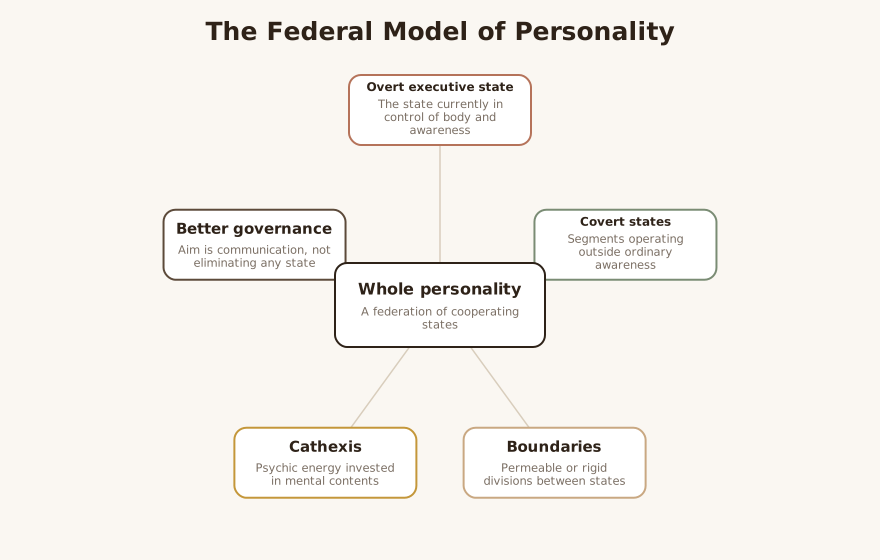
The central construct is the ego state, understood as an organized system of behavior and experience — a covert “segment” of personality bound together by a common principle and separated from other states by a boundary 1. Federn’s contribution, which the Watkins built upon, was the idea that mental contents are invested with psychic energy (cathexis) and that boundaries between states can be relatively permeable or relatively rigid 3. Normal personality, in this view, is not the absence of parts but the smooth, cooperative movement among them; pathology arises when boundaries become too rigid or when states are in unresolved conflict 3.
EST distinguishes covert states (those operating outside ordinary awareness) from the overt state currently “executive” — that is, in control of the body and consciousness at a given moment 1. A useful organizing metaphor is the “federal” model of personality: like states in a federation, ego states retain partial autonomy while belonging to a larger whole, and the therapeutic aim is better governance and communication rather than elimination of any state 3. This non-pathologizing stance — that even troublesome states once formed to serve an adaptive purpose — is a defining feature LLM.
A further principle is the continuum of differentiation: the degree of separation among states ranges from ordinary adaptive mood-and-role shifts, through neurotic conflict, to the highly compartmentalized states seen in dissociative disorders 1. EST therefore frames dissociative identity not as categorically alien but as the extreme end of a normal dimension of internal organization 3.
Interventions & Techniques
The first task in EST is locating and accessing the relevant ego states. Watkins distinguished between “talking through” (addressing states while the client remains in ordinary waking consciousness) and “talking with” or hypnotically activating states so they can speak in the first person 1. Hypnosis is the classic vehicle for the latter, used to lower the boundary between executive awareness and covert states so a conflicted or wounded state can be contacted directly 1.
Helen Watkins’ Silent Abreaction is a structured technique for discharging trauma-related affect — particularly rage and guilt — in a contained, imaginal way rather than through uncontrolled flooding 4. The Somatic Bridge uses a present-day bodily sensation as a route back to the originating experience, allowing the clinician to reach the state that holds the unresolved material 4. These sit alongside John Watkins’ earlier Affect Bridge, a hypnoanalytic technique that follows a current emotion back to its first occurrence to locate the formative event and the state attached to it 6.
Once states are accessible, the therapeutic work is fundamentally relational and negotiative: helping states recognize one another, voice their concerns, grieve, and reach cooperative agreements, with the therapist acting as facilitator and the adult self increasingly mediating 1. Ego-strengthening — building the client’s resources and the stability of the overall system before deeper trauma work — is integral, reflecting Helen Watkins’ emphasis on alliance, resonance, and therapist presence 4. The aim throughout is integration and cooperation rather than removal of any part 1.
Evidence Base
EST is best described as an established clinical tradition — long-standing, taught internationally, and embedded in the hypnosis and dissociation communities — rather than as an empirically validated standalone treatment 45. Its development and progress through the twentieth century are documented historically, but that documentation is largely conceptual, clinical, and case-based rather than built on controlled trials 3.
Practitioners and clinical writing report benefit for trauma- and dissociation-related presentations, and the model’s plausibility is bolstered by its overlap with better-studied parts-based and trauma frameworks 2. However, the contemporary research base specific to EST as a discrete modality is sparse: there are few randomized controlled trials isolating EST from the broader psychotherapy or hypnosis in which it is typically embedded, and much of its evidentiary weight is theoretical or shared with related approaches LLM. Clinicians should therefore present EST to clients honestly as an experienced-based, tradition-grounded framework whose specific efficacy has not been established to the standard of front-line trauma treatments, and consider it as a component within an evidence-informed plan rather than a substitute for one LLM.
Populations & Indications
EST is most associated with trauma-spectrum presentations: trauma survivors, people with complex PTSD, and survivors of childhood abuse, where internal fragmentation and conflicting self-states are common 1. It is a core tool in work with dissociative disorders, given that its theory treats dissociative identity as the high-differentiation end of the ego-state continuum 3. Beyond trauma, the framework is applied to internal conflict and harsh self-criticism, where opposing states pull a person in incompatible directions LLM.
A practical indication is the client who is amenable to and comfortable with hypnosis or focused experiential work, since access to covert states is often facilitated hypnotically 1. EST is also used adjunctively for anxiety, depression, identity disturbance, self-sabotage, maladaptive coping patterns, and emotion dysregulation when these appear driven by an underlying parts conflict rather than by a unitary process 2. The strongest indication is the presentation that “talks in parts” — where the client spontaneously describes a part of them that wants one thing and another that wants the opposite LLM.
Problems-for-Work
-
Dissociative disorders and complex PTSD: mapping the system of states, building safety and cooperation among them, and gradually integrating trauma-holding states 3.
-
Childhood trauma: using the Affect or Somatic Bridge to reach the young state that carries the original experience and providing corrective, contained care to it 4.
-
Internal conflict and self-sabotage: facilitating dialogue between a state that pursues a goal and a protective state that undermines it, seeking a negotiated agreement 1.
LLM-generated illustrative example (not a guideline): A client repeatedly cancels job interviews despite wanting work. EST framing would explore a “protector” state that learned visibility leads to criticism, and a “striving” state that wants advancement; the work is helping these states hear one another and agree on a graded, lower-threat step rather than one overriding the other. LLM
-
Self-criticism, anxiety, and depression: identifying a punitive inner state, clarifying its origin and intent, and reducing its dominance over the executive self LLM.
-
Emotion dysregulation and maladaptive coping: reaching the state that activates during dysregulation and renegotiating its role so coping becomes more cooperative and graded LLM.
Contraindications, Cautions & Cultural Humility
The principal caution is the same one that attends all parts-based and hypnotic trauma work: uncovering or activating dissociated material can destabilize a fragile client, and hypnotic access to covert states should not precede adequate stabilization, ego-strengthening, and a secure alliance 4. EST should be undertaken only by clinicians trained in both the model and in hypnosis and dissociation, and within scope of practice and licensure 5. Because hypnotically retrieved material can be vivid yet unreliable as historical fact, clinicians must avoid confirming the literal accuracy of recovered “memories” and should be especially careful in any forensic or medicolegal context LLM.
Hypnosis-assisted EST is contraindicated or requires marked caution where there is acute psychosis, severe untreated dissociation without containment, active suicidality, or substance intoxication, and where the client cannot give informed consent to experiential parts work LLM. Clients differ in their willingness to accept a “parts” or hypnotic frame, and the model should never be imposed LLM.
Cultural humility matters because notions of self, spirit possession, and inner multiplicity carry very different meanings across cultures and faith traditions; the language of “ego states” may resonate, be reinterpreted, or feel alien depending on a client’s worldview LLM. The clinician should adapt metaphors to the client’s own framework, attend to how stigma around dissociation may affect disclosure, and treat the client as the authority on their own internal experience LLM.
Treatment-Plan Suggestions & SMART Objectives
| Goal | SMART objective (example) | Mechanism |
|---|---|---|
| Establish safety and stabilization | Within 6 sessions, client will independently use a grounding or “safe-place” skill to reduce distress from ≥8/10 to ≤4/10 in 3 logged instances | Ego-strengthening and resource-building before deeper state work 4 |
| Build internal awareness of states | Within 8 weeks, client will identify and name ≥3 recurring internal states and describe each one’s protective intent in session | Mapping covert and overt states; non-pathologizing framing 1 |
| Reduce internal conflict driving self-sabotage | Over 10 sessions, client will report ≥50% fewer self-described “two-parts-pulling” episodes per week on a self-log | Facilitated negotiation between conflicting states toward cooperation 1 |
| Process a circumscribed trauma memory | Within 12 sessions, client will reprocess one target memory with subjective distress dropping to ≤2/10 and no post-session dissociation lasting >24h | Affect/Somatic Bridge plus contained (silent) abreaction 46 |
| Decrease intensity of harsh self-criticism | Within 8 weeks, client will report a ≥30% reduction in a standardized self-criticism measure | Clarifying and renegotiating the role of a punitive inner state LLM |
| Improve emotion regulation | Over 10 sessions, client will demonstrate use of an internal “check-in with states” strategy in ≥4 of 5 logged dysregulation episodes | Reaching and recruiting the activating state into a cooperative plan LLM |
| Strengthen overall integration | By session 16, client will report on a self-rating scale that internal states feel “more cooperative than conflicting” (≥7/10) | Negotiated agreements and adult-self mediation toward integration 1 |
Common Misconceptions
A frequent misconception is that EST treats ego states as literally separate people or “alters” in every client; in the Watkins model, states exist on a continuum of differentiation, and most clients have ordinary, fluidly cooperating states rather than dissociative identities 13. A related error is assuming the goal is to eliminate a “bad” part — the aim is cooperation and integration, on the premise that each state once served an adaptive purpose 1.
It is also mistaken to equate EST with the Internal Family Systems model; they share a parts paradigm and overlap clinically, but they are distinct lineages with different histories, language, and techniques LLM. Finally, EST is not synonymous with hypnosis: hypnosis is a common and powerful vehicle for accessing states, but the Watkins explicitly described “talking through” states in ordinary waking consciousness as well 1.
Training & Certification
EST is taught and credentialed primarily through specialty organizations rather than through generic graduate curricula 5. Ego State Therapy International (ESTI) maintains the lineage and certification standards descending from the Watkins’ work, and in North America, Ego State Therapy North America (ESTNA) — co-founded by Wendy Lemke and Maggie Phillips — disseminates education about the approach 54.
ESTNA describes itself as “a community for the dissemination of information only, not a society, so there are no membership meetings or dues,” and it does not itself certify practitioners 5. Instead, certification is handled by approved ESTI trainers, with ESTNA providing “the process and certification requirements established by Ego State Therapy International”; the resulting credential is dual-based under both ESTNA and ESTI’s international branch, and certified clinicians are listed in an online directory 5. Because EST relies heavily on hypnosis and trauma work, clinicians are expected to bring prior grounding in clinical hypnosis and dissociation before pursuing certification LLM.
Key Terms
- Ego state: an organized system of behavior and experience bound by a common principle and separated from other states by a boundary 1.
- Covert vs. overt state: a state operating outside ordinary awareness versus the state currently “executive” and in control of consciousness 1.
- Cathexis / boundary: the psychic energy invested in mental contents (Federn) and the permeable-to-rigid divisions between states 3.
- Federal model: the metaphor of states as semi-autonomous members of a federation, the larger personality 3.
- Affect Bridge: a hypnoanalytic technique following a present emotion back to its origin to locate the formative state and event 6.
- Silent Abreaction: Helen Watkins’ contained technique for discharging trauma-related rage and guilt 4.
- Somatic Bridge: using a current bodily sensation as a route back to the originating experience and the state holding it 4.
Resources & Further Reading
▶ Watch — a video introduction to this concept:
- Watkins, J. G., & Watkins, H. H. (1997). Ego States: Theory and Therapy. W. W. Norton
- Ego State Therapy: Benefits, Techniques & How It Works — GoodTherapy
- Ego State Therapy: Its development and progress in the 20th Century — ResearchGate
- Ego State Therapy International (ESTI) — Jack & Helen Watkins
- About Us — Ego State Therapy North America (ESTNA)
- John G. Watkins — Wikipedia
Reflective / Supervision Questions
- When a client describes “a part of me,” am I assessing where they fall on the differentiation continuum, or am I prematurely reifying that part as a separate identity? LLM
- Have I confirmed adequate stabilization and ego-strengthening before using hypnosis to access covert or trauma-holding states? 4
- How am I documenting EST work so that it is clearly framed as a technique within a recognized billable modality, tied to the diagnoses I am treating? LLM
- Am I honestly representing the evidence base to clients — as a long-established tradition with limited controlled support rather than a first-line, empirically validated trauma treatment? 3
- How does this client’s cultural or spiritual framework shape what “inner states” mean to them, and am I adapting my language accordingly rather than imposing the model? LLM
- When a state seems destructive, am I exploring its protective origin and intent, or am I implicitly trying to eliminate it? 1