
Type & Discipline
Shamanic journeying is a technique — not a standalone, empirically validated psychotherapy — sitting within the broader practice system Michael Harner called core shamanism 2. It belongs to the transpersonal / shamanic family and draws on comparative shamanism (the cross-cultural anthropology of ecstatic healing practitioners) and transpersonal psychology (the strand of psychology concerned with spiritual, peak, and non-ordinary states) 2. The defining act is a voluntary, drumming-induced shift into an altered state in which the practitioner “travels” to perceived non-ordinary realities to retrieve guidance, power, or lost soul-parts on behalf of a client 2. LLM
For practicing therapists, the cleanest framing is this: journeying is a structured imaginal/altered-state procedure that some clinicians integrate into a transpersonal or expressive treatment frame, much as guided imagery or Jungian active imagination are integrated. LLM It is not, in the licensed-mental-health sense, an established standalone modality with its own outcome literature, and this article will keep that distinction explicit throughout. LLM
Creators & Lineage
The technique as Western clinicians encounter it was synthesized by Michael James Harner (1929–2018), an American anthropologist with a Berkeley PhD (1963) who taught at Columbia, Yale, and the New School before leaving academia in 1987 to work full-time on shamanism 45. His formative fieldwork was Amazonian: with the Shuar (Jívaro) in Ecuador beginning in 1956–57, and with the Conibo in Peru in 1960–61, where he experimented with ayahuasca 45. His 1980 book The Way of the Shaman is widely credited with launching the contemporary “shamanic renaissance,” and he founded what became the Foundation for Shamanic Studies in the early 1980s 45.
Harner’s central move was to extract what he saw as the “universal, near-universal, and common features of shamanism” across cultures — the journey to other worlds, the altered state, the helping spirits — and strip away culturally specific ceremony, producing an “acultural” system teachable to Westerners 25. He framed this not as invention but as recovery of something ancient: “Shamanism is not ‘New Age.’ It is Stone Age and has been living ever since” 2. The Foundation positions core shamanism as a deliberately “conservative, purist approach” that, by design, “does not focus on ceremonies, such as those of Native American medicine men and women” 2.
The broader lineage a clinician should hold in mind includes transpersonal psychology, Jungian active imagination, and guided imagery — all of which use directed inner experience toward therapeutic ends — alongside the indigenous healing traditions that Harner abstracted from 2. LLM That last link is also the most contested, as the Cautions section below details. LLM
Core Principles
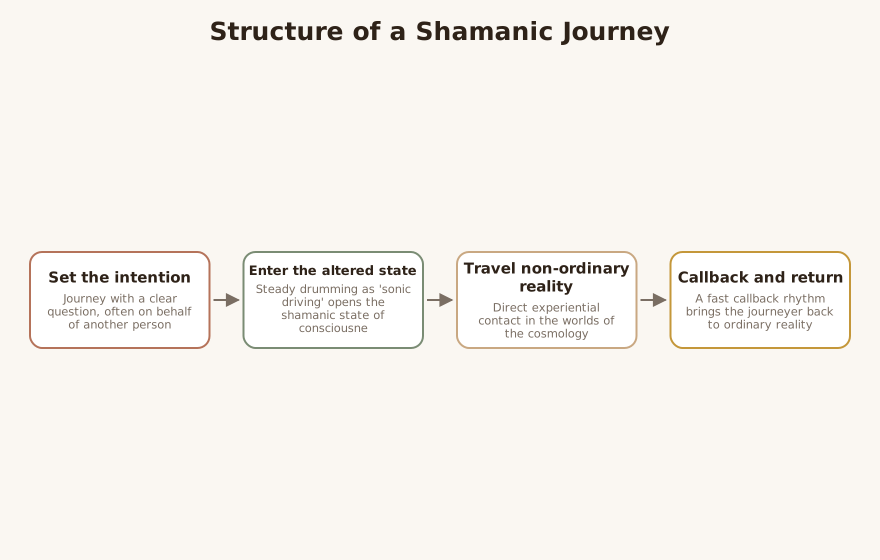
Core shamanism rests on a small set of operating assumptions. First, that ordinary and non-ordinary realities both exist and that the latter can be visited intentionally 2. Second, that this visit happens in an altered “shamanic state of consciousness” reachable by non-pharmaceutical means — above all rhythmic drumming, which Harner termed a form of “sonic driving” 2. Third, that the practitioner does not journey idly but with a clear intention or question, often on behalf of another person 23.
The cosmology taught to journeyers organizes non-ordinary reality into worlds the practitioner travels to and returns from, and the practical emphasis is on direct experiential contact rather than belief or doctrine 2. LLM The drum is treated as a functional instrument, not entertainment: the Foundation is explicit that “shamanic drumming is not music, and it is not intended for musical enjoyment,” but is “intended to facilitate shamanic journeying” 3. A session is bounded — it opens with a steady driving rhythm and closes with a fast “callback rhythm to bring the journeyer back to ordinary reality” 3. LLM This bracketed, intention-set-then-return structure is what makes the practice legible to a therapist used to grounding and containment. LLM
A note of caution on mechanism: proponents often describe drumming as entraining brain rhythms into trance, but none of the provided sources establishes a specific neurological mechanism, and the Foundation’s own drumming page does not assert one 3. The honest clinical statement is that the procedure is well-specified while its mechanism is not, in the sources here, scientifically settled 13. LLM
Interventions & Techniques
The core procedure is the journey itself. The practitioner lies down, typically with eyes covered, sets an intention, and listens to monotonous frame-drum rhythm — in the Foundation’s materials, a “steady rhythm at approximately 5 beats per second” on “a traditional-style, single-headed frame drum” — using headphones if a recording is used 3. The drumming continues for a set period and ends with the accelerated callback signal that returns the journeyer to ordinary awareness 3. The experimental literature has used a comparable stimulus: roughly 255 beats per minute (about 4.2 Hz) of repetitive drumming over a 15-minute exposure 1.
Within that container, several named applications recur in the tradition: retrieving guidance from a perceived helping spirit or “power animal,” restoring a sense of personal power, and “soul retrieval” — the recovery of dissociated or lost parts of the self, a framing that maps loosely onto how trauma fragments experience 2. LLM For a therapist, the transferable, lower-claim elements are the procedural ones: rhythmic auditory induction, a structured imaginal excursion organized by a clear question, and a deliberate return-and-debrief 3. LLM
LLM-generated illustrative example (not a guideline): A clinician trained in both transpersonal methods and an evidence-based trauma model might use a brief drumming-supported guided imagery to help a grieving client “visit” and say what was left unsaid to a deceased parent, then spend the bulk of the session processing the imagery’s affective content using established grief and trauma techniques. The journey supplies imaginal material; the standard modality does the therapeutic work. LLM
Evidence Base
Be plain with clients and supervisees: the maturity here is “established” only in the sense of a codified, widely-taught tradition with a clear lineage — not in the sense of demonstrated clinical efficacy 24. The distinction matters and should not be blurred. LLM
The most rigorous source provided is a single randomized study of 39 inexperienced, non-clinical participants who received 15 minutes of either repetitive drumming or instrumental meditation music, crossed with either shamanic-journeying or relaxation instructions 1. Its findings cut two ways. On physiology, all four conditions produced an equivalent, modest cortisol decrease (a mean drop of about 0.35 ng/ml) with no differences across conditions — drumming and journeying instructions did not outperform meditation music for endocrine stress reduction 1. On subjective experience, the drumming-plus-journeying instruction produced striking effects: roughly 90% reported heaviness, about 90% reported a felt decrease in heart rate, and 100% reported dreamlike experiences, versus only about a quarter to a third of relaxation-instruction participants 1. The authors concluded that the subjective effects attributed to drumming and journeying “may not be reflected in differential endocrine responses,” i.e., that instruction and expectation, not a unique drumming physiology, largely shaped what people experienced 1.
That is essentially the controlled clinical-outcome base available in these sources: one small, short, non-clinical study showing vivid but expectancy-shaped subjective phenomena and no physiological signal unique to the technique 1. There are no controlled trials here for grief, trauma, or existential distress outcomes 1. A clinician integrating journeying should therefore present it as an experiential/meaning-making practice with face validity and a long cultural pedigree, not as an empirically supported treatment for any DSM condition. LLM
Populations & Indications
Within the tradition and its surrounding transpersonal literature, journeying is most often sought by people pursuing spiritual growth or personal meaning, individuals curious about altered states, people navigating major life transitions, and those carrying grief 2. LLM Trauma survivors also appear among the populations drawn to it, frequently via the “soul retrieval” framing of recovering split-off parts of the self 2. LLM
Indications, honestly stated, are experiential rather than diagnostic: the practice may suit clients who are stable, curious about imaginal and spiritual work, and explicitly consenting to a non-ordinary-state procedure as an adjunct within a broader treatment frame. LLM It is best considered for meaning-making, grief integration, and re-connection work in clients with adequate ego strength and grounding skills, and it should never be positioned as a primary treatment where an evidence-based modality is indicated. LLM
Problems-for-Work
The problems clinicians and clients most plausibly bring to this kind of work are existential and relational rather than narrowly symptomatic. LLM
- Grief and loss. A journey framed around contact or completion with the deceased can surface unfinished emotional material for processing within a grief-focused frame 2. LLM
- Loss of meaning / existential distress. Journeying toward a “question” about purpose or direction can externalize and concretize an otherwise diffuse sense of meaninglessness 2. LLM
- Disconnection and emotional numbness. The vivid, embodied, dreamlike quality many participants report can serve as a bridge back to felt experience for clients who describe feeling cut off 1. LLM
- Trauma and the sense of lost self. “Soul retrieval” gives clients a metaphor for reclaiming dissociated parts, useful only alongside, never instead of, a trauma-specific evidence-based approach 2. LLM
- Spiritual crisis and life-transition difficulty. A bounded altered-state ritual can offer structure and symbolic passage during destabilizing transitions 2. LLM
Contraindications, Cautions & Cultural Humility
The strongest cautions are clinical, ethical, and cultural. LLM
Clinical. Intentional altered states are not benign for everyone. Clients with psychosis-spectrum conditions, a history of dissociative disorders, severe untreated trauma, or fragile reality testing can be destabilized by inducing non-ordinary states and “soul-loss” framings, and journeying should generally be avoided or approached with extreme caution in these presentations. LLM Adequate grounding, containment, and a clear return-and-debrief are minimum safeguards, and the technique should sit inside a treatment frame that can hold whatever it surfaces. LLM
Evidentiary. Because the controlled evidence shows expectancy-shaped subjective effects and no unique physiological benefit, presenting journeying as a proven treatment would misrepresent the science to clients 1. Informed consent should name it as an experiential adjunct. LLM
Cultural humility. This is non-negotiable. Core shamanism is explicitly an acultural abstraction that Harner built by extracting common elements from diverse indigenous traditions and removing their cultural contexts 5. That move has drawn substantial backlash “from the cultures Harner cited as sources,” with critics noting that the resulting practices “do not resemble the religious practices or beliefs of any of these cultures,” that “shaman” was applied as a pan-indigenous generalization to peoples who do not use the term, and that the commercialization of such practices raises serious appropriation concerns (e.g., the “plastic shamans” critique) 5. A clinician using these techniques carries a duty to name this lineage and its contestation honestly, to avoid claiming indigenous authority or authenticity, and to defer to living indigenous communities about their own traditions. LLM
Treatment-Plan Suggestions & SMART Objectives
These are illustrative integrations — journeying as a contained adjunct inside an established frame, never as the primary treatment. LLM
| Goal | SMART objective (example) | Mechanism |
|---|---|---|
| Reduce avoidance of grief | Within 6 weekly sessions, client will complete one drumming-supported guided journey addressing the deceased and process the imagery aloud, reporting reduced avoidance on a 0–10 scale by ≥2 points 23 | Imaginal exposure and meaning-making within a grief frame LLM |
| Restore felt connection to experience | Over 4 sessions, client will identify and report at least two embodied sensations noticed during journeying as anchors for re-engaging emotion 1 | Embodied attention countering numbness/dissociation-lite LLM |
| Clarify direction amid life transition | Within 3 sessions, client will articulate one concrete next step generated from a journey “question” and rate confidence ≥6/10 2 | Symbolic problem-structuring and self-efficacy LLM |
| Build self-regulation around altered states | By session 5, client will demonstrate a grounding sequence before and after each journey, independently, on 3 consecutive occasions 3 | Containment and arousal regulation LLM |
| Integrate a “lost self” narrative after trauma | Over 8 sessions, client will reframe one dissociated self-experience using soul-retrieval imagery and link it to a trauma-focused processing technique each time 2 | Narrative integration adjunct to evidence-based trauma care LLM |
| Reduce acute distress within session | Across sessions, client will report subjective distress reduction (SUDS) after a 15-minute drumming-supported relaxation in ≥70% of trials 1 | Nonspecific relaxation/expectancy effect, honestly framed LLM |
| Strengthen meaning and reduce existential despair | Within 6 sessions, client will record three meaning-relevant insights from journeys in a journal and review them with the clinician 3 | Reflective meaning-making and continuity LLM |
Common Misconceptions
“It’s an evidence-based treatment.” No — the one controlled study available is small, non-clinical, short, and found no physiological effect unique to the technique 1. “The drumming does something neurologically special.” The provided sources do not establish a specific brain mechanism; the Foundation’s own drumming page asserts none, and the RCT attributes much of the experience to instruction and expectancy 13. “Core shamanism is an authentic indigenous practice.” It is explicitly an acultural synthesis that Harner abstracted and de-contextualized, and it has been criticized by the very cultures it drew from 25. “The drumming is for relaxation or ambiance.” The tradition states the opposite — it is a functional driving rhythm “not intended for musical enjoyment” 3. “It requires hallucinogens.” Core shamanism was designed as a non-pharmaceutical method reachable through drumming, distinguishing it from the ayahuasca contexts of Harner’s fieldwork 24.
Training & Certification
There is no mental-health licensure pathway specific to this technique; relevant training lives outside clinical credentialing. LLM The primary institutional home is the Foundation for Shamanic Studies, which Harner founded and which teaches core shamanism through structured workshops, beginning with foundational journeying instruction 24. The Foundation’s published materials (its core-shamanism and drumming pages) function as the canonical description of the method and the basic procedure 23. The Way of the Shaman remains the standard introductory text 45. A clinician integrating any of this should treat such training as adjunctive enrichment, keep their actual scope of practice anchored in their licensed modality, and seek consultation before using altered-state procedures with vulnerable clients. LLM
Key Terms
- Core shamanism — Harner’s acultural system of the common, cross-cultural features of shamanism, taught independently of any single tradition 2.
- Shamanic journey — an intentional excursion in an altered state to perceived non-ordinary reality to retrieve guidance, power, or soul-parts 2.
- Sonic driving — Harner’s term for using repetitive drumming to induce the altered state 2.
- Callback rhythm — the fast closing drumbeat that signals return to ordinary reality 3.
- Soul retrieval — recovery of dissociated or “lost” parts of the self, a core therapeutic framing in the tradition 2.
- Power animal — a perceived helping spirit contacted during journeying 2. LLM
Resources & Further Reading
▶ Watch — a video introduction to this concept:
- Exploring Shamanic Journeying: Repetitive Drumming Induces Specific Subjective Experiences but No Larger Cortisol Decrease than Instrumental Meditation Music (PLoS One, 2014)
- Core Shamanism — Foundation for Shamanic Studies
- Shamanic Drumming — Foundation for Shamanic Studies
- Michael Harner — Foundation for Shamanic Studies
- Michael Harner — Wikipedia
Reflective / Supervision Questions
- How would I describe this technique’s evidence base to a client in plain, honest terms, and does my consent process reflect that it is experiential rather than empirically supported? 1 LLM
- For this specific client, do altered-state and “soul-loss” framings carry a risk of destabilization, and have I assessed reality testing, dissociation, and trauma load first? LLM
- Am I positioning journeying as an adjunct inside an established modality, or have I let it drift into being the primary treatment where an evidence-based approach is indicated? LLM
- How do I name the contested, de-contextualized lineage of core shamanism without claiming indigenous authority I do not hold? 5 LLM
- What grounding, containment, and debrief structures do I have in place before, during, and after a journey — and is my training adequate to hold what surfaces? 3 LLM