
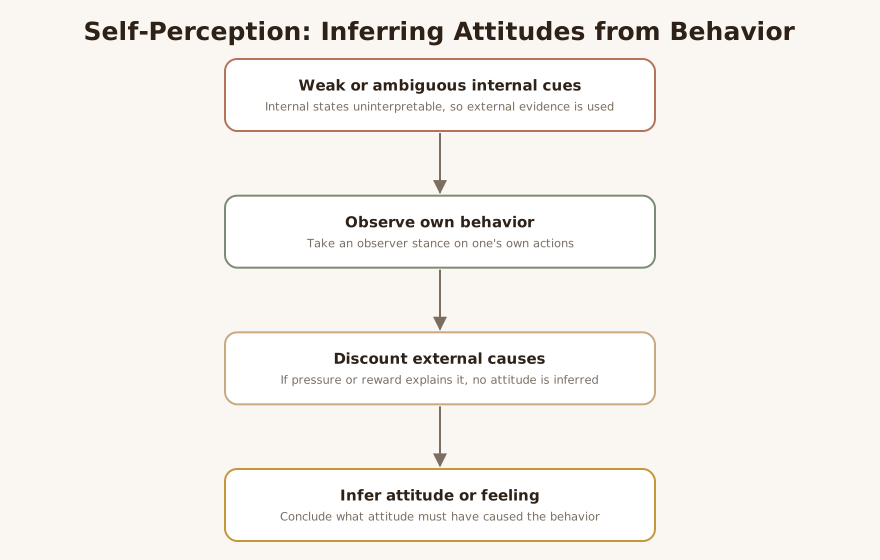
Self-perception theory is one of those social-psychology ideas that quietly underwrites a great deal of what works in behavioral therapy. It is not a treatment. It is a claim about self-knowledge: that we do not always read our attitudes and feelings off some inner dial, but often infer them backward from what we observe ourselves doing 1. Once a clinician sees this, the logic of behavioral activation, exposure, and “behave your way into a new feeling” stops being folk wisdom and becomes a mechanism LLM.
Type & Discipline
Self-perception theory is a descriptive theory drawn from social psychology, specifically the study of attitude formation and self-knowledge 2. Its central claim, advanced by Daryl Bem in 1967 and elaborated in 1972, is that “individuals come to know their own attitudes, emotions, and other internal states partially by inferring them from observations of their own overt behavior and the circumstances in which this behavior occurs” 2. The theory deliberately treats the self as, in effect, an outside observer: when a person’s internal cues are weak, ambiguous, or hard to interpret, the individual is “functionally in the same position as an outside observer” and must rely on external behavioral cues to infer the inner state 2. This is a counterintuitive reversal of the commonsense view that attitudes cause behavior; here, observed behavior is a source of attitude 3. Although it began as a basic account of how people make causal sense of themselves, it has been extended into clinical, health, and consumer-behavior domains 4.
Creators & Lineage
The theory was developed by the social psychologist Daryl Bem, who first articulated it in 1967 and gave it its fullest statement in a 1972 chapter in Advances in Experimental Social Psychology 12. Bem’s original motivation was partly polemical: he proposed self-perception as a parsimonious, behaviorist-flavored alternative explanation for findings that had been credited to Leon Festinger’s cognitive dissonance theory 2. Where dissonance theory posited an aversive internal drive state that people act to reduce, Bem argued that no such inner tension was necessary; the same attitude-change results could be explained by people simply inferring their attitudes from their behavior, as any observer would 2.
Bem’s account is openly indebted to behaviorism and to the radical-behaviorist idea that even self-reports of private states are learned, behavior-anchored verbal responses 3. It also sits alongside attribution theory, since self-perception is essentially attribution turned inward: the person makes a causal inference about themselves from observed action and context LLM. The “Bem versus Festinger” debate ran for years and was, in part, resolved by recognizing that the two theories describe different conditions rather than competing universally 2. For clinicians, the lineage that matters most runs forward, not backward: the behavioral logic of self-perception is the conceptual engine inside behavioral activation and other “action precedes mood” interventions in cognitive behavioral therapy LLM.
Core Principles
The first principle is behavioral inference: people partly determine their own attitudes and feelings by observing their behavior and concluding what attitude must have caused it 2. The second is the weak-cue boundary condition, which is the single most important qualifier for clinical use: self-perception operates primarily when internal cues are weak, ambiguous, or uninterpretable, and the person therefore falls back on external behavioral evidence 2. When internal states are strong and clear, people read them directly and do not need to infer 3.
A third principle is the observer stance: the individual infers their own state using the same external evidence an outside observer would use, which is why self-perception is sometimes called self-attribution 2. A fourth is discounting and context-sensitivity: if the behavior is obviously caused by external pressure, reward, or coercion, the person will not infer a corresponding internal attitude from it, because the situational cause “explains away” the behavior 3. This is why a freely chosen action shapes self-concept far more than a coerced one LLM. Together these principles predict that behavior reliably changes attitudes and emotions only under specific conditions, a nuance that distinguishes the theory from naive “fake it till you make it” advice LLM.
Interventions & Techniques
Self-perception theory does not prescribe a protocol, but it explains why several established behavioral techniques work, and it sharpens how to deliver them LLM. The most direct application is behavioral activation: scheduling and completing valued or mastery-giving activity, from which a depressed client can begin to infer “I am someone who does things,” countering a depleted self-concept 4. The theory predicts this works best when the activity is experienced as self-initiated rather than coerced, so clinicians should maximize the client’s sense of choice and ownership LLM.
A second application is the foot-in-the-door sequence, a classic self-perception phenomenon: agreeing to a small request makes a person more likely to agree to a larger one, because they infer from the first action that they are the kind of person who does such things 25. Translated to therapy, this is the logic of shaping change through small, escalating behavioral commitments LLM. A third is emotion work via behavior and labeling: because people partly infer emotion from behavior and context, clinicians can attend to posture, expression, and action as inputs to felt state, and can help clients re-examine how they are labeling ambiguous arousal 2. A fourth is identity-consistent action in recovery and identity work: repeatedly enacting a new role lets the client infer a new self-description LLM.
LLM-generated illustrative example (not a guideline): A withdrawn, anhedonic client insists, “I have no motivation and I’m just not a social person.” Rather than debating the belief, the clinician negotiates one small, freely chosen step, texting a friend to meet for coffee. The following week the client notes, almost surprised, “I guess I did want to see people.” The action supplied the evidence the depleted internal cue could not LLM.
Evidence Base
Self-perception theory is an established theory within social psychology, with decades of experimental support, and it remains a standard entry in textbooks and research reviews 24. Its most cited supporting phenomena include foot-in-the-door compliance effects and the overjustification effect, in which offering an external reward for an already-enjoyed activity can reduce intrinsic interest, consistent with people re-inferring their attitude from the now externally-justified behavior 2. The theory’s resilience came in part from showing that it could account for dissonance findings without invoking an inner drive state, which forced the field to specify when each theory applies 2.
The honest caveats are several. First, self-perception and cognitive dissonance are now generally seen as complementary rather than rival: dissonance processes dominate when behavior is clearly counter-attitudinal and discrepant, while self-perception dominates when the behavior falls within a person’s “latitude of acceptance” and internal cues are weak 2. Second, “established theory” is not “established therapy”; as a clinical tool, self-perception operates downstream, embedded inside behavioral activation and other behavioral methods rather than as a standalone evidence-based modality 4LLM. Third, the boundary condition is real and limiting: when clients have strong, clear internal states, behavior-to-attitude inference is weak, so the mechanism cannot be assumed to fire in every case 2LLM.
Populations & Indications
The framework applies broadly across adults and adolescents and is most clinically useful with clients in behavioral therapy, where the action-to-attitude pathway is already the working medium 4LLM. It is especially apt for people with low self-awareness or weak access to internal states, because the weak-cue condition is precisely where self-perception does its work 2LLM. It speaks directly to identity formation, including adolescents and others constructing a self-narrative, who refine self-descriptions by observing the choices they make 3LLM. In addiction recovery, repeatedly enacting recovery-consistent behavior gives the client behavioral evidence for an emerging “person in recovery” identity LLM. The strongest single indication is the depressed or avoidant client whose self-report (“I can’t, I don’t want to, that’s not me”) is treated as an inference open to revision through new behavioral evidence 4LLM.
Problems-for-Work
Self-perception theory gives clinicians a mechanism-level vocabulary for a cluster of presenting problems LLM.
- Motivation deficits and behavioral activation needs. Waiting to feel motivated before acting inverts the self-perception sequence; acting first supplies the evidence from which motivation and engagement are inferred 4LLM.
- Avoidance. Each avoided situation furnishes self-evidence of incapacity; graded approach behavior generates contrary evidence the client can observe in themselves LLM.
- Maladaptive self-concept and low self-esteem. A global “I’m worthless” can be treated as an over-generalized self-inference that targeted mastery behavior begins to contradict 4LLM.
- Attitude/behavior incongruence. When stated values and actions diverge, small value-consistent actions let the client infer and consolidate the endorsed attitude 2LLM.
- Emotional misattribution. Because emotion is partly inferred from arousal and context, clients can mislabel ambiguous arousal; clarifying the actual context corrects the inference 2LLM.
- Identity confusion. Observing one’s own freely chosen patterns of action becomes data for a clearer self-description 3LLM.
LLM-generated illustrative example (not a guideline): A client in early recovery says, “I’m not really a ‘sober person,’ I’m just white-knuckling it.” Over weeks of attending meetings, declining drinks, and helping a newer member, the behavioral record accumulates. The clinician simply reflects the pattern back, and the client begins to infer the identity the behavior already supports LLM.
Contraindications, Cautions & Cultural Humility
The first caution is the boundary condition itself: where internal cues are strong and clear, behavior-to-attitude inference is weak, so clinicians should not assume that “just do the behavior” will reliably shift a firmly held feeling 2LLM. The second is the discounting principle: behavior experienced as coerced, externally rewarded, or imposed will not produce attitude change and may even backfire via overjustification, so interventions should preserve genuine choice and avoid heavy external contingencies for behavior you want internalized 2LLM. Pushing a client to act “as if” in a way that feels false can also breed self-distrust rather than insight LLM.
A serious cultural and ethical caution applies to identity and attitude “shaping.” Using self-perception logic to nudge a client toward a self-concept the clinician prefers, rather than one the client values, is manipulative; the technique’s power over self-attribution is exactly why it requires transparency and consent LLM. Self-narrative and the very weight placed on internal versus situational explanation are also culturally shaped, so a clinician should not assume that a client’s situational or relational self-account is a deficit in self-awareness rather than a different, valid model of selfhood LLM. As with attribution work generally, the categories are heuristics to hold loosely, not facts to impose LLM.
Treatment-Plan Suggestions & SMART Objectives
| Goal | SMART objective (example) | Mechanism |
|---|---|---|
| Build motivation through action | Within 4 weeks, client will complete and log at least 3 scheduled activation activities per week, rated for mastery/pleasure | Action supplies behavioral evidence from which engagement is inferred 4 |
| Reduce avoidance | Over 6 sessions, client will complete a weekly graded approach step and record what the action implies about their capability | New approach behavior generates self-evidence contradicting “I can’t” LLM |
| Revise a global negative self-concept | By week 8, client will identify 2 weekly instances where their behavior contradicts “I’m worthless” and state the revised self-inference | Targeted mastery behavior contradicts over-generalized self-attribution 4LLM |
| Consolidate a recovery identity | Over 8 weeks, client will enact 3 recovery-consistent actions weekly and journal the implied self-description | Repeated freely chosen action lets client infer an emerging identity LLM |
| Align values and behavior | Within 5 sessions, client will take one small value-consistent action between sessions and note the attitude it confirms | Value-consistent action lets client infer and endorse the attitude 2 |
| Correct emotional misattribution | By week 6, client will use a 3-column log (situation, arousal, label) to re-examine the actual cause of an ambiguous feeling 3x/week | Clarifying context corrects behavior/arousal-based emotion inference 2 |
| Strengthen self-knowledge | Within 6 sessions, client will review a record of their own choices and name 2 stable preferences observed in their behavior | Observing one’s own action builds clearer self-description 3 |
Common Misconceptions
The most damaging misconception is that self-perception is just “fake it till you make it,” with no conditions attached; in fact the theory specifies that the inference operates mainly when internal cues are weak and the behavior is freely chosen, so coerced or strongly counter-attitudinal action does not reliably produce it 2LLM. A second is that self-perception replaced or defeated cognitive dissonance theory; the mature view is that they are complementary, each governing different conditions of behavior and internal-cue strength 2. A third is that the theory claims people have no introspective access to their own states at all; Bem’s claim is the more limited one that self-inference becomes the route only when internal cues are weak or ambiguous 23. A fourth, more practical error is assuming that piling on external rewards will deepen a desired attitude; under the overjustification logic, salient external rewards can crowd out the internal attribution you were trying to build 2LLM.
Training & Certification
There is no certification in self-perception theory, and none is needed; it is a conceptual model, not a credentialed therapy LLM. Clinicians typically meet it in graduate social-psychology coursework and then absorb its logic through training in behavioral activation and cognitive behavioral therapy, where the action-to-attitude pathway is operationalized as technique 4LLM. Competence comes from supervised behavioral practice and from understanding the theory’s boundary conditions well enough to know when the mechanism will and will not fire, rather than from any standalone course 2LLM.
Key Terms
- Self-perception: inferring one’s own attitudes, emotions, and internal states from observation of one’s own behavior and its context 2.
- Weak-cue (boundary) condition: self-perception operates chiefly when internal cues are weak, ambiguous, or uninterpretable 2.
- Observer stance / self-attribution: the person infers their state using the same external evidence an outside observer would use 2.
- Discounting: behavior visibly caused by external pressure or reward does not yield a corresponding internal-attitude inference 3.
- Overjustification effect: rewarding an intrinsically enjoyed activity can reduce intrinsic interest, consistent with re-inferring attitude from externally justified behavior 2.
- Foot-in-the-door: agreeing to a small request increases compliance with a larger one, via inference about the kind of person one is 25.
- Latitude of acceptance: the range of behavior within which self-perception, rather than dissonance, tends to govern attitude change 2.
Resources & Further Reading
▶ Watch — a video introduction to this concept:
- Self-Perception Theory (Bem, 1972), Advances in Experimental Social Psychology — ScienceDirect
- Self-perception theory — Wikipedia
- Self-Perception Theory in Social Psychology — iResearchNet
- Self-Perception Theory (SPT) — EBSCO Research Starters
- Self-Perception Theory — The Decision Lab
- Self-Perception Theory (Bem) — Learning Theories
Reflective / Supervision Questions
- When a client tells me “that’s just not who I am,” am I treating that as a fixed fact or as a self-inference that new behavioral evidence could revise? LLM
- For this client, are internal cues strong and clear (where behavior-to-attitude inference will be weak) or weak and ambiguous (where self-perception is most likely to operate)? 2
- Am I preserving the client’s genuine sense of choice in any behavioral assignment, or am I introducing external pressure that could trigger discounting and undermine internalization? 2
- Where am I using self-perception logic to help a client clarify their own valued identity versus subtly steering them toward a self-concept I prefer? LLM
- Could this client’s situational or relational self-account be a culturally valid model of selfhood rather than a deficit in self-awareness? LLM