
Type & Discipline
Regulatory Focus Theory (RFT) is a theory of motivation and self-regulation within social and motivational psychology, not a packaged psychotherapy 3. It describes how people pursue valued end-states rather than what they want, distinguishing two self-regulatory orientations that shape strategy, affect, and decision-making 3. For clinicians, its value is as a transtheoretical lens on motivation that can be layered onto existing modalities, not as a standalone treatment LLM. Throughout this article, the core constructs are well-supported by basic research, while their translation into clinical technique is reasoned extrapolation flagged as LLM LLM.
Creators & Lineage
RFT was formulated by E. Tory Higgins at Columbia University and presented in its mature form in his 1998 chapter “Promotion and Prevention: Regulatory Focus as a Motivational Principle” 1. It grew directly out of Higgins’s earlier self-discrepancy theory, which mapped the gap between the actual self and two distinct self-guides — the ideal self (hopes and aspirations) and the ought self (duties and obligations) 1. RFT extended that work by linking the ideal self to a promotion system and the ought self to a prevention system 1. The framework sits alongside broader approach–avoidance motivation theory and the hedonic principle that people approach pleasure and avoid pain, which RFT refines by specifying two different ways that principle operates 3. Its emphasis on goals, strategies, and self-regulation places it in close conceptual company with social-cognitive accounts of motivation LLM.
Core Principles
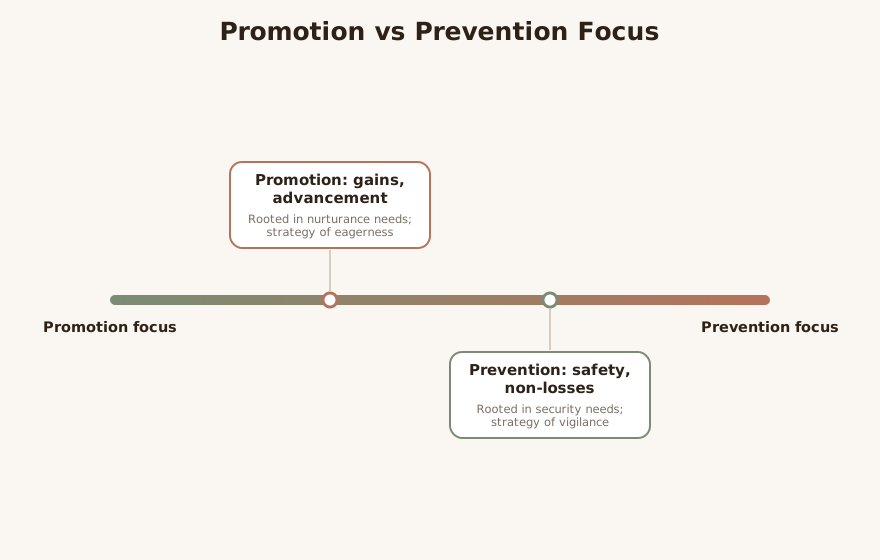
The central claim is that goal pursuit is organized by one of two foci 3. A promotion focus is concerned with advancement, growth, ideals, gains, and accomplishments; it is rooted in nurturance needs and oriented toward the presence and absence of positive outcomes 3. A prevention focus is concerned with safety, security, responsibility, and the avoidance of losses; it is rooted in security needs and oriented toward the presence and absence of negative outcomes 3.
A key subtlety is that the distinction is structural, not emotional 4. A prevention-focused person can be optimistic about avoiding threats, and a promotion-focused person can doubt their capacity to reach their ideals — the focus describes the kind of goal, not the mood 4. Each focus recruits a characteristic strategy: promotion favors eagerness (trying many routes, saying yes, tolerating uncertainty to maximize hits), while prevention favors vigilance (eliminating possibilities, saying no, minimizing errors) 4. Crowe and Higgins demonstrated this in recognition tasks where promotion participants maximized hits and prevention participants minimized false alarms 4.
The foci also carry distinct emotional signatures 4. Promotion success produces cheerfulness and elation while promotion failure yields dejection and disappointment; prevention success produces calm and relief while prevention failure yields anxiety and worry 4. This affective mapping is the bridge most relevant to mood and anxiety presentations LLM.
The theory’s signature mechanism is regulatory fit: when a person’s strategy matches their focus — eager means for a promotion goal, vigilant means for a prevention goal — the pursuit “feels right,” intensifying engagement and the sense that one is doing the right thing 4. Fit is consequential: in Higgins’s research, participants would pay substantially more for identical items under fit conditions, though a later meta-analysis placed the average fit effect in the moderate range (around d = 0.30), meaningful but not transformative 4.
Interventions & Techniques
RFT does not prescribe a protocol; clinicians adapt its principles into existing work LLM. The most direct application is message and goal framing matched to focus — couching change talk in gain/advancement language for promotion-oriented clients and in safety/non-loss language for prevention-oriented clients, leveraging fit to raise engagement 4. A second technique is strategy–focus alignment: helping a vigilant, prevention-leaning client set careful, error-minimizing, step-by-step plans, while encouraging an eager, promotion-leaning client to brainstorm broadly and tolerate early uncertainty 4. A third is assessment of chronic versus situational focus, recognizing that focus can be a stable individual difference or primed momentarily by context and language 3.
LLM-generated illustrative example (not a guideline): For a prevention-focused client ambivalent about exposure work, the clinician frames practice as “protecting the gains you’ve already made and keeping anxiety from taking more ground,” rather than “reaching your full potential,” to create fit and reduce resistance LLM.
Evidence Base
Honesty about maturity requires separating two questions LLM. The basic-science status of RFT is established: the promotion/prevention distinction, the eagerness/vigilance strategies, and regulatory fit are supported by a substantial experimental literature spanning persuasion, decision-making, consumer behavior, and health messaging 3. Message framing matched to a recipient’s focus reliably increases persuasiveness and engagement, and fit effects replicate across many paradigms, albeit at moderate average magnitude 4.
The clinical-outcome status is far less mature LLM. There is no robust body of randomized trials showing that RFT-based therapy improves mental-health outcomes; the constructs are imported into treatment as a heuristic rather than validated as an intervention LLM. Clinicians should treat the populations, problems, and treatment-plan material below as theory-informed reasoning, not empirically demonstrated efficacy LLM.
A specific measurement caution sharpens the picture 2. The two dominant self-report instruments — the Regulatory Focus Questionnaire (RFQ) and the General Regulatory Focus Measure (GRFM) — show minimal convergence and load on different factors, with the RFQ tracking a self-guide (ideals vs. obligations) definition and the GRFM a reference-point (gains vs. losses) definition 2. The GRFM also correlated with positive affect (r = .31) and negative affect (r = .39), violating the theoretical claim that regulatory focus is independent of emotional valence, whereas the RFQ did not 2. The authors concluded it is difficult to disentangle the reference-point definition from affectivity using self-report, so findings from one scale cannot be assumed to replicate with another 2. Clinically, this means any “focus score” should inform formulation cautiously, never diagnostically LLM.
Populations & Indications
RFT is most useful where motivation, ambivalence, or goal structure is central to the work LLM. Clients in motivational treatment and those with low treatment adherence are natural candidates, because matching framing to focus is a low-cost lever on engagement 4. Adults with depression are indicated targets because depressive anhedonia and approach deficits resemble a weakened or failing promotion system, whose failure signature is precisely dejection 4. Anxiety-disorder patients map onto an overactive prevention system, whose failure signature is anxiety and worry 4. People pursuing health-behavior change and goal-oriented clients benefit from fit-based framing that the persuasion literature most directly supports 4. These indications are conceptual matches, not validated selection criteria LLM.
Problems-for-Work
Approach and avoidance motivation. RFT gives a vocabulary for whether a client is moving toward gains or away from threats, informing how goals are framed 3.
LLM-generated illustrative example (not a guideline): A client who only ever describes goals as “not failing” is helped to articulate one promotion-framed aim (“build a portfolio I’m proud of”) to widen their motivational range LLM.
Depression (anhedonia / approach deficits). A blunted promotion system can be addressed by rebuilding small, eager, gain-oriented behavioral steps 4.
LLM-generated illustrative example (not a guideline): In behavioral activation, the clinician deliberately labels scheduled activities by what they add rather than what they prevent, to re-engage a promotion orientation LLM.
Anxiety (avoidance / prevention focus). An overactive prevention system can be worked by validating the security need while loosening rigid vigilance 4.
Procrastination and behavior-change resistance. Misfit between a client’s focus and the strategy being asked of them can masquerade as resistance, and is often resolved by re-framing rather than confrontation 4.
LLM-generated illustrative example (not a guideline): A vigilant client stalled by an “imagine your best possible self” exercise re-engages when the same goal is reframed as “secure what matters most to you” LLM.
Contraindications, Cautions & Cultural Humility
RFT carries no inherent contraindication, but several cautions apply LLM. Because self-report focus measures are unreliable and affect-contaminated, clinicians should not label a client as “a promotion type” or “a prevention type” as if it were a fixed trait or diagnosis 2. Focus is both a chronic individual difference and a state that situations and language can prime, so formulations should stay flexible 3. Cultural humility matters because what counts as advancement, duty, security, or loss is shaped by cultural context, family role, and socioeconomic reality; a clinician’s promotion-framed “reach your potential” may not fit a client for whom safeguarding family obligations is the salient goal LLM. The structural-not-emotional principle also guards against misreading a calm prevention-focused client as unmotivated or an anxious one as treatment-resistant 4.
Treatment-Plan Suggestions & SMART Objectives
| Goal | SMART objective (example) | Mechanism |
|---|---|---|
| Increase treatment engagement | Within 4 sessions, client identifies whether each weekly goal is gain-oriented or safety-oriented in 3 of 4 check-ins | Building focus awareness to enable matched framing 3 |
| Reduce avoidance-driven inaction | Over 6 weeks, client completes one previously avoided task per week using a vigilance-matched, error-minimizing plan | Regulatory fit lowers felt resistance 4 |
| Re-engage approach motivation in depression | Within 30 days, client schedules and completes 2 gain-framed pleasant activities weekly | Reactivating a blunted promotion system 4 |
| Improve health-behavior adherence | For 8 weeks, client follows a focus-matched reminder script for medication or exercise, logged daily | Fit-based framing raises persuasive impact 4 |
| Soften rigid prevention vigilance | Within 8 sessions, client tolerates one planned, low-stakes “imperfect” action weekly without corrective ritual | Loosening over-vigilant strategy 4 |
| Broaden goal repertoire | By session 10, client articulates at least one promotion goal and one prevention goal for a target domain | Naming both self-guides to widen range 1 |
| Reduce procrastination from misfit | Over 4 weeks, client reframes one stalled task per week into focus-congruent language and starts it within 48 hours | Resolving strategy–focus misfit 4 |
Common Misconceptions
A frequent error is treating promotion and prevention as good versus bad or optimistic versus pessimistic; both are functional systems, and the distinction is about the type of goal, not the desirability of the person or their mood 4. A second misconception is that focus is a permanently fixed trait, when in fact it can be primed situationally as well as held chronically 3. A third is assuming the two main questionnaires measure the same thing, when evidence shows they diverge and one is affect-contaminated 2. A fourth is reading regulatory fit as a large, reliable lever; the average effect is moderate, useful but not magical 4. Finally, the basic-science maturity of the constructs is sometimes mistaken for evidence that RFT-based therapy is itself validated, which it is not LLM.
Training & Certification
There is no credential, license, or certification in “Regulatory Focus Therapy,” because RFT is a basic theory rather than a manualized treatment LLM. Clinicians develop competence by reading Higgins’s foundational work and the surrounding experimental literature, then integrating the framing and strategy-matching ideas into modalities they are already trained in, such as motivational interviewing or cognitive behavioral therapy 1. Familiarity with the measurement cautions is part of responsible use, so that focus assessment informs rather than distorts formulation 2.
Key Terms
Promotion focus — a self-regulatory orientation toward advancement, gains, ideals, and accomplishment, rooted in nurturance needs 3.
Prevention focus — a self-regulatory orientation toward safety, responsibility, and avoiding losses, rooted in security needs 3.
Ideal self / ought self — the two self-guides from self-discrepancy theory that anchor the promotion and prevention systems respectively 1.
Eagerness vs. vigilance — the contrasting strategic means, maximizing hits versus minimizing errors, characteristic of promotion and prevention 4.
Regulatory fit — the “feels right” state arising when strategy matches focus, intensifying engagement 4.
Chronic vs. situational focus — focus as a stable individual difference versus a state primed by context or language 3.
Resources & Further Reading
▶ Watch — a video introduction to this concept:
- Higgins, E. T. (1998). Promotion and Prevention: Regulatory Focus as a Motivational Principle (Advances in Experimental Social Psychology)
- Self-Report Measures of Individual Differences in Regulatory Focus: A Cautionary Note (PMC)
- Regulatory focus theory (Wikipedia)
- Regulatory Focus Theory Guide: Promotion vs Prevention (Yu-kai Chou)
Reflective / Supervision Questions
- When I set goals with a client, do I default to promotion-framed language (“reach your potential”) regardless of whether it fits their focus? LLM
- How would I notice the difference between a calm prevention-focused client and a disengaged one, given identical surface affect? 4
- Where in my caseload might apparent “resistance” actually be strategy–focus misfit that reframing could resolve? 4
- Am I treating any focus assessment as a stable trait when it may be situationally primed or measurement artifact? 2
- How does a client’s cultural and family context shape what counts as advancement versus security for them? LLM