
Type & Discipline
Self-Discrepancy Theory is a theory of the relationship between self-structure and affect, situated within social-cognitive psychology 1. It is not a treatment modality in itself; it is an explanatory framework about how the organization of a person’s self-beliefs generates specific emotional vulnerabilities 1. Its native home is the literature on motivation and self-concept, and it has since been absorbed into clinical thinking as a way to understand why two clients with comparably low self-esteem can present with entirely different affective profiles — one chronically sad, the other chronically anxious 1LLM.
The theory belongs to a broader family of cognitive theories of emotion, which hold that emotional states follow from how people appraise and represent their situations rather than from events alone 1. What distinguishes Self-Discrepancy Theory from generic inconsistency models is its central claim of emotional specificity: different kinds of self-belief mismatch are predicted to produce different, identifiable kinds of distress, not merely undifferentiated discomfort 1. For clinicians, that specificity is the clinically useful part — it offers a map from a self-structure to a likely symptom cluster LLM.
Creators & Lineage
The theory was formulated by E. Tory Higgins and published in Psychological Review in 1987 1. Higgins explicitly positioned it as the heir to a long tradition relating self-conflict to emotional problems — citing James, Cooley, Mead, Freud, Adler, Horney, and Rogers among its ancestors — while aiming to do something those earlier accounts did not: distinguish which discomfort follows from which discrepancy 1.
Its proximal lineage runs through cognitive dissonance and balance theories (Festinger, Heider) on the question of belief inconsistency, and through self-concept and social-cognitive theory on the structure of self-knowledge 12. Downstream, Higgins’s own work extended Self-Discrepancy Theory into Regulatory Focus Theory, which reframes the ideal/ought distinction as two motivational systems — a promotion focus oriented toward gains and an prevention focus oriented toward avoiding losses 3. Later theorists added refinements: Carver and colleagues proposed a “feared self” domain, recognizing that people often work harder to avoid a dreaded self than to approach an ideal one 2. June Price Tangney and collaborators then subjected the specificity claims to rigorous test, a contribution discussed in the Evidence section 4.
Core Principles
The theory is built from two simple dimensions that combine to define a person’s self-structure 1.
Three domains of the self. The actual self is the representation of the attributes a person believes they currently possess — the self-concept 1. The ideal self is the representation of the attributes someone hopes, wishes, or aspires to have 1. The ought self is the representation of the attributes a person believes they have a duty, responsibility, or obligation to possess 1. The ideal and ought selves together function as self-guides — internalized standards against which the actual self is continuously, often automatically, compared 3.
Two standpoints. Each domain can be held from the person’s own standpoint or from the standpoint of a significant other (a parent, partner, or other important figure whose perspective the person has internalized) 1. Crossing three domains with two standpoints yields the self-state representations Higgins worked with, and clinical attention has focused on four discrepancies in particular: actual/own versus ideal/own, actual/own versus ideal/other, actual/own versus ought/own, and actual/own versus ought/other 1.
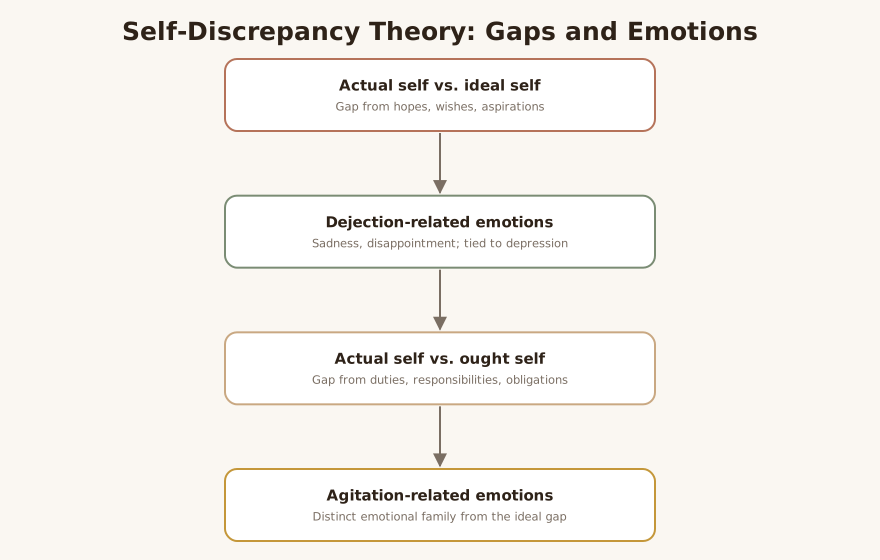
Two discrepancies, two emotional families. This is the heart of the theory. A gap between the actual self and an ideal self-guide signifies the absence of positive outcomes and is associated with dejection-related emotions — disappointment, dissatisfaction, sadness, and the affective signature of depression 1. A gap between the actual self and an ought self-guide signifies the presence of negative outcomes and is associated with agitation-related emotions — fear, threat, edginess, guilt, and the affective signature of anxiety 1. The two situations are psychologically distinct: one is a story of something good missing, the other a story of something bad impending 1.
Magnitude, availability, and accessibility. A self-discrepancy must first be available (it exists in the person’s self-structure with some magnitude of divergence) and then accessible (currently activated) to influence feeling 1. Accessibility rises with the recency and frequency of activation and with the discrepancy’s applicability to the present situation 2. Chronic, highly accessible discrepancies are the ones that produce stable emotional vulnerabilities, and a discrepancy that is large but dormant may exert little influence until something in the environment primes it 13.
Interventions & Techniques
Self-Discrepancy Theory is a model, not a manualized treatment, so its clinical use is in assessment and case formulation and in guiding the targets of existing therapies LLM.
Assessment. The classic measure is the Selves Questionnaire, in which clients list the attributes of their actual, ideal, and ought selves from own and other standpoints; discrepancies are then scored by comparing the lists for matches and mismatches 3. In practice clinicians rarely administer the formal instrument and instead elicit the same material conversationally — asking what the client believes they are like, what they wish they were like, and what they feel they should or must be like LLM.
Mapping affect to structure. Once the discrepancies are surfaced, the clinician uses the affective signature to confirm the formulation: a predominantly dejected, “I’m falling short of who I want to be” presentation points toward actual/ideal work, while a predominantly tense, “I’m failing my obligations and something bad will follow” presentation points toward actual/ought work 1LLM.
Closing or reframing the gap. Interventions then aim either to move the actual self toward the guide through behavioral change and graded goals, to revise an unrealistic or borrowed guide through cognitive restructuring, or to reduce the accessibility of a chronic discrepancy through self-compassion and acceptance work 6. Importantly, the theory predicts that which of these targets will relieve which symptom: softening a punishing ought standard should preferentially reduce agitation, whereas making progress toward an ideal should preferentially reduce dejection 1LLM.
LLM-generated illustrative example (not a guideline): A graduate student reports flat, defeated sadness and the recurring thought, “I should have been further along by now.” The clinician notices this is framed as aspiration rather than obligation, formulates a large actual/ideal discrepancy, and structures sessions around realistic ideal-self standards and small, achievable mastery goals — rather than the reassurance-and-safety strategies that would better fit an actual/ought, agitation-driven picture LLM.
Evidence Base
The maturity of Self-Discrepancy Theory is best described as established: it is a widely cited, decades-old framework with substantial correlational and experimental support, and it remains a standard reference in personality and clinical psychology 12. Higgins’s original paper reported both correlational and experimental evidence that actual/ideal discrepancies predicted dejection and actual/ought discrepancies predicted agitation 1.
Honesty requires noting that the specificity claim — the cleanest and most clinically attractive part of the theory — has not held up uniformly 2. Tangney and colleagues (1998) tested whether shame and guilt map onto distinct self-discrepancies and found that the predicted unique relations were not consistently obtained, challenging the strong form of emotional specificity 4. Higgins’s own response reframed the field’s question from “Is there an effect?” to “When is there an effect?” — pointing to moderators such as the magnitude, accessibility, applicability, and personal importance of a discrepancy as the conditions under which specific discrepancy–emotion links emerge 4. Subsequent work on individual differences supports this conditional reading: the relationship between self-discrepancies and emotional experience is real but moderated by characteristics of the person and the discrepancy rather than being a fixed one-to-one mapping 5.
The practical upshot for clinicians: treat the actual/ideal → dejection and actual/ought → agitation mappings as clinically useful heuristics that are most trustworthy when the discrepancy is large, chronically activated, and matters to the client — not as a deterministic law 45LLM.
Populations & Indications
The framework applies broadly across adults and adolescents, the populations in which self-guides and the capacity for abstract self-comparison are well developed 1LLM. It is particularly illuminating with perfectionistic individuals, whose presenting problem often is a large, rigid, and highly accessible gap between actual and ideal (or ought) selves 6LLM. Clients with low self-esteem are a natural indication, since the theory specifically distinguishes the kind of low self-regard a person carries by which guide they fall short of 1.
The model has been applied to people with eating disorders and body image concerns, where actual/ideal and actual/ought body-related discrepancies are thought to drive different presentations — ideal-related discrepancies linked more to bulimic patterns and ought-related discrepancies to restrictive patterns in some accounts 3. More generally it speaks to anyone whose distress is organized around falling short of an internalized standard, whether that standard is self-authored or borrowed from a significant other 1.
Problems-for-Work
- Major depressive disorder / dejection-related emotions. When a client’s sadness is organized around unrealized hopes and a sense of “the good life I’ll never reach,” formulate and target the actual/ideal discrepancy and the standards feeding it 1LLM.
- Generalized and social anxiety / agitation-related emotions. When apprehension is organized around failing duties and anticipating something bad, formulate the actual/ought discrepancy, paying particular attention to ought/other standpoints in social anxiety, where the imagined standard belongs to others 12.
- Perfectionism. Make the relevant self-guide explicit, test whether it is an aspiration or an obligation, and work on its rigidity and on the magnitude of the gap 6LLM.
- Shame and guilt. Use the affective quality to probe structure, while remembering that Tangney’s findings caution against assuming shame and guilt map onto fixed, distinct discrepancies 4.
- Low self-esteem. Differentiate “I am not who I wish to be” from “I am not who I must be,” because the two call for different conversations 1LLM.
Contraindications, Cautions & Cultural Humility
There are no contraindications to thinking with this model, but there are several cautions in applying it as if its mappings were certainties LLM. The specificity findings are mixed, so a clinician who rigidly assigns every depressed client to “actual/ideal” and every anxious client to “actual/ought” will sometimes formulate incorrectly; let the client’s own language and the moderators (magnitude, accessibility, importance) guide the inference 45LLM.
The construct of self-guides is also culturally situated LLM. The ought self is built largely from internalized obligations to significant others, and the salience and content of those obligations vary substantially across more individualist and more collectivist or family-centered contexts 1LLM. What a clinician might pathologize as an oppressive ought standard may, for a given client, be a valued expression of duty and belonging; cultural humility means exploring the meaning and chosenness of a standard with the client before treating the gap itself as the problem LLM. The standpoint distinction is the useful tool here: it lets clinician and client examine whose voice a standard carries without assuming that an “other”-sourced guide is automatically maladaptive 1LLM.
Treatment-Plan Suggestions & SMART Objectives
| Goal | SMART objective (example) | Mechanism |
|---|---|---|
| Surface the client’s self-guides | Within 3 sessions, client will articulate actual, ideal, and ought self-attributes from own and other standpoints | Makes available discrepancies explicit for formulation 13 |
| Differentiate the affective driver | Within 2 sessions, client will accurately label whether distress is predominantly dejection- or agitation-related on 3 logged episodes | Aligns target with the relevant discrepancy 1 |
| Reduce a punishing ought standard | Over 8 weeks, client will reframe 2 “I must” rules as flexible preferences, rated on a tension scale | Lowers actual/ought gap and agitation-related affect 16 |
| Make progress toward an ideal | Over 6 weeks, client will complete 1 small mastery action per week aligned with a valued ideal | Narrows actual/ideal gap, reducing dejection-related affect 16 |
| Lower chronic accessibility of a discrepancy | Daily for 4 weeks, client will practice a brief self-compassion exercise when a self-critical comparison is noticed | Reduces frequency/recency of activation of the discrepancy 26 |
| Examine the source of a standard | Within 4 sessions, client will identify whose standpoint each major self-guide reflects | Clarifies own vs. other origin and chosenness of standards 1 |
| Stabilize self-esteem | Over 10 weeks, client will report a 30% reduction on a discrepancy-distress self-rating | Targets the structural source of self-regard rather than mood alone 15 |
Common Misconceptions
“Actual/ideal always means depression and actual/ought always means anxiety.” This overstates the evidence; the specific mappings are heuristics that hold best under particular conditions and were not uniformly replicated by later studies 45. “It’s a therapy you can deliver.” It is a model that informs formulation and target selection within other treatments, not a standalone protocol LLM. “Self-discrepancy is the same as low self-esteem.” Higgins drew a deliberate distinction: low self-esteem refers to negativity of the actual self, whereas self-discrepancy is about the relation between the actual self and a guide — and the theory was built partly to show that this relational structure predicts the kind of distress, not just its presence 1. “Bigger gap, more distress, full stop.” Magnitude matters only in concert with accessibility; a large but inactive discrepancy may be quiet, while a smaller, chronically primed one may dominate 1.
Training & Certification
There is no certification in Self-Discrepancy Theory; it is academic knowledge, not a credentialed modality LLM. Clinicians typically encounter it within graduate coursework in personality, social, or clinical psychology, and engage the primary literature directly through Higgins’s 1987 paper and the subsequent specificity debate 14. The most efficient path to competent clinical use is to read the original theory, read at least one critical test of it, and then practice eliciting actual/ideal/ought material and standpoints in supervision so the formulation skill becomes routine 14LLM.
Key Terms
- Actual self — representation of attributes one believes one currently has; the self-concept 1.
- Ideal self — representation of attributes one hopes or aspires to have 1.
- Ought self — representation of attributes one believes one has a duty or obligation to have 1.
- Self-guide — an ideal or ought representation serving as a standard for the actual self 3.
- Standpoint (own / other) — whose perspective a self-representation reflects: the person’s own, or an internalized significant other’s 1.
- Dejection-related emotions — sadness, disappointment, dissatisfaction; tied to actual/ideal discrepancies and the absence of positive outcomes 1.
- Agitation-related emotions — fear, threat, guilt, edginess; tied to actual/ought discrepancies and the presence of negative outcomes 1.
- Availability vs. accessibility — whether a discrepancy exists in the self-structure versus whether it is currently activated and thus influential 1.
Resources & Further Reading
▶ Watch — a video introduction to this concept:
- Higgins, E. T. (1987). Self-discrepancy: A theory relating self and affect. Psychological Review, 94(3), 319-340.
- Self-discrepancy theory — Wikipedia
- Self-Discrepancy Theory in Social Psychology — iResearchNet
- Tangney et al. (1998), Are shame and guilt related to distinct self-discrepancies? — PubMed
- Individual differences in self-discrepancies and emotional experience — ScienceDirect
- Unveiling the Layers of Self: Higgins’ Self-Discrepancy Theory — Psychology Fanatic
Reflective / Supervision Questions
- For my last three clients presenting with self-criticism, did I distinguish whether the distress was dejection- or agitation-related, or did I treat “low self-esteem” as a single undifferentiated target? LLM
- When I infer an actual/ought discrepancy from a client’s anxiety, am I checking the standpoint — is this the client’s own obligation, or one they have internalized from a significant other? 1LLM
- Where am I treating the theory’s emotion mappings as facts rather than heuristics, and what client data would tell me the formulation is wrong? 4LLM
- For a self-guide that looks “too high,” have I explored its cultural meaning and chosenness before framing it as a problem to be lowered? LLM
- Am I tracking accessibility — what primes a client’s chronic discrepancy in daily life — or only its content? 1LLM