
Type & Discipline
The Wellness Recovery Action Plan (WRAP) is a structured self-management planning process rather than a psychotherapy — it is a framework a person follows to build and use an individualized wellness plan, not a clinician-delivered treatment technique 7. It belongs to the discipline of mental health recovery and the broader family of peer-led self-management approaches 5. Disseminators describe it as “an evidence-based, self-directed wellness process for anyone who wants to get well, stay well, and create the life they want — despite life’s challenges,” functioning as both a prevention and a recovery tool 5. Its defining feature is that the person in recovery is the author and owner of the plan: people develop their own WRAP, drawing on their own knowledge of what keeps them well 7.
Two characteristics distinguish WRAP from clinician-authored relapse-prevention plans LLM. First, it is self-directed — the content is generated by the individual rather than prescribed, and it focuses on strengths rather than perceived deficits 7. Second, it is most often peer-facilitated, taught in groups led by trained facilitators with their own lived experience of recovery, rather than delivered by professionals as an expert intervention 5. WRAP is also explicitly voluntary and trauma-informed, which shapes both how it is taught and what kinds of plans it produces 7.
Creators & Lineage
WRAP was developed in 1997 by a group led by Mary Ellen Copeland following an eight-day peer gathering in northern Vermont 1. Copeland had personally struggled with anxiety, depression, and extreme mood swings that led to hospitalizations and social isolation, and she came to her work as someone seeking strategies that the medication-focused psychiatry of her era had not provided 1. Her development process began empirically: she surveyed 125 peers about the strategies they used to get and stay well, and from their responses she distilled five foundational recovery concepts — hope, personal responsibility, education, self-advocacy, and support — along with a set of practical wellness techniques 1.
The plan itself took shape at the Vermont retreat, where participants collaboratively identified strategies for preventing crises and maintaining wellness; when one participant observed that the material needed organizing, Copeland and Jane Winterling built it into a structured system they named the Wellness Recovery Action Plan 1. WRAP’s lineage runs through several overlapping traditions LLM. From the recovery model of mental health it inherits the conviction that recovery is possible and that hope and self-determination are central 7. From psychiatric rehabilitation it takes its orientation toward function, strengths, and the life the person wants rather than symptom suppression alone LLM. From the peer support movement it derives its facilitation model and its insistence that lived experience is a legitimate source of expertise 5. From illness self-management it inherits the idea that people can be taught structured skills to monitor and manage chronic conditions over time 2. WRAP was subsequently codified into a curriculum and disseminated internationally through trained facilitators 7.
Core Principles
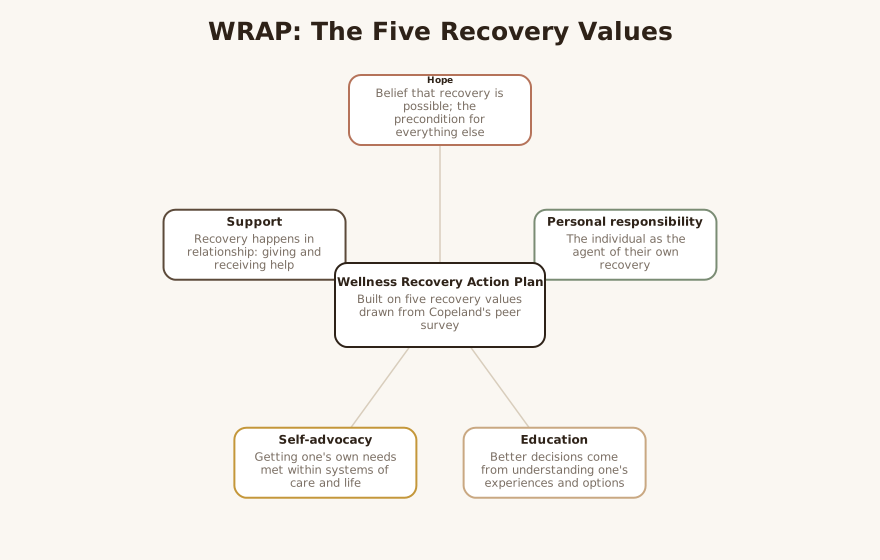
WRAP rests on the five recovery values Copeland drew from her peer survey, which function as the philosophical backbone of every plan 1. Hope — the belief that recovery is possible — is treated as the precondition for everything else 1. Personal responsibility locates the work of wellness with the individual as the agent of their own recovery rather than a passive recipient of treatment 1. Education holds that people make better decisions when they understand their own experiences, symptoms, and options 1. Self-advocacy is the capacity to get one’s own needs met within systems of care and life more broadly, and support recognizes that recovery happens in relationship — both giving and receiving help 1.
Beyond these values, the framework embeds several operating principles LLM. WRAP is self-determined: the person decides what goes in the plan, including their own definition of wellness and their own goals 2. It emphasizes wellness over illness management, prioritizing well-being and the life the person wants rather than controlling pathology alone 1. It is voluntary, trauma-informed, and strengths-based, building on what already keeps the person well so the process enhances rather than overrides their agency 7. These principles are why WRAP is best understood as a self-management framework owned by the client and supported by clinicians, rather than a protocol imposed on them LLM.
Interventions & Techniques
The core “intervention” of WRAP is the guided construction of the plan itself, which is conventionally organized into a sequence of sections 1. The first is the Wellness Toolbox: a personally generated list of the things the person knows help them feel and stay well — activities, contacts, practices, and coping strategies — which is then drawn upon throughout the rest of the plan 1. The remaining sections each deploy elements from that toolbox to a particular situation LLM.
The Daily Maintenance Plan describes how the person is when well and the daily wellness actions they need to take to stay well 1. The Triggers section identifies external events or circumstances that could provoke a worsening of symptoms, paired with an action plan for responding 1. Early Warning Signs captures the internal, often subtle signs that things may be starting to shift, again with a planned response 1. The When Things Are Breaking Down section names the signs that the person is becoming more unwell — but is still able to act — and the more intensive steps to take at that stage 1. The Crisis Plan, functioning as an advance directive, specifies what the person wants others to do when they can no longer make decisions for themselves, including whom to contact and what supports and treatments they prefer 1. Finally, the Post-Crisis Plan addresses recovery after a crisis and the resumption of wellness 1.
LLM-generated illustrative example (not a guideline): A client with bipolar I disorder might list, under Early Warning Signs, “sleeping under five hours for two nights, starting several projects at once, friends saying I’m talking fast,” paired with the action plan “tell my partner, call my prescriber for an earlier appointment, cancel non-essential commitments, and use my toolbox items.” None of this is dictated by a clinician — it is the client’s own early-detection system, built in a session and rehearsed before it is needed LLM.
WRAP is taught through this guided process, typically in peer-facilitated groups using recovery-focused books, workbooks, and training manuals, after which the person continues to use and revise their plan over time 5.
Evidence Base
The evidence maturity for WRAP is best described as established LLM. WRAP is listed in SAMHSA’s National Registry of Evidence-Based Programs and Practices (NREPP), a designation that followed years of research and is regarded as a significant marker of its evidence status 4. The most cited support comes from a body of work by Cook and colleagues, including a randomized controlled trial whose findings on depression, anxiety, and recovery were recognized by the field, with results published in venues including Psychiatric Services (2009) and Schizophrenia Bulletin (2011) 3. Across studies, the outcomes most consistently associated with WRAP participation include improved hope and recovery attitudes, increased propensity for self-advocacy, positive effects on psychiatric symptoms, and improved illness self-management 3. Additional studies — including statewide peer-led initiatives such as those in Ohio and Vermont — have similarly documented positive recovery outcomes 3.
Honesty about the evidence requires several qualifications LLM. A systematic-review protocol notes that, despite widespread international adoption, “there has been little to no synthesis of the evidence base for WRAP outside of the Copeland Center’s internal reviews,” and that the broader literature remains fragmented, with limited research across cultural and international contexts and some evaluations predating current curriculum versions 2. Disseminators themselves emphasize that the evidence applies to WRAP as studied — properly implemented and not inappropriately modified — so programs that alter the model cannot assume the same outcomes 3. The fair summary is that WRAP has genuine randomized-trial support for recovery-oriented outcomes and a recognized place on a national registry, while the depth and cultural breadth of the literature are still developing LLM.
Populations & Indications
WRAP was originally developed by and for people with serious mental illness, and much of its evidence base concerns adults living with conditions such as bipolar disorder, schizophrenia and other psychotic disorders, and major depressive disorder 23. A systematic-review protocol describes the relevant population broadly as adults with mental health challenges who are receiving mental health services and who wish to make positive changes toward their own self-defined recovery goals 2. It is well suited to peers in recovery and to people with chronic mental health conditions for whom ongoing self-monitoring and relapse prevention are clinically central 5.
In practice WRAP has been applied well beyond its original population, with disseminators describing its use across addictions, trauma, neurodiversity, physical-health conditions, major life transitions, justice-involved populations, and military service members 5. This breadth reflects WRAP’s design as a general wellness and prevention framework rather than a diagnosis-specific treatment 5. The common thread is not a particular disorder but a clinical situation in which structured self-monitoring, early intervention, and crisis planning are valuable — and in which the person is willing to take an active, self-directed role LLM. Notably, the standard systematic-review scope excludes children and adolescents, addiction-only populations, and people whose primary concern is intellectual disability, marking the edges of where WRAP’s evidence most directly applies 2.
Problems-for-Work
WRAP lends itself to a characteristic set of presenting problems, each addressed through the structure of the plan LLM:
- Relapse prevention — the Daily Maintenance Plan, Triggers, and Early Warning Signs sections together build an individualized early-detection and early-action system that catches deterioration before it escalates 1.
- Symptom self-management — the framework teaches people to monitor their own symptoms and deploy specific toolbox strategies in response, supporting the illness-self-management outcomes seen in research 3.
- Crisis management — the Crisis Plan functions as an advance directive, specifying preferences and supports for the period when the person cannot make decisions, so a crisis is met with the person’s own prior choices 1.
- Suicidality monitoring — within a clinician’s risk framework, the Early Warning Signs and Crisis Plan sections can make a person’s warning signs and protective steps explicit and rehearsed, supporting collaborative safety planning LLM.
- Medication nonadherence — because the plan is self-authored and value-driven (personal responsibility, self-advocacy), it can surface and address the person’s own reasons and supports around treatment without framing adherence as externally imposed LLM.
- Co-occurring substance use disorders — WRAP has been applied with people facing addictions, and the toolbox and trigger work can be adapted to substance-use recovery alongside mental health 5.
LLM-generated illustrative example (not a guideline): For a client with schizophrenia whose problem-for-work is relapse prevention, the WRAP process might identify the earliest reliable warning sign as “I start to think my neighbors are watching me,” paired with the planned response of contacting his case manager and sister and reviewing his medication — a sequence he wrote and can act on before symptoms become severe LLM.
Contraindications, Cautions & Cultural Humility
WRAP’s principal cautions follow from its nature as a voluntary, self-directed process LLM. Because the plan depends on the person’s willingness and capacity to author and use it, WRAP presupposes a degree of insight, engagement, and stability sufficient to do reflective planning work; it is a poor fit when imposed on someone who has not chosen it, which would contradict its own trauma-informed, voluntary design 7. Clinicians should also avoid treating a WRAP Crisis Plan as a clinical safety plan or a substitute for a thorough, ongoing suicide-risk assessment — it is the person’s own advance-directive document and complements, but does not replace, the clinician’s risk management responsibilities LLM.
Fidelity is a genuine caution: the evidence applies to WRAP as studied and not inappropriately modified, so casually altered versions cannot claim the same support 3. Cultural humility is especially important given how broadly WRAP is now used, and the systematic-review protocol explicitly notes limited research across cultural and international contexts, so clinicians cannot assume the studied outcomes transfer cleanly to every population 2. What a person counts as “wellness,” who belongs in their support network, and what they want others to do in a crisis are all culturally shaped — and the strength of WRAP is precisely that the person defines these for themselves rather than against a normative template LLM. The clinician’s role is to support that self-definition without steering it toward their own assumptions LLM.
Treatment-Plan Suggestions & SMART Objectives
| Goal | SMART objective (example) | Mechanism |
|---|---|---|
| Build a usable wellness toolbox | Client will identify and document at least eight personal wellness strategies in a written Wellness Toolbox within 4 weeks | Self-generated inventory of strategies the person knows help them stay well 1 |
| Establish a daily maintenance routine | Client will complete a written Daily Maintenance Plan and follow at least three daily wellness actions on 5 of 7 days each week for 6 weeks | Daily structure that sustains wellness and provides a baseline for detecting change 7 |
| Identify triggers and responses | Client will name three external triggers and a specific action plan for each within 3 sessions | Explicit trigger-response pairing reduces escalation from known stressors 7 |
| Recognize early warning signs | Client will list personal early warning signs and a planned response, and report any occurrence at the next session, over the next 8 weeks | Early-detection system enabling early intervention before deterioration 1 |
| Create a crisis/advance plan | Client will complete a written Crisis Plan naming supports, preferences, and contacts within 6 weeks | Advance specification of preferences for periods of incapacity 1 |
| Strengthen self-advocacy | Client will identify two needs and rehearse how to communicate them to a provider or support person within 4 weeks | Self-advocacy as a core WRAP recovery value 1 |
| Plan post-crisis recovery | Client will draft a Post-Crisis Plan describing steps to resume wellness after an acute episode within 8 weeks | Structured re-entry to wellness following crisis 1 |
| Sustain ongoing use | Client will review and update their WRAP at least monthly for the next quarter | Self-management is iterative; plans are revised as the person learns 2 |
Common Misconceptions
A frequent misconception is that WRAP is a therapy delivered by a clinician — it is a self-directed self-management framework that the person authors and owns, most often taught by trained peers rather than as a professional intervention 57. Another is that WRAP is a clinician-written relapse-prevention plan; the defining feature is that the content is generated by the individual, focused on their strengths and their own definition of wellness 7.
People also wrongly assume that WRAP is only for serious mental illness; while it was developed in that context and most of its evidence concerns those populations, it is designed and used as a general wellness and prevention framework across many populations 25. A further misconception is that any plan resembling WRAP carries WRAP’s evidence; the research applies to the model as studied and not inappropriately modified, so altered versions cannot assume the same outcomes 3. Finally, the Crisis Plan is sometimes mistaken for a clinical safety plan — it is the person’s own advance directive and complements, rather than replaces, the clinician’s risk assessment and safety planning LLM.
Training & Certification
WRAP is disseminated through a structured facilitator-training system rather than individual clinical licensure LLM. The Copeland Center trains WRAP facilitators across the United States and internationally, with practitioners reported in countries including Canada, Japan, New Zealand, the United Kingdom, the Netherlands, China, and Ireland 7. Facilitators are typically peers with lived experience who are trained to lead WRAP groups, consistent with the model’s peer-facilitated design 5.
Advocates for Human Potential (AHP) functions as a dissemination hub, offering multiple implementation pathways — individual training, “train the trainer” programs to build internal facilitator capacity, seminars, and certification courses for standard and Advanced Level Facilitators — along with the books, workbooks, and manuals used in WRAP groups and consultation to help systems implement WRAP at scale 5. The founder, Mary Ellen Copeland, has remained a public reference point for the model’s direction, including in forums such as NAMI’s discussion of the future of WRAP 6. For clinicians, the practical implication is that supporting WRAP usually means partnering with trained facilitators or pursuing facilitator training, rather than expecting WRAP to be a competency conferred by an existing clinical credential LLM.
Key Terms
- Wellness Toolbox — a personally generated list of strategies the person knows help them stay well, drawn upon throughout the plan 1.
- Daily Maintenance Plan — a description of the person when well and the daily actions needed to stay well 1.
- Triggers — external events that could worsen symptoms, paired with planned responses 1.
- Early Warning Signs — subtle internal signs of an impending shift, with a planned response 1.
- When Things Are Breaking Down — signs of becoming more unwell while still able to act, with more intensive steps 1.
- Crisis Plan — an advance-directive section specifying preferences and supports for periods when the person cannot decide for themselves 1.
- Post-Crisis Plan — the section addressing recovery and resumption of wellness after a crisis 1.
- Five recovery values — hope, personal responsibility, education, self-advocacy, and support: the philosophical backbone of WRAP 1.
Resources & Further Reading
▶ Watch — a video introduction to this concept:
- The WRAP Story / What is WRAP — Mary Ellen Copeland
- The Evidence Base for WRAP: Protocol for a Systematic Review and Meta-Analysis (PMC)
- WRAP Research Findings — Copeland Center
- SAMHSA’s National Registry of Evidence-Based Programs and Practices (Copeland Center)
- Wellness Recovery Action Plan (WRAP) — Advocates for Human Potential (AHP)
- NAMI Ask the Expert: The Future of WRAP with Founder Mary Ellen Copeland
- Wellness Recovery Action Plan — Wikipedia
Reflective / Supervision Questions
- For a given client, is the WRAP genuinely self-authored, or are we as clinicians subtly steering its content toward our own definition of wellness? LLM
- How do we hold a client’s WRAP Crisis Plan alongside, rather than in place of, our ongoing suicide-risk assessment and clinical safety planning? LLM
- Where might a client’s cultural context change what counts as a trigger, a support, or an acceptable crisis response, and are we leaving room for that? 2
- For clients with serious mental illness, which WRAP sections are doing the most work in preventing relapse, and how would we know? 3
- Are we partnering with trained peer facilitators where they exist, and what is lost when WRAP is delivered by clinicians as an “intervention” rather than as a peer-supported, self-directed process? 5
- When a client’s WRAP has been informally modified, are we still assuming it carries the evidence of the studied model, and does that assumption hold? 3