
Narrative Exposure Therapy (NET) is a brief, structured trauma treatment in which a survivor reconstructs their life as a single chronological narrative, pausing to process traumatic events in detail and re-embedding them within the whole biography. 1 It was designed expressly for people who have endured multiple and complex traumas — refugees, asylum seekers, and survivors of war, torture, and organized violence — including in low-resource settings where long-term care is not feasible. 8 This article orients practicing clinicians to what NET is, how it is delivered, what the evidence does and does not support, and how to position it responsibly within a treatment plan.
Type & Discipline
NET is a manualized, trauma-focused individual psychotherapy that sits within the exposure-based family of treatments and is rooted in clinical psychology. 5 It is best understood as a short-term intervention — frequently delivered in a single-digit number of sessions — rather than an open-ended course of therapy. 8 Conceptually it occupies the same evidence-based niche as Prolonged Exposure and trauma-focused CBT, and it is named in major guidelines as a manualized trauma-focused psychotherapy with a primary component of exposure and cognitive restructuring. 8 What distinguishes it from single-incident exposure protocols is its biographical, life-span scope: rather than isolating an index trauma, it works across the survivor’s entire history of adversity. 6
Creators & Lineage
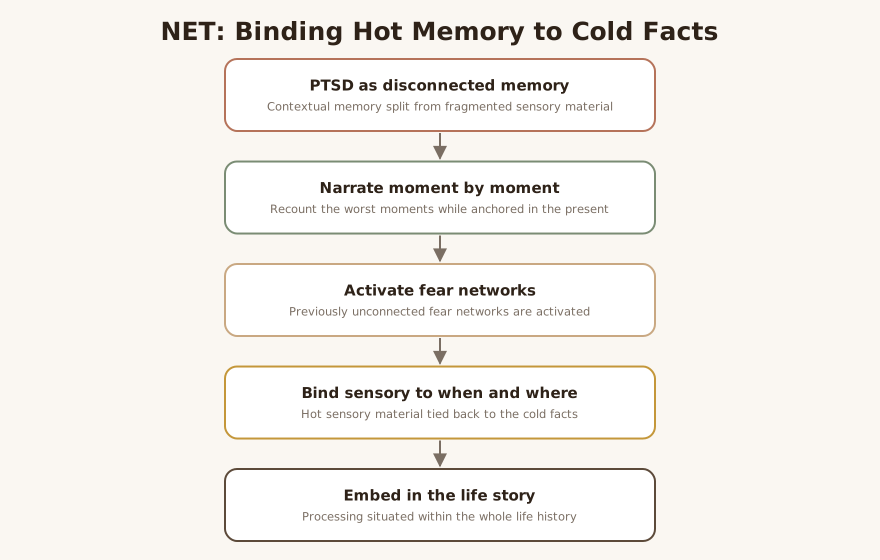
NET was developed by Maggie Schauer, Frank Neuner, and Thomas Elbert, whose 2005 and 2011 manuals codified the approach. 8 Its lineage draws together two earlier traditions. From Testimony Therapy it inherits the practice of producing a documented account of human-rights violations that can serve advocacy and acknowledgment, not only symptom relief. 6 From Prolonged Exposure and the broader cognitive-behavioral tradition it inherits the therapeutic engine of repeated, detailed activation of the trauma memory until the fear response habituates and the memory can be reprocessed. 8 The theoretical synthesis rests on a dual representation model of traumatic memory articulated by Elbert and Schauer: the autobiographical record splits into “cold” memory (the factual knowledge of time, place, and sequence) and “hot” memory (the sensory, physiological, affective, and cognitive elements of the experience), and trauma symptoms arise when these become dissociated. 8 NET’s task is to re-link the two. 8
Core Principles
The governing premise is that PTSD is, in significant part, a disorder of memory — specifically a disconnection between contextual/declarative memory and fragmented sensory representations. 5 By narrating the worst moments “moment by moment” while staying anchored in the present, the therapist helps the patient activate previously unconnected fear networks and bind the hot sensory material back to the cold facts of when and where it happened. 8 A second principle is contextual embedding: trauma processing is never an isolated event but is always situated within the traumatic context and within the life history as a whole. 1 A third, and clinically distinctive, principle is the therapeutic stance Neuner frames as “I want to hear your story” — the survivor holds narrative authority, and the clinician offers active listening, empathic understanding, and unconditional positive regard rather than directing attention to a single worst event. 8 6 Restoring the capacity to narrate is itself understood as restoring dignity, countering the speechlessness that fragmentation, shame, and helplessness produce. 6
Interventions & Techniques
The signature procedure is the lifeline: a length of rope laid out to represent the lifespan, onto which the patient places symbolic objects — flowers for positive or happy events, stones for traumatic events, sometimes candles for losses to be grieved, and (in later refinements) sticks to mark acts of aggression the survivor committed. 1 The lifeline is typically built early, often in a single session, and provides a chronological map for the work that follows. 5
Therapy then proceeds chronologically along the lifeline. At each stone, the therapist guides the patient to relive and narrate the event in slow, present-tense detail — exploring sensory impressions, thoughts, emotional responses, and bodily sensations — while repeatedly reorienting them to the safety of the here-and-now. 5 Positive events (flowers) are narrated too, so that the trauma is reintegrated into a fuller life rather than allowed to define the whole. 1 Sessions involve briefly re-reading the prior narrative, correcting details, processing the next events, and continuing until the lifespan is covered. 5
The work culminates in a written testimony: a coherent autobiographical document that the therapist records and the patient reviews and signs, receiving their own copy. 5 6 Beyond its therapeutic function, this document can serve as a “comprehensible documentation of a single fate” usable for human-rights or legal purposes — a feature Neuner treats as integral to NET’s identity, not incidental. 6
LLM-generated illustrative example (not a guideline): A clinician and a refugee client lay the rope across the floor. The client places a flower for the birth of a younger sibling, then a stone for the night their village was attacked. Narrating the stone in present tense, the client describes the smell of smoke and the weight in their chest; the therapist gently notes, “and that was eleven years ago — you are here in this room now,” binding the sensory memory to the timeline. LLM
Evidence Base
NET has an established evidence base, though one with important qualifications. A foundational randomized controlled trial in a Sudanese refugee settlement in Uganda (N = 43) compared four sessions of NET against four sessions of supportive counseling and a single session of psychoeducation; at one-year follow-up, only 29% of NET participants still met PTSD criteria, versus 79% and 80% in the comparison arms. 2 A review of the developing evidence reported good support for NET in PTSD across 18 RCTs (N = 950) and positioned it as among the most evidence-based trauma treatments for culturally diverse populations. 1
Authoritative bodies concur on direction. The 2017 VA/DoD Clinical Practice Guideline gives a “Strong For” recommendation to manualized trauma-focused psychotherapies including NET, and a 2018 AHRQ systematic review update found NET reduced PTSD symptoms with a moderate strength of evidence (three trials, 232 participants). 8 A 2014 Cochrane review of interventions for torture survivors found NET reduced PTSD symptoms at six-month follow-up, but rated the quality of evidence as very low. 8
Honesty about maturity requires flagging the limits. A meta-analysis of 24 RCTs found only moderate effect sizes for PTSD severity at mid- and long-term follow-up and for depression at mid-term; the number of PTSD diagnoses dropped significantly in the short term but this was not sustained in the long term, and the authors cautioned about high heterogeneity, low quality of evidence, and possible small-study effects. 3 The European review and meta-regression of NET’s effectiveness reaches a broadly consistent conclusion that the modality is effective while urging interpretive caution. 4 The military evidence brief is also explicit that effectiveness relative to other front-line treatments is not established and that treatment selection should weigh clinical judgment, patient characteristics, and patient preference. 8
Populations & Indications
NET is indicated above all for survivors of multiple and complex trauma, where a single-incident protocol is poorly matched to the clinical reality. 8 Its core populations are refugees, asylum seekers, and survivors of war, torture, and organized violence, and it has been delivered across Africa, Europe, and Asia, including with earthquake survivors. 1 A notable feature is its feasibility in unstable settings: the Ugandan trial demonstrated benefit even among refugees still living in unsafe conditions. 2 A child and adolescent adaptation, KIDNET, has been tested in a randomized trial of traumatized refugee children aged 7–16 (N = 26): eight sessions produced significant improvement across PTSD-relevant measures versus a waitlist, with gains stable at 12-month follow-up. 7 Within general health systems, NET has also been studied for PTSD in refugees and asylum seekers receiving routine care. 8
Problems-for-Work
- PTSD from cumulative trauma. The lifeline is purpose-built when no single “worst” event organizes the picture; it lets multiple stones be processed in sequence. 1
- Complex PTSD. Biographical embedding addresses the diffuse, identity-spanning impact of prolonged victimization rather than a discrete fear memory. 6
- Intrusive memories and hyperarousal. Detailed present-tense narration targets the dissociated hot/cold memory split thought to drive re-experiencing. 8
- Avoidance. The structured chronological pass commits the patient and therapist to approaching, rather than circumventing, each marked event. 5
- Comorbid depression. Meta-analytic data show mid-term improvement in depressive symptoms alongside PTSD. 3
- Traumatic grief. Candles on the lifeline explicitly mark losses for mourning within the narrative. 1
LLM-generated illustrative example (not a guideline): For a torture survivor with both PTSD and entrenched avoidance, the clinician might frame the testimony document as the explicit goal — “we are building the record of what was done to you” — which can re-motivate a patient who experiences ordinary symptom-focused exposure as re-victimizing. LLM
Contraindications, Cautions & Cultural Humility
The provided sources do not enumerate formal contraindications, and that absence should not be read as a green light for unselected use. 5 Several cautions follow from the modality’s mechanism and evidence. First, NET is an exposure therapy: detailed reliving carries the usual risks of transient symptom escalation and requires that the patient can maintain dual awareness (memory plus present safety), so active suicidality, unmanaged dissociation, or acute instability warrant stabilization first. 5 LLM Second, the strongest data come from refugee and organized-violence samples; the military evidence brief does not establish superiority over other front-line treatments, so NET should be selected, not defaulted to. 8 Third, the human-rights/testimony dimension raises real-world stakes — a documented account may intersect with asylum or legal proceedings — and the clinician must clarify with the patient how the document will and will not be used. 6 LLM
Cultural humility is intrinsic rather than optional here. NET assumes that trauma reactions reflect broadly universal neurobiological responses but are expressed through culturally specific idioms, so the clinician should attend to local meanings of memory, mourning, and disclosure rather than imposing a template. 6 The approach’s pragmatism — it has been delivered effectively by trained lay therapists in crisis regions — is a feature for access, but supervision and fidelity remain essential. 6
Treatment-Plan Suggestions & SMART Objectives
| Goal | SMART objective (example) | Mechanism |
|---|---|---|
| Reduce PTSD symptom severity | Patient will show a clinically meaningful decrease on a validated PTSD measure across the NET course (e.g., over 4–10 sessions) | Habituation and re-linking of hot/cold memory through repeated detailed narration 8 |
| Build a coherent trauma narrative | Patient will complete a chronological lifeline marking major positive and traumatic events within the first 1–2 sessions | Contextual embedding of trauma within the life history 1 |
| Decrease intrusive re-experiencing | Patient will report reduced frequency/intensity of intrusions for the processed events by mid-treatment | Reprocessing dissociated sensory memory into declarative context 8 |
| Reduce avoidance | Patient will narrate each stone on the lifeline in present-tense detail without leaving the event prematurely | Structured approach to feared material rather than escape 5 |
| Improve comorbid depressive symptoms | Patient will show measurable improvement on a depression measure by mid-treatment follow-up | Mid-term depression gains observed in meta-analysis 3 |
| Restore narrative agency / dignity | Patient will review and sign a written testimony of their life story by the final session | Acknowledgment and recovery from “speechlessness” 6 |
| Address traumatic grief | Patient will mark and narrate at least one loss (candle) and articulate associated meaning by treatment end | Integration of mourning within the chronological narrative 1 |
Common Misconceptions
- “NET is just journaling or telling your story.” The narration is a controlled exposure procedure with present-tense reliving of sensory detail and explicit re-linking to the timeline, not free recollection. 5 8
- “You must identify the single worst trauma.” NET deliberately rejects the index-trauma model in favor of a life-span perspective covering accumulated adversity. 6
- “The evidence is uniformly strong.” Effects are robust short-term but moderate and less durable long-term, with high heterogeneity and low-to-moderate quality ratings across reviews. 3 8
- “It only works with extensive resources.” It was built for low-resource crisis settings and has been delivered by trained lay therapists. 8 6
- “The testimony is a side note.” The documented account is integral to the modality’s identity and to its acknowledgment/human-rights function. 6
Training & Certification
The sources here do not specify a single credentialing body; the foundational training resources are the Schauer, Neuner, and Elbert manuals (2005, 2011), which codify the protocol clinicians follow. 8 A practically important point is that NET was designed to be teachable to non-specialist and lay therapists for delivery in crisis regions, which speaks to its protocol-driven, learnable structure — while underscoring that fidelity and supervision matter precisely because delivery is widely distributed. 6 LLM Clinicians seeking to practice NET should pursue manual-based training and supervised practice consistent with the developers’ protocol. 8 LLM
Key Terms
- Lifeline — a rope laid out to represent the lifespan, with flowers (positive events), stones (traumatic events), candles (grief/loss), and sticks (acts of aggression) placed chronologically. 1
- Hot memory — the sensory, physiological, affective, and cognitive elements of an experience. 8
- Cold memory — the factual, contextual knowledge of time, place, and sequence. 8
- Dual representation — the model holding that trauma symptoms arise when hot and cold memory become dissociated. 8
- Testimony — the written, signed autobiographical document produced through NET, usable for acknowledgment and human-rights purposes. 6
- KIDNET — the child/adolescent adaptation of NET for ages roughly 7–16. 7
Resources & Further Reading
▶ Watch — a video introduction to this concept:
- Narrative exposure therapy: an evidence-based treatment for multiple and complex trauma (PMC) 1
- Neuner et al. (2004): NET vs. supportive counseling vs. psychoeducation in an African refugee settlement (PubMed) 2
- Raghuraman et al. (2021): Evaluating NET for PTSD and depression — a meta-analysis (Clinical Psychology & Psychotherapy) 3
- The effectiveness of NET: a review, meta-analysis and meta-regression (European Journal of Psychotraumatology) 4
- Narrative Exposure Therapy (NET) — Psychology Tools 5
- I Want to Hear Your Story: The Identity of NET — Frank Neuner (ISTSS Clinician’s Corner) 6
- Ruf et al. (2010): KIDNET RCT with traumatized refugee children (PubMed) 7
- Narrative Exposure Therapy for PTSD — Defense Health Agency Evidence Brief 8
Reflective / Supervision Questions
- For this patient, does the cumulative, life-span structure of NET fit the trauma history better than a single-incident exposure protocol, and how will I decide? 6 LLM
- Is the patient stable enough to tolerate detailed present-tense reliving while maintaining dual awareness, or is stabilization needed first? 5 LLM
- How have I discussed with the patient the purpose, ownership, and potential legal/asylum uses of the testimony document? 6 LLM
- Given that long-term diagnostic gains were not consistently sustained in meta-analysis, how will I plan for maintenance, booster contact, or follow-up measurement? 3 LLM
- Whose cultural idioms of memory, grief, and disclosure am I bringing into the room, and how do they differ from the patient’s? 6 LLM
- Am I selecting NET because it is the best fit for this patient, or defaulting to it — and could another front-line trauma therapy serve them better? 8 LLM